This week is Global Media and Information Literacy Week 2016, sponsored by UNESCO. If you are holding any information literacy initiatives, events etc. please do tweet them using the tag #milweek2016 - it will be good to have information literacy visible this week!
The website is at http://en.unesco.org/global-mil-week-2016
Curating information literacy stories from around the world since 2005 - - - Stories identified, chosen and written by humans!
Monday, October 31, 2016
Friday, October 28, 2016
Call for nominees: Library Instruction Round Table (LIRT) Awards
The ALA Library Instruction Round Table (LIRT) is now accepting nominations (until January 15 2017) for two awards created to recognize excellence in information literacy and instruction. The LIRT Librarian Recognition Award is presented to an individual librarian in appreciation for her/his contributions to the field, while the LIRT Innovation in Instruction Award is given to a Library that demonstrates innovation in support of information literacy and instruction. The awards will be presented at the American Library Association Annual Conference in Chicago in June 2017. Award winners receive a US $1,000 cash award, a plaque, and a US $500 travel stipend to be used to attend the ALA Annual Conference. Awards are sponsored by the Library Instruction Roundtable. More information at http://www.ala.org/lirt/awards.
Wednesday, October 26, 2016
Accessibility in Libraries – an Information Literacy Approach
Accessibility in Libraries – an Information Literacy Approach is a free teachmeet event at Staffordshire University Library, sponsored by the CILIP Information Literacy Group. It takes place on 14 December 2016, 14:00-16:30 UK time, in Stoke-on-Trent, UK. "Information Literacy good practice can be utilised to identify free tools / apps, search for software available, digitising and requesting resources, highlighting support available. We aim to develop staff information literacy skills and believe library and information professionals should make a significant contribution to increasing digital inclusion and participation. This inclusion is dependent upon these professionals having the capabilities and knowledge to promote inclusivity and accessibility". You can book to give a 10 minute presentation or to be an "enthusiatic audience member". To book, go to https://www.eventbrite.co.uk/e/accessibility-in-libraries-an-information-literacy-approach-staffordshire-university-library-tickets-28857064256 where there is also more information on the event.
Photo by Sheila Webber: seagull high in a blue sky, Aberystwyth, October 2016
What the news media can learn from librarians
Thanks to Karen F. Kaufmann who posted a link on the acrlframe list to an article by "a longtime journalist and media educator" about librarians (who are "delightful people, by the way") and the ACRL Information Literacy Framework:
Lief, L. (2016, 24 October). What the news media can learn from librarians. Columbia Journalism Review. http://www.cjr.org/innovations/librarians_journalism_lessons.php
Tuesday, October 25, 2016
SCONUL Seven Pillars of Information Literacy
Sometime earlier this year SCONUL finally put together a page at http://www.sconul.ac.uk/page/seven-pillars-of-information-literacy where you can access most of the SCONUL 7 Pillars of Information Literacy material. It includes links to the 2011 Core model and the various lenses (Digital Literacy, Open Content, and Research). The Graduate Employability link didn't work at time of writing it should be this. Additionally there are links to the original 7 Pillars model and a couple of reports. There is further material on a page about employability and information literacy http://www.sconul.ac.uk/page/employability
7 Pillars diagram: SCONUL, released under creative commons
Monday, October 24, 2016
A New Look at Wikimedia, the World's Largest OER #OAweek
This week is Open Access week and on 26 October 2016 (12.30-13.30 UK time, which is 7.30-8.30am US Eastern time) The Association for Learning Technology, Open Education Special Interest Group have organised a webinar, A New Look at Wikimedia, the World's Largest OER, featuring Martin Poulter, ICT Manager for the Economics Network based at the University of Bristol. He will be "considering whether Wikimedia has a role in Open Education and can be used in ways not previously considered - part repository, part VLE, part academic publishing and collaboration. Is there an opportunity here to move more into Wikimedia? Can Wikimedia take up some of these roles?" More information and to join the webinar: https://www.alt.ac.uk/civicrm/event/info?reset=1&id=271
Logo downloaded from Open Access Week http://openaccessweek.org/page/downloads-2 under a Creative Commons Attribution License
Sunday, October 23, 2016
Pan-African Alliance on Media and Information Literacy
The Pan-African Alliance on Media and Information Literacy (PAMIL) was agreed upon by African participants at the UNESCO/UNAOC Global Forum for Partnership on MIL (GFPMIL) conference in Abuja, Nigeria, June 26-29, 2013. As the name suggests, PAMIL is planned as an independent alliance among the different organizations and individuals that are working on Media and Information Literacy across the African continent. The website has information about its activities http://www.pamil.info/events/
Photo by Sheila webber: lunch, Brännö, August 2016
Saturday, October 22, 2016
Capacity Building Workshop on Media and Information Literacy for Youth
A UNESCO-Supported Capacity Building Workshop on Media and Information Literacy for youth and Youth-led Organizations in India was held 17-19 October 2016 at Punjabi University, Patiala, India. The aim of the workshop was to provide an intensive overview of media and information literacy (MIL) knowledge, skills, and attitudes, aimed at people leading youth organisations and initiatives.
The workshop web page is here http://punjabiuniversity.ac.in/pbiuniweb/MIL/CB_Workshop_final.htm and a report in The Tribune [India] is at http://www.tribuneindia.com/news/chandigarh/education/workshop-held/311332.html. The workshop is organized as part of a pilot initiative led by UNESCO: MIL Capacity Building for Youth Organizations in India, Kenya and Nigeria.
Photo by Sheila Webber: Abeystwyth, October 2016
The workshop web page is here http://punjabiuniversity.ac.in/pbiuniweb/MIL/CB_Workshop_final.htm and a report in The Tribune [India] is at http://www.tribuneindia.com/news/chandigarh/education/workshop-held/311332.html. The workshop is organized as part of a pilot initiative led by UNESCO: MIL Capacity Building for Youth Organizations in India, Kenya and Nigeria.
Photo by Sheila Webber: Abeystwyth, October 2016
Thursday, October 20, 2016
Web 2.0 Information Sources and Tools in Academic Writing #ecil2016
This is one of the posters from the European Conference on Information Literacy that was held last week. Montserrat Casanovas Català, Yolanda Capdevila Tomàs, and Olivia Dumitrina Nechita presented a poster: Web 2.0 Information Sources and Tools in Academic Writing: The impact of Students’ Digital Competence on Information Management. Hopefully you can read the main points on the poster on the right (click on the picture to see it larger size).
Monday, October 17, 2016
The framework catalogue of digital competences #ECIL2016
After a few days rest, I'll start to catch up with posts from the European Conference on Information Literacy 2016 which took place last week. A presentation given by Justyna Jasiewicz, Małgorzata Kisilowska and Anna Mierzecka on Relationality is the Key: The Family of Digital Competencies’ Catalogues and Their Potential Applications described initial research (quite substantial) which had gone into developing a set of digital competencies frameworks in Poland. There is a general framework, one aimed at over 50s and one aimed at Small and medium Sized Enterprises (SMEs). There is an English version of the general Framework catalogue of digital competences here: https://mc.gov.pl/files/ramowy_katalog_kompetencji_cyfrowych_final_ang_jj_2.pdf
There is a Polish site here. A distinguishing feature of the framework is that it identifies benefits (ones which had been identified in the research study by participants) and then links the skills to the benefits, which is a neat idea.
Thursday, October 13, 2016
ECIL closing #ecil2016
Apologies that my liveblogging fell in a heap at the end of the European Conference on Information Literacy 2016, in Prague. I was overtaken by duties chairing a long session yesterday, and a panel session today. I will catchup on some of this, in a few posts later.
However, here is a glimpse of the closing session. Stephane Goldstein presented a conference wrap-up, giving his impressions of the conference as rapporteur. He identified how we had learnt about information literacy "in all its guises". This year, there had been a focus on "the inclusive society", which had also led to there being more of a political aspect to the conference.
Goldstein felt that this strand of inclusion had arisen not just in the session dedicated to that theme, but also in a variety of presentations including, for example Tara Brabazon's keynote. Annemaree Lloyd had reminded us about the need and challenge of refugees integrating into new information landscapes. The notion of librarian neutrality had arisen a lot, as well as libraries/librarians engaging with social justice issues: this was addressed by speakers from many different parts of the world.
Goldstein identified that inclusive society means reaching out - and there were examples of librarians reaching out to make a difference. He felt that ECIL needed to open out to "players beyond academia and beyond the library world", to understand these other conceptions and practice of information literacy. This could include elected representives, civil society groups, healthcare parctioners, patient groups, trade unionists and managers. There could be e.g. a target of 10% participation from outside the library/academic world.
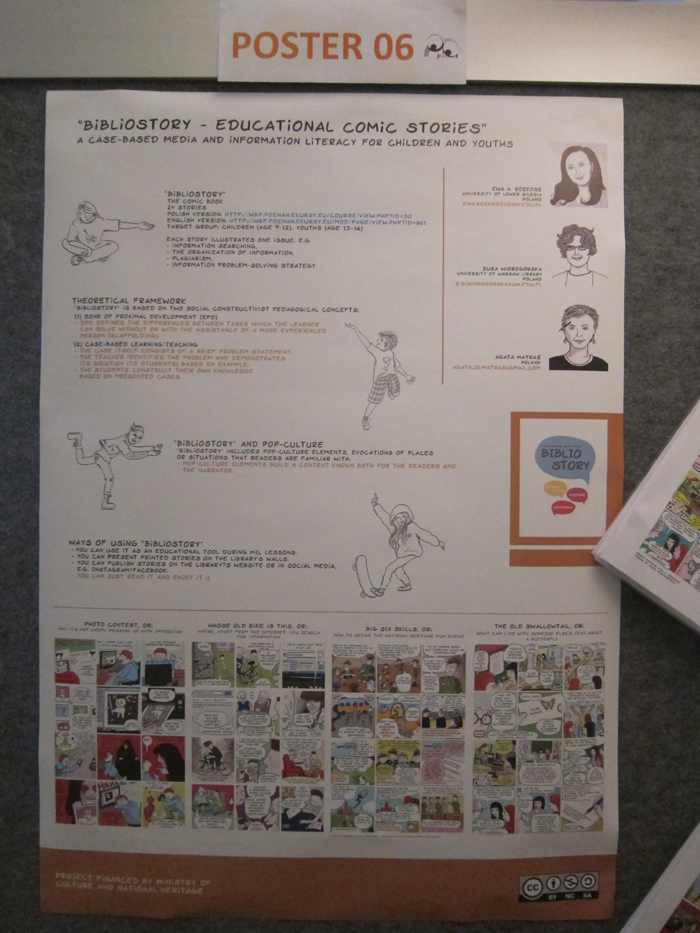
Following this the best poster award was made to Ewa Rozkosz, Zuzanna Wiorogorska and Agata Matras for their poster "Bibliostory: educational comic stories": a case-based Media and Information Literacy for children and youth. The first picture shows their poster, which I will blog about separately (with better pictures!).
The patrons, organisers and speakers were thanked by Hana Landova (pictured, showing the vonteer group), who herself had been tireless in organising the event. There had been 312 participants from 11 Asia-Pacific countries, 3 African, 4 North/South American countries and 32 different European countries.
The presentations will be on the website (depending on the permission from authors) and there are already some pictures of the conference.
Joumana Boustany was introduced as the chair of the Local Organising Committee for ECIL 2017, which will be held on 18-21 September 2017 in Saint-Malo in France!
However, here is a glimpse of the closing session. Stephane Goldstein presented a conference wrap-up, giving his impressions of the conference as rapporteur. He identified how we had learnt about information literacy "in all its guises". This year, there had been a focus on "the inclusive society", which had also led to there being more of a political aspect to the conference.
Goldstein felt that this strand of inclusion had arisen not just in the session dedicated to that theme, but also in a variety of presentations including, for example Tara Brabazon's keynote. Annemaree Lloyd had reminded us about the need and challenge of refugees integrating into new information landscapes. The notion of librarian neutrality had arisen a lot, as well as libraries/librarians engaging with social justice issues: this was addressed by speakers from many different parts of the world.
Goldstein identified that inclusive society means reaching out - and there were examples of librarians reaching out to make a difference. He felt that ECIL needed to open out to "players beyond academia and beyond the library world", to understand these other conceptions and practice of information literacy. This could include elected representives, civil society groups, healthcare parctioners, patient groups, trade unionists and managers. There could be e.g. a target of 10% participation from outside the library/academic world.
Following this the best poster award was made to Ewa Rozkosz, Zuzanna Wiorogorska and Agata Matras for their poster "Bibliostory: educational comic stories": a case-based Media and Information Literacy for children and youth. The first picture shows their poster, which I will blog about separately (with better pictures!).
The patrons, organisers and speakers were thanked by Hana Landova (pictured, showing the vonteer group), who herself had been tireless in organising the event. There had been 312 participants from 11 Asia-Pacific countries, 3 African, 4 North/South American countries and 32 different European countries.
The presentations will be on the website (depending on the permission from authors) and there are already some pictures of the conference.
Joumana Boustany was introduced as the chair of the Local Organising Committee for ECIL 2017, which will be held on 18-21 September 2017 in Saint-Malo in France!
Wednesday, October 12, 2016
Designing Educational Games and Simulations for Humanities: Case Study of Czechoslovakia 38-89 #ECIL2016
More liveblogging from the European Conference on Information Literacy 2016, in Prague. Invited speaker Vít Šisler talked about Designing Educational Games and Simulations for Humanities: Case Study of Czechoslovakia 38-89. He started by talking about his early love of games that allowed you to create your own world. Simulations and games have been used for a long time and are still used in the military, health etc.
An early example of a humanities simulation is a historical game which could be seen as a simulation. One thing that emerged from use of this was that it is likely to be better to use games specifically designed for education, rather than commercial games. The speaker was then involved in developing a simulation about international relations, which enables students to implement neew policies and see what the result is. To be successful the learner has to negotiate, critically evaluate the results of decisions. This was aimed at high schools, and is used in over 300 high schools in the Czech Republic.
The speaker went on to talk about the research process he and his colleagues used to evaluate the impact of a simulation game (involving a number of tests e.g. pre and post tests). The results indicated that it was the longer term retention of knowledge/understanding that was most benfitted by use of serious games. I think this is the research paper about it
He went on to talk about a specific serious game Czechoslovakia 38–89: The Assassination. There is information on it here http://cs3889.com/ and here http://www.ff.cuni.cz/2015/08/educational-game-czechoslovakia-38-89-wins-prestigious-international-competition/ They used real testimony and evidence from the time, but are very aware of being sensitive to the people and situation, with their being emotional and ethical issues. Therefore whilst thyey used the real testimony, it was with fictitious characters, constructing testimonies which students can interact with critically. The game designers were not interested in enabling people to replay history. You are in the position of being a kind of detective finding out what happened to your grandpa, but examining testimonies which may be contradictory or complementary, and you have to work out what you feel has actually happened and understand the situation better. This means, as with real history, there is not a straightforward story, it is complex with different viewpoints. The game includes testimonies from people who were not part of mainstream culture such as a Roma girl.
They have undertaken an evaluation in successive semesters in various high school classes. The game is available for free use in education. The trailer is below.
An early example of a humanities simulation is a historical game which could be seen as a simulation. One thing that emerged from use of this was that it is likely to be better to use games specifically designed for education, rather than commercial games. The speaker was then involved in developing a simulation about international relations, which enables students to implement neew policies and see what the result is. To be successful the learner has to negotiate, critically evaluate the results of decisions. This was aimed at high schools, and is used in over 300 high schools in the Czech Republic.
The speaker went on to talk about the research process he and his colleagues used to evaluate the impact of a simulation game (involving a number of tests e.g. pre and post tests). The results indicated that it was the longer term retention of knowledge/understanding that was most benfitted by use of serious games. I think this is the research paper about it
He went on to talk about a specific serious game Czechoslovakia 38–89: The Assassination. There is information on it here http://cs3889.com/ and here http://www.ff.cuni.cz/2015/08/educational-game-czechoslovakia-38-89-wins-prestigious-international-competition/ They used real testimony and evidence from the time, but are very aware of being sensitive to the people and situation, with their being emotional and ethical issues. Therefore whilst thyey used the real testimony, it was with fictitious characters, constructing testimonies which students can interact with critically. The game designers were not interested in enabling people to replay history. You are in the position of being a kind of detective finding out what happened to your grandpa, but examining testimonies which may be contradictory or complementary, and you have to work out what you feel has actually happened and understand the situation better. This means, as with real history, there is not a straightforward story, it is complex with different viewpoints. The game includes testimonies from people who were not part of mainstream culture such as a Roma girl.
They have undertaken an evaluation in successive semesters in various high school classes. The game is available for free use in education. The trailer is below.
A Toolbox Approach to Researching, Understanding and Teaching for Information Literacy #ecil2016
The third day of the European Conference on Information Literacy 2016, in Prague, Czech Republic, and it starts with an invited talk from Ola Pilerot A Toolbox Approach to Researching, Understanding and Teaching for Information Literacy. I'm liveblogging, so as usual apologies for any unwitting misrepresentations of what was said.
First of all he talked about the information literacy discourse: in a previous study he and his co-author had identified some gaps in the information literacy landscape. Pilerot felt that part of the problem was partitioners and researchers not "talking the same language" (e.g. practitioners not reading research, researchers ignoring common practical problems). Pilerot presented a table which identified the ways IL was presented in reports and practitioner texts, and on the ways in which it emerged from research literature. For example in professional practice it tended to be presented as a fixed set of generic skills, and in research as "situated, related to contexts". Arising from this he felt there needed to be a more nuanced discussion about the concept.
Pilerot felt that what he was going to say could also be applied to other literacies, and stressed that he also preferred to talk about "literacies" rather than "literacy". He felt it was fine also to use concepts which helped to spread the idea (for example "Media and Information Literacy" appealing more to politicians).
Pilerot noted that people often said that information literacy was a difficult concept to get over to ther people. Why was it elusive. Pilerot thought this was because it could be used in different ways - a word that meant different things when spoken by different people. Pilerot quoted Wittgenstein "The meaning of a word is its use in the language". The phrase IL was used by different types of people (i.e. not just librarfians) and they were likely mean different things.
Pilerot identified four ways of using information literacy. (1) As a label (for a field of professional practice) (2) As an empirical concept "something that can be observed through the study of what people do" (3) A theoretical concept "an analytical and theoretical tool" (4) as a political concept
Pilerot then explained his idea of a toolbox approach (for theorising information literacy). I think that this involved having more of a toolbox of questions (rather than skills) looking at the person/group in context e.g. "what is regarded as valuable knowledge in this context" - looking at situated practice. Pilerot drew on his own research study of a community of design scholars. In order to understand their information practice, these questions were important. For example, what genres did they engage with, that were important to their practice? What is their disciplinary world? What are the material objects used in, and shaping, their practice? There are may also be spaces and practices that are a tacit part of the community (the example was given of a PhD student who realised that going to the copy room and drinking coffee their was a ways of connecting and exchanging information).
Also I should mention that Pilerot felt that you could teach for information literacy, but not teach information literacy (something I disagree with, but a topic for fruitful discussion!)
First of all he talked about the information literacy discourse: in a previous study he and his co-author had identified some gaps in the information literacy landscape. Pilerot felt that part of the problem was partitioners and researchers not "talking the same language" (e.g. practitioners not reading research, researchers ignoring common practical problems). Pilerot presented a table which identified the ways IL was presented in reports and practitioner texts, and on the ways in which it emerged from research literature. For example in professional practice it tended to be presented as a fixed set of generic skills, and in research as "situated, related to contexts". Arising from this he felt there needed to be a more nuanced discussion about the concept.
Pilerot felt that what he was going to say could also be applied to other literacies, and stressed that he also preferred to talk about "literacies" rather than "literacy". He felt it was fine also to use concepts which helped to spread the idea (for example "Media and Information Literacy" appealing more to politicians).
Pilerot noted that people often said that information literacy was a difficult concept to get over to ther people. Why was it elusive. Pilerot thought this was because it could be used in different ways - a word that meant different things when spoken by different people. Pilerot quoted Wittgenstein "The meaning of a word is its use in the language". The phrase IL was used by different types of people (i.e. not just librarfians) and they were likely mean different things.
Pilerot identified four ways of using information literacy. (1) As a label (for a field of professional practice) (2) As an empirical concept "something that can be observed through the study of what people do" (3) A theoretical concept "an analytical and theoretical tool" (4) as a political concept
Pilerot then explained his idea of a toolbox approach (for theorising information literacy). I think that this involved having more of a toolbox of questions (rather than skills) looking at the person/group in context e.g. "what is regarded as valuable knowledge in this context" - looking at situated practice. Pilerot drew on his own research study of a community of design scholars. In order to understand their information practice, these questions were important. For example, what genres did they engage with, that were important to their practice? What is their disciplinary world? What are the material objects used in, and shaping, their practice? There are may also be spaces and practices that are a tacit part of the community (the example was given of a PhD student who realised that going to the copy room and drinking coffee their was a ways of connecting and exchanging information).
Also I should mention that Pilerot felt that you could teach for information literacy, but not teach information literacy (something I disagree with, but a topic for fruitful discussion!)
Tuesday, October 11, 2016
The End of Information Literacy? #ecil2016
I am giving 2 presentations this morning, so I'm not doing much liveblogging! However here is a note of one of the talks just given at the European Conference on Information Literacy 2016, in Prague. Michaela Dombrovská talked about The End of Information Literacy? She presented the case of some different literacies (information, financial, general, media, digital) in the Czech Republic. The title arose from her wondering why initiatives to get information literacy adopted at a policy level seemed to get frozen and did not progress. She had been involved directly in developing statements and initiatives on information and financial literacy at a national level. The financial literacy initiatives had been more succesful than that on information literacy.
In all cases she observed the literacy went through 3 stages
- concept (expert's agreement). Information Literacy has not moved beyond this stage in the Czech Republic, for various reasons, including a financial scandal that arose, where information literacy was a badge that had been used (I think for misuse of funds)
- public awareness which turns the concept to a policy. For financial literacy, this more easily appeals to the public, they can see how it could help their everyday life. They way of making people realise the value of information literacy has not really been discovered yet.
- law (citizens' right and duty). People can not be obliged to do things unless it is enshrined in law and for example in the national curriculum.
The speaker also identified what helps:
- stable or increasing public interest
- existing EU or international policies
- overall coopertation among key players
She gave some examples in the Czech context e.g. National Strategy on Financial Literacy, Strategy on Digital Literacy 2015-2020.
In the case of IL: general interest is unlikely, key players do not cooperate and IL is not mentioned in laws. However, the speaker felt it was not a lost cause! For this to happen she felt that IL needed to be presented as a set of competencies, and that each competency appeared in some law or policy (rather than having to be in one policy).
The photo is unrelated to the talk - Italian ice cream at a local Czech cafe
In all cases she observed the literacy went through 3 stages
- concept (expert's agreement). Information Literacy has not moved beyond this stage in the Czech Republic, for various reasons, including a financial scandal that arose, where information literacy was a badge that had been used (I think for misuse of funds)
- public awareness which turns the concept to a policy. For financial literacy, this more easily appeals to the public, they can see how it could help their everyday life. They way of making people realise the value of information literacy has not really been discovered yet.
- law (citizens' right and duty). People can not be obliged to do things unless it is enshrined in law and for example in the national curriculum.
The speaker also identified what helps:
- stable or increasing public interest
- existing EU or international policies
- overall coopertation among key players
She gave some examples in the Czech context e.g. National Strategy on Financial Literacy, Strategy on Digital Literacy 2015-2020.
In the case of IL: general interest is unlikely, key players do not cooperate and IL is not mentioned in laws. However, the speaker felt it was not a lost cause! For this to happen she felt that IL needed to be presented as a set of competencies, and that each competency appeared in some law or policy (rather than having to be in one policy).
The photo is unrelated to the talk - Italian ice cream at a local Czech cafe
Information Resilience in a Resettlement Landscape #ecil2016
The next invited talk at the European Conference on Information Literacy 2016, in Prague is Annemaree Lloyd talking about Learning to Go On: Information Resilience in a Resettlement Landscape: Key Themes and Challenges of Fractured Landscape Research.
There were lots of fascinating material and ideas in this presentation, and as usual this liveblog only captures my impression, limited by my typing speed.
Lloyd started by saying that information resillience is seen as an outcome of information literacy practice, and is what enables or helps people to bounce back or go on after a setback. She distinguished between refugees (forced to flee their country, and probably unable to return home) and migrants (which does not come with the same political obligations). From an information perspective, refugees often have to leave behind their trusted information sources and personal networks, and they have to "rebuild fractured landscapes [including information landscapes] in strange and unfamiliar lands". They most likely have no time to plan, or build networks in advance, so the wrench is greater than in voluntary migration. Lloyd referred to her previous and ongoing work, including the Supporting refugees in transition (SpIRIT) project.
Lloyd posed the question of what happend when this information landscape fractures, with familiar ways of knowing left behind. Characteristics of a fractured landscape are disconnection, uncertainty (through lack of knowledge of the new landscape), lack of confidence, absence and "inability to know the paths, nodes and edges". Main themes emerging from Lloyd's research [these are my quick notes from what Lloyd said] are the complexity of the information needs (about health, everyday spaces e.g. how to shop etc.), uncertainty because of the new "paths, nodes and edges"; the need to identify the information landscape of the new country, so they can learn how to (for example) recognise misinformation; social information is important; barriers and constraints are perceived - for example in relation to textual information, which is seen as being official and fixed and possibly to be dealt with quickly. Mobile technology and social media are central for those in transition (to connect to the previous [home] world and culture, and with the new).
Thus social networking sites were central; "secondary worlds" with the digital and physical worlds seamless. However, if people were not good at using technology, and also if they had literacy and language problems, then this was not an area that was available to them. Additionally, people might not want to be traced, and therefore would avoid mobile (trackable) devices.
Spaces were important to social enactment (spaces connected with faith practices, home, sport etc) - they also were where people could exchange and verify information.
Lloyd proposed a framework for information literacy contributing to resettlement: this has 4 "Rs" - Reporient, Reajust, Reframe, Reestablish. In turn this leads to formulating the concept of information resillience (to use information literacy to readjust etc.). It includes information awareness, being able to map the new paths etc. Libraries have a part in this, with information literacy education tailored to the needs of men, women and children; helping refugees to acquire the social capital to integrate and adjust. So a central theme is the idea of enabling people to "go on" transforming to meet the needs of everyday life in a new country.
Photo by Sheila Webber: people of many nations on the Charles Bridge, Prague, on a murky Saturday
There were lots of fascinating material and ideas in this presentation, and as usual this liveblog only captures my impression, limited by my typing speed.
Lloyd started by saying that information resillience is seen as an outcome of information literacy practice, and is what enables or helps people to bounce back or go on after a setback. She distinguished between refugees (forced to flee their country, and probably unable to return home) and migrants (which does not come with the same political obligations). From an information perspective, refugees often have to leave behind their trusted information sources and personal networks, and they have to "rebuild fractured landscapes [including information landscapes] in strange and unfamiliar lands". They most likely have no time to plan, or build networks in advance, so the wrench is greater than in voluntary migration. Lloyd referred to her previous and ongoing work, including the Supporting refugees in transition (SpIRIT) project.
Lloyd posed the question of what happend when this information landscape fractures, with familiar ways of knowing left behind. Characteristics of a fractured landscape are disconnection, uncertainty (through lack of knowledge of the new landscape), lack of confidence, absence and "inability to know the paths, nodes and edges". Main themes emerging from Lloyd's research [these are my quick notes from what Lloyd said] are the complexity of the information needs (about health, everyday spaces e.g. how to shop etc.), uncertainty because of the new "paths, nodes and edges"; the need to identify the information landscape of the new country, so they can learn how to (for example) recognise misinformation; social information is important; barriers and constraints are perceived - for example in relation to textual information, which is seen as being official and fixed and possibly to be dealt with quickly. Mobile technology and social media are central for those in transition (to connect to the previous [home] world and culture, and with the new).
Thus social networking sites were central; "secondary worlds" with the digital and physical worlds seamless. However, if people were not good at using technology, and also if they had literacy and language problems, then this was not an area that was available to them. Additionally, people might not want to be traced, and therefore would avoid mobile (trackable) devices.
Spaces were important to social enactment (spaces connected with faith practices, home, sport etc) - they also were where people could exchange and verify information.
Lloyd proposed a framework for information literacy contributing to resettlement: this has 4 "Rs" - Reporient, Reajust, Reframe, Reestablish. In turn this leads to formulating the concept of information resillience (to use information literacy to readjust etc.). It includes information awareness, being able to map the new paths etc. Libraries have a part in this, with information literacy education tailored to the needs of men, women and children; helping refugees to acquire the social capital to integrate and adjust. So a central theme is the idea of enabling people to "go on" transforming to meet the needs of everyday life in a new country.
Photo by Sheila Webber: people of many nations on the Charles Bridge, Prague, on a murky Saturday
Digital and Substantive Skills for Every Citizen, Worker and Consumer in the 21st Century #ecil2016
The Keynote Speech at day 2 of the European Conference on Information Literacy 2016, in Prague today was Jan Van Dijk, talking about Digital and Substantive Skills for Every Citizen, Worker and Consumer in the 21st Century. His website is at https://www.utwente.nl/bms/vandijk/
Van Dijk distinguished between digital skills ("medium-related and content-related skills needed to operate digital technology") and 21st century skills ("general substantial skills" which includes higher order skills). He sees digital skills as having 6 types: operational, formal, information, communication, strategic, and content-creation. Thre first two are medium-related and the last four are content-related. He identified the relationship between them (see the rather fuzzy picture) and felt that they needed to be addressed sequentially: strategic skills are at the top of the hierarchy (then the other content related ones below that, then at the bottom the medium-related ones).
As revealed in a question afterwards, unfortunately he saw information literacy as "part of information skills".
Van Dijk moved to differentiating between digital and traditional media skills. Some things (e.g. reading, writing, intellectual ability) were required by both. Digital media make tasks easier in some ways, but also required new skills to cope with navigation, information selection, overload and so forth. He then took us through the different kinds of skills listed earlier, starting with the medium-related skills. For example information skills included choosing a website or search engine, querying sources, selecting and evaluating material. Communication skills included things like managing your social media profile - basically communicating in different formats and media. Content creation skills includes content in multimedia. Strategic digital skills means "Using the internet as a means to a particular goal" (including taking action and making decisions).
The speaker described some results from tests of Dutch citizens who undertook 9 internet tasks, using public services. They found the biggest differences in age and education. Younger people (18-30) were better at formal internet skills, but older were better at information and strategic. Younger people were quicker, but not neccessarily finding better information. The conclusion was that if the older people are able to acquire the medium-related skills, they will become much better, because they already have some of the content-related skills. However, the younger people need more development in content-related skills.
Moving on to 21st century skills, he identified these are including ways of thinking and working, tools of working, and living in the world. (To begin with I thought these were related to the AASL 21st Century skills or the Framework for 21st Century learning but it is slightly different), As robots took over more jobs, 21st century skills become more important, as the new jobs will be in areas which robots can't cover. This could lead to social divides. There is also a need to "prepare people for the internet of things" - as more devices are available to monitor and report, and these in turn create relationships with other companies and people. For example, smart energy meters (which are sold as giving you more information and control) also mean you are sharing more detailed information with your energy supplier, which the supplier can exploit and even demand.
Finally, the speaker turned to policy, and how to avoid exclusion. He identified 5 strategies: awareness and organisation, design improvement, technology provision, contenet development, education.
Van Dijk gave some specific recommendations: using public libraries, public services and community services more effectively, and providing citizenship courses for migrants, including internet courses in their native language. In terms of libraries, because not everyone goes at the moment, more triggers are needed to attract people, and there need to be more activities in which staff guide people in the multimedia world.
I already linked to the speaker's website: this presentation explains the "Four successive types of access" model that he introduced at the start of talk, but which I didn't have time to blog, and something about the types of skills and the digital divide.
Van Dijk distinguished between digital skills ("medium-related and content-related skills needed to operate digital technology") and 21st century skills ("general substantial skills" which includes higher order skills). He sees digital skills as having 6 types: operational, formal, information, communication, strategic, and content-creation. Thre first two are medium-related and the last four are content-related. He identified the relationship between them (see the rather fuzzy picture) and felt that they needed to be addressed sequentially: strategic skills are at the top of the hierarchy (then the other content related ones below that, then at the bottom the medium-related ones).
As revealed in a question afterwards, unfortunately he saw information literacy as "part of information skills".
Van Dijk moved to differentiating between digital and traditional media skills. Some things (e.g. reading, writing, intellectual ability) were required by both. Digital media make tasks easier in some ways, but also required new skills to cope with navigation, information selection, overload and so forth. He then took us through the different kinds of skills listed earlier, starting with the medium-related skills. For example information skills included choosing a website or search engine, querying sources, selecting and evaluating material. Communication skills included things like managing your social media profile - basically communicating in different formats and media. Content creation skills includes content in multimedia. Strategic digital skills means "Using the internet as a means to a particular goal" (including taking action and making decisions).
The speaker described some results from tests of Dutch citizens who undertook 9 internet tasks, using public services. They found the biggest differences in age and education. Younger people (18-30) were better at formal internet skills, but older were better at information and strategic. Younger people were quicker, but not neccessarily finding better information. The conclusion was that if the older people are able to acquire the medium-related skills, they will become much better, because they already have some of the content-related skills. However, the younger people need more development in content-related skills.
Moving on to 21st century skills, he identified these are including ways of thinking and working, tools of working, and living in the world. (To begin with I thought these were related to the AASL 21st Century skills or the Framework for 21st Century learning but it is slightly different), As robots took over more jobs, 21st century skills become more important, as the new jobs will be in areas which robots can't cover. This could lead to social divides. There is also a need to "prepare people for the internet of things" - as more devices are available to monitor and report, and these in turn create relationships with other companies and people. For example, smart energy meters (which are sold as giving you more information and control) also mean you are sharing more detailed information with your energy supplier, which the supplier can exploit and even demand.
Finally, the speaker turned to policy, and how to avoid exclusion. He identified 5 strategies: awareness and organisation, design improvement, technology provision, contenet development, education.
Van Dijk gave some specific recommendations: using public libraries, public services and community services more effectively, and providing citizenship courses for migrants, including internet courses in their native language. In terms of libraries, because not everyone goes at the moment, more triggers are needed to attract people, and there need to be more activities in which staff guide people in the multimedia world.
I already linked to the speaker's website: this presentation explains the "Four successive types of access" model that he introduced at the start of talk, but which I didn't have time to blog, and something about the types of skills and the digital divide.

Monday, October 10, 2016
Exercising Critical Health Literacy Skills #ecil2016
Another liveblog post from the first day at the European Conference on Information Literacy 2016, in Prague. Shaheen Majid presented a paper coauthored with Venkata Ratnadeep Suri, Hannah Trinity Javier, Yun Ke Chang; and Schubert Foo Exercising Critical Health Literacy Skills: A Qualitative Study of how Patients Make Sense of their Information Landscape.
The study (in Singapore) looked at how patients and their care givers find information, focusing on diabetes and cardiovascular diseases. Both of these are highly prevelant diseases, especially in Singapore. They wanted to find out why health literacy is important, what information patients and caregivers use, and what would help them. There was both qualitative and quantitative research and this was a presentation of the qualitative part. There were 13 focus groups (44 patients and 26 caregivers) and they used Grounded Theory to analyse the transcript data.
The participants agreed that they need health literacy because: interactions with doctors are very short (so people cannot get all the information from doctors and nurses); health information is broad and contradictory (so abilities in filtering and evaluating is needed to find the contextually relevant information). In terms of preference for finding information, participants want authoritative information. Doctors are seen as top of the hierarchy; after that come Singapore official and health sites, international official sites and certain news information (e.g. in special health supplements). Other people (family, friends and fellow sufferers from an illness) came after that. However, participants had quite simple ways of evaluating information e.g. has it got a lot of links or hits? what do my friends recommend?
The length of time that people have been suffering from an illness has an impact on their information behaviour - they may identify good information over time.
The participants said that they would LIKE the ability to question conflicting health information coming from authoritative sources (ie the conflicting information was particularly confusing when the contradictory sources were all authoritative). They also wanted to be able to find the connections between information on different illnesses (as they might have more than one illness - e.g. diabetes and heart problems). The last thing they identified was the ability to identify whether or not the information was relevant to their own particular context.
The speaker finished by saying that there remained the issue of how these needs could be met - who should act and how. He himself felt that having additional information filtered and provided by the doctor him/herself (so that the relevance and authority was stronger) would be helpful.
The study (in Singapore) looked at how patients and their care givers find information, focusing on diabetes and cardiovascular diseases. Both of these are highly prevelant diseases, especially in Singapore. They wanted to find out why health literacy is important, what information patients and caregivers use, and what would help them. There was both qualitative and quantitative research and this was a presentation of the qualitative part. There were 13 focus groups (44 patients and 26 caregivers) and they used Grounded Theory to analyse the transcript data.
The participants agreed that they need health literacy because: interactions with doctors are very short (so people cannot get all the information from doctors and nurses); health information is broad and contradictory (so abilities in filtering and evaluating is needed to find the contextually relevant information). In terms of preference for finding information, participants want authoritative information. Doctors are seen as top of the hierarchy; after that come Singapore official and health sites, international official sites and certain news information (e.g. in special health supplements). Other people (family, friends and fellow sufferers from an illness) came after that. However, participants had quite simple ways of evaluating information e.g. has it got a lot of links or hits? what do my friends recommend?
The length of time that people have been suffering from an illness has an impact on their information behaviour - they may identify good information over time.
The participants said that they would LIKE the ability to question conflicting health information coming from authoritative sources (ie the conflicting information was particularly confusing when the contradictory sources were all authoritative). They also wanted to be able to find the connections between information on different illnesses (as they might have more than one illness - e.g. diabetes and heart problems). The last thing they identified was the ability to identify whether or not the information was relevant to their own particular context.
The speaker finished by saying that there remained the issue of how these needs could be met - who should act and how. He himself felt that having additional information filtered and provided by the doctor him/herself (so that the relevance and authority was stronger) would be helpful.
Knowledge Management and Information Literacy: An Exploratory Analysis #ecil2016
Next for my liveblogging from the European Conference on Information Literacy 2016, is Sirje Virkus talking on Knowledge Management and Information Literacy: An Exploratory Analysis.
This was a study of the literature, using statistical and content analysis. Virkus observed some similarities. For example the various definitions of both terms, the debates of their relationship with other disciplines (or literacies), focus on finding, evaluating, sharing and using information. KM has grown since the mid 1990s, IL from the early 1970s. The understanding of each subject has also shifted: for KM Virkus gave a definition from Kimiz Dalkir (2011) and for information literacy she gave her own definition from 2006. In Web of Science she found 2586 publications on "Information Literacy", with 2013 having the largest number of IL publications (probably through the influence of the first ECIL conference!): overall the numbers are increasing. In terms of types of publication, the majority are in LIS journals.
KM has 17757 articles in Web of Science, with 2008 and 2009 as the years with the biggest output. Even just in LIS journals/conferences, KM had more articles published than did information literacy. However the largest number of KM items are published in other disciplines e.g. computer science and management.
Virkus identified a paucity of research of information literacy in the workplace, and within those, a lack of definition of what IL means in the workplace. She also noted how KM has been put forward as an opportunity for librarians. Virkus went on to highlight authors who have identified the close link between KM and information literacy. Only 31 items, one or few a year covered both topics, and often did not discuss them in depth together, and few were connected to empirical research.
This was a study of the literature, using statistical and content analysis. Virkus observed some similarities. For example the various definitions of both terms, the debates of their relationship with other disciplines (or literacies), focus on finding, evaluating, sharing and using information. KM has grown since the mid 1990s, IL from the early 1970s. The understanding of each subject has also shifted: for KM Virkus gave a definition from Kimiz Dalkir (2011) and for information literacy she gave her own definition from 2006. In Web of Science she found 2586 publications on "Information Literacy", with 2013 having the largest number of IL publications (probably through the influence of the first ECIL conference!): overall the numbers are increasing. In terms of types of publication, the majority are in LIS journals.
KM has 17757 articles in Web of Science, with 2008 and 2009 as the years with the biggest output. Even just in LIS journals/conferences, KM had more articles published than did information literacy. However the largest number of KM items are published in other disciplines e.g. computer science and management.
Virkus identified a paucity of research of information literacy in the workplace, and within those, a lack of definition of what IL means in the workplace. She also noted how KM has been put forward as an opportunity for librarians. Virkus went on to highlight authors who have identified the close link between KM and information literacy. Only 31 items, one or few a year covered both topics, and often did not discuss them in depth together, and few were connected to empirical research.
Institute of Research Design for Librarianship: Impact on Information Literacy Research and Practice #ecil2016
Lili Luo presented a paper (coauthored with MariesKennedy, and Kristine Brancolini): Institute of Research Design for Librarianship: Impact on Information Literacy Research and Practice (at the European Conference on Information Literacy 2016, in Prague, Czech Republic, which I'm liveblogging).
The Institute of Research Design for Librarianship is funded by IMLS 2013-2016 to provide research methods training and support to academic librarians. Its website is at http://irdlonline.org/ There is a central summer workshop, which goes through the research process and then there is ongoing support for the librarians' chosen projects through the year (librarians have to apply to the project, with their own proposals for research). In 2014 and 15, 28 out of 46 librarian projects were to do with information literacy. Examples include exploring using vine videos for library teaching (using focus groups), looking at how engineering students manage information, investigating graduate student needs through focus groups, surveys and interviews.
Librarian participants identified benefits such as: increased research confidence; increased ability to interpret published research; becoming better at designing and conducting research; improved ability to disseminate research (including in peer reviewed journals) and ability to carry out their job or advance their career. They also appreciated the "supportive network of librarian researchers".
Photo by Sheila Webber: legs on the Charles Bridge, Prague
The Institute of Research Design for Librarianship is funded by IMLS 2013-2016 to provide research methods training and support to academic librarians. Its website is at http://irdlonline.org/ There is a central summer workshop, which goes through the research process and then there is ongoing support for the librarians' chosen projects through the year (librarians have to apply to the project, with their own proposals for research). In 2014 and 15, 28 out of 46 librarian projects were to do with information literacy. Examples include exploring using vine videos for library teaching (using focus groups), looking at how engineering students manage information, investigating graduate student needs through focus groups, surveys and interviews.
Librarian participants identified benefits such as: increased research confidence; increased ability to interpret published research; becoming better at designing and conducting research; improved ability to disseminate research (including in peer reviewed journals) and ability to carry out their job or advance their career. They also appreciated the "supportive network of librarian researchers".
Photo by Sheila Webber: legs on the Charles Bridge, Prague
Critical Incident Technique in Information Literacy Research in the XXI Century #ecil2016
In this session on IL research at the European Conference on Information Literacy 2016, in Prague, Czech Republic my next liveblog is Sabina Barbara Cisek, talking on Critical Incident Technique in Information Literacy Research in the XXI Century.
She started by defining Critical Incident Technique (CIT), which has been used in many disciplines including librarianship and information science. It is used to identify (in)effective behaviours in relation to a particular activity. The critical incident is a single event that significantly influences an activity and the person involved, but it does not have to be a "dramatic" incident. The idea is that by encouraging people to tell stories of single incidents in great depth, you avoid fuzzy generalisations.
Mainly data is collected through semi structured interveiws, though other data might also be relevant e.g. reports. There is also a process to be followed in the interview (eleciting details of the event and encouraging reflection) (there is a useful article here)
So, Cisek was investigating how often, and how, CIT was used in information literacy. She did a systematic review (2001-2015) and then qualitative analysis. Only 10 articles were identified using CIT in information literacy. In terms of aspects and topics - there was a range, although there was a focus on students on students and/or library instruction in a number of them. The prompts used to elicit narratives varied (e.g. "most memorable", "most surprising" incident, a "negative" experience. There were different types of sample purposive, random, convenience - numbers varied from 11 to over 300. Widely differing conceptual frameworks included ACRL standards, phenomenography, self-perception theory. Cisek felt it was a pity that the approach was not used more often, because of its power for uncovering experiences. She noted the larger number of uses of CIT in information behaviour research.
She is putting her slides on slideshare at http://www.slideshare.net/sabinacisek
She started by defining Critical Incident Technique (CIT), which has been used in many disciplines including librarianship and information science. It is used to identify (in)effective behaviours in relation to a particular activity. The critical incident is a single event that significantly influences an activity and the person involved, but it does not have to be a "dramatic" incident. The idea is that by encouraging people to tell stories of single incidents in great depth, you avoid fuzzy generalisations.
Mainly data is collected through semi structured interveiws, though other data might also be relevant e.g. reports. There is also a process to be followed in the interview (eleciting details of the event and encouraging reflection) (there is a useful article here)
So, Cisek was investigating how often, and how, CIT was used in information literacy. She did a systematic review (2001-2015) and then qualitative analysis. Only 10 articles were identified using CIT in information literacy. In terms of aspects and topics - there was a range, although there was a focus on students on students and/or library instruction in a number of them. The prompts used to elicit narratives varied (e.g. "most memorable", "most surprising" incident, a "negative" experience. There were different types of sample purposive, random, convenience - numbers varied from 11 to over 300. Widely differing conceptual frameworks included ACRL standards, phenomenography, self-perception theory. Cisek felt it was a pity that the approach was not used more often, because of its power for uncovering experiences. She noted the larger number of uses of CIT in information behaviour research.
She is putting her slides on slideshare at http://www.slideshare.net/sabinacisek
Subscribe to:
Posts (Atom)