
Go to https://www.sagepub.com/our-initiatives/critical-thinking/critical-thinking-bootcamp-2026
Photo by Sheila Webber: lowering weather in North Greenwich, August 2026

The latest issue (vol 20 issue 1) of the open access Journal of Information Literacy includes
- Critical thinking, disillusion, and dissent: Information literacy in a refused knowledge information landscape by Madelene Logren
- The anatomy of collaborative open-source software development: A practice-based view on how open-source communities work by Renesa Tamannum, José Apolinário Teixeira , Gunilla Widén
- Disinformation and gender issues: A study with young people from Salvador and Porto Alegre (Brazil) by Daniela Silva, Ana Cristina Prates, Josiene da Silva Niesciur
- Digital literacy challenges in higher education: Information literacy in the face of misinformation by José G Casas-Puente
- Information and digital literacy at school: A BRIDGE between critical thinking and equality values by Dora Sales, Christina Banou, Mara Morelli, Anna Antoniazzi, İpek Şencan, Serap Kurbanoğlu, Heidi Enwald, Noora Hirvonen, Stéphane Goldstein, Sarah Pavey, Konstantina Martzoukou, Petros Kostagiolas
- Guided inquiry design for online information literacy media by Nove E Variant Anna, Miyarso Dwi Ajie, Piyapat Jarusawat, Yollanda Nundy Alshafa
- Teacher, trainer, or facilitator? by Katie Smith, Jessica Waite
- From one-shots to assignment design: Developing a library-led faculty development program by Nathaniel King, Alena Manjuck, Yvonne Tran
- Subject librarian reflections on upskilling to support staff and students with systematic reviews: Our experience at UWE Bristol by Hannah Poore, Philip O'Shaughnessy
- Promoting reflection by students on their use of information by Andrew K. Shenton
- Articulating generative AI information literacy competencies: An ACRL Framework–driven model for academic libraries by Ladislava Khailova, Melissa Netzband Wathen , Melissa Jones
- Adding a simple log to in-text citations to strengthen information literacy and argumentation while blocking casual misuse of generative AI by Peter Tamas, Leonie Kamminga
plus book reviews and two reports on the 2026 LILAC conference (by Jane Pothecary and Tom Cross)
Go to https://journals.cilip.org.uk/jil/issue/view/58
Photo by Sheila Webber: spring roses, May 2026


A report from UNESCO on media and information literacy (MIL) campaigns in Ukraine, which also encompass Critical Thinking Evenings: https://ukraine.un.org/en/291548-unescos-campaigns-media-and-information-literacy-empower-millions-ukraine-think-critically
Photo by Sheila Webber: Blackheath Pond edge, August 2025

Yim, I.H.Y., Su, J. (2025). Artificial intelligence literacy education in primary schools: a review. International Journal of Technology and Design Education. https://doi.org/10.1007/s10798-025-09979-w (open access)
"Twenty-five
empirical studies focusing on the primary school context were selected.
The review revealed that (1) AI literacy encompasses a fluid conceptual
understanding of digital literacy in terms of interacting and
collaborating with AI, computational thinking, critical data literacy,
and AI ethics; (2) constructionism, the constructivist theoretical
framework, and the ARCS (Attention, Relevance, Confidence, and
Satisfaction) model of instructional design were the dominant means of
constructing the research design of the selected studies; (3)
constructivist methodologies, project-based learning, programming, and
human-agent interaction were commonly used by the selected studies, and
AI learning tools, particularly intelligent agents, were often adopted
in AI literacy teaching and learning research; (4) mixed-research
methods were the most common, with surveys, interviews, and artifacts
being employed to evaluate students’ learning outcomes; and (5) there
were positive academic, affective, and behavioral educational outcomes,
as well as course satisfaction. "
Hao-Ping (Hank) Lee, Advait Sarkar, Lev Tankelevitch, Ian Drosos, Sean Rintel, Richard Banks, and Nicholas Wilson. (2025). The Impact of Generative AI on Critical Thinking: Self-Reported Reductions in Cognitive Effort and Confidence Effects From a Survey of Knowledge Workers. In CHI Conference on Human Factors in Computing Systems (CHI ’25), April 26–May 01, 2025, Yokohama, Japan. ACM. https://doi.org/10.1145/3706598.3713778 1
Wong, E. K. C., & Chiu, D. K. W. (2025). AI literacy instruction program in international school libraries: A qualitative study under the lens of the Big Six Information Literacy model. Journal of Librarianship and Information Science. https://doi.org/10.1177/09610006251331977 (not open access) "Eight ESF Year 12 students (five males and three females) studying IBDP were selected for interviews to learn about their perceptions, needs, and challenges in using GenAI, including their understanding of the ethical application of using GenAI at ESF King George V School. Two ESF secondary school librarians were interviewed at ESF Sha Tin College and ESF King George V School to seek their ideas and experiences in instructing students on AI literacies or competencies."
Barber, S. T. (2025). A 2010s-Era MLS Library Reference Assignment Meets 2025-Era AI: An Assessment of the Suitability of AI Tools to Support Scholarly Research. Internet Reference Services Quarterly, 1–84. https://doi.org/10.1080/10875301.2025.2490489 (not open access)
Photo by Sheila Webber: memories of early spring, March 2025.

Some of the presentations and materials from the 2025 LOEX (US information literacy) conference are available. It was held 15-17 May 2025 and the theme was Crafting a Future for Information Literacy. The presentations are listed alphabetically by title and you can see which ones have links to material. Numerous interesting items, I will just pick out 4 that caught my eye:
- The Lost Art of Skilled Belief: Rebalancing Our Approach to Information Literacy from Kate Wimer (George Fox University, USA) (Presentation, Activity materials, Further reading)
- Assessing the Quality of the Primo AI Research Assistant for Use in Library Instruction and Research Consultations from Crystal Goldman and Dominique Turnbow (UC San Diego, USA) (Presentation)
- Who's Afraid of Little Old AI? Using an AI Literacy Framework to Create an Instruction Session from Sandy Hervieux and Amanda Wheatley (McGill University, Canada) (Presentation, Handout, Template, Activity materials, Further reading)
- Creating a Necklace from a Pile of Beads: Crafting Impactful Library Instruction with Interpretive Communication by Elizabeth C. Bittner (University of Texas at Arlington, USA) (presentation)
Go to https://loexconference.org/breakout-session-materials/
Photo by Sheila Webber: wisteria in bloom, and chimney detail, May 2025

An great open-access review article:
Hirvonen, N., Multas, A-M., Nygård, T. & Huotari, M.L. (2024). Cognitive authority: A scoping review of empirical research: An Annual Review of Information Science and Technology (ARIST) paper. Journal of the Association for Information Science and Technology, 76(1), 155–192. https://doi.org/10.1002/asi.24942
"This article provides a scoping review of 25 years of research on the notion of cognitive authority (CA), examining its conceptualization and empirical examination. ... In total, 40 articles were included in the review, extracted, and analyzed with qualitative content analysis focusing on the conceptualization of CA, the methodological approach taken to examine it, and the different spheres of knowledge and levels of activity the research addressed. Based on this analysis, four parallel lines of research were identified including studies conceptualizing CA: (1) as an indicator of information source quality, (2) as discursively constructed, (3) as situated in social mechanisms and settings, and (4) as institutional legitimacy of science and professions. ... "
Image created by Sheila Webber using Midjourney AI, using the prompt: The notion of Cognitive Authority, watercolour, abstract, warm

The January 2025 issue of College & Research Libraries News (volume 86, no. 1) includes:
- Emily Jaeger-McEnroe. Rethinking Authority and Bias: Modifying the CRAAP Test to Promote Critical Thinking about Marginalized Information.
- Kevin Adams. Surveillance and Privacy: How Can the Framework Support Privacy Literacy? (that's the ACRL IL Framework)
Go to https://crln.acrl.org/index.php/crlnews/issue/view/1671/showToc
Photo by Sheila Webber: discarded Christmas trees, January 2025

The latest issue of open access Journal of Information Literacy Vol. 18 No. 2 (2024) includes:
- Past, present and future of information literacy in Latin America by Alejandro Uribe-Tirado, Juan D. Machin-Mastromatteo
- A mindfulness-based information literacy framework for the current information environment by Matthew N. Hannah, Jennifer Hoewe, Hanna Sistek, Taeik Kim, Dan Goldwasser
- Chaos creator: Misinformation inoculation in information literacy instruction by Mandi Goodsett
- Cultivating critical information evaluation through motivational confidence: An exploratory crosswalk analysis by Samantha LeGrand, Victoria Dawkins
- The early development of information literacy instruction for young people as revealed by six volumes by Andrew Shenton
- Integrating basic artificial intelligence literacy with media and information literacy in higher education by Miriam Wanjiku Ndungu
- Three shots are better than one: Establishing and evaluating the English library instruction pilot by Amy McLay Paterson, Benjamin Mitchell, Stirling Prentice, Elizabeth Rennie
Go to https://journals.cilip.org.uk/jil/issue/view/50
Photo by Sheila Webber: Botanic Gardens, October 2024

My next liveblog from the WILU conference In Vancouver, Canada is a debate: Does AI degrade critical thinking? with the speakers Joanna Nemeth (Managing Librarian, Library Information Services, Athabasca University Library, Canada) and Kimberly Frail (Head, Teaching and Learning, University of Alberta Library, Canada), moderated by Leeanne Morrow (Associate University Librarian, University of Calgary. There was a padlet for comments http://tinyurl.com/AI-panel-comments.
First of all the argument that AI helps to develop critical thinking skills. Creating prompts can help develop creativity and artistic flair. The University of Alberta generative AI guide outlines a CLEAR framework for forming prompts. Also generative AI has led to innovations in teaching, learning and assessment. In an example, a teacher tells students to use AI to create innovative designs for bridges, then students can critique them. There are also specialised AI/bots e.g. the Anne Frank bot, where students can ask questions and critique the output. This could also be used to interrogate people from historical times or collections of literature. You can obviously also ask learners to critique images and text created by AI. I thought that they said that ACRL had sandbox on "Artifical Intelligence", but in fact they were showing the image response to that prompt. However in my misguided attempt to locate the ACRL AI sandbox I discovered this article which has a lot of useful links!
Returning to the speaker's argument: therefore it seems essential for librarians to understand and teach how and when to use AI (being AI literate): guides produced by the University of Alberta were given as examples. This includes guiding people which tools to use for different tasks. The metaphor of AI as chain saw, which is really useful in certain situations, was used. Thus using AI can be seen as a way of sharpening critical thinking.
Secondly the argument was given that AI degrades critical thinking skills. Firstly if you a beginner to a topic you would not be able to spot the biases and misinformation, as you would need to already have a grasp of the subject in order to do that. An example was given of generative AI to identify the name of a real film, and it made up a plausible-sounding but non existent title. The next point was the way AI tried to fit things into neat boxes "data separated out from continuity of experience". It is Google-fying knowledge. Learners might expect that they can find articles that exactly match their topics: in reality it is unlikely to be this simple, but generative AI may come up with something that appears to exactly match their needs (thus bypassing the need for thr learner to reflect and learn, and also the reference might not exist). The speaker also gave a quotation saying that use of generative AI may impair critical thinking and memorisation (I think this might have been based on research).
Then there was a rebuttal phase of the debate. Rebutting the "against" arguments, points included: AI does reflect biases, but it can be used as a jumping off point for information literacy and critical thinking, bringing our biases to the forefront (to be confronted). Of the point about AI destroying cognitive functions: other tools have come along (like calculators, which have been incorporated into people's practice without destroying our cognitive function). Rebutting the "pro" argument, we were asked who didn't use a calculator (answer - everyone in the room used one - so perhaps AI had stopped our ability to do maths). Also there was a point about how not everyone gets exposed to critical thinking training (in fact, at the moment I imagine most people don't?)
We were then asked to respond to a lightening round, but as the link was only in a QR code I didn't participate (my liveblogging device doesn't do QR codes!) Anyway responses were: that AI wouldn't replace human creativity; that people didn't think AI was always reliable and accurate, nor that it understood the consequences of its output. Following this there was a lively discussion about this topic which is obviously going to develop or grow.
Image created by Sheila Webber using Midjourney AI using the prompt: Does AI degrade critical thinking? No cliches there, then!

An open access book now in its 2nd edition is:
Gruwell, C & Ewing, R. (2023). Critical Thinking in Academic Research. 2nd ed. https://open.umn.edu/opentextbooks/textbooks/1190
Photo by Sheila Webber: autumn rose, September 2023

Pam McKinney live blogging from #LILAC23: Melissa Johnson and Thomas Weekes from Augusta University, Georgia, USA, spoke about the different skill levels of their incoming undergraduates. They have preconceived notions of authority and bias, and some are reluctant to use peer reviewed journal articles because the authors are experts and therefore biased. Is all bias inherently bad? The position these presenters have is that students need to engage with bias in order to understand it. Many of us are familiar with the concept of bias in the media, particularly relating to political views. There is also bias in health science research, for example selection bias, or detection bias. In social science research there is an inherent bias between qualitative and quantitativ research, and bias generally in academia e.g. citation bias and publication bias.
As librarians, how do we help students navigate bias? Simplistic definitions of bias can be seen in models of information evaluation e.g. the CRAAP test. Unfortunately, bias is not well defined, so librarians could do more to help users navigate bias. Using theory is a better way to help students understand bias, for example epistemic injustice, which is defined as the wrong done to one in their capacity as a knower (Fricker 2007). We have to be aware of whether the academy marginalised non-scholarly voices because they experience the world in a different way. Students tend to think of bias simply, but it can lead them to define other people as biased due to their own prejudices.
Examining one’s positionality is an important activity to address this. Positionality is linked to the ACRL Framework of information literacy dispositions, students as researchers need to understand their position. Students occupy a specific social position due to their gender, class, background etc, and have a limited vantage point from which to understand the world. Our position gives us certain ways of thinking that prejudice us towards certain ways of knowing and understanding. Teaching students about this is hard, as students find this challenging of their world view uncomfortable. We need to move beyond the checklist approach when teaching bias, and teach them to reflect on their own positionality when evaluating bias, however this is challenging in the context of the one shot library induction session. Using flipped learning can help, and building credit bearing library courses, and using continuous reinforcement.
Photo Pam McKinney, Cambridge Zoology Museum

Recordings from the October 2022 Pacific Library Partnership conference, The Future of Libraries 2022: Expanding Your Toolbox for a Changing World, have been published.
It includes the presentation by Frieda Afary (an Iranian American librarian, translator and writer) on Confronting Disinformation and Book Bans by Cultivating Critical Thinking and Empathy.
Go to
https://www.plpinfo.org/fall-conference-archive/

The latest issue (vol 83 no. 1) of open access journal College & Research Libraries contains:
- Fostering Critical Thinking in First-Year Students through Information Literacy Instruction
by Mandi Goodsett, Hanna Schmillen ("Through a series of in-depth
interviews, the researchers sought to understand how academic librarians
who primarily instruct first-year college students conceive of, teach,
and assess critical thinking skills in relation to information
literacy.")
- Academic Freedom and (Anti) Social Media? by Wendi Arant Kaspar
- Toward a Critical Turn in Library UX by Maura Seale, Alison Hicks, Karen P. Nicholson ("We contend that UX would benefit from a deeper engagement with user-centered theories emerging from Library and Information Science (LIS) and critical and feminist perspectives on practice, embodiment, and power or risk perpetuating oppressive, hegemonic ideas about the academic library as a white space and its users as able-bodied.")
- Standing Out or Blending In: Academic Libraries in the Crowded Informal Learning Space Ecosystem by Erica Lynn DeFrain, Jennifer Thoegersen, Miyoung Hong
("Using mixed methods, this study examines the relationship between students’ use, satisfaction, and productivity needs at five discrete locations at a large public university.")
- Why Objects Matter in Higher Education by Joanna Cobley ("This article provides insight into what happened when students engaged with authentic historical artifacts for the purposes of learning for the first time.")
Go to https://crl.acrl.org/index.php/crl/issue/view/1611/showToc


From the last couple of issues of Portal: Libraries and the Academy (priced publication), articles include:
- Baer, A. (2021). Exploring Librarians’ Teaching Roles through Metaphor. portal: Libraries and the Academy, 21(1), 63-79. https://doi.org/10.1353/pla.2021.0005
- Huber, S., Bosman, L., & Bartholomew, S. (2021). Library Instruction and Adaptive Comparative Judgment to Foster Visual Literacy Skills. portal: Libraries and the Academy, 21(1), 149-169. https://doi.org/10.1353/pla.2021.0001 (" In a Midwestern research university, students in an engineering technology portfolio class assembled a visual career board and visual résumé. The instruction and research team collaborated to provide an active learning module on visual literacy that integrated library instruction with an assessment-based pedagogical approach called adaptive comparative judgment (ACJ).")
- Kapfer, P., & Ryan, M. (2021). The Quandary of Factual Ambiguity. portal: Libraries and the Academy, 21(1), 1-7. https://doi.org/10.1353/pla.2021.0002
- Klucevsek, K.M., & Brungard, A.B. (2020). Digital Resources for Students: Navigating Scholarship in a Changing Terrain. portal: Libraries and the Academy, 20(4), 597-619. https://doi.org/10.1353/pla.2020.0040
- Worosz, M.R., Farrell, B., & Jenda, C.A. (2020). Teaching Critical Thinking via the “Wicked Problem” of Food Insecurity. portal: Libraries and the Academy, 20(4), 621-653. https://doi.org/10.1353/pla.2020.0030 ("This article describes a project to engage sociology students in real-world research designed to foster critical thinking about food security. Faculty-librarian collaboration was an essential component. ... Results (from an evaluation) show that the project helped students identify the complex processes and relationships that contribute to food insecurity."

The latest issue of Communications in Information Literacy (Volume 14, Issue 2) contains:
- Assessing the Potential for Critical Thinking Instruction in Information Literacy Online Learning Objects Using Best Practices by Mandi Goodsett
- Instructional Experience and Teaching Identities: How Academic Librarians’ Years of Experience in Instruction Impact their Perceptions of Themselves as Educators by Amanda Nichols Hess
- Teaching and User Satisfaction in an Academic Chat Reference Consortium by Kathryn Barrett, Judith Logan, Sabina Pagotto, and Amy Greenberg
- Critical Thinking in a Service-Learning Course: Impacts of Information Literacy Instruction by Heather R. Kennedy and Anne Marie H. Gruber
- Not a Blank Slate: Information Literacy Misconceptions in First-Year Experience Courses by Michelle Keba and Elizabeth Fairall
- The Journalistic Approach: Evaluating Web Sources in an Age of Mass Disinformation by Victoria Elmwood
- Information Literacy Practices and Perceptions of Community College Librarians in Florida and New York by Heidi Julien, Don Latham, Melissa Gross, Lindsey Moses, and Felicia Warren
- Professional Development for Research-Writing Instructors: A Collaborative Approach by Melissa Bowles-Terry and Kaitlin Clinnin
- Embedding Metaliteracy in the Design of a Post-Truth MOOC: Building Communities of Trust by Thomas P. Mackey
- Analyzing Information Sources Through the Lens of the ACRL Framework: A Case Study of Wikipedia by Trudi E. Jacobson
- A Noteworthy Next Class: Making Learning Objectives Work for You by Amy B. James
Plus book reviews of: The Engaged Library: High-Impact Educational Practices in Academic Libraries; and Learning Beyond the Classroom: Engaging Students in Information Literacy through Co-Curricular Activities; and Meeting the Challenge of Teaching Information Literacy
Go to https://pdxscholar.library.pdx.edu/comminfolit/vol14/iss2/
Photo by Sheila Webber: wreaths of South London, December 2020
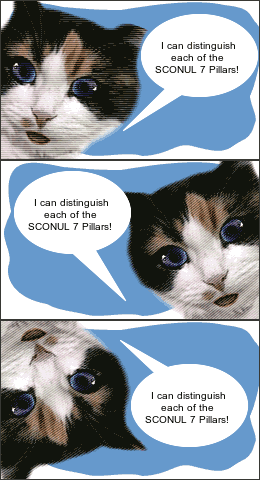 No-one is going to take this infolit talking cat for a deepfake, but I generated it here and thought it was rather cute.

