Showing posts with label wlic2014. Show all posts

Wednesday, August 20, 2014

MOOCs not just in the keynote at #wlic2014

Pierre Dillenbourg was today's keynote at the World Library and Information Conference (IFLA) 2014 in Lyon, France. Academic director of the EPFL Center for Digital Education at École polytechnique fédérale de Lausanne (Switzerland), he's talked about Ten surprises in our MOOC experience. Since I've now gone through the process of preparing material for a MOOC (the Play MOOC offered by Futurelearn) and have read a good deal about them I didn't find so many surprises, but it was interesting to hear from someone from outside the English-speaking sphere and he is an entertaining speaker. Just to remind you, MOOC stands for Massive Online Open Course. This will find my previous posts about MOOCs http://information-literacy.blogspot.fr/search?q=moocs
Just to pick out a few things that struck me:
- One of his messages was that MOOCs can enable a smaller university to punch above its weight, reaching a huge audience internationally (e.g. they have many students from the USA, France and the UK).
- Dillenbourg said that "MOOCs save Books" i.e. the MOOC may stimulate book buying particularly if the video is attached to an academic or a course that has produced the book-of-the-course.
- Students may use a MOOC as the "textbook" for the credit-bearing course they are studying at university, and the speaker positioned this as part of a flipped classroom approach.
- Learners may be "watching MOOCs in teams" (the MOOC platforms that his university uses are Cousera and EdX i.e. what are termed xMOOCs, taking a less social/constructivist approach, so "watching", the word he used, may be appropriate)
- amusing soundbite "Good MOOCs are (in general) better than bad MOOCs"
- I was surprised, but not in a good way, by the statement that "MOOCs turned teaching into a high stakes activity" (surely it should be high-stakes anyway - it certainly is high stakes for the learners!), though it may just present the reality that teaching is seen as less important than research even now (in terms of getting promotion etc.)

Also rather surprisingly, considering he'd been invited to a library conference, the speaker evidently hadn't done much googling of "moocs librarians" or "moocs bibliothécaires" as when asked about the role of librarians he did not seem to feel there was one. I did feel compelled to make a comment on that e.g. mentioning the Futurelearn librarians' group.

A quick google turned up other presentations on MOOCs in which this speaker was an author e.g. this one which makes some of the same points.

Last year at IFLA there was this paper:
CALTER, Mariellen (2013) MOOCs and the library: engaging with evolving pedagogy. Paper presented at: IFLA WLIC 2013 — Singapore — "Future Libraries: Infinite Possibilities" in Session 98 - Knowledge Management with Academic and Research Libraries.

There was a whole session on MOOCs this year, but unfortunately none of the papers from that session are in the IFLA library yet (and I couldn't go to it as it clashed with the session in which I was givinga paper). I will link to them when they appear. There is a paper in another session that also focuses on the librarian's role in MOOCs:

Eisenberger-Pabst, D. et al. (2014) The academic library – a hidden stakeholder - in the age of MOOCs. Paper presented at: IFLA WLIC 2014 – Lyon - Libraries, Citizens, Societies: Confluence for Knowledge in Session 210 - Information Technology. In: IFLA WLIC 2014, 16-22 August 2014, Lyon, France. http://library.ifla.org/id/eprint/905
Photo by Sheila Webber: cakes at teh reception last night

Information literacy + Service Learning = Social Change #wlic2014

I've just been in the session organised by the IFLA Social Science Libraries with Women, Information and Libraries Special Interest Group at at the World Library and Information Conference (IFLA) 2014 in Lyon, France, where Tiffini Travis gave a paper (coauthored with Jennifer Gradis) on Information literacy + Service Learning= Social Change. They work at California State University, United States and this presentation was about the information literacy contribution to a service learning course at their university.
Service Learning is a term that doesn't really get used in the UK, but it seems a part of US higher education. Wikipedia says it means "a method of teaching that combines classroom instruction with meaningful community service" (although that article is flagged as having issues, that seems pretty much what service learning means).
Travis started by saying that she connected information literacy with empowerment and it should lead to action. She identified that research and problem solving can be used for social activism. Travis referenced the new proposed ACRL information literacy framework, and saw this teaching intervention as fitting in the "Research as inquiry" frame. She categorised what she was doing as experiential learning, with a cycle of thinking, doing, experiencing and reflecting. In a video, Travis' coauthor described the service learning assignment - the learners have to select an organisation that addresses a socially significant problem, they have to contact it and undertake some service learning, and produce a portfolio including a presentation about the organisation and their own specific contribution. The information resources that the students discover can contribute to learning about the organisation and its impact, and the library's contribution has meant that the students are finding better and more wide ranging materials that help them understand and complete their assignment. Travis gave an example of finding scholarly articles about the problems of homeless pregnant women.
The speakers emphasised the impact, including attitudinal and emotional impact, of this particular course, since students are learning to work with classmates and people in the outside world. The issues they investigate also can have a big impact on the students which the speakers felt "could lead to a positive social change". One of teh messages from the talk's conclusion was that this intervention "allows the reenvisioning of IL to focus on the application of information rather than just the search for information".
The slides will be available at http://www.slideshare.com/T_Travis (added 28 August: this is the specific link: http://www.slideshare.net/T_Travis/social-activism-and-information-literacy-video
Photo by Sheila Webber: the reception last night at La Saltiere, Lyon

Tuesday, August 19, 2014

Role of information literacy in agricultural productivity #wlic2014

The IFLA Agricultural Libraries Special Interest Group had a session focusing on information literacy at the World Library and Information Conference (IFLA) 2014 in Lyon, France: Role of information literacy in agricultural productivity and food security: An international perspective. I didn't go to this session (as it clashed with the IL Section Lunch), but most of the papers are already in the IFLA library, and they include:
- Embedding Information Literacy into the Agriculture Curriculum in Liberia: A Model Approach for Developing Countries Worldwide from Martin Kesselman (Rutgers University, New Jersey, United States)
- Farmers Information Literacy and Awareness towards Agricultural Produce and Food Security: FADAMA III programs in Osun state Nigeria from Abiola Abosede Sokoya (Yaba College of Technology Library, Sabo, Lagos, Nigeria) and colleagues
- Influence of Information Literacy skills in accessing agricultural information: with special reference to paddy farmers of Ampara district, Sri Lanka from Mohamed Majeed Mashroofa (South Eastern University of Sri Lanka, Oluvil, Sri Lanka) and Wathmanel Senevirathne (Open University of Sri Lanka, Nugegoda, Sri Lanka)
- Attaining Information Literacy: An assessment of Indian Agricultural Universities approach to enhancing Student’s Information and Research skills from Neena Singh (G B Pant University of Agriculture and Technology, Uttrakhand, India)
Photo by Sheila Webber: more trees in the park (Parc de la Tête d'Or), Lyon, August 2014

Information-seeking behaviour of LGBTQ health professionals #wlic2014

Another post from the LGBTQ session at the World Library and Information Conference (IFLA) 2014 in Lyon, France. Martin Morris (Schulich Library, McGill University, Canada) and K.R. Roberto (Graduate School of Library and Information Science, University of Illinois at Urbana-Champaign, United States) talked about Information-seeking behaviour of LGBTQ health professionals: New data to inform inclusive practice

They reported on the results of a research project. This was folowing up on a study by Fikar and Keith (2004). There is evidence that medicine "has been almost silent on the issue of access to healthcare for LGBTQ patients". The researchers carried out a questionnaire survey and got 123 responses. They found that a majority (64.5%) did feel that they had specific information needs.  Comments included a need to have information related to (amongst other things) abuse, reproductive options, LGBTQ mental health, transgender issues. There was a call to be educated by LGBTQ peers. Straight librarians were felt to have a lack knowledge about LGBTQ issues. The researchers asked whether the participants in online chat with a librarian, and about 43% found it more appealing than f2f (in this case having the chat with a LGBTQ librarian didn't make the option more appealing). Lessons drawn from this included that: LGBTQ people continue to have specific needs; librarians can expect more complex questions; better trained librarians are needed; making the physical library more LGBTQ friendly e.g. having gender-neutral toilets inthe library; advertising these things on your library website. There was also the issue of "were respondents wrong about straight librarians"; there did seem to be a need for librarians who were out as LGBTQ and have librarians who engage with LGBTQ networks. A short paper is at http://library.ifla.org/id/eprint/1032

Fikar, C. and Keith, L. (2004). Information needs of gay, lesbian, bisexual, and transgendered health care professionals: results of an Internet survey. Journal of the Medical Library Association, 92(1), 56- 65.

Other talks in this LGBTQ session are available in the IFLA library:
JOSÉ AUGUSTO CHAVES GUIMARÃES et al. Gay Marriage and Homoaffective Union: a terminological analysis of the social values of libraries as a source for an ethical subject representation and dissemination in Brazil
B. Mehra and L. Gray “Don’t Say Gay” in the State of Tennessee: Libraries as Virtual Spaces of Resistance and Protectors of Human Rights of Lesbian, Gay, Bisexual, Transgender, and Queer (LGBTQ) People
N. Somorjai Reducing the Suicide Risk of LGBTQ Library Users
J.A. Winkelstein Public Libraries: Creating Safe Spaces for Homeless LGBTQ Youth She also mentioned http://lambda.sis.utk.edu
C. Edeholt and M. Lindgren. The Rainbow Library at Umeå City Library and The Swedish Network for LGBTQ Issues at Libraries (the photo is of a slide showing the Rainbow shelf at Umeå City Library.
E. da S. Alentejo Power and community: organizational and cultural LGBT responses against homophobia and promotion of inclusion values

Supporting and working effectively with indigenous students #wlic2014

Liveblogging at the World Library and Information Conference (IFLA) 2014 in Lyon, France, I attended a session of the IFLA IndigenousMatters special interest group. Camille Callison (Indigenous Services Librarian and Liaison Librarian for Anthropology, Native Studies and Social Work, University of Manitoba, Canada; pictured at the lectern) talked about Supporting and working effectively with indigenous students whilst building and strengthening relationships between indigenous communities and the academic library. She felt that libraries and archives play a vital role in helping preserving and honouring indigenous culture and history. At Manitoba they wanted to be a centre of excellence for indigenous education and research. This includes engaging with the community, and ensuring that indigenous cultures and knowledge are integrated into work and study. Here is the link to their Indigenous Connect website: http://umanitoba.ca/indigenous/. Callison identified the history of distrust and cultural imperialism, and a "culture of whiteness" in crricula and library holdings, which all provide barriers to achievement.
One way in which these barriers are addressed is through a home and community (Bald Eagle Lodge). They have also attempted to decolonise the library, although this is a slow process (for example classification systems e.g. that indigenous people are "ghettoised" in "History"; the confusion about cvarious LC subject headings to do with indigenous people).

Callison said that the library aims to address the unique needs of the indigenous students. Strategies include: recognising bias; bringing the library to students by having sessions in the Migizii Agamik (sitting by the lift to catch them on their way to coffee!) and having special sesions in the library; dialogue e.g. in the classroom, working with them on assignments; having a special Facebook group; relationship building with the local indigenous community; holding an Aboriginal Archives Day and a storytelling event.

She visits schools and other recruitment events so the prospective students know they will be supported. Collection development is also important, in the general collections and special collections e.g. graphic novels. Collison also talked about the library's role in terms of preserving and giving access to indigenous knowledge.The third photo here shows a statement about indigenising the academy (which I wasn't quick enough to transcribe)
She mentioned a book in which she has a chapter Aboriginal and visible minority librarians book and the International indigenous librarians Forum to be held in 2015.

Monday, August 18, 2014

Just when the caterpillar thought the world was over #ifla_set40

Liveblogging from the 40th anniversary conference of the IFLA Section on Education and Training which is part of the WLIC (IFLA) 2014 in Lyon, France. I was too nervous to liveblog in the 2nd IGNITE session as I was speaking in it. I'll blog a little about it later.
The last keynote is from Lynn Silipigni Connaway, entitled Just when the caterpillar thought the world was over, it became a butterfly: developing educational programs for an emerging profession. She started by revolving around the tensions in library and information education - in particular the tension between research and practice. She pointed out that the criticism that LIS research is not of practical use to libraries has been around for a while.
In terms of education she felt that it wsn't the tools (including technology tools), but rather the values, ethics and fundamentals that educators should concentrate on teaching (the tools were no good without these). She mentioned things like organisation of information, understanding of theory, people skills and collaboration as being part of the fundamentals. Understanding and researching people's behaviour (including formal service evaluation and usability studies) was important. Working out how to build relationships was also vital: and in fact a focus on relationship building rather than service excellence (citing Brian Mathews). To do this, students also needed to develop their problem solving and decision making skills and master research methods.
Connaway saw great potential in data specialist or data librarian posts, but with emphasis on people skills, not just technical skills.
Connaway cited various studies or statements that showed that employers did not feel enough library graduates were prepared for the library workplace. At the end she felt that the person had a good approach when she said that a library qualification gave them an understanding of why librarians do what they do, based on a grounding in theory.
Connaway does interesting research at OCLC, which I've blogged about previously, but here's a random link to an article from last year:
Connaway, L.S. et al.  (2013) "I always stick with the first thing that comes up on Google. . ." Where People Go for Information, What They Use, and Why. EDUCAUSE Review, December 6.
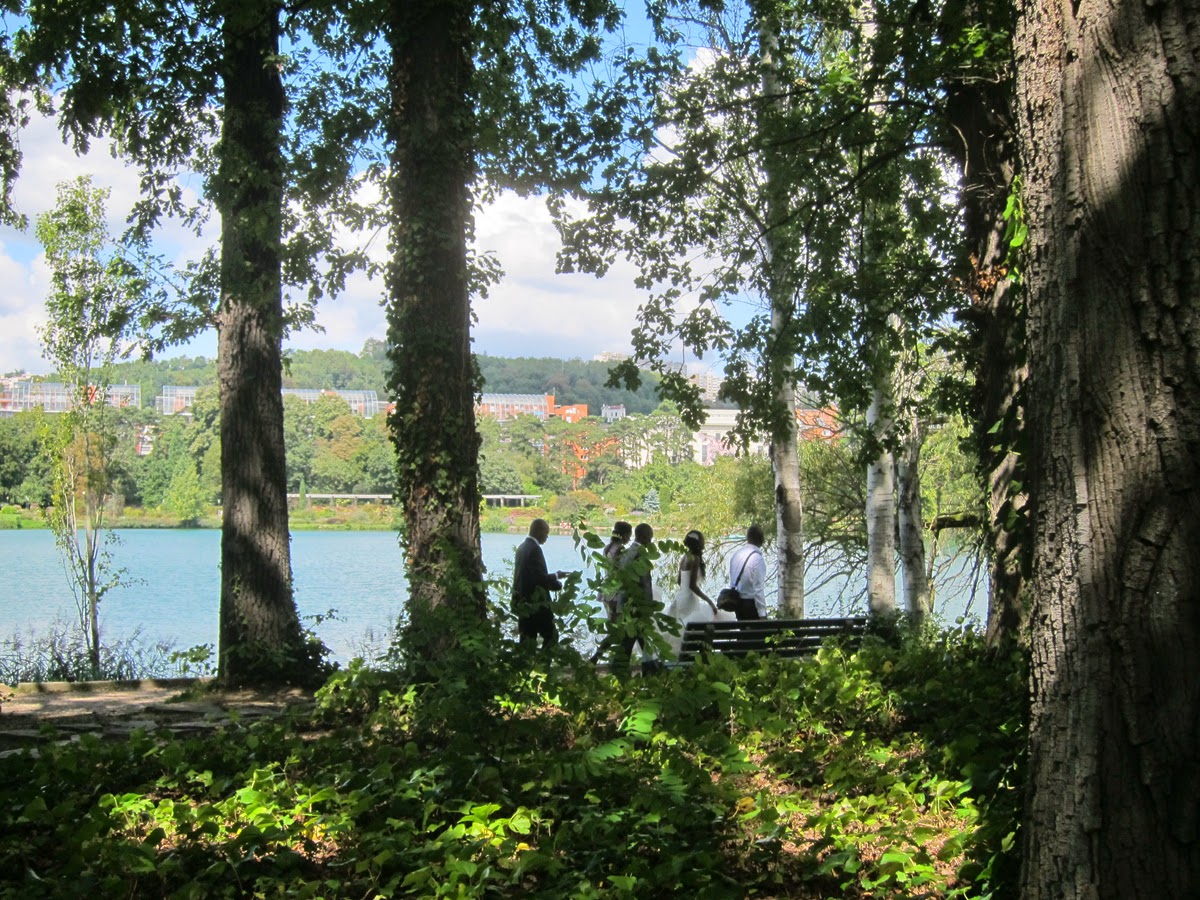
Photo by Sheila Webber: Spot the bridal party, Lyon August 2014

Lyon Declaration On Access to Information and Development #wlic2014

The Lyon Declaration On Access to Information and Development http://www.lyondeclaration.org/ was launched today at the World Library and Information Conference (IFLA) 2014 in Lyon, France. Geared to the likely new UN Millennium Development goals, it starts by saying that
"We, the undersigned, believe that increasing access to information and knowledge across society, assisted by the availability of information and communications technologies (ICTs), supports sustainable development and improves people’s lives.
"We therefore call upon the Member States of the United Nations to make an international commitment to use the post-2015 development agenda to ensure that everyone has access to, and is able to understand, use and share the information that is necessary to promote sustainable development and democratic societies."
Organisations are encouraged to be signatories to the Declaration (there is information on how to do this).
Photo by Sheila Webber: another picture of trees in the park, Lyon, August 2014

IGNITE! group problem solving; international collaboration; social justice #wlic2014 #ifla_set40

I'm liveblogging from the 40th anniversary conference of the IFLA Section on Education and Training which is part of the WLIC (IFLA) 2014 in Lyon, France. The current session is an IGNITE session, in which people are allowed 5 minutes to present, using 20 slides (so rather like a Pecha Kucha, but even shorter) so it will be impossible to capture much about each. This will be an impressionistic blog post and I won't cover all of them.
- Terttu Kortelainen talked about getting groups to work on a research problem using brainstorming and also the group creating a story around the problem, to give the problem better context (e.g. so that later they can ask "would this kind of person have access to this"), and she also emphasised critical discussion within the group to generate criteria for evaluation and to evaluate what has been applied.
- Barbara Moran gave some tips for international exchanges and collaborations e.g. faculty or student exchanges, joint programmes etc. These included the importance of being selctive about picking partners; being clear and realistic about goals and that "nothing substitutes for personal contact".
- LaVerne Gray and Rashauna Brannon talked about The social justice imperative in library and information science education and research and the ongoing development of the ALISE/ALA Social Justice Collaboratorium (I'll add a link to further information if I find one).
Photo by Sheila Webber: lake in the park, Lyon, August 2014

Library and Information education - curriculum - values #wlic2014 #ifla_set40

As part of the World Library and Information Conference (IFLA) 2014 in Lyon, France I'm attending the 40th anniversary conference of the IFLA Section on Education and Training. Since this isn't focusing on Information Literacy I will just cover it briefly. It is a whole day conference and I am doing a very short presentation this afternoon.
The day started with a keynote from Dr Ismail Serageldin (Bibliotheca Alexandrina). He touched on some of the same points as his keynote in Singapore last year, for instance concerning the 7 Pillars of the Knowledge Revolution, but with exploration of the changes affecting librarians and the need to espouse and enact core values. To illustrate the latter point he gave examples of US librarians resisting giving up patron information, and citizens defending the Bibliotheca Alexandrina during the revolutions in Egypt.
This was followed by an international panel representing various associations (e.g. the iSchools consortium, the Council on Library and Information Science Education (CILISE). Panellists talked about challenges such as coping with changes in higher education (and these will vary country to country), achieving changes to the curriculum and simply keeping in touch with each other. It was evident, unsurprisingly, that while some issues were common across countries (e.g. a focus on technology), others were specific to particular countries or regions (e.g. in African context a need for more agreement on standards and competencies; in Japan the low or hidden status of librarianship in comparison with computer science).
Personally I am a bit concerned that with too much emphasis on technology (big data etc.) some of the core of information science, and the human/social perspective, may be lost sight of (so that it becomes difficult to distinguish it usefully from other technology-focused disciplines). However, perhaps it is easy to say this when I am in a comparatively technology-rich country. Some of the participants (for example Dick Kawooya and Filiberto Felipe Martinez Arellano) did talk about the issue of the nature of the core curriculum and the place of technology within it.
Paul Sturges (from the audience) also raised the issue of whether associations might becoming too controlling  and stifle creativity. Responses from the panel indicated that some associations were not at the stage to be controlling, but in some cases there could be a need to have standradisation etc. in order to maintain an identity and professionalism.
Photo by Sheila Webber: lake in the park, Lyon, August 2014

Sunday, August 17, 2014

How AASL Learning Standards Inform ACRL’s Information Literacy Framework #wlic2014

I have a gulity confession from the World Library and Information Conference (IFLA) 2014 in Lyon, France. I meant to go to the session which included Lesley Farmer's talk about information literacy, but I'm afraid that instead I ended up spending more time than I meant to, eating lunchtime crepes in the park... However, fortunately Lesley's paper is already in the IFLA library full text. AASL = American Association of School LIbrarians and ACRL = the (US) Association of College and Research Libraries.
Farmer, L. (2014) How AASL Learning Standards Inform ACRL’s Information Literacy Framework. Paper presented at IFLA WLIC 2014: Lyon: Libraries, Citizens, Societies: Confluence for Knowledge, 16-22 August 2014, Lyon, France. http://library.ifla.org/id/eprint/831
Photo by Sheila Webber: trees in the park (Parc de la Tête d'Or), Lyon, August 2014

First information Literacy section meeting at #wlic2014

I'm now at the World Library and Information Conference (IFLA) 2014 in Lyon, France. It's taking place in the congress centre (pictured) which is beside a very beautiful park (you will get several pictures of that over the next days).
Yesterday the main event from me was the first section committee meeting of the IFLA Information Literacy Section. I am a section committee member. There are members from many diffirent countries around the world and this is the only time I meet up with most of them face to face, although obviously we also communicate via email etc. We were discussing how the Limerick conference had gone (by the way I will do a final wrap-up post from that today or tomorrow) and looking forward to the two sessions in the main programme. Next year the main IFLA WLIC conference is in Cape Town, and colleagues on the committee are coorganising a pre conference satellite (working title "School libraries as a catalyst for developing information literacy skills") with LIASA School Libraries and Youth Services Interest Group. We then broke up into groups to discuss different issues, and I was in the one discussing the UNESCO Media and Information Literacy recommendations: i.e. what actions we need to take to get more national, international and local attention and action.