Showing posts with label Jordan. Show all posts

Friday, September 01, 2023

Media and Information Literacy in Jordan

Photo by Sheila Webber my hydrangea August 2023

A review of Media and Information Literacy in Jordan has been released.
Al Muheisen, R. (Aug 18,2023). JMI study reveals state of information literacy in Jordan. Jordan Times. https://jordantimes.com/news/local/jmi-study-reveals-state-information-literacy-jordan
Unfortunately I couldn't find the report online, but here is a summary of the Jordan national plan.
Ministry of Culture, Jordan. Executive Summary on the National Plan to Disseminate Media and Information Literacy 2020-2023 https://erasmus-plus.org.jo/Portals/0/Media%20and%20Information%20Literacy%281%29.pdf
In it, Media and Information Literacy is defined as "the skills and competencies that enable individuals to access, analyze, evaluate and produce media wisely and ethically. As an essential life skill, MIL also builds an understanding of the role of media in society and develops critical thinking, a main pillar of 21st century education."
Also, this is the Jordan Media Institute's Media and Information Literacy Center https://www.jmi.edu.jo/en/mil-media-center
Photo by Sheila Webber: my hydrangea, August 2023

Sunday, July 03, 2022

Recent articles: ACRL Framework; Nursing students; doctoral journeys

The latest issue of Reference Services Review (priced journal) vol. 50 issue 2 includes
- Is the ACRL Framework a teaching tool? Undergraduates’ interpretations of its language and concepts by Jennifer Jarson, Rachel Hamelers. "In this case study, the authors analyzed 25 undergraduates’ reflections on their information literacy learning guided by recommendations for thematic analysis of qualitative data from Braun and Clarke (2006) and Castleberry and Nolen (2018). ... The authors’ analysis of students’ reflections offers insight into how these students interpreted the Framework’s language and related it to their own experience. By noting language that seemed to resonate in this instance, the authors suggest ways in which educators could effectively use the Framework’s language with undergraduates."
- Information literacy: assessment of undergraduate and graduate nursing students by Rabia S. Allari, Khaldoun Hamdan, Maha Alkaid Albqoor, Abeer Shaheen. "Cross sectional-correlational design was utilized. Data were collected using an electronic self-administered questionnaire from graduate and undergraduate nursing students in Jordan. ... Information competency of nursing students was positively correlated with students' age. Significant differences were found in information competency according to the academic level, addressing scientific research and research in databases in the course of the study, frequency of meeting the supervisor to discuss the research and university sector."
- Graduate student intellectual journeys: a functional method to identify library service gaps by Elizabeth Kline
Go to https://www.emerald.com/insight/publication/issn/0090-7324/vol/50/iss/2

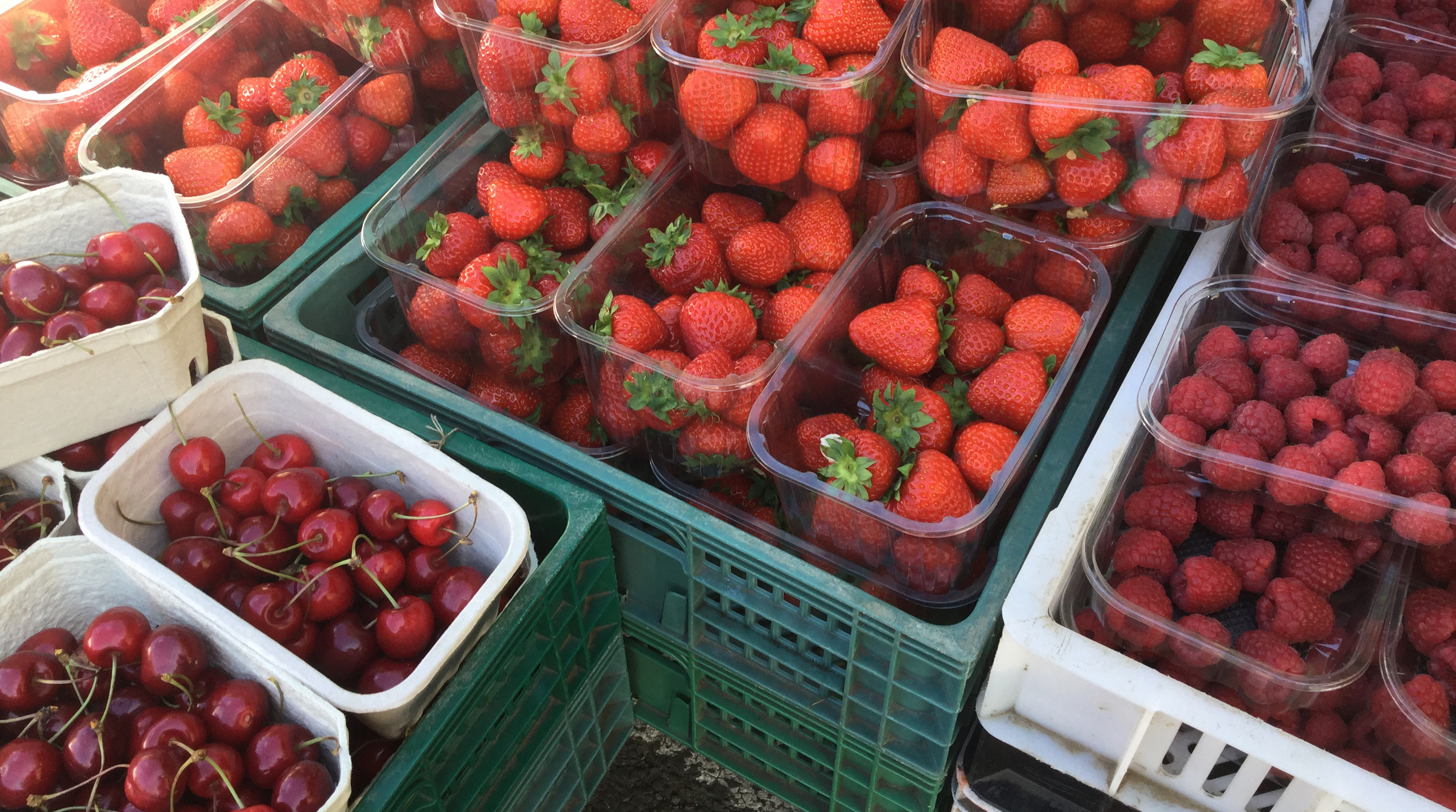
Photo by Sheila Webber: Red berries at Farmers Market, June 2022

Thursday, September 03, 2020

New articles: Faculty in Jordan; Undergraduates in China; Parents information seeking

- Kubb, C., and Foran, H.M. (2020). Online Health Information Seeking by Parents for Their Children: Systematic Review and Agenda for
Further Research. Journal of Medical Internet Research, 22(8), e19985. https://www.jmir.org/2020/8/e19985
A notable flaw in this "systematic" review (evidently not picked up in peer review!) is that they didn't search any information databases (such as LISA), but just medical ones plus Google Scholar, and although they did search PubMed (which includes some information science journals) and Scholar, their search was very limited in terms of alternatives to "information seeking" (e.g. it didn't include "information searching" or "information behavio(u)r"). Moving on from that gripe, it is a useful search of the medical literature on this topic. From the abstract " A total of 33 studies met the inclusion criteria. Findings suggest that parents worldwide are heavy online users of health-related information for their children across highly diverse circumstances. A total of 6 studies found high parental health anxiety, with prevalences ranging from 14% to 52%. Although parents reported wishing for more guidance from their pediatrician on how to find reliable information, they rarely discussed retrieved information from the web. The conceptual model of proxy online health information seeking includes 49 variables."
- Niqresh, M., & Al Dwairi, K. (2020). The degree of possession of the faculty members at Princess Alia University College for the skills on the use of databases and its relation to research performance. International Journal of Library and Information Science, 12(1), 1-8. https://doi.org/10.5897/IJLIS2019.0893
"This study aimed to know the viewpoint of faculty members at Princess Alia University College [which is in Jordan] on the degree of possession of the skills to use databases and its relationship with their research performance and to investigate the effect of gender, experience, qualification, and academic rank on the point of view of faculty members.The study sample consisted of 40 faculty members, males (17) and females (23) from Princess Alia University College. Means and standard deviations and t-test were used to analyze the results. The results showed that there were statistically significant differences in the views of the faculty members on the degree of possession of skills on the use of databases and its relationship with their research performance. It also showed a statistically significant difference at the level of significance (α ≥ 0.05) in their views attributed to the experience. There are statistically significant differences at the level of significance (α ≥ 0.05) in their views attributed to gender, and results also showed the existence of clear statistically significant differences in the views of the faculty members on the degree of possession of the skills on the use of databases and its relationship with their research performance by reason of qualification and academic rank variables."
- Jiang, X. et al. (2020). Investigation of Information Literacy of Undergraduate. ICIEI 2020: Proceedings of the 5th International Conference on Information and Education Innovations. (pp.52–55) https://doi.org/10.1145/3411681.3411690
"We collected the questionnaires of 11051 students from 65 universities [in China], which are selected from 16 provinces and 35 cities." "By the investigation, we find the following cases. (1) The students have less access to information. The utilization of school libraries is not high. (2) The students can't process information well, and are not familiar with literature retrieval and search engine methods. And these have the limited search methods and want to learn the methods of academic research. (3) The students talked excessively, violated other people's privacy or reputation, and 54.73% of the students could not report illegal websites. The reason is the lack of understanding of laws and regulations"
Photo by Sheila Webber: garden pot of geraniums, August 2020

Thursday, March 09, 2017

#MILID yearbook: Opportunities for Media and Information Literacy in the Middle East and North Africa

The open access book has been published:
Abu-fadil, M., Torrent, J. and Grizzle, A. (Eds) (2016). Opportunities for Media and Information Literacy in the Middle East and North Africa. Gothenburg, Sweden: The International Clearinghouse on Children, Youth and Media. ISBN 978-91-87957-33-8
This is the latest MILID Yearbook (Media and Information Literacy and Intercultural Dialogue). The chapters are:
- Magda Abu-Fadil: Introduction:
- Alton Grizzle: Preliminary Comparative Analysis of Media and Information Literacy in the MENA Region
- Jad Melki & Lubna Maaliki: Helping Arab Digital and Media Literacy Blossom. Three years of the Media and Digital Literacy Academy of Beirut (MDLAB)
- Jordi Torrent: Youth and Digital Media. Drafting a Landscape from Fez and Cairo
- Lucy Nuseibeh & Mohammed Abu Arqoub: An Overview from the Occupied Palestinian Territories
- Abdul Ameer Al-Faisal: An Iraqi Perspective
- Redouane Boujemaa: An Algerian Perspective
- Abdelhamid Nfissi & Drissia Chouit: A Moroccan Perspective
- Samy Tayie: An Egyptian Perspective
- Yasar Durra: A Jordanian Perspective
- Naifa Eid Saleem: An Omani Perspective
- Magda Abu-Fadil: A Lebanese Perspective
- Carmilla Floyd & Gabriella Thinz: Empowering Children and Youth in Tunisia
The page with links to all the MILID yearbooks is http://www.unesco.org/new/en/communication-and-information/media-development/media-literacy/global-alliance-for-partnerships-on-media-and-information-literacy/milid-network/
Photo by Sheila Webber: Seagulls over the Thames, December 2017

Wednesday, May 18, 2016

New Media and Information Literacy project in Jordan

#UNESCO and the Jordan Media Institute (JMI) have launched a Media and Information Literacy (MIL) project Jordan. "The program aims to contribute to capacity building of national educational institutions in MIL and transferring skills to new generations, in addition to spreading awareness and knowledge among decision makers, opinion leaders and society." The first involves developing a policy paper and a strategy for introducing MIL into the curriculum. The second phase involves trainingh teachers and introducing MIL to school curricula. There is more information at http://www.unesco.org/new/en/media-services/single-view/news/jordan_media_institute_and_unesco_launch_media_and_information_literacy_project/back/9597/#.Vzw2y-bdiZM
Photo by Sheila webber: cherry branches, May 2016