Showing posts with label Discipline - history. Show all posts

Monday, February 16, 2026

New articles: Collaboration; Assessment, AI

bare branches of three trees against a grey sky

The latest issue of open access College & Research Libraries News (volume 87 issue 2) includes: 
- It’s Not Easy Staying Human: Generative AI, Cognition, and Reflection by Maxwell Gray
- Intentional Co-Instruction: Bringing the Framework and Guidelines into Conversation for Undergraduate History Information Literacy Instruction by John Caldwell, Kaitlyn Tanis
-  Pathways to Impact: Anticipating Action in Library Assessment by Becky Croxton, Megan Oakleaf
Go to https://crln.acrl.org/index.php/crlnews/issue/view/1691/showToc
Photo by Sheila Webber: winter branches, February 2026

Thursday, May 16, 2024

Embracing RUSA's Guidelines for Secondary Source Literacy #WILU2024

Photo by Sheila Webber: art on the floor at the Kwantlen Polytechnic University, May 2024

I am liveblogging from the WILU conference In Vancouver, Canada. Charting the Course: Embracing RUSA's Guidelines for Secondary Source Literacy by Kristen Howard (Liaison Librarian, McGill University, Canada). Apologies that there were lots of examples given, and I haven't been able to capture all/most of them.
She introduced the RUSA guidelines and identified how secondary sources allow researchers "to engage with scholarly conversations about history". Also engaging  with secondary sources require evaluation etc. skills. Howard introduced her context: McGill history and classics department has 450 majors and 275 minors. She then described some ways she had changed her teaching after examining the RUSA guidelines. For example, in talking about "Why are there so many places to search" this includes acknowledging that this can be overwhelming, but explaining how each source has its function and biases and what support there is for searching. One tip from another session on search headings was saying that subject headings are like hashtags.
Howard highlighted learning objective 2.5 ("Trace citations to find additional sources relevant to a research project. Examine works cited in secondary sources to find earlier sources, including primary sources. Use citation search tools to find more recent work that cites relevant sources.") and how she used Google Scholar to find a title and chain backwards and forwards.
Learning objective 4.2 is "Critically evaluate the perspective of the creator(s), including authority, tone, subjectivity, biases, social context(s), methods, and/or guiding theories, and consider how these relate to the original purpose(s) and audience(s) of the source." and Howard talked about using a framework that could be used for primary or secondary sources to reflect on who the creator is and why they are writing etc.
Howard is also aiming to integrate the RUSA learning objectives into the general departmental learning objectives for history. She gave numerous examples of the goals for secondary source skills in these departmental document, compared with what is in the RUSA guidelines. For example, for "research skills" the historians say that students are "expected to organize their own research strategy" which is rather vague (with assumptions about what is already understood), and so there can be conversation about incorporating some more explanatory detail from the RUSA guidelines. There was less agreememt in the area of use of resources (for example, the departmental guidelines focusing on aspects such as engaging and critiquing arguments, the RUSA mentioning summarising and critiquing the stance of the creator).
Altogether Howard was finding the RUSA guidelines useful for her practice and in efforts to update the departmental learning objectives.
Photo by Sheila Webber: art on the floor at the Kwantlen Polytechnic University, May 2024

Thursday, April 20, 2023

Authority of knowledge: historians on Wikipedia in higher education #LILAC23

In this session Dr Delphine Doucet (University of Sunderland) presented insights from her research exploring the relationship between history academics’ conceptions of knowledge and authority in their fields of research and their assessment of Wikipedia’s authority and credibility as a teaching resource.

She talked about her context - until recently she was a history lecturer, with a focus in intellectual history16th-18th, and one of the questions in that field is how authority is created, and what tools people use to mark authority. Then on the LISM course at Sheffield iSchool (where I was her dissertation supervisor) she got interested in the issue of Wikipedia and authority (stimulated by work by Diana Park & Lauri Bridges - see e.g. here).  Doucet talked about the way in which wikipedia has entered the academic discourse, and how the literature shows that academics in some disciplines (e.g. health) have been more positive than others. She discovered that history articles are the most consulted, and all this led to examining history academics' opinions and practice concerning Wikipedia. 

Doucet interviewed 8 academic historians, from different types of university and at different stages of their career.These are some insights. Firstly there was the definition of authority. There are some traditional types of marker (such as publication, academic position) but also authority is seen as cultural and situated and as one interviewee said "bound up with kind of cultural assumptions and social assumptions we make". 

Doucet asked each historian to evaluate 2 Wikipedia pages related to their subject specialism: one broader and one more specialist. There was consensus that the pages were factually accurate - however they were also problematic. One problem was giving too much prominence to particular aspect - so inaccuracy which distorts the subject, but not factual inaccuracy. Another problem was the structuring of articles which was needed to make them better relect current thinking. A further problem is in niche areas - for example a topic where the published information is in old encyclopaedias, so (as one interviewee said) a 21st century medium presenting 19th century ideas. There may be too much influence from the niche enthusiast with a particular viewpoint. While Wikipedia was good with factual information, it was not good in areas where there were different perspectives (which a historian would want represented) - this was a problem partly because of Wikipedia's emphasis on consensus. There was also a cultural/linguistic issue (e.g. French vs. English Wikipedia).

In terms of teaching with Wikipedia, two interviewees were reluctant to see Wikipedia as a teaching tool, and the others were interested (one was using it already) and wanted to move away from the old "don't use wikipedia" position. They might recommend the Wikipedia article as a starting point, but caveats included the fact that references in Wikipedia articles might not be accessible (e.g. referring to older textbooks etc.) and might not reflect the best reading recommended for that topic. The interviewees used it themselves for leisure, but for historical practice it was used mainly to check dates. They considered using wikipedia editing as part of teaching and assessment, but there were tensions which she illustrated in a model (see the image above). Problems included the question of whether editing in wikipedia would develop historical writing skills (as required elsewhere in the programme) and at what stage of education it would be feasible/ usable. However Wikipedia can be useful to develop other information and writing skills.


Wednesday, January 05, 2022

New articles: Library UX; Objects; Critical Thinking; Academic freedom

The latest issue (vol 83 no. 1) of open access journal College & Research Libraries contains:
- Fostering Critical Thinking in First-Year Students through Information Literacy Instruction by Mandi Goodsett, Hanna Schmillen ("Through a series of in-depth interviews, the researchers sought to understand how academic librarians who primarily instruct first-year college students conceive of, teach, and assess critical thinking skills in relation to information literacy.")
- Academic Freedom and (Anti) Social Media? by Wendi Arant Kaspar
- Toward a Critical Turn in Library UX by Maura Seale, Alison Hicks, Karen P. Nicholson ("We contend that UX would benefit from a deeper engagement with user-centered theories emerging from Library and Information Science (LIS) and critical and feminist perspectives on practice, embodiment, and power or risk perpetuating oppressive, hegemonic ideas about the academic library as a white space and its users as able-bodied.")
- Standing Out or Blending In: Academic Libraries in the Crowded Informal Learning Space Ecosystem by Erica Lynn DeFrain, Jennifer Thoegersen, Miyoung Hong ("Using mixed methods, this study examines the relationship between students’ use, satisfaction, and productivity needs at five discrete locations at a large public university.")
- Why Objects Matter in Higher Education by Joanna Cobley ("This article provides insight into what happened when students engaged with authentic historical artifacts for the purposes of learning for the first time.")
Go to https://crl.acrl.org/index.php/crl/issue/view/1611/showToc

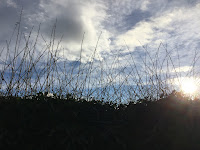
Photo by Sheila Webber: Hedge and sky, Chapelgarth, December 2021

Wednesday, September 11, 2019

Recent articles: STEM; history; bootcamps; teaching librarians

Recent articles from the open access journal College & Research Libraries News include: from Vol 80, No 8, 2019 includes
- Assessment and social change: Empowering underserved students to reimagine their future through STEM outreach by Thura Mack, Savanna Draper
Go to https://crln.acrl.org/index.php/crlnews/issue/view/1527/showToc

I haven't yet covered the previous issue, Vol 80, No 7, 2019, which included
- New models for instruction: Fusing the ACRL Framework and Roles and Strengths of Teaching Librarians to promote the lifelong learning of teaching librarians by Annie Armstrong
- A restructured freshman history course: The evolution of a librarian’s role by Laurie Scrivener
- Repackaging library workshops into disciplinary bootcamps: Creating graduate student success by Erin R. B. Eldermire, Erica M. Johns, Susette Newberry, Virginia A. Cole
Go to https://crln.acrl.org/index.php/crlnews/issue/view/1131/showToc
Photo by Sheila Webber: Juliusspital park, artwork, August 2019

Thursday, June 04, 2015

Reference Services Review: format; badging; learning theory; evaluation; disciplines; collaboration

The latest 2 issues of Reference Services Review (a priced publication) include the following:
Volume 43 issue 1
- Teaching “format as a process” in an era of Web-scale discovery by Kevin Patrick Seeber (pp. 19 - 30)
- Badge it!: A collaborative learning outcomes based approach to integrating information literacy badges within disciplinary curriculum by Emily Ford , Betty Izumi , Jost Lottes , Dawn Richardson (pp. 31 - 44)
- Learning information literacy through drawing by David James Brier , Vickery Kaye Lebbin (pp. 45 - 67)
- One-shot Wikipedia: an edit-sprint toward information literacy by John Thomas Oliver (pp. 81 - 97)
- Flashlight: using Bizup’s BEAM to illuminate the rhetoric of research by Kate Rubick (pp. 98 - 111)
- Leveraging adult learning theory with online tutorials by Rebecca Halpern , Chimene Tucker (pp. 112 - 124)
- Integrating the thematic approach into information literacy courses by Elizabeth Price , Rebecca Richardson (pp. 125 - 136)
- Piloting a blended model for sustainable IL programming by Jody Nelson , Joan Morrison , Lindsey Whitson (pp. 137 - 151)
Volume 44 issue 2 (at time of writing this was early publication, so no page numbers)
- Learning from Degree-Seeking Older Adult Students in a University Library by Mary C. Aagard , Marilia Y. Antunez , Jaime N. Sand
- Evaluation of Sources: A New Sustainable Approach by Sharon Radcliff , Elise Y. Wong
- Using Interviews to Improve Relationships with Library Partners: A Case Study by Bridget Farrell
- Situated Information Literacy: History Instruction at a High School Early College by Meghann Walk
- Situating Information Literacy in the Disciplines: A Practical and Systematic Approach for Academic Librarians by Robert Farrell , William Badke
Go to http://www.emeraldinsight.com/loi/rsr
Photo by Sheila Webber: St Georges Church, Sheffield University: there are 3 peregrine falcons in this picture and since the photo isn't very sharp I have put red "x"s above them (a chick in the nest platform and one just-fledged chick on the ledge above the clock, and a parent bird sitting at the side). Click photo for full size. 2 June 2015

Thursday, September 20, 2012

Search skills resource for history students, in French and German

Compas http://www.compas.infoclio.ch/ is a project og infoclio.ch, which is a Swiss subject portal for the discipline of history. Compas is designed to be a resource for developing history students' information literacy and searching skills. The material is produced in two languages: French and German. I looked at the German version as my German is better than my French.
There are three themes: developing your own digital skills and support for your studies (e.g. using computers to help manage your work, take notes etc.); Researching topics in your discipline; Developing your network (including using social media, blogs and publication). For each there are subsections with advice (text is kept short), links, and the possibility to download the material in pdf.
For each theme there is a short video on the (mostly unfortunate) experience of a history student, done like silent films. Below is one of them (with German text, but I don't think you need to understand German to see what's going on). I think they are meant to convey "avoid being an idiot like Sophie" but I wonder whether it might rather say "you are doomed to fail". However the videos are professionally done and the rest of the resource is nice. But ... spot the librarian stereotype!!

Monday, February 13, 2012

Arcadia project reports

I have blogged about the recent information literacy currculum project which was part of the Arcadia Programme, but I don't think I have highlighted some of the other outcomes from the prammes. There are still some reports to be published, Student reading in theory and practise by Oszkar Nagy and a report on implementing the information literacy curriculum. As background, "The Arcadia Programme was a three-year programme (2008-2011) funded by a generous grant from the Arcadia Fund to Cambridge University Library. The grant enabled us to explore the role of academic libraries in a digital age, create new programmes and services, particularly for undergraduates -- and also to improve the external environment of the library."
Previous reports/websites include: History uncovered - by Carolyn Keim; Internet Informed Patient symposium website and blogs on the event - by Isla Kuhn; Postgraduate information needs and online tools awareness - by Esther Dingley; IRIS(Induction, Research and Information Skills) - by Lizz Edwards Waller. Go to http://arcadiaproject.lib.cam.ac.uk/publications.html
Photo by Sheila Webber: branch on the icey lake, Sheffield, February 2012

Thursday, May 05, 2011

Practice and Evidence of the Scholarship of Teaching and Learning in Higher Education

The latest issue of the open access journal Practice and Evidence of the Scholarship of Teaching and Learning in Higher Education (PESTLHE) is online. One particularly interesting article is:
Wood, J.P. (2011) "Helping Students to Become Disciplinary Researchers Using Questioning, Social Bookmarking and Inquiry-Based Learning." Practice and Evidence of the Scholarship of Teaching and Learning in Higher Education, 6 (1), 3-26.
Other articles address assessment and feedback issues.
The journal home page is at: http://www.pestlhe.org.uk./index.php/pestlhe
Photo by Sheila Webber: Couthurst Road flying the flag on the Royal Wedding day.

Thursday, July 16, 2009

LTEA conference: Using Delicious

A session that I missed at the Learning Through Enquiry Alliance conference in Reading was by a colleague in The Centre for Inquiry Based Learning in the Arts and Social Sciences (CILASS), Jamie Wood. He was talking about using delicious with history students. I have been meaning to link to his PowerPoint on Slideshare about this for a while: so here it is http://www.slideshare.net/cilass.slideshare/
jamie-wood-delicious-050508-presentation


Photo by Sheila Webber: Thames at Henley, conference dinner.