The latest issue of the open-access Journal of Media Literacy Education (volume 18 no.1) comprises:
- Building resilience: The influence of the format on the effectiveness of news literacy messages by Patrick F. A. van Erkel, Peter Van Aelst, David N. Hopmann, Claes H. de Vreese, and Joren Van Nieuwenborgh
- Promoting News Literacy with epistemological beliefs, IFLA checklist and AI: Insights from a teacher training program in Italy by Flavio Manganello
- Don’t tell me how to fact-check; show me, and let me try! A media literacy intervention with sixth-graders by Thomas Nygren and Carl-Anton Werner Axelsson
- Productive Disruptions: An equity oriented framework for civic media literacy in the digital era by Carlos Jimenez, Lynn Schofield Clark, and Johnny Ramirez
- The Creative Participation pedagogical approach to media literacy education by Amanda Levido
- Teacher reflections on media and information literacy in Vietnamese K-12 schools: Current practices, challenges, and pathways for improvement by Tinh T.T Le, Minh Tran, Anh Dương, Huong T. Pham, Vy Tran, and Daniel Jackson
- From Y to Z: A cross-generational examination of new media literacy and online information searching strategy by Taibe Kulaksız, Ali Geriş, and Sena Özşirin
- From consumers to creators: Social media information literacy of university students by Thuy Thanh Bui, Quyen Trang Mai Nguyen, Tu Thi Thanh Nguyen, and Minh Cao Luu
- Leveraging critical social media literacy to safeguard youth against violent radicalization and extremism by Muhammad Akram, Adeela Arshad-Ayaz, and Muhammad Ayaz Naseem
- Didactic aspects of education of primary teachers with a focus on strengthening their media literacy and fighting disinformation. Experience from the Czech Republic by Kamil Kopecký and Veronika Krejčí
Go to https://digitalcommons.uri.edu/jmle/vol18/iss1/
Photo by Sheila Webber: border at the botanics, June 2026
Curating information literacy stories from around the world since 2005 - - - Stories identified, chosen and written by humans!
Saturday, June 27, 2026
New articles: News literacy; Media literacy; Fact checking; Disinformation
Tuesday, June 02, 2026
New articles: Use of AI; faculty development; upkilling with systematic reviews; guided inquiry; reflection; mis- and disinformation; open source communities
The latest issue (vol 20 issue 1) of the open access Journal of Information Literacy includes
- Critical thinking, disillusion, and dissent: Information literacy in a refused knowledge information landscape by Madelene Logren
- The anatomy of collaborative open-source software development: A practice-based view on how open-source communities work by Renesa Tamannum, José Apolinário Teixeira , Gunilla Widén
- Disinformation and gender issues: A study with young people from Salvador and Porto Alegre (Brazil) by Daniela Silva, Ana Cristina Prates, Josiene da Silva Niesciur
- Digital literacy challenges in higher education: Information literacy in the face of misinformation by José G Casas-Puente
- Information and digital literacy at school: A BRIDGE between critical thinking and equality values by Dora Sales, Christina Banou, Mara Morelli, Anna Antoniazzi, İpek Şencan, Serap Kurbanoğlu, Heidi Enwald, Noora Hirvonen, Stéphane Goldstein, Sarah Pavey, Konstantina Martzoukou, Petros Kostagiolas
- Guided inquiry design for online information literacy media by Nove E Variant Anna, Miyarso Dwi Ajie, Piyapat Jarusawat, Yollanda Nundy Alshafa
- Teacher, trainer, or facilitator? by Katie Smith, Jessica Waite
- From one-shots to assignment design: Developing a library-led faculty development program by Nathaniel King, Alena Manjuck, Yvonne Tran
- Subject librarian reflections on upskilling to support staff and students with systematic reviews: Our experience at UWE Bristol by Hannah Poore, Philip O'Shaughnessy
- Promoting reflection by students on their use of information by Andrew K. Shenton
- Articulating generative AI information literacy competencies: An ACRL Framework–driven model for academic libraries by Ladislava Khailova, Melissa Netzband Wathen , Melissa Jones
- Adding a simple log to in-text citations to strengthen information literacy and argumentation while blocking casual misuse of generative AI by Peter Tamas, Leonie Kamminga
plus book reviews and two reports on the 2026 LILAC conference (by Jane Pothecary and Tom Cross)
Go to https://journals.cilip.org.uk/jil/issue/view/58
Photo by Sheila Webber: spring roses, May 2026
Thursday, May 14, 2026
Learning programmes for older adults.
This report is particularly related to my interest in education for older people, and combatting ageism: it has recommendations for upskilling and reskilling of older people. Sadly, information literacy isn't mentioned, but it does talk about aspects of digital literacy.
UNESCO and Shanghai Open University. (2026). Implementing effective
reskilling and upskilling: learning programmes for older adults. UNESCO
Institute for Lifelong Learning. https://unesdoc.unesco.org/ark:/48223/pf0000397435
The report describes examples from Colombia, Japan, Singapore, Sweden and the United States of America (USA) taking different approaches. For example there is the example of The Senior University: A lifelong learning experience for older adults at the Universidad del Rosario, Colombia. The report ends with recommendations.
Photo by Sheila Webber: lilac and buttercups, May 2026
Friday, February 06, 2026
New articles: immigrants' information needs; scholarly misconduct
- Shahid, S.H. & Sinnamon, L. (2026). A meta-ethnographic synthesis of researchers' views on scholarly misconduct in the health sciences. Library & Information Science Research, 48(1), Article 101399.
https://doi.org/10.1016/j.lisr.2026.101399 ("Complimentary access" which I think is free access for a limited period)
"the three forms of misconduct of most concern to researchers are fabrication and falsification, plagiarism, and unethical authorship, while emerging issues include power manipulation and failure to report integrity concerns." Although the focus is health sciences, I would think the findings are of interest/concern in other subjects too.
- Ahmadinia, H. (2026). Belonging through information: Mapping immigrant integration needs in Nordic societies. Library & Information Science Research, 48(1), Article 101400 https://doi.org/10.1016/j.lisr.2026.101400 (Open access)
"The findings show that difficulties in locating reliable information, limited access to familiar languages, and fragmented institutional communication constrain participation across daily life. Participants often relied on informal networks to compensate for unclear or inaccessible official information."
Photo by Sheila Webber: snow, a few weeks ago, January 2026
Tuesday, September 23, 2025
Pecha Kucha session #ECIL2025
Hi, Pam McKinney here live-blogging from the second day of the ECIL conference. This dedicated session features six Pecha Kucha presentations which each last only 6 minutes, so I will do my best to keep up!
Monday, July 28, 2025
Recent articles: Disinformation; low news media literacy; AI literacy; teachers' media literacy; transmedia literacy; media use in lessons
The latest issue of open-access Journal of Media Literacy Education (vol 17 issue 2) contains:
- Disinformation awareness via SMS? Exploring a new modality for boosting adult media literacy by Jannie Lilja, Ester Tottie, Niklas Eklund, Tobias Lindé, and Gunhild Hoogensen Gjørv
- Battle cry to “Do the research”: Vulnerability to QAnon, Alt Media, and low news media literacy by Kaye D. Sweetser and Kalyca Lynn Becktel
- Classroom contexts: Teachers talk teaching media literacy by Sakshi Bhalla, Michelle R. Nelson, and Michael Spikes
- Insights from educators: Integrating AI literacy into media literacy education in practice by Stephanie Jean Tsang
- Media and information literacy strategies: A joint reflection with teenagers in Brazilian public school by Fábio Henrique Pereira, Cristine Marquetto, Liliane Maria Macedo Machado, Nathália Coelho da Silva, Rafiza Varão, and Mariana Fagundes Ausani
- How to shape digital competences among pre-service teachers: A global expert analysis by Łukasz Tomczyk, Francisco David Guillén-Gámez, Maria Lidia Mascia, and Julio Ruiz-Palmero
- Media literacy in the crosshairs: NATO’s strategic goals and the revival of protectionist pedagogy by Nolan Higdon and Sydney Sullivan
- A systematic review of transmedia literacy: Implications for lifelong learning by Rafel Meyerhofer-Parra
- Constructivist media decoding in elementary school: Media literacy instruction across a school year by Faith Rogow, Bridget Crossman, Michele Coolbeth, and Janet Balk
- Using media as a source in lessons: Media literacy methodology and Constructivist Media Decoding by Ayşe Aslı Sezgin Büyükalaca, Chris Sperry, and Cyndy Scheibe
Photo by Sheila Webber: mulberries, July 2025
Saturday, February 15, 2025
NORDIS: AI Guide for teachers
NORDIS is the the Nordic Observatory for Digital Media and Information Disorder "an independent non-partisan multidisciplinary hub" and part of the European observatory EDMO. They have produced an AI Guide for Teachers which is available in English, Swedish and Finnish. Go to https://faktabaari.fi/edu/oppaat/
The website also includes a recording of the Digital Information Literacy Forum (Generative AI, media literacy and ethics – Navigating authenticity in learning), which they held in January 2025 - this is the page with programme and links
Wednesday, February 07, 2024
Recent articles: Outcomes; Disinformation; Print/digital preferences; Social media evaluation; Searching as strategic exploration
I need to catch up on articles from the Journal of Academic Librarianship (a priced publication)! The last 2 issues of Volume 49 (2023), include the following:
- Miller, K. Kaufmann, K. & Trnka, R.E. (2023). Measuring outcomes:
Information literacy instruction assessment in a cross-institutional
study. The Journal of Academic Librarianship, 49(6), article 102796. https://doi.org/10.1016/j.acalib.2023.102796.
- Chomintra, M. (2023) Assessing the use of critical literacies in mis/disinformation literacy instruction. The Journal of Academic Librarianship, 49(5), article 102762. https://doi.org/10.1016/j.acalib.2023.102762.
Rather curiously this article posits in the abstract that "The approaches to mis/disinformation in libraries and information studies have largely been grounded in two forms of literacy education; media literacy and digital literacy" but it is interesting in taking selected lesson plans uploaded to the ACRL sandbox and project CORA and doing a text analysis, including for Equity diversity inclusion and social justice terms.
- Chyne, R.C., Khongtim, J. & Wann, T. (2023). Evaluation of social media information among college students: An information literacy approach using CCOW. The Journal of Academic Librarianship. 49(5), article 102771. https://doi.org/10.1016/j.acalib.2023.102771.
CCOW = Credentials, Claims, Objectives, Worldview. "The findings highlighted significant differences in the evaluation of social media information following the implementation of the CCOW information literacy approach."
- Dahlqvist, C.(2023). Cognitive and motivational qualities of task instruction: Cognitive appraisals and achievement emotions of Swedish primary teacher students. The Journal of Academic Librarianship,
49(6), article 102797. https://doi.org/10.1016/j.acalib.2023.102797.
- Johnson, B. & Reed, E. (2023) The impact of cultural capital on searching as strategic exploration in incoming first-year students. The Journal of Academic Librarianship,49(6), article 102807,
https://doi.org/10.1016/j.acalib.2023.102807.
- Yu, C. (2023). Integrating Information Literacy and Academic Writing: Developing a Self-Assessment Scale of Information-Based Academic Writing. The Journal of Academic Librarianship,49(6), article
102804. https://doi.org/10.1016/j.acalib.2023.102804.
- Shehata, A. & Eldakar,M. (2023). Scholarly communication practices and attitudes of Egyptian junior researchers: An exploratory study. The Journal of Academic Librarianship, 49(6), article 102811,
https://doi.org/10.1016/j.acalib.2023.102811.
- Matthews, J. & Johnson, A. (2023). Preferring print: The planned behavior and preferences of first-generation college students in the academic library. The Journal of Academic Librarianship, 49(6), article 102813. https://doi.org/10.1016/j.acalib.2023.102813.
Tuesday, January 02, 2024
Universal design in libraries
An open-access paper (and brochure) from the 2023 IFLA conference:
Larsson, Karin. (2023) Universal design: Aiming for Universal Design. Paper presented at 88th IFLA World Library and Information Congress (WLIC), 2023 Rotterdam.
"Universal Design is a perfect vision to aim for. An environment, a
library, designed to meet everyone’s needs. Universal Design is, and has
been, explained simply as good design. The design and composition are
understood, accessed, and used by everyone - not only by someone
disabled. In Malmö, Sweden, there are twelve libraries spread across the
municipality. Are these libraries accessible for everyone? Maybe not,
but they are a work in progress. A library wherever it is located must
be a welcoming place for everyone wanting to visit. It is a human right.
Presented in this paper is a guide written to help and inspire all
staff working with accessibility at any of Malmö’s libraries. Does this
guide alone let us reach the universal design – no, however there are
many changes being made throughout our libraries and they all are
striving for universal design. "
https://repository.ifla.org/handle/123456789/2670
Photo by Sheila Webber: another Xmas wreath, December 2023
Tuesday, August 23, 2022
Recent articles: Health literacy; COVID and #infolit; Enterprise search; Information behaviour of pets and people; Refugee information behaviour
- Ashraf, S., Batool, S., Sulehri, I., Eman, S., Rehman, A. & Mahmood, K. (2022). Measuring Everyday Health Information Literacy: A Survey of Pakistani Married Working Women. Libri, 72(2), 97-107. https://doi.org/10.1515/libri-2021-0021 (priced article)
- Lloyd, A. and Hicks, A. (2022). Saturation, acceleration and information pathologies: the conditions that influence the emergence of information literacy safeguarding practice in COVID-19-environments. Journal of Documentation, 78(5), 1008-1026. https://doi.org/10.1108/JD-08-2021-0162
- Lykke, M., Bygholm, A., Søndergaard, L.B. and - Byström, K. (2022). The role of historical and contextual knowledge in enterprise search. Journal of Documentation, 78(5), 1053-1074. https://doi.org/10.1108/JD-08-2021-0170
- Solhjoo, N., Krtalić, M. and Goulding, A. (2022). Pets and people: information experience of multispecies families. Journal of Documentation, 78(5), 1092-1108. https://doi.org/10.1108/JD-03-2021-0052
- Kainat, K., Eskola, E.-L. and Widén, G. (2022). Sociocultural barriers to information and integration of women refugees. Journal of Documentation, 78(5), 1131-1148. https://doi.org/10.1108/JD-05-2021-0107
Photo by Sheila Webber: flowers at the farmers market, August 2022Wednesday, February 16, 2022
New articles: Skills and gaps; IL and humour; Emotional intelligence; Librarians as faculty developers; Librarian deference
The latest complete issue of the Journal of Academic Librarianship (a priced publication), Volume 48 issue 1 (January 2022) includes the following:
- Information literacy skills and learning gaps: Students' experiences and teachers' perceptions in interdisciplinary environmental science by Teresia Svensson, Julie Wilk, Kajsa Gustafsson Åman
- Librarians as faculty developers: Competencies and recommendations by Melissa Bowles-Terry, Karen Sobel
- Academic librarians: Their understanding and use of emotional intelligence and happiness by Michele A.L. Villagran, Lisa Martin (Open access article)
- Information Literacy: Making Asynchronous Learning More Effective With Best Practices That Include Humor by Debby R. Wegener
(a study in a Singaporean university)
- It's Not Personal, It's Professional: Causes of Academic Librarian Deference Behavior by Lyda Fontes McCartin, Raquel Wright-Mair
Go to https://www.sciencedirect.com/journal/the-journal-of-academic-librarianship/vol/48/issue/1
Thursday, February 10, 2022
Recent articles: Health literacy as vaccine; fact checking in Sweden; Information behaviour in COVID19; Health information behaviour; IL in Ghana; Citizen science
- Okan, O. et al. (2022). Health literacy as a social vaccine in the COVID-19 pandemic
Health Promotion International, daab197, https://doi.org/10.1093/heapro/daab197
- Ahmadinia, H., Eriksson-Backa, K. and Nikou, S. (2022), Health-seeking behaviours of immigrants, asylum seekers and refugees in Europe: a systematic review of peer-reviewed articles, Journal of Documentation, 78(7), 18-41. https://doi.org/10.1108/JD-10-2020-0168
- Dreisiebner, S., März, S. and Mandl, T. (2022), Information behavior during the Covid-19 crisis in German-speaking countries, Journal of Documentation, 78(7), 160-175. https://doi.org/10.1108/JD-12-2020-0217
- Juneström, A. (2022), Discourses of fact-checking in Swedish news media, Journal of Documentation, 78(7), 125-140. https://doi.org/10.1108/JD-03-2021-0061
- Ozor, A. & Toner, J. (2022) Information Literacy Behavior and Practice: An Assessment of Undergraduate Students at Ada College of Education, Ghana. Journal of Library Administration, 62(1), 132-151. https://doi.org/10.1080/01930826.2021.2006992
(open access) " The results from this survey present an overview of the
College’s current approach to information literacy instruction,
resource accessibility, as well as students’ information literacy
comprehension and application. A series of recommendations are presented
for the College to consider in improving its approach to supporting
information literacy skills development."
- Ekström, B. (2022), A niche of their own: variations of information practices in biodiversity citizen science, Journal of Documentation, 78(7), 248-265. https://doi.org/10.1108/JD-07-2021-0146
- Multas, A.-M. and Hirvonen, N. (2022), “Let's keep this video as
real as possible”: young video bloggers constructing cognitive authority
through a health-related information creation process, Journal of Documentation, 78(7), 42-64. https://doi.org/10.1108/JD-02-2021-0027
- Graminius, C. (2022), Fast-food information, information quality and information gap: a temporal exploration of the notion of information in science communication on climate change, Journal of Documentation, 78(7), 89-105. https://doi.org/10.1108/JD-03-2021-0072
"In their discussion of the concept of information, Capurro and Hjörland (2005) tentatively ask what else we might need to know about information. Perhaps there is room for more research on the concept of information and temporal issues since this study shows how notions of information come into being in the contextual intersections of time, actions and materials."
Photo by Sheila Webber: sign of spring, February 2022
Tuesday, August 25, 2020
Articles froom JDoc: resettlement IL framework; information encountering; information in schools
Sayyad Abdi, E., Partridge, H., Bruce, C. & Watson, J. (2019). Skilled immigrants: a resettlement information literacy framework. Journal of Documentation, 75(4), 892-908. https://doi.org/10.1108/JD-02-2019-0034 "The study uncovered six different themes of experiencing using information to learn among skilled immigrants. The themes, presented as a framework, explain skilled immigrants learn about their new life through: attending to shared stories by others; getting engaged; researching; comparing and contrasting past and present; being reflective; and being directly educated."
Lundh, A.H., Dolatkhah, M. & Limberg, L. (2018). From informational reading to information literacy: Change and continuity in document work in Swedish schools. Journal of Documentation, 74(5), 1042-1052. https://doi.org/10.1108/JD-11-2017-0156
Erdelez, S. & Makri, S. (2020). Information encountering re-encountered: A conceptual re-examination of serendipity in the context of information acquisition. Journal of Documentation, 76(3), 731-751. https://doi.org/10.1108/JD-08-2019-0151
Jiang, T., Fu, S.& Song, E. (2020). Toward a description framework of information encountering experiences: Guidance for diarists in story telling. Journal of Documentation, 76(4), 807-827. https://doi.org/10.1108/JD-07-2019-0131
Photo by Sheila Webber: more rosehips, July 2020
Thursday, June 11, 2020
Doctor & patient perspectives; Information use in pregnancy; Eating disorders #AECIST20
The keynote was from Christiane Grünloh on “My Work Tool” versus “My Body, My Data”: Conflicting stakeholder perspectives on digital data access. She started by talking about changes in health-related technology and how that has affected the citizen and the interactions between patient and healthcare practitioner. There have also been changes in the way patients are involved in decision making, making them more equal partners, each partner bringing their own expertise. She mentioned the advocacy for epatients or Dana Lewis, for example.
Grünloh went on to talk about online health records, and specifically the national system in Sweden, which currently has about 3 million people registered. This was the focus for the research she was reporting. The introduction of this system was controversial, in particular with some physicians opposing, although some though it was democratising. Their research was looking into what the concerns of the doctors were, and the perceptions of patients after implementation of ehealth records - revealing contrasting views about what the records were for and who the records belonged to.
The physicians saw the patient records as tools important for their work: they were concerned e.g. about increased workload, patients monitoring doctors' behaviour in viewing records. The patients, on the other hand, were mostly positive about having access, for example feeling that they could communicate better with doctors, and access to records made it easier to follow up things they did not understand.
The researchers explored the findings further in terms of values in design. Considering "ownership and property" the doctors saw the record as their property and their tool to do their work, whereas the patients saw it as their property since it is about them. As regards "Autonomy" the doctors felt they should have control over their work, so they could make the necessary decisions and keep records in a way that made sense to them (rather than writing to be understood by patients). However patients could have the perspective of "nothing about me without me".
The patients' well-being was the doctors' chief preoccupation and they were concerned that this might be compromised by free access to your record: for example that patients might be worried by information without being able to sk immediately for clarification. Finally, there is "accountability and transparency, and privacy" with is associated with issues of trust, with doctors feeling that they will be trusted less and more checked-up-on.
The different assumptions and values of different stakeholders can hinder effective dialogue about these issues. The final message was "it's complicated"!
Following my and Pam's presentation, Paulina Bressel talked about #Recovery of Eating Disorders on Social Media - the extended abstract of her talk is here. Finally the third presentation was Health Information Use During Pregnancy from Carolanne Mahony (presenter), Ciara Heavin and David Sammon (all from University College Cork, Ireland). Using Tom Wilson's information behaviour model, they identified the "information processing and use" part of that model as being under researched and the part they wanted to focus on. They rationale for focusing on expectant mothers was to do with this being an important life event, and literature showing e.g. that expectant mothers combined information when making decisions.
Overall they did a longitudinal study over 18 months, but the results reported here related to the intervews before the child was born. There were 12 interviewees, in which the researchers asked the participants to identify information seeking incidents and tell the story of each. The researchers did thematic analysis, inductive and deductive coding, and the participants were given the analysis to check themselves. The researchers divided the themes into positive and negative impacts, and internal or external use. For example one participant talked about being given a lot of books, and then being overwhelmed and avoiding books altogether (so that was Negative external/behavioural); another was someone looking up physical symptoms online and getting reassurance (so that was Positive/internal).
Big thanks to those organising and moderating the conference, which was really well run and engaging! The team consisted of Aylin Ilhan, Crystal Fulton, Noora Hirvonen, Kaja J. Fietkiewicz, Isabelle Dorsch, Fabian Odoni and Tamara Heck of the ASIS&T European Chapter.
Monday, February 17, 2020
Recent articles: School libraries around the world; Gamification; Digital literacies; Inquiry approach; Fiction as information
To pick out a few:
- Fiction as Information: A Look at Reading as Information Source by Mary Ann Harlan. This includes a literature review (looking at reading and information literacy) and a study of 16/17 year olds. (North America) The author concludes " ... that fiction as a form of art is a way to engage our emotions, to explore our world, a way to learn" https://journals.library.ualberta.ca/slw/index.php/iasl/article/view/7378
- Pedagogical centre: A way of empowering and transforming a school library by Therése Haglind, Emmelie Ernst, Ulrika Boström (Sweden) "This paper will present a process of development, successful in our school; a cooperation between Pedagogical centre, teachers and management" https://journals.library.ualberta.ca/slw/index.php/iasl/article/view/7369
- School library concepts developed by an inquiry-approach curriculum organization by User experiences and perceptions about the Ideal Libraries document of the International Baccalaureate by Anthony Tilke (Netherlands) https://journals.library.ualberta.ca/slw/index.php/iasl/article/view/7398
- Gamification in School Libraries by Dejan Šiptar (Croatia) https://journals.library.ualberta.ca/slw/index.php/iasl/article/view/7389
- Digital and information literacies and the school library: A case study by Yvonne L Barrett (Turkey) https://journals.library.ualberta.ca/slw/index.php/iasl/article/view/7384
- School Library Perspectives from Asia: Trends, Innovations and Challenges in Singapore, Hong Kong and Japan by Chin Ee Loh, Annie Tam, Daisuke Okada (not about IL< but useful background) https://journals.library.ualberta.ca/slw/index.php/iasl/article/view/7258
Photo by Sheila Webber: Farmers' market, February 2020
Friday, April 06, 2018
International students #lilac18
The presenters held seminars with other library staff and presented findings from their study to teh library director’s council, and then an invitation to draw up a policy or guidelines for international students. They presented some comments from international students, illustrating the diversity of past experience, and the students perception of the library systems as complex. There were also comments about the different approach to learning (more constructivist) in the Swedish university.
The presenters are keen to make this durable, and not just a one off project. They decided to dive into the literature, but it mostly generated new questions. Firstly: what is an “international” student? For example, are some more “international” than other. What if a student has non-Swedish heritage but is counted as a “home” student. This can lead to the question: is it even relevant to categorise this as a group. Secondly: What does internationalisation mean to libraries? This is something discussed in my university, for example is it actually integrated into the whole curriculum. Is it it just to do institutional initiatives?
Thirdly: How can you develop from a single project to a systematic approach, integrated into the library service/system? They looked at the various activities targeted to international students (I think, those the library does and those done elsewhere in the institution). The presenters drew the conclusion that how you see the group will define where effort is put. Thus if the international student is framed as a “problem” you look at “fixing” the students. However, if you see international students as a permanent and significant group, then this could lead to seeing the library as the “problem”, with more internationalisation needed.
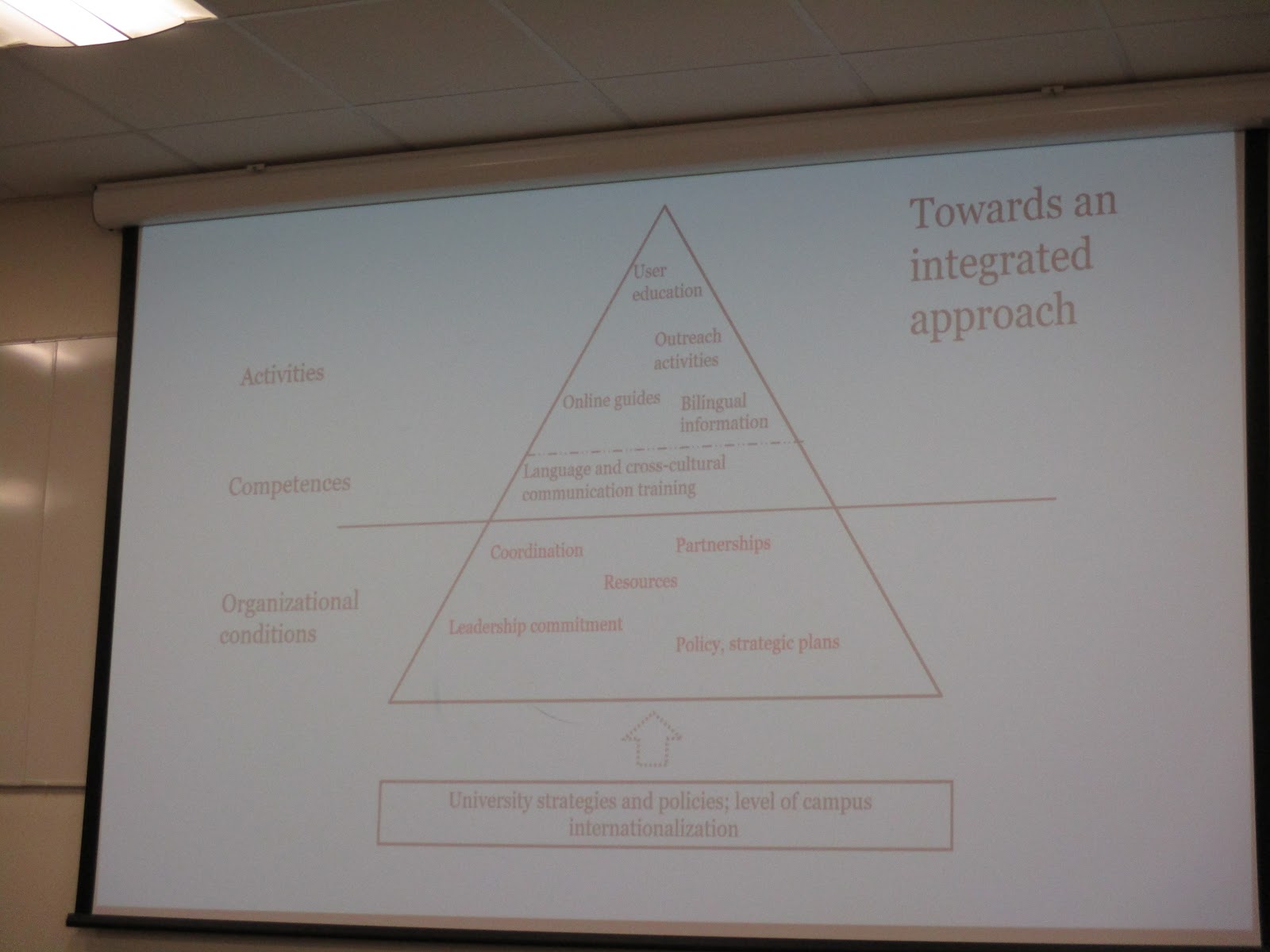
Thus they have created a model, underpinned by university strategies and policies (see poor photograph above). There are then the organisational conditions, such as resources, coordination, partnership, leadership commitment. Above this are competencies (language and cross-cultural communication training) and finally at the top user education, outreach, online guides and bilingual information. This top part is what tends to be discussed in the library literature, but it seems evident that it needs to be underpinned by all the other elements.
They finished with presenting a 3 level action plan: at level 1 tours, guides etc; Level 2 included more initiatives such as including in UX projects, reviewing library signs; Level 3 formulating a library internationalisation policy and measurable goals, developing staff language and cultural skills and employing international students as ambassadors.
Friday, October 27, 2017
MIL in Latin America, CIS, China, Sweden #globalmilweek
The session was moderated by Carolyn Wilson (Chair, GAPMIL International Steering Committee, Lecturer, Western University, Canada). The first speaker was Tomas Durán-Becerra (National Research Director, National Unified Corporation of National Education, Colombia) who talked about MIL in Latin America. He started by acknowledging the work of Jesus Lau. They had undertaken a content analysis of documents relating to policies, curricila etc. in 11 Latin American countries, as well as a literature review, and examination of relevant statistics. They identified whether there were relevant national agencies or campaigns. A questionnaire was produced: asking questions about MIL curriculum, policy, MIL industry and telecommunications industry, MIL and civil society, and other MIL activities. The speaker presented findings in terms of literacy rates, internet users etc.
In terms of some larger conclusions: on the good side, for example, there is a variety of OERs, all countries have departments for education and access to and policies on technology, but there were problems in a number of MIL-specific areas e.g. few countries had MIL agencies/departments, there were few MIL policies, there is a huge emphasis on digital skills, but little development of media competence. (There was lots of detail in this presentation, I couldn't capture a lot of it)
Out of all this they calculated the MIL-readiness, Costa Rica came out as the most MIL ready and Ecuador the least (using the UNESCO assessment framework). There were big differences in some specific categories, e.g. Civil Society.
Wang Tiande (Zhejiang University of Media and Communications, China) presented on the research status of China's media literacy education. He said that media literacy was effectively introduced into China in 1997 as a research topic. In 2003 the first international media literacy conference was hosted in China. Strands of ML research included: developing ML theory and focusing on ML practice (including looking at ML education in schools and teacher training). Distinctive specialisms, relating ML to other subjects, also have emerged.
Monika Johansson and Tobias Ruhtenberg (University of Borås, Sweden) talked about Media and Information Literacy in education. They described a course, of the same name, based on the UNESCO Media and Information Literacy framework. It is an online course, with the target learners being educators and librarians. Topics include the MIL concept, digital tools, professional development, collaboration between teachers and school librarians, social media and big data, source evaluation, the digital divide, action research, and sustainability of MIL development.
Collaborators are the Swedish Media Council, the Swedish Educational Broadcasting Company, Filmpedagogerna, and the Nordicom Clearinghouse at the University of Gothenburg. Additionally the two speakers come from different departments (librarianship and education). Course work consists of a report on a practical MIL project and a wiki-page demonstrating critical skills. Following on from this they are talking with Kenyan partners on extending the course and incorporating intercultural dialogue.
Tatiana Murovana (UNESCO Institute for Information Technologies in Education, Russia) was the next speaker. She identified that there had been an increase in activities and awareness of MIL in the Commonwealth of Independent States. For example, there are secondary school curricula incorporating MIL in Moldova and Armenia, Russia had a government programme on the information society (but the latter only focusing on media literacy, rather than MIL). There has been localisation and promotion of the UNESCO MIL curriculum for teachers in Russia.
Nevertheless , media education is a sensitive issue as regards values and social effects, which can hinder its acceptance and development. The speaker felt that there was a need to have a more unified MIL brand and definition,
Finally Leo Pekkala talked about Shifts in Media Literacy education paradigms. He contrasted school education in the 1950s with the current Finnish approach which supports learners constructing their own reality, and this includes developing multiliteracies. He said that there had been a Media Literacy Week for 6 years in Finland, and there is also a gaming week. As an example, one thing they developed to help develop media literacy in politics is http://www.populismibingo.fi/en On the other hand he warned against seeing ML as a solution for everything. Pekkala referred to the term “expansive learning”, which is required for being able to learn about/discover new ways of doing things in a changing world. Finally, Media Literacy was not needed for itself, but for what it can support or enable e.g. peace.
Photo by Sheila Webber
Wednesday, July 27, 2016
IFLA papers: literacy
- MUSEMBURI, Darlington and NHENDO, Collen (2016) “Information literacy for all”: Interfacing academic and public librarians in developing a legal information literate society in Zimbabwe. Paper presented at: IFLA WLIC 2016 – Columbus, OH – Connections. Collaboration. Community
- LANGENDONK, Adriaan and BON, Ingrid (2016) Literacy Matters: Strategies and best practice initiatives for supporting development through literacy and reading in the Netherlands. Paper presented at: IFLA WLIC 2016 – Columbus, OH – Connections. Collaboration. Community
- WILLANDER, Linda (2016) Literacy and Reading - Best Practices in Malmö, Sweden. Paper presented at: IFLA WLIC 2016 – Columbus, OH – Connections. Collaboration. Community
- DOWNS, Ashley L. and KENNEDY, Sarah E. and PFANDER, Jeanne L. and DOYLE, Kelly and KELLY, Julie (2016) Planning a multi-institution Wikipedia Edit-a-thon for agriculture: Fulfilling the land grant mission while contributing to the world’s understanding of agriculture. Paper presented at: IFLA WLIC 2016 – Columbus, OH – Connections. Collaboration. Community
- BERNAOUI, Radia and ANSEUR, Ouardia (2016) Information Needs of Algerian Farmers Through an Animal Agricultural Information System. Paper presented at: IFLA WLIC 2016 – Columbus, OH – Connections. Collaboration. Community
- ZIMMERMAN, Margaret Sullivan (2016) Female Literacy and Access to Information in Asia - Assessing Maternal Health Impacts. Paper presented at: IFLA WLIC 2016 – Columbus, OH – Connections. Collaboration. Community
Photo by Sheila Webber: tomatoes, July 2016
Monday, February 15, 2016
Nordic Journal of Information Literacy in Higher Education: librarians' role; skills; behaviourist vs constructivist; play
- Information literacy is not a one-man show by Mette Bønløkke, Else Kobow, Anne-Kirstine Østergaard Kristensen
- Informationskompetence som medlæring. Konstruktivistiske og handlingsorienterede læringsforståelser mellem uddannelseslæring og informationssøgning [in Danish] by Volkmar Engerer, Jens Kristian Dahlgaard Gudiksen
- The Role of Information Literacy in Higher Education: An Initiative at Al Akhawayn University in Morocco by Aziz El Hassani
- Bibliotekariernas roll i skolan [in Swedish] by Peter Kåhre
- An Information Literacy Course for Doctoral Students: Information Resources and Tools for Research by Ann-Louise Paasio, Kristiina Hintikka
- Information and Communication Technology Literacy Skills and Class Instruction: a Comprehensive Perception Survey of University of Benin First Year Students by Luke O. Obasuyi
- Playful Information Literacy: Play and information Literacy in Higher Education by Andrew Walsh
The issue is at https://noril.uib.no/index.php/noril/issue/view/16
Photo by Sheila Webber: paper cutting at the Chinese new year event in the iSchool last week (I made the square paper cut)
Tuesday, October 20, 2015
Information-seeking Behavior and Information Needs of Farmers in Turkey and Sweden #ecil2015
The speakers identified that farmers encounter problems, both do to with their farm produce and the more general economy, climate etc. Previous research has identified that farmers benefit from national systems to support the farmers' information needs. There may also be issues of farmers' literacy.
This study investigated the needs to two areas, in Western Sweden (a developed country) and a comparatively less developed region of Turkey, Fethiye. A questionnaire was used for both countries, using both print and online (36 respondents in Sweden, 38 in Turkey) Additionally in Turkey there was an interview with farming associations, and for those Turkish farmers who were illiterate, there were phone questionnaires.
The educational and literacy levels were higher in Sweden. The biggest needs in Turkey were seed and product cultivation and other physical aspects (more so than in Sweden, where there was more interest in market prices and day to day trends). The Swedish farmers were using libraries to find information, in contrast to Turkey.
Recommendations included "green spaces" in libraries, and courses from libraries, but most of all there was a need to tailor services and information to the local needs of the farmers, which the study showed were varying.
Photo shows another view of lunchtime at the conference