Showing posts with label researchers. Show all posts

Friday, February 06, 2026

New articles: immigrants' information needs; scholarly misconduct

a snowy bush in the foreground and at the side and in the mid distance a house with one window lit and a snowy roof and it is night time

- Shahid, S.H. & Sinnamon, L. (2026). A meta-ethnographic synthesis of researchers' views on scholarly misconduct in the health sciences. Library & Information Science Research, 48(1), Article 101399. https://doi.org/10.1016/j.lisr.2026.101399 ("Complimentary access" which I think is free access for a limited period)
"the three forms of misconduct of most concern to researchers are fabrication and falsification, plagiarism, and unethical authorship, while emerging issues include power manipulation and failure to report integrity concerns." Although the focus is health sciences, I would think the findings are of interest/concern in other subjects too.

- Ahmadinia, H. (2026). Belonging through information: Mapping immigrant integration needs in Nordic societies. Library & Information Science Research, 48(1), Article 101400 https://doi.org/10.1016/j.lisr.2026.101400 (Open access)
"The findings show that difficulties in locating reliable information, limited access to familiar languages, and fragmented institutional communication constrain participation across daily life. Participants often relied on informal networks to compensate for unclear or inaccessible official information."
Photo by Sheila Webber: snow, a few weeks ago, January 2026

Saturday, February 26, 2022

Interview with Briony Birdi

There is a fascinating interview with my colleague in the Information School (at Sheffield University), Dr Briony Birdi, talking about her career and academic life. She is interviewed by Sandrine Soubes as part of the Tesselle Development podcast which explores research culture, go to https://tesselledevelopment.com/research-lives-and-cultures/briony-birdi for Briony's interview

Monday, December 13, 2021

New articles: librarian researcher; IL course for faculty; ACRL Framework

The latest issue of open access Canadian Journal of Academic Librarianship / Revue canadienne de bibliothéconomie universitaire (CJAL/Rcbu) (volume 7) includes:
- Faculty and Librarian Perceptions of Librarians as Researchers: Results from Semi-Structured Interviews by Maureen Babb ("Librarian research was found to be sometimes unsupported and therefore difficult to conduct, but valuable to librarians and the discipline of librarianship. Additionally, librarian research was found to improve relations between librarians and faculty, and more broadly, was found to create a more collegial academic climate.")
- Insiders' Perspectives on the ACRL Framework for Information Literacy An Interview with Trudi Jacobson and Craig Gibson/ Retour sur le Référentiel de l’ACRL avec ceux qui l’ont créé entretien avec Trudi Jacobson et Craig Gibson by Jean-Michel Lapointe, Craig Gibson, Trudi Jacobson
- Creation of an Online Library Instruction Course for Faculty by Diane Zerr, Tasha Maddison Go to https://cjal.ca/index.php/capal/issue/view/2425

Photo by Sheila Webber: Snowman on the wine, November 2021

Tuesday, December 18, 2018

New articles: health literacy; workplace information literacy; international students; information users

The new issue of open-access journal Information Research (vol. 23, issue 4) has been published. It includes:
- Margaret S. Zimmerman: Information horizons mapping to assess the health literacy of refugee and immigrant women in the USA
- Hanseul Stephanie Lee: A comparative study on the health information needs, seeking and source preferences among mothers of young healthy children: American mothers compared to recent immigrant Korean mothers
- Sarah Bukhari, Suraya Hamid, Sri Devi Ravana and Mohamad Taha Ijab Modelling the information-seeking behaviour of international students in their use of social media in Malaysia
Go to: http://www.informationr.net/ir/23-4/infres234.html
There is also a Special supplement: Proceedings of ISIC: the information behaviour conference, Krakow, Poland, 9-11 October, 2018: Part 1
- Farhan Ahmad and Gunilla Widén, Information literacy at workplace: the organizational leadership perspective
- Tim Gorichanaz, Perspective in information behaviour research
- Heidi Julien, Lynne McKechnie, Sarah Polkinghorne and Roger Chabot, The "user turn" in practice: information behaviour researchers’ constructions of information users
- Waseem Afzal, Weaving an affective framework for information behaviour research: a consideration of ‘trilogy of mind’ and ‘flow’
- Jela Steinerova, Perceptions of the information environment by researchers: a qualitative study
- Hue Thi Pham and Kirsty Williamson, A two-way street: collaboration and information sharing in academia. A theoretically-based, comparative Australian/Vietnamese study
Go to: http://www.informationr.net/ir/23-4/isic2018/isic2018.html
Photo by Sheila Webber: Indside the Diamond Building, University of Sheffield.

Thursday, October 04, 2018

What's my approach? Deciding on the approach to use for your research #ecil2018

This is the presentation that formed the introductory part of the workshop that Pamela McKinney and I gave at the European Conference on Information Literacy , in Oulu, Finland, on September 26 2018. The objectives of the workshop were:
"(1) To identify key characteristics of selected qualitative and mixed-methods research approaches, and to show what kinds of research questions and problems each approach is most suited to. The research approaches covered were: action research; case study; phenomenography; ethnography; autoethnography.
(2) To enable participants to understand the issues, advantages and disadvantages of different approaches, by looking at a practice-based information literacy problem, and asking participants to identify the implications of choosing one approach or another."


Wednesday, September 26, 2018

Data Literacy perception and practices in the information environment #ECIL2018

The final session this morning that I (Sheila) am liveblogging is Data Literacy perception and practices in the information environment (presented by Jela Steinerova and co-authored with Miriam Ondrisova). They were looking at "what is the typology of research data" and "what is the perception of research data practices by Slovak researchers", and were concerned with the implication for library and information education. Steinerova considered definitions of research data and research data literacy (see photo). Research data practices will be dependent of the context of the researcher and the data. They used the concept of information infrastructure, as that was important for researcher practice. Finally they used the concept of an information environment as a framework (of objects, networks, systems etc.) supporting information use.
Steinerova said that they drew on 2 projects on modelling the information environment of digital scince, and one of information behaviour in the electronic environment. One study was a qualititative study of 19 experts from various disciplines. One of the outputs was a diagram revealing a typology of research data.Some aspects were common, but others specific to particular disciplines. Another study was their contribution to a multinational study of research data management, where there were 257 responses from Slovakia. The findings showed that the researchers had positive attitudes to research data, but concerns about misuse and misinterpretation of research data. Steinerova showed a bar chart comparing whether certain types of data were used and whether they were produced by researchers. In particular, there was more use than production of zipped and online data sets. The largest number of researchers shared data only with researchers in their own team. There were differences between disciplines. The social sciences had most concerns about misinterpretation of data (and the sciences least: overall, the science researchers had least concerns about sharing data.) According to the responses, universities in Bratislava mostly don't have data management plans, or consistent guidelines for metadata etc.
From this, Steinerova concluded that people mostly shared data with their own team and collaborators, and have concerns about misuse and misinterpretation. The research data practice was intuitive and contextualised by the research discipline. In terms of implications for library and information science education, this pointed up the need for courses in Research Data Management, the need for doctoral students to have training in research data management, and the need for education in core data processes, data visualisation etc. Steinerova also emphasised the need to see the data infrastructures as ecosystems, taking into account data use, information behaviour and re-use behaviour. She saw data librarianship as a new role for librarians. At the conclusion of the session Steinerova presented a model of the interactive academic library (see photo) - the bubbles are services from the library.
There were some interesting conversations afterwards about the value of sharing data, but also the need, ethically, to protect research participants, in qualitative research, but also in quantitative research where in fact people might be identifiable by triangulating the data.

Tuesday, April 10, 2018

Recent articles: tutorials; Health Information Literacy; Blackboard; Student priorities

The latest issue of The Journal of Academic Librarianship (volume 44 issue 2) (priced publication) includes:

- Organization of Materials and Accessing the Library in Blackboard: A Learner-centered Usability Study: Michelle J. Gibeault
- Using Practitioner-engaged Evidence Synthesis to Teach Research and Information Literacy Skills: A Model and Case Study: Sarah Young, Mary Maley
- The Role of Affect in the Information Seeking of Productive Scholars: Sarah Rose Fitzgerald
- Information Literacy in Practice: Content and Delivery of Library Instruction Tutorials: Laura Saunders
- International Trends in Designing Electronic Health Information Literacy for Health Sciences Students: A Systematic Review of the Literature: Hussein Haruna, Xiao Hu
- How Well Do We Know Our Students? A Comparison of Students' Priorities for Services and Librarians' Perceptions of Those Priorities: Brian W. Young, Savannah L. Kelly
Go to https://www.sciencedirect.com/journal/the-journal-of-academic-librarianship/vol/44/issue/2
Photo by Sheila Webber: blossom, April 2018

Thursday, August 24, 2017

Scientific videos; evaluating videos; creating videos #wlic2017

At the 2017 World Library and Information Conference in Wroclaw, Poland I'm attending a session Media is the Message: Critical Use of Video in the Digital Age. It was organised by 3 IFLA sections: Audiovisual and Multimedia, Information Literacy and School Libraries. I will be saying something about each talk.

Extending Media Literacy Education: The Popular Science Video Workshop from Margret Plank (German National Library of Science and Technology, Germany), Attila Dávid Molnár (speaker) (Eötvös Loránd University of Sciences, Hungary), Paloma Marín-Arraiza (São Paulo State University, Brazil). The speaker referred back to his youth and the creation of his first scientific film inspired by Carl Sagan. Now he makes these professionally. He talked about the increasing multimodality of scientific communication e.g. vidoes, links embedded in a scintic article. However some scientists are sceptical about video as a valid method of communicating scientific research. To help overcome this they organised three workships in Germany and Hungary, with the aim of convincing academics that videos were a good way of communicating science. (the photo is an illustration from a workshop)
The speaker talked about video abstracts, something you may have seen on journal websites: the idea is to abstract the paper, but using video. Here's some guidelines from the New Journal of Physics http://iopscience.iop.org/journal/1367-2630/page/How%20to%20make%20a%20good%20video%20abstract
They type of content in visual tends to be divide in 4 kinds: on camera video of the person, animation, documentary and stills. The workshop covers this (emphasising that people will already be used to taling about their work!), but starts with writing, and creating a script, going on to filming and editing. The full paper is here: http://library.ifla.org/1776/1/242-plank-en.pdf

How the Library Can Better Support Students to Analyse and Evaluate Sources When Using Popular Media Platforms from Malin Nilsson (speaker) (Medical Library), Magnus Olsson, Lenita Berggren (Arts Campus Library), Samo Grasic (HUMlab), Susanne Sjöberg (speaker) (Library) (all from Umeå University, Sweden).
They identified that various popular platforms like Buzzfeed or Vimeo are increasingly used by students. They decided to investigate how students use and evaluate film. They did interviews as a pilot study and then workshops. They learned that film was not seen as a primary source, but was used to explain things, to understand and for inspiration. Students were uncertain about using it in academic work - whether it was ok (was it approved the lecturers) and how to cite it. The authors found that the students felt that print sources were more relable than film sources (even if they had the same content). The editing process for books/articles made students feel they must be more reliable.
In terms of evaluating film, the source (producer/director/publisher) was seen as important; the agenda of the producers was considered; recommendations from faculty had a big impact; also if the film was produced in a technically competent way, this was seen as a signal of reliability.
Messages for librarians included: explaining how to cite all types of media, with examples; creating more visual guidance (about library services generally, I think); teaching students about information in all types of media. Full paper is here http://library.ifla.org/1809/1/242-nilsson-en.pdf

Faculty Readiness in Teaching Video Information Creation in Nigerian Library and Information Science Departments was the next talk. It was presented by Professor Assani on hehalf of from Nancy Achebe, Victoria N. Okafor, Ngozi Osadebe, Ezinne O. Njoku, Beatrice O. Ewa (all University of Nigeria, Nigeria). The presenters noted the increasing opularity and power of videos in learning, and it is also getting easier to make them. Videos can also help achieve a globalisation strategy: to reach out to a wider number of students without geographic barrier. Therefore the skill of video creation can also be useful to library and information professionals to support their work: however this was not an area covered in Nigeria higher education. The authors decided to undertake a study to find out whether LIS departments in Nigeria were prepared and able to teach this. They investigated 12 departments, using an observation checklist and questionnaire. They found that there was no standard curriculum for teaching video creation, with challenges like irregular power supply, lack of resources and training. There needed to be training for LIS faculty to raise their interests and skills, so that video creation could be part of all LIS curriculum. There also needed to be awareness raising, to understand the value of using videos in different ways, so the faculty cvould also motivate the LIS students. The full paper is here: http://library.ifla.org/1786/1/242-achebe-en.pdf

Tuesday, August 22, 2017

Storytelling for reference and information #wlic2017

At the 2017 World Library and Information Conference in Wroclaw, Poland I attended yesterday a session on Storytelling for Sustainability and Solidarity - Reference and Information Services. The photo is of one of the dwarf statues that are a feature in Wroclaw: I'm not sure if she's telling a story or casting a spell.
The WLIC session was chaired by Marydee Ojala, and I'll say something about each of the papers. It started with an introduction to storytelling from Erik Boekesteijn (National Library of the Netherlands), which I have to confess I missed. However I discovered this article in which he talks about using stories in libraries:
Boekesteijn, E. (2008). Discover Innovations at DOK, Holland’s 'Library Concept Center'. Marketing Library Services, 22(2). http://www.infotoday.com/MLS/mar08/Boekesteijn.shtml
and this short interview with him Connecting people to stories with library innovation https://www.youtube.com/watch?v=kH529HcXeeU I
n fact there is loads on storytelling for librarians eg this and this.
However, I did hear the rest of the talks! Most of them had already deposited full text papers in the IFLA library, and I'll link to those.
Raymond Pun (Fresno State University, United States) gave a talk Telling First Year Experience: Visual Techniques to Assess First Year Students and Their Information Seeking Behaviors (coauthored with Yujin Hong (Kyung Hee University, Republic of Korea) and Minsun Kim (Sogang University, Republic of Korea). Their strategies included using photovoice with first year students. photovoice means asking people to take photos on the topic you are interested in, for example you might say "take photos of places, things etc. that help you write your essay". You then use the photos as a focus for discussing the topic with the students. This can give you insight into their world and narrative. I will add (from a talk I attended at another conference) that you also need to brief the students about the ethics of taking photos (in particular asking people's permission to take photos).
Ray talked about getting students to share on instagram etc. and this use of social media being a good way to share and get feedback/reaction. He also talked about ethno-mapping, i.e. using mapping as a way to understand people's conceptions of something. For example, you could ask students to draw a map of the library or a picture of the library website. From that, you can get an idea of how much and what they use, and possibly how they feel about it too. His library had drawn on the research they had done to develop a video 10 Things You Should Know About the Henry Madden Library https://www.youtube.com/watch?v=DwyBTJK6cJs

The full paper is available here: http://library.ifla.org/1634/1/122-pun-en.pdf

The next paper I heard was: Crisis of Professional Identity or Challenge for Personal Development : My Story as a Reference and User Services Librarian. Maja Krulić Gačan talked about how they had used marketing strategies to develop services in her library to meet users needs (Public Library "Fran Galovic" Koprivnica, Croatia). For example, she talked about services for babies and parents, and campaigns using social media. The paper is here: http://library.ifla.org/1638/1/122-krulic-en.pdf

This was followed by Before and Beyond Embedding: A Reference Fable from the National Library of Technology in Prague authored by Martin Stehlik, Sasha Skenderija and Tomas Houdek.
Their initiative was triggered by an impressive new library building: on the one hand the new building was an apparent success, but there was a disconnect with academic life. The librarians identified a narrative disconnect, which included library-centred narratives, librarians' lack of experience with research environments and low subject knowledge, and low expectations of reference services.
By identifying different discourses, they aimed to get into the academic narrative.To pull out a key sentence from their paper "we now present our services using vocabulary and messages that make more sense to our users, employing both “small” narratives surrounding individual user tasks (need help writing your thesis?) to “grand” or “meta” narratives regarding fundamental values and beliefs shared within academia (e.g., research integrity)". The slide includes an interesting thought, that to say you are "embedded" implies that you are are still an outside observer. The full paper is here, and it gives numerous concrete examples: http://library.ifla.org/1636/1/122-skenderija-en.pdf They also played this video https://www.youtube.com/watch?v=RXCB2ZZgiRI

The final paper in the session was Why Horror Stories Don’t Lead to Nightmares, by Helen Morgan and Heather Todd (The University of Queensland Library, Australia). They had been trying to find ways to make researchers interested in the rather dry subject of Research Data Management. They had done this by collecting real-life horror stories of people losing their research data (e.g. losing the data stick; having your computer lost in a fire) and having the research rejected because they couldn't produce the raw research data. They started with examples from elsewhere, but now have stories from within the University of Queensland, and found some senior researchers very helpful in sharing stories. This has indeed helped to make researchers more engaged with the issue.

Thursday, June 15, 2017

Recent articles: STEM infolit; data literacy; digital literacy; information behaviour of farmers and beggars

(open access) Harris, S.Y. (2017). Undergraduates’ assessment of Science, Technology, Engineering and Mathematics (STEM) information literacy instruction. IFLA Journal, 43(2), 171-186. http://www.ifla.org/files/assets/hq/publications/ifla-journal/ifla-journal-43-2_2017.pdf (this is a pdf of the whole issue)

(priced) articles from the Journal of Librarianship and Information science (volume 49, issue 1)
- Data literacy for researchers and data librarians by Tibor Koltay, pp. 3–14
- A study on the effect of digital literacy on information use behavior by Younghee Noh, pp. 26–56
- Information sources preference of poultry farmers in selected rural areas of Tanzania by Grace E.P. Msoffe, Patrick Ngulube, pp. 82–90
- An explanatory study into the information seeking-behaviour of Egyptian beggars by Essam Mansour, pp. 91–106
http://journals.sagepub.com/toc/lisb/49/1
Photo by Sheila Webber: wild strawberries, June 2017

Tuesday, April 11, 2017

Reaching out with research : promoting academic scholarship and synthesis via research cafes #lilac17

Another report from Pam McKinney @ischoolPam (pictured) at the LILAC conference:
"Katherine Stephen, research support librarian at Liverpool John Moores University presented Reaching out with research : promoting academic scholarship and synthesis via research cafes, focusing on the "present" pillar of the SCONUL model of IL. There aren't many opportunities for people to present their research in an informal and non threatening environment, so these research cafes were designed to provide this safe space and facilitate cross disciplinary engagement.
"Research cafes ran at lunchtimes, in faculty teaching spaces. Eventbrite was used to manage advertising and members of the public were encouraged to come. The problem of leftover food is partially solved by providing brown bag lunches that can be more easily passed on. It can be a good opportunity to promote particular library collections in conjunction with the researchers who use them. A key message was that librarians involving themselves in research events at their institution can really become part of the research culture and make connections with and between researchers."

Sunday, February 19, 2017

Free chapter of: Practical Tips for Facilitating Research

A substantial chapter can be downloaded from the publisher's website:
Bent, M. (2016). Practical Tips for Facilitating Research. London, England: Facet. ISBN 9781783300174
The chapter is "Chapter 8: Specific interventions in the research process or lifecycle" including: Identifying opportunities in research workflows; Make early contact with the research community;  Attend research group meetings; Communicate your message effectively; Contribute to research proposals; Charge for literature searches; Systematic reviews – get involved in the planning process; (and lots more)
http://www.facetpublishing.co.uk/title.php?id=300174
Photo by Sheila Webber: remembering past spring, taken a few years ago

Wednesday, May 25, 2016

#QQML2016 Scholarly sharing of articles

Another post from the QQML conference. Carol Tenopir (with a presentation coauthored with prject partnered) reported on an international study which is investigating researchers' behaviours with sharing articles etc. They have undertaken focus groups in the USA and the UK and administered a questionnaire survey in various countries. They have discovered that people are sharing both informally and informally, in all sorts of ways e.g. via email, reference management software, printing things out. 16.7 full text articles and 8.6 links/references were on average shared by respondents (asked what they had shared in their last project). The mean number of articles downloaded per project were 65 (with a range between zero and 500, so working out percentage of those shared based just on average items shared seems too simplistic). Just over half of the downlaods came from library collections. Out of the works shared (whether their own work or others) the large majority were of the published version of the article.
There were some differences based on age e.g. people under 30 and over 60 shared less. Also there were some disciplinary differences e.g. engineers shared more via email and through other informal methods, social scientists shared a lot and shared more on social media. The project website is  http://libraryconnect.elsevier.com/beyond-downloads and Carol Tenopir's publications on Researchgate are here: https://www.researchgate.net/profile/Carol_Tenopir/publications
There is, for example, a paper about this research here (so here I am, as a social science researcher, sharing links informally....)

Thursday, May 05, 2016

Practical Tips for Facilitating Research

A book from Moira Bent, that is worth acquiring:
Bent, M. (2016). Practical Tips for Facilitating Research. London: Facet. 9781783300174. Price: £49.95; CILIP members price: £39.96. "This practical guide offers innovative tips and reliable best practice to enable new and experienced library and information professionals to evaluate their current provision and develop their service to meet the evolving needs of the research community."
There is a sample from it on the Facet website http://www.facetpublishing.co.uk/title.php?id=300174#.Vyk2P-bdiZM and a review of the book at http://www.libfocus.com/2016/04/practical-tips-for-facilitating.html
Photo by Sheila Webber: my cherry blossom, May 2016

Friday, June 26, 2015

An information conundrum: Dorothy Williams at #i3rgu

The final keynote from the i3 conference was from Dorothy Williams (original chair ofthe i3 conference) on An information conundrum. She defined a conundrum as an "intricate and difficult problem".
A central problem was "In an information world - a world which already recognises the importance of information - how can we tell the world how important information is?". This tied back to some of the arguments of the first keynote speaker, Olof Sundin. As he said, information has become an everyday part of life, and (quoting Floridi) the "information revolution" affects our understanding of ourselves and how we are connected and part of the world.
The word "information" itself has become even more an everyday word, sometimes used to help explain other difficult phenomena (e.g. DNA). In fact the ubiquity of information is one of the challenges of getting our messages across: getting them across in a world that may think it already "knows" and "gets" information.
In terms of importance: a lot of money is spent in facilitating access to information via ICT, stories about information security and misinformation get into the headline etc. However, information practitioners and researchers still feel that they have contributions that will make a difference.
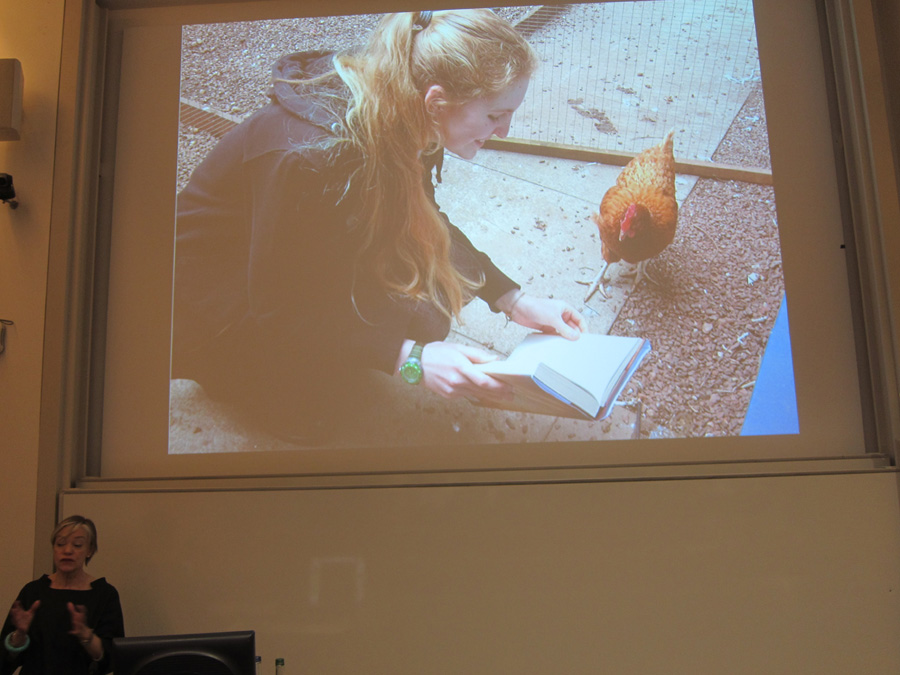
Williams used an anecdote situated in an Edinburgh highschool library that incorporates a courtyard with chickens (pictured above) which hosted the launch of a campaign to save school libraries and librarians. One member of parliament who attended said "his eyes had been opened" in terms of what information literacy and librarians can do. This highlights how people can be unaware of the impact of what we are doing, but may respond very positively and actively once they do.
A second example was a research study on energy innovation in meat and dairy industries. Part of the model they developed included whether the companies had data, or information, or knowledge about what was going on in the company so they could MAKE informed decisions about energy decisions. For example, one company did not even know what they spent on energy, another did not know what all the bits of kits were that consuming energy. So information was vital to getting to grips with the business problem.
From these various concerns, the i3 conference itself emerged (Williams showed a picture from the first conference, which I was at, only rather younger and slimmer at that point) to encourage research conversations between different related fields and encourage impact and interaction.
This moved her on to "Are our own i3 information conversations changing the world?". Williams had analysed past conference contributions in terms of whether they dealt with: information behaviour; information literacy; impact; or agent of change (this last one was just flagged up recently). This was going by how authors self-identified their papers, and with impact the association was sometimes rather loose, rather than central. Thus it was less prominent than Information Behaviour or IL. About half the papers focused on one theme.
In terms of contexts for research described in the papers at i3: education was by far the most frequent (although the number of papers on this had gone down over the years), followed by the online environment, and then health, workplace, demographics (i.e. focus on a specific age group ort sector), community and social media (with a variety of others covered less often e.g. cultures, government, business, knowledge management). Williams picked out an underlying theme of looking at how we can give more equal or better access to information.
Williams then stepped back to what the world has been talking about e.g. austerity, energy and climate change, poverty, privacy and security. She queried how we connected with those big issues, and whether we had a contribution that could demonstrate our value in meeting these big challenges.
Williams picked out themes she saw in the i3 conversations over the years since the first conference in 2007. Note that in every conference there have been sessions where questions and concerns were discussed explicitly. There were questions about the scope of the field (e.g. covering the affective domain better), what should be researched and how the fields were related. We have asked (in the conferences) whether we were too risk averse, and whether we needed to tackle more uncomfortable questions. Questions of "how well are we doing ourt research" also emerged from conferences e.g. were the range of methods too narrow, whether more clarity was needed. Then there was "Complexity" - whether we were reflecting the messiness and complexity of information and information problems. There was the difficulty of dealing with complex systems - and also understanding where does the complexity lie. An ongoing challenge was in dealing with this complexity when talking to communities outside the information field.
Finally a theme emerged about impact, how to demonstrate the impact of information, to identify the role of information (support or change agent), and the need for more evidence of impact (e.g. in the workplace). Williams noted here that good case studies help demonstrate impact. This was related to "getting the message across", another recurrent challenge discussed at i3 conferences. Questions included the role of jargon and identifying our distinctive perspective.
Williams finished by identifying that the clarity of the message needed to be improved: stating more clearly and boldly what the contribution of our research is. She felt despite these reservations we are addressing a wider range of problems and more evidence about impact and value ould help us get our message across. Williams returned to Floridi and suggested that our role in the information revolution could be "to help the world understand itself": to help people understand themselves better, because information is so much part of ourselves and our lives.

Monday, March 09, 2015

Latest articles: Library and Information Research

The latest issue of open-access journal Library and Information Research (vol 38, no 119, 2014), includes:
Assessing varied instructional approaches in the instruction of online graduate students by Mary Francis
Assessing the impact of evidence summaries in library and information practice by Lorie Andrea Kloda, Denise Koufogiannakis, Alison Brettle
Demonstrating impact: a possible approach for the LIS researcher by Andrew Kenneth Shenton
Go to http://www.lirgjournal.org.uk/lir/ojs/index.php/lir/issue/view/70
Photo by Sheila Webber, March 2015, taken in the virtual world, Second Life

Thursday, November 27, 2014

Library and Information Research : new articles

The latest issue of open access journal Library and Information Research (Vol 38, No 118, 2014) includes:

Reading lists – time for a reality check? An investigation into the use of reading lists as a pedagogical tool to support the development of information skills amongst Foundation Degree students by Gillian Siddall, Hannah Rose. "This article presents the results of an action research project exploring the use and value of reading lists for Foundation Degree students. ... It was found that reading lists were being used by students to identify and find resources for their academic studies. Qualitative data from students and staff illustrate how reading lists are being used and the gaps between student and staff expectations of them. The article provides recommendations on how reading lists can be utilised to help students to develop their information skills."

The Researcher Librarian Partnership: building a culture of research by Helen Partridge, Insa Haidn, Terry Weech, Lynn Silipigni Connaway, Michael Seadle. "This paper reports on the Researcher-Librarian Partnership, a research-mentoring programme that was initiated by the International Federation of Library Associations and Institutions. Six new LIS practitioners within their first seven years of professional practice took part in the programme. Each was partnered with an experienced LIS researcher who provided mentoring and support."
http://www.lirgjournal.org.uk/lir/ojs/index.php/lir/issue/view/69
Photo by Sheila Webber: Masaryk University, Brno, Library Faculty of Arts, November 2014

Sunday, November 09, 2014

New articles: Researchers, Assessment; LibGuides; Copyright

The latest issue of the The Journal of Academic Librarianship (priced publication) includes the following:

- Exner, N. (2014). Research Information Literacy: Addressing Original Researchers' Needs. The Journal of Academic Librarianship, 40 (5), 460-466.

- Turcios, M. et al (2014). How Much of Library and Information Science Literature Qualifies as Research? The Journal of Academic Librarianship, 40 (5), 473-479.

- Drabinski, E. (2014). Toward a Kairos of Library Instruction. The Journal of Academic Librarianship, 40 (5), 480-485.

- Rodriguez, J. et al (2014). Copyright and You: Copyright Instruction for College Students in the Digital Age. The Journal of Academic Librarianship, 40 (5), 486-491.

- Al-Shboul, M. and Abrizah, A. (2014). Information Needs: Developing Personas of Humanities Scholars. The Journal of Academic Librarianship, 40 (5), 500-509.

- Oakleaf, M. (2014) A Roadmap for Assessing Student Learning Using the New Framework for Information Literacy for Higher Education. The Journal of Academic Librarianship, 40 (5), 510-514.

- Dalton, M. and Pan, R. (2014). Snakes or Ladders? Evaluating a LibGuides Pilot at UCD Library. The Journal of Academic Librarianship, 40 (5), 515-520.

- Brown, R. (2014). A Literature Review of How Videogames Are Assessed in Library and Information Science and Beyond. The Journal of Academic Librarianship, 40 (5), 447-451.
The journal home page is here: http://www.sciencedirect.com/science/journal/00991333
Photo by Sheila Webber: beech leaves, November 2014

Thursday, August 14, 2014

Studying students to advance information literacy #IFLALimerick

I'm blogging from the IFLA Information Literacy Satellite conference held in Limerick, Ireland 14-15 August 2014. It is hosted by Limerick Institute of Technology but takes place at the Absolute Hotel.
The first keynote speaker was Nancy Fried Foster (Senior Anthropologist at Ithaka S+R: the latter is "a research and consulting service that helps academic, cultural, and publishing communities in making the transition to the digital environment.") Her talk was Studying students to advance information literacy.
She started by mentioning the ACRL standards (the existing ones, not the proposed revision). She idetified that it was straightforward and understandable, but very oriented to behaviours. She identified that there was growing feeling that such a framework should take account of attitudes, students as creator etc. and she mentioned the proposed revised version (since I've blogged about these numerous times I won't say any more about them). Dr Foster said she thought that this document definitely represented progress and felt that it assumed more of an understanding of research. Whereas the standards seemed to represent a "student who does well", whereas the the revised version seems more to match with a real, good researcher.
She argued that if someone is doing good scholarship or research, then de facto they are information literate, and then gave some examples of her research.
The first example was research into how people were using Extensible Catalog, with the research undertaken across four US universities. Dr Foster and her colleagues aimed to get insights into people's research processes through observation, interviews and so forth. They discovered that people's most useful information leads were discovered through personal networks and, for example, their own readings and collections. The participants' offices were often "messy" but things only had to be findable by the person, so the messiness was working for them (I'm reminded of a Sheffield iSchool PhD for which I was recently internal examiner for (the viva of now-Dr Mashael Al-Omar), which looked at how researchers organised their research material - "files and piles" featured strongly!). Dr Foster said that the researchers also mentioned the value of serendipity, and she quoted an undergraduate who talked about the need for him/her to get plugged into conversations which would help his/her research (e.g. conferences, meetings).
Dr Foster highlighted that this behaviour (by people who had demonstrably do good research) did not particularly fit with the old ACRL standards (e.g. they might not be using information "efficiently"). "So if THEY are not up to standard, then the standard has to change". She felt that their behaviour did match better with the proposed new ACRL standards.

Dr Foster then talked about a study of study of faculty members and use of institutional repositories. The article about this is here http://www.dlib.org/dlib/january05/foster/01foster.html.
After this the speaker showed this Google map of libraries doing ethnographic research and she then talks about a few specific research tequniques
- The first was using map diaries, so participants put where they went e.g. on a campus map.
- The second was using photo elicitation interviews, where you get participants to take photos relating to whatever you are interested in, and then the photos form the focus of interviews
- The third was retrospective interviews, which are a bit like critical incident, but using a comic strip as a focus for unfolding the story
- The fourth was running a design workshop

After this, the speaker moved on to talk about a project based at the University of Chicago, studying 3rd year medical students at 6 medical schools in the USA. They got the students to log/diary their day, noting whenever they had a need for information. This is an ongoing study, so there are just emerging results. Because their days are so packed they make a lot of quick decisions about the cost (time)/benefit of using different sources of information: they are strategic and practical. Again Dr Foster felt that this behaviour fitted more comfortably with the revision to ACRL rather than the old standards.

The final example was "Ripped from the headlines". She referenced a Buzzfeed story (about George Bush socks) that got copied, and the plagiarised reporter then filed an article complaining about the plagiarism. However, the Buzzfeed reporter himself was then taken to task for plagiarising material. Dr Foster asked one of the people about how he/she had managed to investigate this. This had been done by searching for phrases, including in earlier versions of wikipedia. The dialogue about this took place via channels such as Twitter (as it was seen as the best way of getting to many people, particularly media people, all at once), but also got news coverage. Foster asked why the (anonymous) commentators why they did this, and it was because they cared what went on in the world, hold conversations about important things and wanted to encourage good journalism. Foster identified this as example of information literacy. She finished by repeating her message of researching people to discover about their information literacy and what it meant in their context.
Photo by me, taken in the Butlers Chocolate Cafe in Galway, Ireland; a Butlers hot chocolate is chocolate nirvanah.

Tuesday, July 22, 2014

Disseminating your Research to Maximise Impact #ifutures

Today is the iFutures conference, organised by and for doctoral students. It is the annual doctoral conference in my department, the Information School at Sheffield University, and I am doing a workshop for it this afternoon. This is my powerpoint!