Showing posts with label Information Literacy - policy. Show all posts

Monday, February 03, 2025

Media Literacy research and policy reports commissioned by Google

photo of  snow on leaves of a shrub with big sparkling snow crystals

Via EDMO Ireland (a hub of the European Digital Media Observatory (EDMO), links to reports which Google commissioned from Ecorys (a Dutch research consultancy) and which were published September-November 2024
- Research report 1: Putting media literacy on the map – a snapshot of policies and practices in Europe (it looks at 8 European countries, and highlights media literacy, or media and information literacy, initiatives - specifically information literacy is not a focus): https://www.ecorys.com/app/uploads/2019/02/Ecorys-ML-policy-study-report-1.pdf
- Research report 2: Google’s media literacy initiatives and partnerships in Europe – a learning review (this includes research summaries and recommendations - the focus is on the Prebunking; Be Internet Awesome; and Super Serachers projects): https://www.ecorys.com/app/uploads/2019/02/Ecorys-ML-policy-study-report-2.pdf
- Plus a summary aimed at young people: https://www.ecorys.com/app/uploads/2019/02/Media-literacy-study-CYP-summary.pdf 

A set of policy briefs (about 10 pages each) on priority media literacy topics, produced by ECORYS with the LSE:
- Policy brief #1: Generative AI and Media Literacy Education: https://www.ecorys.com/app/uploads/2019/02/Policy-brief-1-Generative-AI-and-Media-Literacy-Education-1.pdf
- Policy brief #2: Enabling civil society to combat disinformation https://www.ecorys.com/app/uploads/2019/02/Policy-brief-2-Enabling-civil-society-to-combat-disinformation-1.pdf
Policy brief #3: Engaging and meeting the needs of underserved populations: https://www.ecorys.com/app/uploads/2019/02/Policy-brief-3-Engaging-and-meeting-the-needs-of-underserved-populations-1.pdf

I tracked down the home page for the reports at https://www.ecorys.com/case-studies/medialiteracyeducation/.
Photo by Sheila Webber: snow crystals, January 2025

Monday, November 04, 2024

Amman declaration on strengthening media and information literacy #GlobalMILweek

cover of the declaration

The Global Media and Information Literacy week feature conference, which took place in Jordam 30-31 October 2024, produced the Amman declaration on strengthening media and information literacy to advance public-interest information in the digital age which claims to be currently available in Arabic and English, but at the moment both links lead to the English version. The English version is here. The page with the links is here, and hopefully the faulty Arabic link will be corrected shortly.
After a 2 page preamble there are commitments and recommendations for governments, for UNESCO and other intergovernmental organizations, for Digital platforms and technology companies, and for Civil society, media, youth, academic institutions and researchers.
The recommendations for governments include "ENACT robust national and regional media and information literacy policies and strategies to sustain media and information literacy for all; allocate resources to advance implementation, ensuring inclusive and multistakeholder engagement; and integrate media and information literacy in upskilling programmes, national development priorities, governance processes;" "SUPPORT the integration of media and information literacy into formal and non-formal education systems and life-long learning, empowering learners and educators to critically assess digital content;"
The recommendations for UNESCO etc. include "PROMOTE cooperation on media and information literacy among United Nations Agencies/Funds/Programmes and regional and international intergovernmental bodies in line with Para 35 of the Global Digital Compact of the Pact for the Future;"
The recommendations for digital platforms include: "PROVIDE users and content creators with tools and resources, developed in partnership with multistakeholder groups and based on established standards, to enhance media and information literacy as critical thinking skills, including flagging AIgenerated content, and implementing content moderation systems that are inclusive and free from bias;"
The recommendations for Civil Society organisations include "LAUNCH initiatives that promote media and information literacy beyond formal education systems, and specifically among youth, marginalized communities and elderly persons, empowering them with the skills to be informed creators and discerning consumers of digital content"
There are also recommendations specifically to do with MIL in crisis situations, as well as ones to do with MIL cities.

Tuesday, June 18, 2024

Mapping of media and information literacy initiatives in Ibero-America - 2023

Front cover of the book showing hands and phones

Available in Spanish and English, Mapping of media and information literacy initiatives in Ibero-America - 2023 (by the Plataforma de Reguladores del Sector Audiovisual de Iberoamérica and published by UNESCO) is just published. It includes Mapping of MIL initiatives in Ibero-Americ; Perspectives on the adaptability of MIL promotion and dissemination practices in Ibero-America; and Recommendations for the Promotion and Dissemination of MIL in Ibero-America
Espanol: https://unesdoc.unesco.org/ark:/48223/pf0000390030
English: https://unesdoc.unesco.org/ark:/48223/pf0000390030_eng

Tuesday, May 21, 2024

Defending democracy

AI generated sketch of a very formal and ornate committee room
With a general election approaching in the UK, the UK's Joint Committee on the National Security Strategy (JCNSS) opened an inquiry into Defending Democracy "to better understand how threats to the UK’s democracy may evolve and be addressed."
Today the JCNSS published a statement relating to the written evidence provided by TikTok, Google/Youtube and Snap Inc (find downloads on this page) in which they outline what they are doing to combat misinformation and disinformation. The Chair of the JCNSS, Margaret Beckett makes a statement which includes the rather damning
".. I am concerned to see the huge disparity in approaches and attitudes to managing harmful digital content in the written evidence submissions we have received across companies from X, TikTok, Snap and Meta to Microsoft and Google. ... For a start, we expected social media and tech companies to proactively engage with our Parliamentary inquiry, especially one so directly related to their work at such a critical moment in our global history. And if we must pursue a company operating and profiting in the UK to engage with a Parliamentary inquiry, we expect much more than a regurgitation of some of its publicly available content which does not specifically address our inquiry. Much of the written evidence that was submitted shows - with few and notable exceptions - an uncoordinated, silo-ed approach to the many potential threats and harms facing UK and global democracy. The cover of free speech does not cover untruthful or harmful speech, and it does not give tech media companies a get-out-free card for accountability for information propagated on their platforms."
You can also read transcripts of evidence given orally to the committee by representatives of Meta, Ofcom etc.
Image created by Sheila Webber on Midjourney AI using the prompt: Joint Committee on the National Security Strategy, Defending democracy, disinformation, monotone sketch, United Kingdom --v 6.0 --ar 16:9

Wednesday, May 08, 2024

Facts not Fakes: Tackling Disinformation, Strengthening Information Integrity

An OECD publication published in March 2024 is:
OECD. (2024). Facts not Fakes: Tackling Disinformation, Strengthening Information Integrity. OECD. https://doi.org/10.1787/d909ff7a-en It is also available in French and Spanish.
"This report presents an analytical framework to guide countries in the design of policies, looking at three complementary dimensions" which are Implementing policies to enhance the transparency, accountability, and plurality of information sources and Fostering societal resilience to disinformation "This involves empowering individuals to develop critical thinking skills, recognise and combat disinformation, as well as mobilising all sectors of society to develop comprehensive and evidence-based policies in support of information integrity." and Upgrading governance measures and public institutions to uphold the integrity of the information space.
There is a substantial chapter relating to Fostering societal resilience to disinformation which rather frustratingly refers to media literacy and media and information literacy most often.
Photo by Sheila Webber: blossom on the grass, April 2024

Wednesday, August 09, 2023

Information Literacy in Malaysia, China, USA

Image of trees and flowers AI-generated

The IFLA Information Literacy Section newsletter, Summer 2023, is published. It contains four articles:
- The Action Plan on Improving Digital Literacy and Skills of the Whole People in China: To Build a Digital Inclusion Society by Qiong Tang and Yufan Wu
- NILA: Malaysia’s National Information Literacy Agenda by Nor Edzan Che Nasir
- Information Literacy at an Independent High School by Sarah Hernandez (USA)
- A Visual Arts Competition to Celebrate and Share Undergraduate Research by Merinda Kaye Hensley (USA)
Go to https://repository.ifla.org/handle/123456789/2662

Nasir provides the definitions agreed for Information Literacy and an information literate individual in Malaysia
"Information literacy is the ability that empowers individuals to identify, evaluate, manage, create and disseminate the needed information in various mediums and formats ethically to support lifelong learning."
"An information literate individual has the ability to:
i. Identify information for current needs
ii. Build an effective and efficient information searching strategy
iii. Evaluate critically the information obtained in order to retrieve quality information
iv. Manage information in various mediums and formats systematically
v. Use information ethically by understanding the issues related to the use of the information
vi. Create new knowledge based on the information obtained to support lifelong learning
vii .Disseminate and share information responsibly with other individuals and the civil society through various mediums and formats
Image created by Sheila Webber with Midjourney AI, July 2023

Friday, October 28, 2022

Abuja Declaration on Financing Media and Information Literacy #GlobalMILWeek #MILclicks

Yesterday in the Global Media and Information Literacy (MIL) week feature conference they released the Abuja Declaration on Financing Media and Information Literacy. At the moment there seems to be just the draft available. This includes exhortations to governements to fund MIL education, especially for young people.
“We urge ... Governments around the world to articulate national media and information literacy policies that will serve as a comprehensive guide in articulating the implementation of media and information literacy initiatives across all levels of governance.”
“We further call upon governments from national to city level, as well as intergovernmental organizations to ... Allocate specific budgets to the developing of Media and Information Literacy programs, with respect to the educational laws or any other regulatory framework that guides the workings of its national/regional/local education systems...”
Find it at https://www.unesco.org/sites/default/files/medias/fichiers/2022/10/abuja_declaration_financing_mil_drafting_committee_21oct2022.pdf

Friday, May 07, 2021

Notes from: Media and Information Literacy for Government Officials and Policy-makers #MILCLICKS

I attended the WSIS forum webinar that I advertised earlier today, which had an impressive list of panellists (see my previous blog post). It started by publicising the MOOC (free online course) that is being developed by the United Nations University: Media, Information and Literacy (MIL) MOOC for Government Officials and Policy-makers (see https://egov.unu.edu/research/media-information-and-literacy-mil-mooc-for-government-officials-and-policy-makers.html#outline) which will launch in a few months. At the start of the webinar they outlined that there will be 4 modules in the course (An invitation to MIL; MIL policies and strategies; Mainstreaming MIL in general policy development; Practice & experience).
There was also broader discussion about related Media and Information Literacy issues. Points that were made included: that in some regions of the world governments would be unwilling to support MIL, because critical and independent thinking is thought of as disrespectful and not something to be developed; that involving citizens in developing MIL was essential (and not just involving media companies etc.) - the link to the SDG about "leaving noone behind" was mentioned; that fact-checking is not enough - for example, critical thinking is vital; the need for all stakeholders to collaborate to move forward, and for it to be transdisciplinary; the need for a multilevel approach (from local grassroots, through national, to international policy), all joined up.
There is a recording of the webinar on Facebook https://fb.watch/5kVUgVaLUr/ and this was the agenda and panel biographies https://www.itu.int/net4/wsis/forum/2021/Agenda/Session/399

Thursday, December 31, 2020

Seoul Declaration on Media and Information Literacy for Everyone and by Everyone: A Defence against Disinfodemics #MILCLICKS

My final post of 2020 looks to the future, in highlighting the Seoul Declaration on Media and Information Literacy for Everyone and by Everyone: A Defence against Disinfodemics which was an outcome of this year's Global Media and Information Literacy week. After the usual preambles, it states the following (below), and then lists actions: for government, for "civil society, media, youth, academic institutions and researchers", for the private sector "including Internet communications companies", and for UNESCO. There is much collaborative work laid out in these actions, which it would be good to address in a (post)pandemic 2021. 

"We understand that MIL on its own is not a cure for all problems, including the pandemic, but insist that MIL be further recognized and valued throughout educational, social and economic systems and that it be applied as part of a more proactive approach in order to build a sustainable and inclusive society; 

"We stress that enhancing media and information literacy for all, which addresses critical thinking, provides a sustainable approach to strengthen people’s critical thinking and their power of discernment about how they engage with information and communication technologies – especially in times of crisis.

 "We urge therefore that “Media and Information Literacy for Everyone and by Everyone” should be advanced in the age of digital connectivity. In this connection, we commit to: 

"1. Promoting MIL within wider efforts to tackle divides such as in access to information and quality education, which have been notably widened by the pandemic, to assure no one is left behind; 

"2. Attracting more participation in MIL and MIL policy from Internet communications companies, academia, NGOs, international and regional organizations, communications regulators, media, civil society, youth and communities; 

"3. Advocating for intensified MIL initiatives to tackle the disinfodemic, climate change, etc., while also urging respect for freedom of expression and access to information which are not only human rights but also part of the solution to disinformation; 

"4. Building MIL considerations into ethical frameworks within institutions and companies, so as to ensure transparent, inclusive and safe development of technologies such as AI; 

"5. Advocate for MIL initiatives to tackle technological determinism." 

Go to https://en.unesco.org/news/seoul-declaration-media-and-information-literacy-everyone-and-everyone-0

Photo by Sheila Webber: pink rose after rain, September 2020 

Friday, November 27, 2020

Survey: please complete and retweet TODAY! #MILCLICKS

Today (27th November) is the final day for the UNESCO Global Survey on Media and Information Literacy Developments. The more responses the better, so please take the time to fill this in and tell others! In particular it is important if you are connected to any kind of institution or association, and they need to collect information from as many countries as possible. Go to https://en.unesco.org/news/take-our-global-survey-media-and-information-literacy-developments (the link is halfway down the page)

Monday, June 08, 2020

Health literacy in practice in Ireland; health information behaviour and e-health services #AECIST20

Today was the first day of the online conference Information Science Trends: Health Information Behavior, organised by the European Chapter of ASIS&T (Association of Information Science & Technology). I will be liveblogging a few of the talks. Extended abstracts of many talks are here: https://zenodo.org/communities/information_science_trends/?page=1&size=20
The keynote Inez Bailey (CEO of the Irish National Adult Literacy Agency) talked about Health literacy in practice in Ireland. She started by explaining the remit of NALA, which includes health literacy, then she defined Health Literacy, situating literacy in social practice. Bailey identified that health literacy is required from the health agencies as well as from individual citizens. She also highlighted the importance of health numeracy as part of health literacy. Bailey presented statistics that showed higher-than-one-might-have-expected levels of poor literacy, numeracy and specifically health literacy. She showed how lower levels of health literacy correlated with behaviours (such as not attending health screening, taking the wrong doses of medicine) which lead to poorer health. NALA has an archive of research here https://www.nala.ie/research/ and aims to bring research evidence to bear in influencing policy.
NALA have developed the idea of being health literacy friendly (see slide, above), with recommendations to practitioners and policymakers of what this should involve, and has literacy-friendly quality standards, including the Crystal Clear quality mark (they found it was easier to get engagement with standrads from pharmacists than with GPs). Bailey went on to give examples of good practice and examples in using language and numbers, to make things easily understood. With food labelling, Bailey raised the issue that some food manufacturers might not want to be totally "plain" in their English if they were trying to make their food seem very healthy....
There were also a lot of interesting questions in discussion e.g. discussing why it is the 18-35 age group who are least likely to ask questions when they don't understand things, asking whether there is evidence that "plain English" writing works better (there is).

The second talk was from Heidi Enwald, Kristina Eriksson-Backa, Noora Hirvonen and Isto Huvila (presented by Enwald and Hirvonen) on Taking health information behaviour into account in user-centered design of e-health services - key findings from an ongoing research project. The extended abstract is here. They were presenting results from the Taking health information behaviour into account project. They are interested in how health information behaviour affects use of technologies associated with health services and information, with particular emphasis on older people.
They did systematic review which was recently published as Older adults’ views on eHealth services: a systematic review of scientific journal articles https://doi.org/10.1016/j.ijmedinf.2019.104031 Key findings were that "Common themes [in the literature] include eHealth service uses, enablers and barriers, and outcomes; eHealth service use can have positive outcomes but also negative consequences; Findings indicate a positivity bias particularly in quantitative studies." Enwald talked about some other findings which have been published: there is a list of publications here http://blogs2.abo.fi/hiba/publications/ In 2019 they did a questionnaire survey and focus groups with older finns, in particular asking about using electronic health records, but they are writing those up at the moment.

Thursday, July 04, 2019

Media and Information Literacy #cilipconf19

I'm at the CILIP 2019 conference in Manchester. The University of Sheffield Information School has an exhibition stand, and I spent most of today on that (together with six of our great students). However, I did go to the last session yesterday, on Media and Information Literacy.

Nicola Aitkin (Head of Counter Online Manipulation, Department for Digital, Culture, Media and Sport) talked about Improving audience resilience to disinformation through media and information literacy. She started by introducing the general background: for example why people are spreading disinformation, the online environment and the “audiences” (including vulnerable audiences). She identified media and information literacy as being vital. They wanted people to be confident and critical in the way they engaged with online information. Aitkin identified that a lot of existing resources are aimed at children, and the number of resources aimed at young people can be bewildering.
The government had committed to a media literacy strategy in the Online Harms white paper and have just finished the consultation process. Aitkin stressed that “the conversation hasn’t finished” and they were keen to reach out to people and organisations who, in particular, can help them engage with more difficult to reach populations. They have also had media literacy round tables.
They have a pilot advertising campaign currently running on Facebook and Twitter aimed at 18-35 year olds with the strapline “don’t feed the beast”. Aitkin said that week they published guidelines aimed at teachers (I haven't traced that yet).

The 2nd talk was from Dr Sangeet Bhullar (Director, WISE KIDS), who talked about promoting digital literacy and digital wellbeing for children and young people. She talked about the Internet as being like a city, and whereas a parent wouldn’t drop a child in a city, they may not prepare their children for the risks of the city of the Internet. The internet differed from a physical city in offering connection to more people, things and spaces. Bhullar felt it was too narrow to position it as a safety issue. It was important to know about the legislation that could be used in this context (which is not just legislation brought in to combat cyber bullying). To illustrate the current risks, Bhullar played a deepfake video which put words into Obama’s mouth.
She also mentioned some of her own research in this area: Rethinking responses to children and young people’s online lives at https://eprints.soton.ac.uk/273226 and the Wise kids generation 2000 research project
Bhullar felt that teachers are not spending enough time listening to young people talking about what they do and value online. It was important for people to recognise risk and not be afraid of the Internet, so they could take advantage of the internet’s benefits. She saw the three key things as being pillars of development: Digital literacy, digital citizenship, character and wellbeing.
She finished by outlining the he role of librarians.

The third presentation was from Philip Russell (Deputy Librarian, Technological University of Dublin) about the be media smart campaign, an initiative from Media Literacy Ireland, which is a collaboration of various organisations, including the Library Associationof Ireland. It was built on the idea – what if we could get people to care as much about where their information comes from, as they do where their food comes from. The TV ad reached half a million and radio ads 2 million people, and there were social media ads and news stories picking up on the campaign. About 30-40 libraries supported the campaign. The cross sectoral approach was important and libraries being involved was significant.

Friday, August 31, 2018

Build Skills, Fight Censorship: IFLA’s Response to Fake News #WLIC2018

Build Skills, Fight Censorship: IFLA’s Response to Fake News was a statement published earlier this week, at the World Library and Information Congress in Kuala Lumpur, by the International Federation of Library Associations and Institutions (IFLA). This statement "reiterates the vital role libraries have in combating misinformation by providing the tools and skills to detect and recognize it. The expertise of librarians makes our institutions unique in their ability to help citizens to evaluate critically the information they find online." "In parallel, libraries combat censorship by defending free speech and freedom of information as a fundamental human right. The Statement underlines this role, and calls on governments to resist the temptation to implement far-reaching ‘bans’ which harm intellectual freedom."
It is available in |English, German, French, Arabic, Russian, Chinese and Spanish at https://www.ifla.org/node/67008

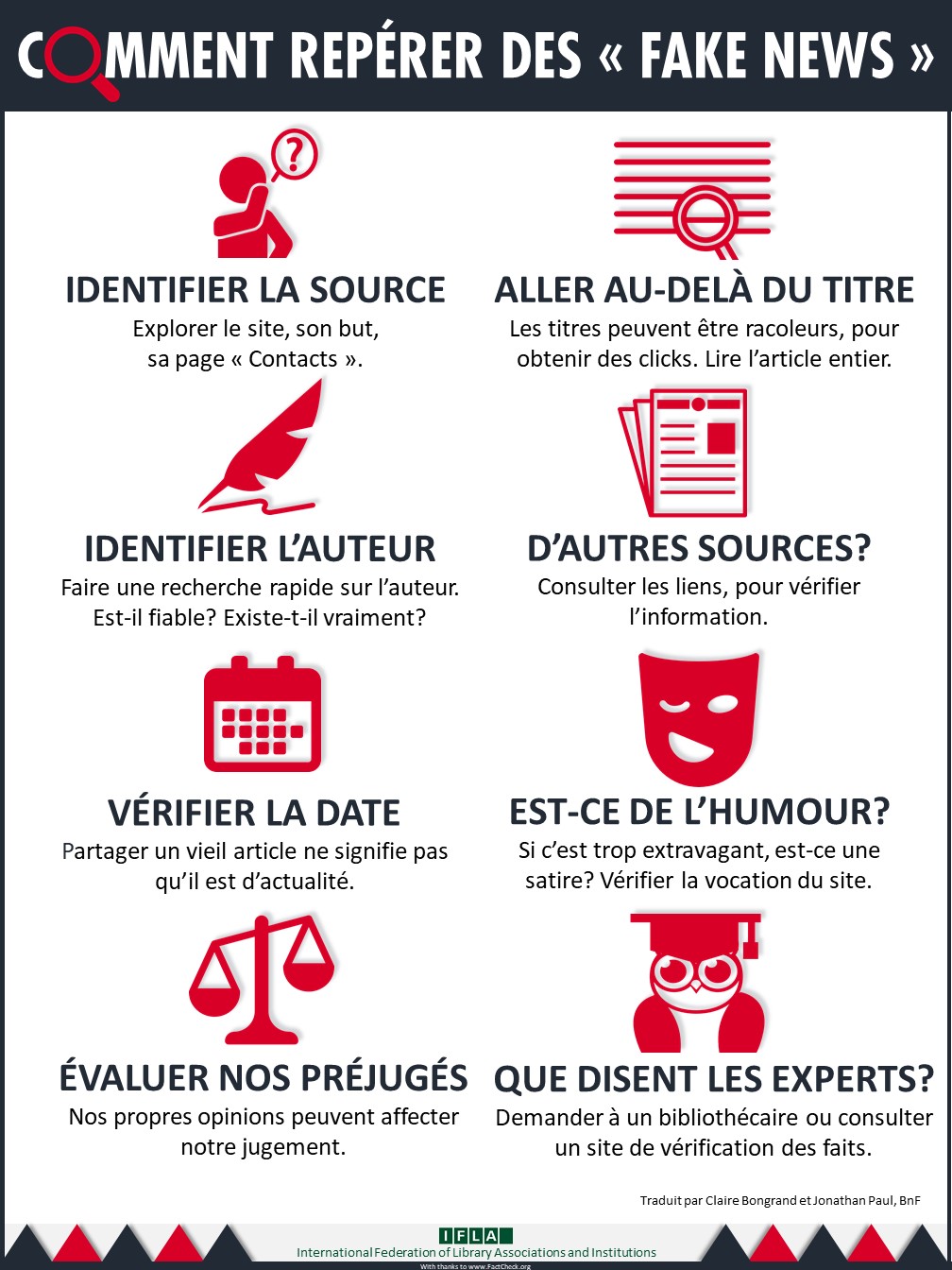
It also links to the popular existing IFLA infographic How to spot fake news, which is available for use freely, in many, many languages (see example here) at https://www.ifla.org/publications/node/11174

Wednesday, September 20, 2017

Evaluating Information Literacy Activity at a National Level: Sheila blogs from #ecil2017

John Crawford's talk on Evaluating Information Literacy Activity at a National Level: an Introductory Study is the next one I'll liveblog from the European Conference on Information Literacy in Saint-Malo. Crawford's context was Scotland. He started by drawing attention to initiatives in Scotland, such as the Scottish Information Literacy Community of Practice. The last slide shows some of the initiatives, and he namechecked the CILIP Information Literacy group as funding some small scale research projects.
He identified that literature which provides guidance on evaluating IL at a national level is sparse. Some points were drawn from the document that Lau and Catts drew up (see second slide), sponsored by UNESCO (http://www.unesco.org/new/en/communication-and-information/resources/publications-and-communication-materials/publications/full-list/towards-information-literacy-indicators/). He also drew some points from two papers in Library Trends, one by Woody Horton and one by Andrew Whitworth (see below). The first slide shows what the Community of Practice had done in line with Horton's "commandments". There has been mixed success e.g. they achieved a visit with a government minister, but the minister proved to be much more interested in digital literacy than information literacy (see first slide).

Horton, W. (2011) Information Literacy Advocacy—Woody's Ten Commandments. Library Trends, 60(2), 262-276. https://doi.org/10.1353/lib.2011.0044
Whitworth, A. (2011) Empowerment or Instrumental Progressivism?: Analyzing Information Literacy Policies. Library Trends, 60(2), 312-337. https://doi.org/10.1353/lib.2011.0039

Wednesday, June 07, 2017

New #openaccess articles:@JInfoLit anniversary issue: information literacy theory, discipline, learning and more!

The tenth anniversary of the open access journal Journal of Information Literacy has been celebrated with a bumper issue (volume 11 issue 1) of articles by information literacy experts from around the world.
The articles can all be accessed from the contents page at http://ojs.lboro.ac.uk/ojs/index.php/JIL/issue/view/185
They are:
- Information literacy: conceptions, context and the formation of a discipline by Sheila Webber, Bill Johnston (this is my blog so I'm highlighting the article by me ;-)
- Information literacy and informed learning: conceptual innovations for IL research and practice futures by Christine Susan Bruce, Andrew Demasson, Hilary Hughes, Mandy Lupton, Elham Sayyad Abdi, Clarence Maybee, Mary M Somerville, Anita Mirijamdotter
- Crossing the threshold: reflective practice in information literacy development by Sheila Corrall
- Lessons from Forty Years as a Literacy Educator: An Information Literacy Narrative by James Elmborg
- The Warp and Weft of Information Literacy: Changing Contexts, Enduring Challenges by Barbara Fister
- Posing the million dollar question: What happens after graduation? by Alison J. Head
- Information literacy and literacies of information: a mid-range theory and model by Annemaree Lloyd
- How can you tell if it’s working? Recent developments in impact evaluation and their implications for information literacy practice by Sharon Markless, David Streatfield
- Information Literacy: Agendas for a Sustainable Future by Ross J. Todd
- Information literacy is a subversive activity: developing a research-based theory of information discernment by Geoff Walton
Photo by Sheila Webber: rose "Sheila", June 2017

Tuesday, April 25, 2017

New German articles on information literacy

The latest issue of the German-language open-access journal o-bib (volume 4 number 1) features information literacy. Apart from the 2nd and 3rd last items (which are in English) the articles are all in German. Apologies for any mistakes in my translation of the German titles. I couldn't decide whether to use "delivery" or "facilitation" for "Vermittlung" and I've used the former, as I think which would be appropriate depends on the context and I'm afraid I haven't read all of these articles [yet]
- Die Förderung von Informationskompetenz ist Kernaufgabe von Bibliotheken – und nicht nur der Senf zur Bratwurst! by Fabian Franke [Development of information literacy is a core mission for the library, not just the mustard on the sausage (i.e. an accompanying garnish)]
- Information Literacy Threshold Concepts and the Association of College and Research Libraries' Framework for Information Literacy for Higher Education by Gayle Schaub, Hazel McClure
- Threshold-Konzepte, das ANCIL-Curriculum und die Metaliteracy – Überlegungen zu Konsequenzen für die Förderung von Informationskompetenz in deutschen Hochschulen by Wilfried Sühl-Strohmenger [Threshold concepts, the ANCIL curriculum and metaliteracy: reflections on the consequences of development of IL in German higher education institutions]
- Threshold Concepts in deutschen Bibliotheken - eine Utopie? by Carolin Ahnert [Threshold concepts in German libraries - a utopia?]
- Fit für die Vermittlung von Informationskompetenz? Anforderungen an die Qualifikation von Teaching Librarians in bibliothekarischen Studiengängen und Ausbildungseinrichtungen by Inka Tappenbeck, Anke Wittich, Maria Gäde [Fit to deliver IL? Requirements for German teaching librarians' qualifications]
- Lehre in Zeiten von Framework und Qualifikationsprofil vor dem Hintergrund der HRK-Empfehlung: Überlegungen zu einer möglichen Umsetzung des „shifts from teaching to learning“ im IK-Unterricht am Fachbereich Archiv- und Bibliothekswesen der Hochschule für den öffentlichen Dienst in Bayern by Naoka Werr [Teaching in the time of the Framework and qualifications profile against the background of the HRK recommendations: Reflections on a possible implementation of "shifts from teaching to learning" in IL teaching in the field of archive and library science at the Hochschule für den öffentlichen Dienst in Bavaria]
- Die Strategie der Kultusministerkonferenz „Bildung in der digitalen Welt“ und der „Referenzrahmen Informationskompetenz“ des Deutschen Bibliotheksverbandes by Andreas Klingenberg [The strategy of the ministerial conference "Education in a digital world" and the "guidelines on IL" from the German Library Association]
- Teaching Libraries zwischen Vermittlung fachwissenschaftlicher Informationskompetenz und der Unterstützung einer Propädeutik für die Digital Humanities by Marcus Schröter [Teaching libraries between delivering IL in the disciplines and the support of a induction for digital humanities]
- Information Literacy an der Pädagogischen Hochschule Thurgau – ein spannendes Experiment zwischen Bibliothek, MDZ und dem Fachbereich Wissenschaft und Forschung by Verena Maria Muheim [IL at the Pädagogischen Hochschule Thurgau – an exciting experiment involving the library, MDZ [I think this means the Medien-und Didaktikzentrums' (MDZ) library] and scholarship and research]
- Kein Königsweg - die Vermittlung von Forschungsdatenkompetenz auf allen universitären Ebenen by Kerstin Helbig, Pamela Aust [No easy way - the delivery of research data literacy at all university levels]
- Quantitative information literacy: Designing an online course at the interface between information literacy and statistical literacy by Christina Kläre
- Die Generation Y – Ein Plädoyer für die Analyse einer „vernetzten Generation“ zur Weiterentwicklung der Bibliotheksdidaktik by Kim Farah Giuliani [Generation Y: a plea for analysis of a "networked generation" for further development of library pedagogy]
- Kooperative Informationskompetenzvermittlung im Fach Architektur: Lehrveranstaltungsreflexion eines Blended-Learning-Workshops mithilfe der Theorie des constructive alignments by Simone Kibler [Cooperative delivery of IL in the discipline of architecture: reflection on learning design of a blended learning workshop, using constructive alignment]
https://www.o-bib.de/issue/view/2017H1/showToc
Thanks to Thomas Hapke for tweeting this
Photo by Sheila Webber: St Georges , Sheffield University, April 2017

Wednesday, April 12, 2017

Information seeking behaviours of advisors to policy makers for homelessness in Ireland #lilac17

Another report from Pam McKinney at the LILAC conference: Pam writes
"The second session of the day featured a presentation by Caitriona Honohan on The information seeking behaviours of advisors to policy makers for homelessness in Ireland. There are increasing numbers of homeless people in Ireland who access emergency housing services. Caitriona was concerned with how research into homelessness reached policy-makers. She Interviewed 6 participants who were all advisors to policy makers from various organisations, e.g. civil servants, homeless charities and regional local government.
"The aim of the project was to understand how and where they searched for information and any barriers they faced. An instrumental case study methodology was adopted with purposive sampling. The interviews lasted around 30 minutes and were audio recorded. A grounded theory approach with a constant comparison was taken to the data analysis.
"The findings showed that personal contacts were key to the information seeking behaviours, but participants also used databases, websites of trusted organisations and libraries. Barriers included time constraints, and limited access to academic sources. The participants displayed "satisficing" behaviours due to time constraints.
"Participants suggested using big data analysis of homelessness data as has been done in other countries, and greater sharing of anonymised data between organisations (charities and government departments). More research would be welcomed on homelessness data and better communication between charities and accommodation providers. It was identified that a central information portal for all stakeholders, which included free access to academic information, would be the ideal solution. Informal personal contacts between homelessness service providers and academic researchers were very important, and the formalisation of these contacts would benefit services."
Photo by Pam McKinney: LILAC delegates enjoy the Swansea beach, April 2017

Friday, December 16, 2016

New articles: Ageing and information; political participation; dyslexia and IL; social equality

The new issue of open-access journal Library and Information Research (vol 40, No 123, 2016) focuses on Strategic and policy making issues in information literacy, with guest Editor John Crawford. The issue includes:
- Ageing and information: The Scottish older people’s movement by Bill Johnston
- Information literacy as a tool to support political participation by Lauren N Smith
- Does dyslexia present barriers to information literacy in an online environment? A pilot study by Lynne Cole, Andrew MacFarlane, George Buchanan
- Information literacy development in a small country: A practical proposition? by John Crawford
- Between digital inclusion and social equality: The role of public libraries in Newcastle upon Tyne by Maria Laura Ruiu, Massimo Ragnedda
- Information literacy and information seeking of public sector managers in the Welsh Government by Elizabeth Tait, Robert Edwards
The issue is at http://www.lirgjournal.org.uk/lir/ojs/index.php/lir/issue/view/74
Photo by Sheila Webber: Dusk, North Greenwich underground station, December 2016

Tuesday, October 11, 2016

The End of Information Literacy? #ecil2016

I am giving 2 presentations this morning, so I'm not doing much liveblogging! However here is a note of one of the talks just given at the European Conference on Information Literacy 2016, in Prague. Michaela Dombrovská talked about The End of Information Literacy? She presented the case of some different literacies (information, financial, general, media, digital) in the Czech Republic. The title arose from her wondering why initiatives to get information literacy adopted at a policy level seemed to get frozen and did not progress. She had been involved directly in developing statements and initiatives on information and financial literacy at a national level. The financial literacy initiatives had been more succesful than that on information literacy.
In all cases she observed the literacy went through 3 stages
- concept (expert's agreement). Information Literacy has not moved beyond this stage in the Czech Republic, for various reasons, including a financial scandal that arose, where information literacy was a badge that had been used (I think for misuse of funds)
- public awareness which turns the concept to a policy. For financial literacy, this more easily appeals to the public, they can see how it could help their everyday life. They way of making people realise the value of information literacy has not really been discovered yet.
- law (citizens' right and duty). People can not be obliged to do things unless it is enshrined in law and for example in the national curriculum.
The speaker also identified what helps:
- stable or increasing public interest
- existing EU or international policies
- overall coopertation among key players
She gave some examples in the Czech context e.g. National Strategy on Financial Literacy, Strategy on Digital Literacy 2015-2020.
In the case of IL: general interest is unlikely, key players do not cooperate and IL is not mentioned in laws. However, the speaker felt it was not a lost cause! For this to happen she felt that IL needed to be presented as a set of competencies, and that each competency appeared in some law or policy (rather than having to be in one policy).
The photo is unrelated to the talk - Italian ice cream at a local Czech cafe

Wednesday, January 27, 2016

Information Literacy Policies and Standards

The International Association of University Libraries (IATUL) Special Interest Group for Information Literacy has published a report on Information Literacy Policies and Standards at IATUL Member Libraries. "The report summarizes the results of a survey conducted between July 2013 and February 2014 to examine the national information literacy standards and frameworks in 13 countries and the institutional guidelines, frameworks, and policies of 100 academic libraries."
"National" here means that some national body (generally, a working party or association of librarians) has developed a model or framework of IL for that country. The main part of the 18 page publication consists of tables listing the countries and libraries, and giving details of any publications (with links: it says the data was revised in October 2015). The report is at https://mediatum.ub.tum.de/node?id=1286822 and the Special Interest Group website is here http://iatul.org/groups/informationliteracyspecialinterestgrouplinks.asp
Photo by Sheila Webber: butterfly in the Winter Gardens ... January 2016