Liveblogging from the 40th anniversary conference of the IFLA Section on Education and Training which is part of the WLIC (IFLA) 2014 in Lyon, France. I was too nervous to liveblog in the 2nd IGNITE session as I was speaking in it. I'll blog a little about it later.
The last keynote is from Lynn Silipigni Connaway, entitled Just when the caterpillar thought the world was over, it became a butterfly: developing educational programs for an emerging profession. She started by revolving around the tensions in library and information education - in particular the tension between research and practice. She pointed out that the criticism that LIS research is not of practical use to libraries has been around for a while.
In terms of education she felt that it wsn't the tools (including technology tools), but rather the values, ethics and fundamentals that educators should concentrate on teaching (the tools were no good without these). She mentioned things like organisation of information, understanding of theory, people skills and collaboration as being part of the fundamentals. Understanding and researching people's behaviour (including formal service evaluation and usability studies) was important. Working out how to build relationships was also vital: and in fact a focus on relationship building rather than service excellence (citing Brian Mathews). To do this, students also needed to develop their problem solving and decision making skills and master research methods.
Connaway saw great potential in data specialist or data librarian posts, but with emphasis on people skills, not just technical skills.
Connaway cited various studies or statements that showed that employers did not feel enough library graduates were prepared for the library workplace. At the end she felt that the person had a good approach when she said that a library qualification gave them an understanding of why librarians do what they do, based on a grounding in theory.
Connaway does interesting research at OCLC, which I've blogged about previously, but here's a random link to an article from last year:
Connaway, L.S. et al. (2013) "I always stick with the first thing that comes up on Google. . ." Where People Go for Information, What They Use, and Why. EDUCAUSE Review, December 6.
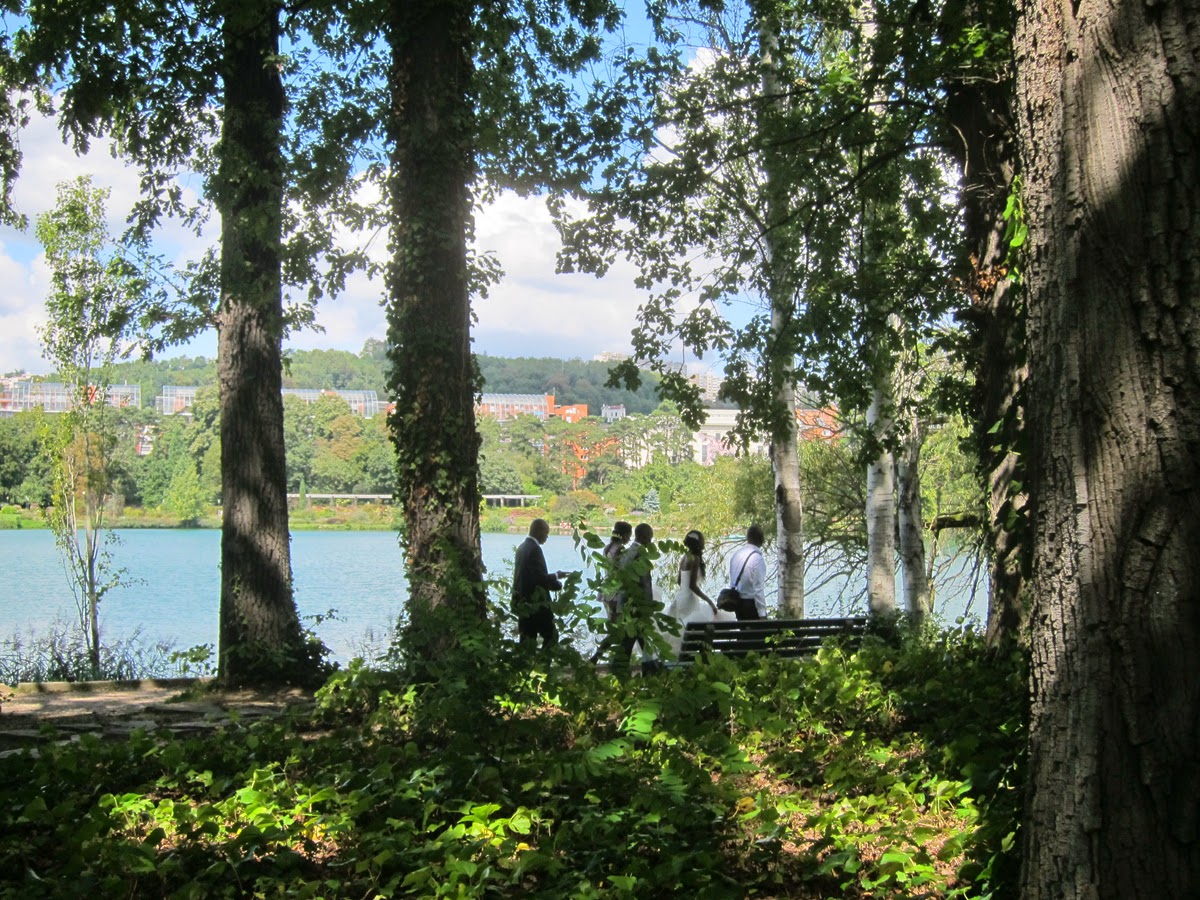
Photo by Sheila Webber: Spot the bridal party, Lyon August 2014
Curating information literacy stories from around the world since 2005 - - - Stories identified, chosen and written by humans!
Showing posts with label ifla_set40. Show all posts
Monday, August 18, 2014
IGNITE! group problem solving; international collaboration; social justice #wlic2014 #ifla_set40
I'm liveblogging from the 40th anniversary conference of the IFLA Section on Education and Training which is part of the WLIC (IFLA) 2014 in Lyon, France. The current session is an IGNITE session, in which people are allowed 5 minutes to present, using 20 slides (so rather like a Pecha Kucha, but even shorter) so it will be impossible to capture much about each. This will be an impressionistic blog post and I won't cover all of them.
- Terttu Kortelainen talked about getting groups to work on a research problem using brainstorming and also the group creating a story around the problem, to give the problem better context (e.g. so that later they can ask "would this kind of person have access to this"), and she also emphasised critical discussion within the group to generate criteria for evaluation and to evaluate what has been applied.
- Barbara Moran gave some tips for international exchanges and collaborations e.g. faculty or student exchanges, joint programmes etc. These included the importance of being selctive about picking partners; being clear and realistic about goals and that "nothing substitutes for personal contact".
- LaVerne Gray and Rashauna Brannon talked about The social justice imperative in library and information science education and research and the ongoing development of the ALISE/ALA Social Justice Collaboratorium (I'll add a link to further information if I find one).
Photo by Sheila Webber: lake in the park, Lyon, August 2014
- Terttu Kortelainen talked about getting groups to work on a research problem using brainstorming and also the group creating a story around the problem, to give the problem better context (e.g. so that later they can ask "would this kind of person have access to this"), and she also emphasised critical discussion within the group to generate criteria for evaluation and to evaluate what has been applied.
- Barbara Moran gave some tips for international exchanges and collaborations e.g. faculty or student exchanges, joint programmes etc. These included the importance of being selctive about picking partners; being clear and realistic about goals and that "nothing substitutes for personal contact".
- LaVerne Gray and Rashauna Brannon talked about The social justice imperative in library and information science education and research and the ongoing development of the ALISE/ALA Social Justice Collaboratorium (I'll add a link to further information if I find one).
Photo by Sheila Webber: lake in the park, Lyon, August 2014
Library and Information education - curriculum - values #wlic2014 #ifla_set40
As part of the World Library and Information Conference (IFLA) 2014 in Lyon, France I'm attending the 40th anniversary conference of the IFLA Section on Education and Training. Since this isn't focusing on Information Literacy I will just cover it briefly. It is a whole day conference and I am doing a very short presentation this afternoon.
The day started with a keynote from Dr Ismail Serageldin (Bibliotheca Alexandrina). He touched on some of the same points as his keynote in Singapore last year, for instance concerning the 7 Pillars of the Knowledge Revolution, but with exploration of the changes affecting librarians and the need to espouse and enact core values. To illustrate the latter point he gave examples of US librarians resisting giving up patron information, and citizens defending the Bibliotheca Alexandrina during the revolutions in Egypt.
This was followed by an international panel representing various associations (e.g. the iSchools consortium, the Council on Library and Information Science Education (CILISE). Panellists talked about challenges such as coping with changes in higher education (and these will vary country to country), achieving changes to the curriculum and simply keeping in touch with each other. It was evident, unsurprisingly, that while some issues were common across countries (e.g. a focus on technology), others were specific to particular countries or regions (e.g. in African context a need for more agreement on standards and competencies; in Japan the low or hidden status of librarianship in comparison with computer science).
Personally I am a bit concerned that with too much emphasis on technology (big data etc.) some of the core of information science, and the human/social perspective, may be lost sight of (so that it becomes difficult to distinguish it usefully from other technology-focused disciplines). However, perhaps it is easy to say this when I am in a comparatively technology-rich country. Some of the participants (for example Dick Kawooya and Filiberto Felipe Martinez Arellano) did talk about the issue of the nature of the core curriculum and the place of technology within it.
Paul Sturges (from the audience) also raised the issue of whether associations might becoming too controlling and stifle creativity. Responses from the panel indicated that some associations were not at the stage to be controlling, but in some cases there could be a need to have standradisation etc. in order to maintain an identity and professionalism.
Photo by Sheila Webber: lake in the park, Lyon, August 2014
The day started with a keynote from Dr Ismail Serageldin (Bibliotheca Alexandrina). He touched on some of the same points as his keynote in Singapore last year, for instance concerning the 7 Pillars of the Knowledge Revolution, but with exploration of the changes affecting librarians and the need to espouse and enact core values. To illustrate the latter point he gave examples of US librarians resisting giving up patron information, and citizens defending the Bibliotheca Alexandrina during the revolutions in Egypt.
This was followed by an international panel representing various associations (e.g. the iSchools consortium, the Council on Library and Information Science Education (CILISE). Panellists talked about challenges such as coping with changes in higher education (and these will vary country to country), achieving changes to the curriculum and simply keeping in touch with each other. It was evident, unsurprisingly, that while some issues were common across countries (e.g. a focus on technology), others were specific to particular countries or regions (e.g. in African context a need for more agreement on standards and competencies; in Japan the low or hidden status of librarianship in comparison with computer science).
Personally I am a bit concerned that with too much emphasis on technology (big data etc.) some of the core of information science, and the human/social perspective, may be lost sight of (so that it becomes difficult to distinguish it usefully from other technology-focused disciplines). However, perhaps it is easy to say this when I am in a comparatively technology-rich country. Some of the participants (for example Dick Kawooya and Filiberto Felipe Martinez Arellano) did talk about the issue of the nature of the core curriculum and the place of technology within it.
Paul Sturges (from the audience) also raised the issue of whether associations might becoming too controlling and stifle creativity. Responses from the panel indicated that some associations were not at the stage to be controlling, but in some cases there could be a need to have standradisation etc. in order to maintain an identity and professionalism.
Photo by Sheila Webber: lake in the park, Lyon, August 2014
Subscribe to:
Posts (Atom)


