Monday, July 31, 2006

Information Literacy meetings in Malaysia

I found out from an article in the Manila Times by Peachy Limpin that there had been an International Workshop on Information Literacy at Petaling Jaya, Malaysia in June 2006.
Limpin, P. (2006) "Terima kasih Malaysia." Manila bulletin online, 21 June. http://www.mb.com.ph/issues/
2006/06/21/TECH2006062167229.html

The UNESCO website section on Information Literacy, frustratingly, doesn't always give information about the events it organises.

I think this is different from the International Conference on Information Literacy held in Kuala Lumpur, Malaysia, also in June, which used to have a website (and evidently a lot of people went) but as far as I can see the website has disappeared except for in search engine caches....

Photo by Sheila Webber: Italian Gardens open air theatre (pale bit amongst the trees) in Eastbourne, Sussex, where I saw my friend Jenny playing Adriana in Comedy of Errors at the weekend.

Sunday, July 30, 2006

Supporting Undergraduate Research Experiences

The 6th Augustana workshop takes place at the University of Alberta in Canada on 16 November 2006. The topic is: Supporting Undergraduate Research Experiences and registration opens in August. The presenter is Elizabeth Dupuis, Head of Instructional Services, University of California, Berkeley. More info at:
http://www.augustana.ca/facilities/
library/infolit/workshop/info.html


Photo by Sheila Webber: Morning cloud, Port Julia, South Australia, June 2006.

Thursday, July 27, 2006

NordINFOLIT summer school

If you speak Swedish you will enjoy the material that is available from NordINFOLIT's summer school, which took place in Stockholm 26-30 June 2006. If you just understand the odd word here and there, like me, you will be tantilised as there were obviously some engaging presentations e.g. on using students to teach students, on evidence-based librarianship, on new ways at looking at IL, on th elibrary as a creative place... The link is from http://www.sub.su.se/subskurser/visakurs.aspx?kid=364 and you click on Program kompletterat med material which includes links to pdfs of powerpoints.
Photo by Sheila Webber: Chair in Finlandhuset, Stockholm, April 2006.

Wednesday, July 26, 2006

Notes from WILU

I've noticed that there are some notes from sessions at the 2006 Canadian information literacy conference, WILU, that was held in May at http://blog.uwinnipeg.ca/
ilig/archives/2006/05/

Scroll to the bottom entry first and then work upwards.
You can also find a number of the powerpoints and handouts from the conference on the conference website at: http://library.acadiau.ca/wilu/programme/, well worth a look.

Photo by Sheila Webber: White abutilons, Roma Street Parkland, Brisbane.

Blogging & mobile reports

Thanks to Vivienne Bernath, who alerted me to this newly published report from the USA:
Lenhart, A. and Fox, S. (2006) Bloggers: A portrait of the internet's new storytellers. Pew Internet Life Project. http://www.pewinternet.org/PPF/r/
186/report_display.asp

"A national phone survey of bloggers finds that most are focused on describing their personal experiences to a relatively small audience of readers and that only a small proportion focus their coverage on politics, media, government, or technology." The survey looks at motivations, how much time people spend blogging etc.

A survey of UK bloggers was published on the next day: I was alerted through an article in the free Metro newspaper which I encountered on my way to work:
Davern, F. (2006) "Every Joe blogs is revealing all online." Metro, 20 July, 3. The article is online , but with a different title, namely"Join the Joe blogs revolution" (demonstrating that the sub-editors rate fitting the headline into the available space above bibliographic consistency). It was produced for MSN Spaces and therefore the sample was more restricted (to MSN users, I think). Also, the two surveys show that your results depend on your questions, as the two lists of "what you do with your blog" are different, with the MSN one more focused to social/emotional activities (blogging to inform others doesn't even feature as a possible option - nearest is blogging a hobby).
MSN Spaces (2006) Blogging Britain: inside the UK's blogging phenomenon. MSN Spaces.
http://www.telegraph.co.uk/news/
graphics/2006/07/21/blogging.pdf
(the most I could find on the MSN/Microsoft website was a press release).

Another interesting report is Mobile Life Report 2006 at http://www.mobilelife2006.co.uk/ which was sponsored by Carphone warehouse and conducted by a team based at the London School of Economics. The survey of 16.5K people was conducted online. It includes some discussion of the results and a marketing classification of mobile phone users (I appear to be a Smart Connected - photo shows me being smart and connected in the British Library when I was down for the SCONUL meeting earlier in the month) .

Monday, July 24, 2006

First years and Information Literacy

Another belated report from the ANZIIL conference in Brisbane's South Bank Institute a couple of weeks ago! (photos show bougainvillea creeping on an arbour on the South Bank). Glynis Shields, from the National Library of New Zealand, presented results from a survey investigating the Information Literacy first year students at Otago Polytechnic. School teachers and lecturers were asked about their expectations of students in the areas of identifying key terms and concepts for an assignment; Searching for information; Selecting & evaluating information ; acknowledging sources; presenting and communicating information. 150 students were asked about what they thought their skill levels were, and also took a multiple choice test based again on the Quebec survey (Ref 1).

Basically, in all categories students were far more confident about their abilities than was justified by the results of the test. For example, for selecting/evaluating the confidence level was 81.5%, whilst the competence level was 33.6%. To give a broad impression of the other results, the expectations of lecturers and of teachers in thebe next-to-last year of school were a lot nearer the competence level, but the final-year school teachers were more optimistic about pupils’ skills, though not as optimistic as the students themselves. As an example, in the Evaluating/selecting category, the figures were 40.7% (Year 12 teachers), 62.6% (Year 13 teachers), 41.5% (lecturers).

Like the colleagues from Monash University who used the Quebec questions, the point was not that this was a perfect way of diagnosing information literacy levels, since again the limitations of such a multiple choice format were acknowledged. However, it was being very useful as a way of highlighting the problem both with schools and with higher education. Already it seems it had had an impact at meetings of school principals, and the work was being disseminated carefully through publication and talks to educators and managers (i.e. not just to librarians!)

The most depressing note emerged from a question that had been asked of teachers and academics about who should provide support in the IL areas mentioned above. Librarians rated very low - the highest score was for 36.6% of lecturers thinking that librarians could support students in developing skills for searching (only 8.7% of teachers saw a role for librarians here). The lowest score of all was in terms of defining the topic, identifying keywords etc - no lecturers thought librarians had a role and only 1% of teachers. Glynis said that these statistics were also causing a reaction e.g. amongst school principals, who could see that the librarians were being undervalued.

Ref 1. Mittermeyer, D. and Quirion, D. (2003) Information literacy: study of incoming first year undergraduates in Quebec. http://crepuq.qc.ca/documents/bibl/formation/studies_Ang.pdf

Saturday, July 22, 2006

Library blogs (again)

I mentioned the week before last that two Australian librarians are doing a survey of Australian library blogs and wikis. I notice that there is a posting on Amanda Etches Johnson's blog about "The state of the library blogosphere 2006" comparing the no. of libraries that have blogs 2005 & 2006 (as listed in her library blog wiki). The posting is at http://www.blogwithoutalibrary.net/?p=211 Amanda is based in Canada, I met her at the WILU conference last year., where I took this picture of East White Pine leaves.

Friday, July 21, 2006

IL and an enviable example

On the train to the SCONUL meeting on Tuesday I finally got a chance to write up a couple of the sessions from the ANZIIL conference held at teh Southbank Institute Brisbane (photo shows mosaic floor at Southbank). First of all, one about school libraries, but one with interesting lessons outside of school (so to speak). Helen Reynolds gave a very interesting description of what she has achieved as Senior Librarian at the Southport School, a boys school in Queensland. She freely admitted that she had a “generous budget” which many would envy, and she has staff who cover some of the more traditional aspects of school librarianship. All the same it’s good to see what can be done in a school where there has been a real drive for information literacy.
She uses the Information Literacy Planning Overview developed by two Queensland teachers and now sold via the Curriculum Corporation, Queensland, as mentioned in an earlier post. It is based round the Six Steps of the Information Process: Define; Locate; Select; Organise; Present; Assess. There is a good deal of supporting material (e.g. worksheets to use with students) which she found very useful.

Helen is a teacher librarian and she works with teachers and classes. In response to a question after her talk she gave a nice example of how she would progress skills in “Defining” an information problem through three years. A key approach for this aspect is getting pupils to identify “focus questions” (the how/what/why etc. of the task or topic) and concept maps. At the first level, she would provide the focus questions as a starting point for the work. At the next level, she would facilitate a brainstorming session in which the pupils identify the focus questions. At the third level, she would tell pupils to identify focus questions and produce a concept map for themselves - but this is still something that could be done in class, as an explicit part of addressing the assignment or task.

Helen has worked assertively in her school, and she has influenced the curriculum to an extent that many academic librarians would envy: though still she felt that information literacy had permeated some subject more than others. She showed us the template for teachers who are writing assignment task sheets, which they have to use for assignments with younger pupils. “Proof of the research process” is one of the elements that students should be required to include with their assignments.

Helen described the variety of ways in which she makes sure that information literacy is on the agenda: posters in classrooms, IL worksheets easily accessible for staff to take in the staff room, a newsletter and website, getting hold of student teachers straight away, holding lunchtime sessions for older boys (“people learn better when they’re well fed”), doing evening classes in IL for parents so they can help their children. As Helen said “I market all the time.”
The theme of the ANZIIL symposium was “transitions”, and although Helen didn’t spend so much time on this aspect, what she had to say was still telling. She had praise for the University of Queensland’s Cyberschool initiative (where they negotiate access to academic databases for schools and have a schools portal). She encourages students to become familiar with the websites of the universities they are aiming to go to, so that the students are in familiar virtual territory when they arrive. She also has feedback that the good IL education that her school provides is appreciated by the universities and by the boys themselves, who feel they have a head start in tackling academic work.

The Southport School website is at http://tss.qld.au/library/library.asp also recommended http://www.edna.edu.au/ as having “fabulous websites for kids.”
Another of her references which I’ll pick out is:
Lonsdale, M. (2003) Impact of school libraries on student achievement: a review of the research. Canberra: ACER. http://www.asla.org.au/research/

Phil Bradley

Phil Bradley recently added a comment to one of my posts and that reminds me to remind people that he has a very useful website which focuses on web search and web tools at http://www.philb.com/ and a good blog on the same theme at http://philbradley.typepad.com/ He also has a regular Q&A column in Library and Information Update (partially online at http://www.cilip.org.uk/publications/updatemagazine)

Photo by Sheila Webber: Canopy of St Pancras station, London, which is still being remodelled, July 2006.

Thursday, July 20, 2006

Information Literacy Petition to Scottish Parliament

Christine Irving has given an update on this. "The public petitions committee met on the 31st May and agreed that given the number and quality of the responses they had received regarding the petition that they would seek our views as the petitioner. Responses received included the Scottish Executive, Learning and Teaching Scotland, the Scottish Qualifications Authority, Her Majesty's Inspectorate of Education, the Educational Institute of Scotland, Universities Scotland, the School Library Association in Scotland, and Unison school librarians in Scotland. We have until early September to comment on the responses so we will be reviewing the comments over the summer." You can get access to the responses via their website - makes an interesting read! http://www.learningservices.gcal.ac.uk/
ils/petition_further.html


Photo by Sheila Webber: Wooden artwork in the British Library piazza, July 2006.

RDN becomes Intute

Behold! - on 13th July an incomprehensible acronym morphed into an enigmatic word. The Resource Discovery Network (RDN) has become Intute , which is not in the Oxford English Dictionary, and is even a mystery to Google. According to the Intute website "Intute is a composite word - derived from 'Internet' and 'Tutorial' - and is intended to convey the experiences of guided learning and online resource discovery."

But enough of this pleasantry. Intute includes the useful subject portals developed over the years with JISC support, like SOSIG (social sciences information) and BIOME (biomedical and health), and the Virtual Training Suite which has lots of tutorials on internet searching for people in different subject areas. http://www.intute.ac.uk/

Photo by Sheila Webber: Great Keppel Island, June 2006.


Wednesday, July 19, 2006

IL at IFLA 2006

The World Library and Information Congress 72nd IFLA General Conference and Council will run from the 20-24 August 2006 in Seoul, South Korea.

Information literacy is highlighted in Division VIII with papers on the theme, "Information Literacy for the Knowledge Society".

"A great deal is written and said about the Knowledge Society, and about the need for effective information infrastructures (especially ICTs) to empower this Society. Underpinning these infrastructures, however, is the issue of literacy and, in particular, Information Literacy, and how these not only help to close the Digital Divide that hampers effective development of knowledge societies, but also how such literacies can contribute directly to a robust and forward-looking Knowledge Society. It is against this background that this Call for Papers is issued, the intention being to solicit contributions that seek to address aspects of Literacy, Information Literacy, the Digital Divide and the Knowledge Society."

For more information, visit the IFLA 2006 website.

Tuesday, July 18, 2006

Corporate blogging

Today I'm down in London (30 something degrees of heat - phew!) for a SCONUL Working Group on Information Literacy meeting. More of that anon - I'm just using a computer in the SCONUL office to post this blog entry that I prepared earlier. Came across this paper (n.b. not free) - it's not an indepth study, being based on observation of blogs on a sample of Fortune 500 companies, but it does propose a typology for corporate blogs (Bottom-up, and then variations on Top-down) and provide some examples.

Lee, S. and Hwang, T (2006) "Corporate blogging strategies of the Fortune 500 companies." Management Decision, 44 ( 3), 316 - 334.

It's helpful in thinking about why companies encourage blogging, and also therefore the extent to which the blogs are conveying a particular perspective on the company. In the respect, of course, it's like any type of company information produced by the company concerned: it can be very valuable in giving factual detail you wouldn't get elsewhere, and in giving an idea of the how the company wants to be perceived, but you need to keep a critical perspective...

Photo by Sheila Webber: Sydney from Watson's bay at dusk (or: Sydney, to look like Venice)

Monday, July 17, 2006

Squidoo-ed

I have succumbed to Squidoo, a free online service that enables you to create information pages on anything you like. I really just started it up as an experiment and don't intend to make a major effort, but if you want to see the page it's at http://www.squidoo.com/
information-literacy/


I think there may be other uses for Squidoo, e.g. I saw one page someone had created specially for a training session. You can create a set of links, create some short text, put in RSS feeds and various other things. Of course, being free, it is possible that one day it will all disappear without trace into the ether.... I haven't yet explored it enough to find out what other useful Squidoo pages there are. It seems to have some useful stuff about "Library 2.0" if you are interested in that sort of thing.

This is the photo I've used in Squidoo (I think with some vague "life is a bowl of cherries" idea). The bowl is Radford pottery and the cherries are from my tree this month.

Sunday, July 16, 2006

LOEX

The powerpoints (plus a few other handouts) from the LOEX (US information literacy) May 2006 conference are up at http://www.emich.edu/public/
loex/handouts/slides2006.html
for example Exploring the Librarian's Role in Promoting Academic Integrity on Campus and Using Scenarios to Teach Undergraduates About Copyright, Fair Use, & Plagiarism . Thanks to the "Information literacy land of confusion" for alerting me to this.

Photo by Sheila Webber: Shop called "Library" in Sydney, selling expensive clothes, so I didn't have the nerve to ask for one of their bags saying "Library" (displayed at the bottom of this picture).

Library Thing

Have just discovered Library Thing "an online service to help people catalog their books easily. You can access your catalog from anywhere—even on your mobile phone—. Because everyone catalogs together, LibraryThing also connects people with the same books, comes up with suggestions for what to read next, and so forth." You can catalogue 100 books for free, with instant sign-up. There is a crude search function of various catalogues, including Library of Congress, National Library of Scotland and Amazon. Only the title is displayed after search, which is irritating when you are trying to pick a specific edition. The display options of the bibliographic and other details are also limited to 7 elements. You can add tags and reviews. You can also see who else catalogued this book, and what other books are tagged like this one. It appears already to have a good number of users.

Am trying to think whether this can be tied to information literacy ..... in that it's social, and on the web, it could perhaps help people to understand how catalogues work, by creating their own. There is some clunkiness (e.g. the first set of tags on my trial book disappeared), admittedly the service is in beta.

Actually it's mostly the idea of non-librarians doing derived cataloguing (I even saw a reference to the MARC format somewhere on the site - though Library Thing wasn't created by a librarian) which I find a little mind-blowing. Although, from the "author cloud", where Pratchett, Tolkein, Rowling etc feature in very large letters, the users are probably not representative of the entire population (in fact I probably fit in pretty well to this nerd/ bookish/ librarian profile). Website is at http://www.librarything.com/

Phot by Sheila Webber: Shark egg case, shore, Port Julia, South Australia June 2006.

Friday, July 14, 2006

I am a podcast

Podcasts of some talks from the Recognising the need conference are online, including my talk on Working towards the information literate university (coauthored with Bill Johnston). Apart from thinking "I say "um" too much!!" (shouldn't have pointed that out should I?) and that I can't bear listening to recordings of myself talking for any extended period of time, this seems pretty cool. At least I get a laugh (intentional) within the first 2 minutes . If you want to follow it with the slides, the slides are here: http://dis.shef.ac.uk/
sheila/staff-webber.pdf
The photograph on the right is of Kyoto Railway station, taken by me in July 2005. I used this photo on one of the slides, and refer to it in the talk. The web page for the Podcasts is at http://www.staffs.ac.uk/infolitconf/ and you can find podcasts from me, Susie Andretta, Mark Hepworth and Peter Godwin, plus all the powerpoints.

Thursday, July 13, 2006

IL event on 19 July

There is an Information Literacy Community of Practice at Staffordshire University (ILCoPSU) workshop 19th July 2006, Ashley Centre for Professional Management, Stoke. Half-day workshop with speakers:
Evans Wema: PhD research student at Loughborough University on his IL training programme for librarians in Tanzania.
Geoff Walton: Learning and Teaching Fellow at Staffordshire University and PhD research student at Loughborough University on his current research centred on delivering information literacy via online collaborative learning and reflective learning. Bookings can be made via http://www.staffs.ac.uk/infolitconf/events/

Photo by Sheila Webber: Yeppoon, Australia, June 2006.

Information fluency & the 12 days of IL ...

Ian Jukes, a consultant from the US, is quoted in Australian newspaper The Age. "We need to teach information fluency, not just information literacy. Information fluency involves learning an unconscious process, allows information seekers to ask good questions, access a wide range of resources, analyse and authenticate data and turn it into knowledge, then apply that knowledge within the context of real-time, real-life experience." (Tarica, 2006). Hmmm, that sounds like information literacy, to me... Looking on his company's website (Infosavvy Group) it's interesting to see that he certainly used to plug information literacy.

Go to http://ianjukes.com/infosavvy/education/ejukesbio.html to see links to some of his papers and presentations, details of his books & consulting etc. They advertise
Jukes, I., Dosaj, A. and McDonald, B. (2000) net.savvy: Building Information Literacy in the Classroom. 2nd ed. Corwin Press. ISBN: 0-7619-7565-9.
This explains their "five-step process, the "5As of Information Literacy," ... learn to solve problems by asking, accessing, analyzing, applying and assessing information from sources like Internet sites, newsgroups, chat rooms, e-mail, and other electronic and non-electronic resources." (I think there's a sort of 12 days of Christmas thing one ought to be able to do e.g. "On the 7th day of Christmas my true love gave to me... SCONUL 7 Pillars of IL, Big 6 IL skills, 5As of IL, four ILPET (Information literacy planning extra teaching) booklets, 3 national frameworks, two UNESCO meetings, and a constructivist approach to pedagogeeeee.")

Reference: Tarica, E. (2006) "Schools failing dotcom kids" The Age. 3 July.

Photo by Sheila Webber: Roma Street Parklands, Brisbane, Australia, July 2006.

Wednesday, July 12, 2006

Australian bloggers

Searching Google blogs for other postings on the ANZIIL symposium (which I really will get round to posting about shortly, for the moment I am glorying in being back with unfettered access to the web) I found a number of other interesting blogs. For example, there is http://librariesinteract.info/ "Blog central for libraries in Australia" which has a list of Australian librarian's blogs, and also, for example a blog specifically focusing on the ALIA Click 06 conference which takes place in Perth, Australia, in September 2006. This blog is Let's blog Click06 [Added on 20 July: it's been renamed blog the conf] The ALIA conference itself has a number of interesting sessions e.g. Towards ‘applied’ information literacy, Innovation in a Podshell: bringing information literacy into the world of podcasting, and Librarians as Learning Advocates.
Also I added a comment to the Click 06 blog in which I mentioned the most-blogged conference I know, namely Computers In Libraries: I envisage presenting there as being a rather daunting experience in which you can see delegates blogging away at their keyboards critiquing your talk as you speak.

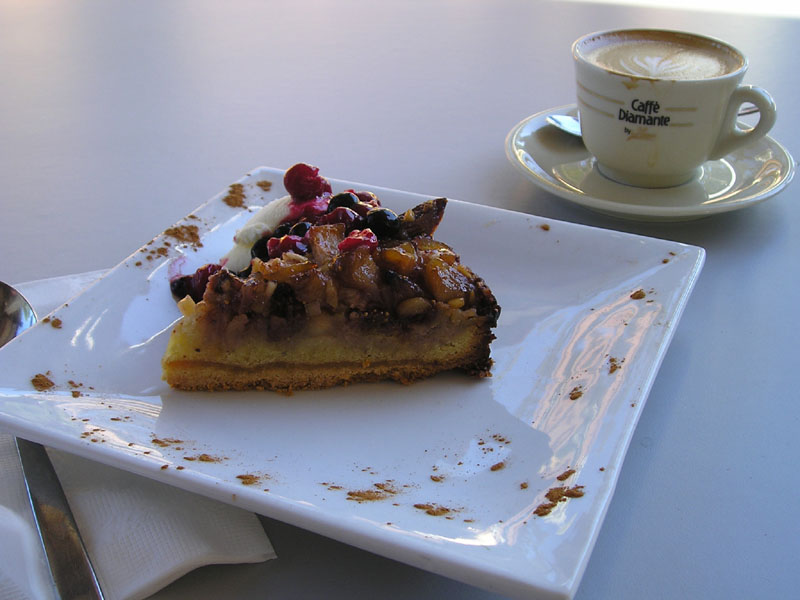
Photo by Sheila Webber: Coffee and cake at the cafe in Roma Street Parklands, Brisbane, Australia, July 2006: they were jolly good.