 Details of ANZIIL's next symposium, on 29 January at the University of Woollongong, Australia, are on the web at http://www.uow.edu.au/
conferences/anziil/home.html
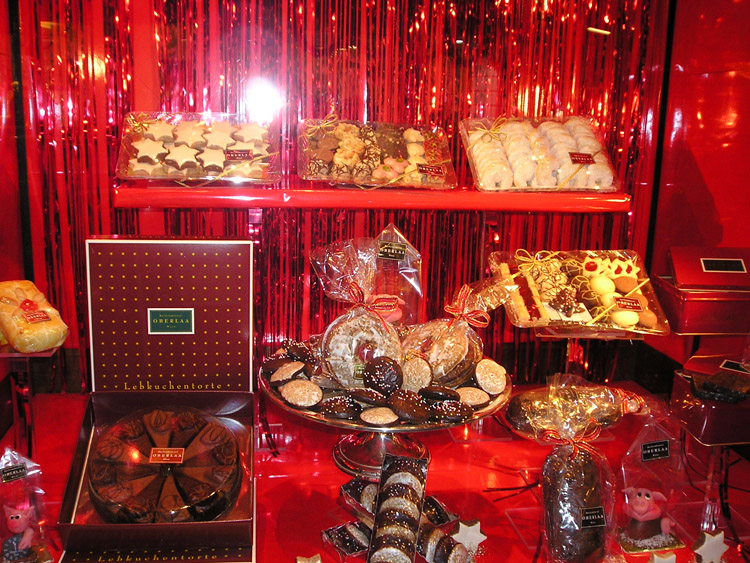
Photo by Sheila Webber: Oberlaa's window, Vienna, December 2006.
Details of ANZIIL's next symposium, on 29 January at the University of Woollongong, Australia, are on the web at http://www.uow.edu.au/ A happy Christmas to all from the Information Literacy Weblog.
 There is another useful site from Julio Anjos, who already produces Info Lit World News: this is Bibliorandum, which gives the latest additions to e-print archives in the information field:
 The website of the conference (June 2006) of the Engineering Libraries Division of the American Society for Engineering Education has some information-literacy related powerpoints and posters e.g. The Literate Engineer: Infusing Info Lit Skills throughout an Engineering Curriculum, Info Lit and Learning Outcome Analysis of Freshman Engineering Course http://eld.lib.ucdavis.edu/conf/conf06.php
 pause - have been on holiday in Vienna. Hereis something I found earlier . I mentioned the new librarians' conference a little while back, it took place at the start of the month. Papers are already archived with ALIA e-prints:
 Netskills are running more workshops in the UK in 2007, at Nottingham University, in January 2007. They are: Communication and Collaboration for e-Learning; Problem Based e-Learning; Effective e-Learning with Moodle; Information Skills: Is Google Enough?; Blogs, Wikis & Social Networking; Surviving Web Overload. See http://www.netskills.ac.uk/workshops for full details.
 On a personal note, today Yazdan Mansourian returns to Iran, his homeland. The photo shows him with my co-supervisor of Yazdan's PhD, Nigel Ford (once again I prove that I am better at photographing flowers than people). Yazdan has also been a good teaching assistant on my information literacy and business information classes and recently (as noted on this blog) contributed to lectures as well, so he will be missed! However, we still have papers to write together, including ones about how a key model from his research (on information visibility) can be used in information literacy education.
 Yesterday (Tuesday) rather than blogging I posted a comment on Brian Kelly's blog entry about Being blogged at an event. I won't reproduce the comments, but the entry stimulates a whole raft of thoughts about: copyright; politeness; attention; & approaches to teaching & presenting. Do people mind being faced with an audience of people apparently immersed in their laptops? Should we, in fact, be planning for how we can help students record their thoughts and our sayings in different ways? (note taking is a skill that many people don't seem to have by the time they come to university).
 A while ago I mentioned the Web 2.0 bullshit generator. Dave Pattern has thoughtfully created the Library 2.0 generator. This has layers of meaning, since for people who know little about Library 2.0 it nicely confirms all your prejudices by juxtaposing fancy jargon with names you don't recognise, whilst for the Library 2.0 cogniscenti it provides amusing counterpoints of names and 2.0-isms. Plus you feel cool for recognising the words and names. I didn't recognise every single word/name, but enough to feel cool. I will pick out "podcast Lorcan Dempsey using facets". Dave has even put an artefact in a Second Life library that you touch to generate a Library 2.0-ism, and you can't get much more Library 2.0 than that. See: http://www.daveyp.com/blog/index.php/archives/106/
 I came across a whole academic class-worth of podcasts from the the University of California at Berkeley (I know I came across this resource via another blog - but can't currently remember which one! When I've traced it back, I'll make an acknowledgement). The class is called History of Information and it covers topics of great interest to anyone concerned in information science and the information landscape. Most of the lectures are from Paul Duguid, of the Social life of information fame. I've only listened to some snippets so far, but intend to listen to some of them properly. Sessions include ones on intellectual property, information work, information economy etc. As you might imagine, one of the lectures I sampled was on Internet and Information Literacy. However, I think he is unaware that there is actually a concept "information literacy" already, since he seems to be talking about other things (interesting though those other things are). On the other hand, perhaps I should listen to all the talk before commenting ;-)
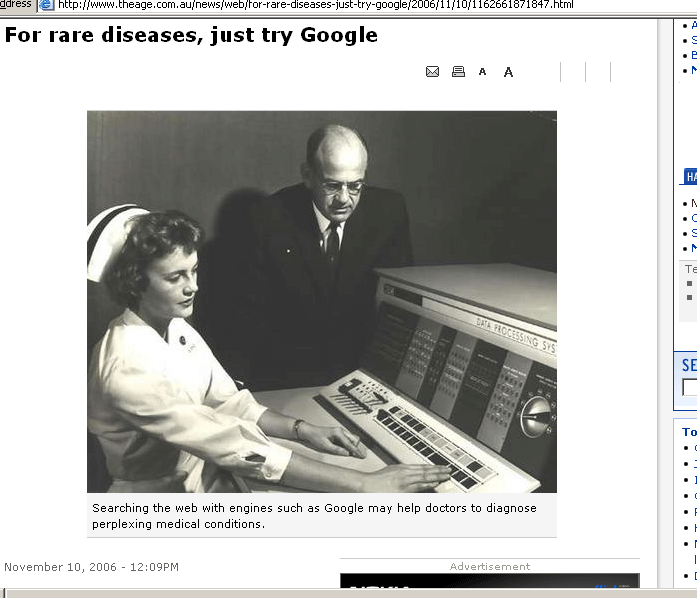 Thanks to Vivienne Bernath for emailing me about another story on the "research" that showed that Doctors might find Google useful for diagnosing patients. It's in the Australian newspaper The Age and the principal reason for linking to it is really the photograph....
 Intute has released a number of new Internet tutorials for the Social Sciences, to add to the updates to Arts and Humanities tutorials a couple of months ago They can all be found in the Virtual Training Suite at http://www.vts.intute.ac.uk/. Social Sciences tutorials updated: Internet Business Manager; Internet for Business Studies ; Internet Economist ; Internet for Education; Internet for Government and Politics; Internet for International Relations; Internet for Lawyers; Internet for Social Policy; Internet for Social Statistics; Internet Social Worker. Udpated Arts/Humanities tutorials are: Internet Archaeologist; Internet for Historians; Internet for Modern Languages ; Internet for Performing Arts; Internet for Religious Studies; Internet Philosopher.
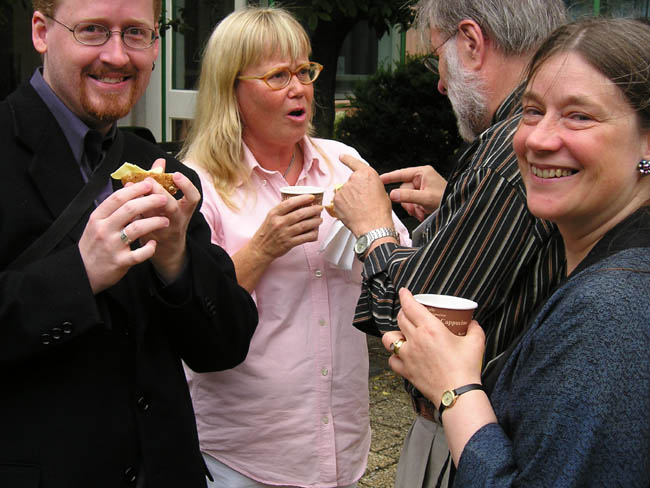 Here is the pdf of the presentation that Bill and Stuart presented at the Phenomenography conference in Hong Kong today: Further reflections on the phenomenographic team research process. As the title implies, it is probably of interest mainly to qualitative researchers! We were reflecting on the impact of working as a team (rather than e.g. as a lone researcher, or in a hierarchical way) on the analysis process. We used an account of team working from another research, Bowden, as a point of comparison. We intend writing this up as a paper. Looking back again to the 2004 phenom. conference in Sweden, above is a picture taken by Bill which shows me (right) and Stuart (left) enjoying the coffee break whilst fellow delegates debate the finer points of phenomenography.
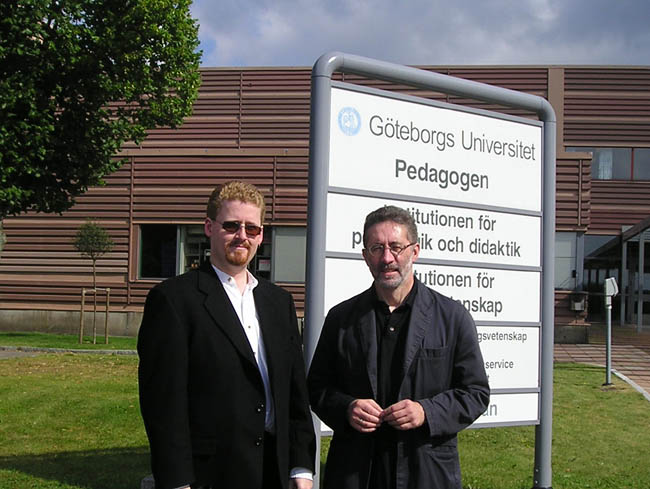 On Thursday Bill Johnston and Stuart Boon will be presenting a talk that I have co-authored with them, at the Phenomenography Special Interest Group workshop in Hong Kong. This event happens every couple of years , and we were all able to go the last one in Goteborg in 2004 (Stuart and Bill are pictured outside Goteborg University on the right), but unfortunately I couldn't get to Hong Kong this time ;-( Our talk is called Further reflections on the phenomenographic team research process, so we are looking at how we worked as a team, particularly in the analysis phase (of our project on UK academics' conceptions of teaching information literacy). Great names in phenomenography are there (e.g. Ference Marton), and there are also participants who may be familiar from this blog and elsewhere e.g. Christine Bruce, Mandy Lupton and Sylvia Edwards. In case you don't know, phenomenography is a research approach which it is valuable to use if you are trying to identify variation in people's way of experiencing or conceiving of a phenomenon.
 The Birmingham Re-Usable Materials (BRUM) Project aims to "develop 15 electronic re-usable learning objects (RLOs) to aid student's information skills then explore academics' and students' perception and use of the learning objects as they are embedded into the curriculum." There is a website to host the learning objects at http://www.is.bham.ac.uk/blasst/brum.htm and a blog at http://brumproject.blogspot.com. A week or so ago they said they were "interested in hearing from anyone who is currently undertaking any similar projects particularly those involving working closely with academics to embed training." Nancy Graham, n.graham.1@bham.ac.uk or Ann-Marie James, a.m.james@bham.ac.uk
 Just discovered Dave Pattern's blog at http://www.daveyp.com/blog/ (a mixture of automation e.g. a post on "export from the OPAC to del.icio.us and LibraryThing", and Alfred Hitchcock) and also a couple of photos taken during my talk (Dave was a speaker at the event, see below). It reminded me that Brian Kelly had suggested tagging things to do with the event in a standard way. I'm not yet using the beta features on Blogger, though....
 Thanks to Dave Parkes for alerting me to a post at Findability which talks about a digital media and learning initiative to help determine how digital technologies are affecting young people's behaviour (http://www.digitallearning.macfound.org/) and a white paper, Confronting the Challenges of Participatory Culture in which Jenkins, the author, proposes eleven new skills or literacies... I approached the latter rather sceptically, and still think there's a certain amount of old-wine-new-bottles going on, but some of the explanations of the "new literacies" are interesting (concerning play, remixing etc.).
 This was the title of the presentation I gave at the Fly the web event mentioned in the previous post. Since Dave Pattern had just made everyone a blogger through the practical exercise in the previous session, I didn't have to spend time explaining what a blog was! However, I did identify characteristics which I think lead to blogs being (quoting from my powerpoint) "Good for news, things with timelines, developing ideas; Not so good as a reference tool or to foster ongoing discussion on a range of topics." I drew a disctinction between individual bloggers and organisational bloggers. I talked about my experiences of blogging (as an "individual" blogger - it's certainly not part of my job description, and it isn't hosted at Sheffield either, now).
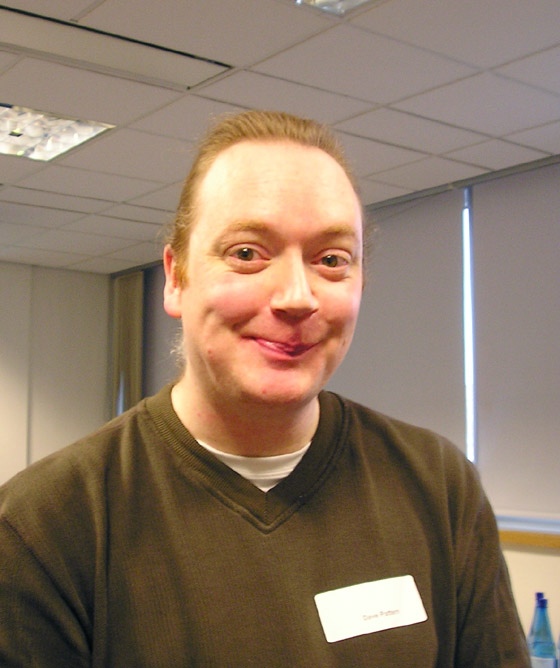 I'm blogging from the CILIP Universities College and Research Libraries seminar Fly the web: power to the user, which is focusing on Web 2.0 applications. Everyone else is creating a blog in blogger in a hands-on session, but I thought I would sneak into this instead and mention some useful insights so far. Brian Kelly (UKOLN) gave the introduction, and he has posted his material at http://ukoln.ac.uk/web-focus/events/seminars/cilip-ucrg-2006-12/ It includes his PowerPoint and some del.icio.us bookmarks. He gives an introduction to the concept and some of the tools and application areas. I won't try and answer the question "what is Web 2.0?" in this entry, as he's done that already!

