Monday, December 05, 2011

Articles from SCONUL Focus

SCONUL Focus (no. 52, 2011) is full text online, and as usual contains numerous short articles. These include:
- 'If the library is the heart of the university, then information literacy is the brain': promoting 'Information literacy week' at Salford University, by Sue Barker-Mathews, and Maggie Costello
- The value of libraries for research:some themes, by Michael Jubb (He is summarising points from: The value of libraries for research and researchers report (2011), available at http://www.rin.ac.uk/our-work/using-and-accessing-information-resources/value-libraries-research-and-researchers
- Tech tips for librarians: Twitterfeed, by Paul Stainthorp
- The SCONUL seven pillars model of information literacy: 2011 update, by Moira Bent, and Ruth Stubbings
- University Science and Technology Librarian's Group: Information Literacy event, reviewed by Jon Fletcher
The SCONUL Focus newsletter is at http://www.sconul.ac.uk/publications/newsletter/52/
Photo by Sheila Webber: first hint of snow, Sheffield, December 2011

Friday, December 02, 2011

Communications in Information Literacy (CIL): new issues

The latest issue (volume 5 issue 1) of Communications in Information Literacy (CIL) has been published. It includes:
Amy E. Mark: Format as a False Judge of Credibility: Messages from Librarians and Faculty and Student Responses
Brian Winterman, Carrie Donovan, Rachel Slough: Information Literacy for Multiple Disciplines: Toward a Campus-Wide Integration Model at Indiana University, Bloomington
Melissa A. Gains, Richard A. Stoddart: Supplementing a Librarian’s Information Literacy Toolkit with Textbooks:A Scan of Basic Communication Course Texts
Go to: http://www.comminfolit.org/index.php?journal=cil&page=issue&op=current
Photo by Sheila Webber: another picture of the Christmas tree in Sheffield, with photoshopped colour

Thursday, December 01, 2011

Moving on up.......School/FE/HE transition

On 19 January at Durham University (UK) the University, College & Research Group (Northern Section) has organised Moving on up.......School/FE/HE transition. "This Event is aimed at School, Further Education and University Librarians and examines the transition that most 16 -18 year olds make from School to College to Higher Education. It will consider what support there is for students making the transition and what can we do to help. There is an impressive programme of presentations delivered by respected and knowledgeable speakers who will be sharing their broad range of experiences and skills." Speakers include: Jackie Dunn and Ann-Marie Laws: "Bridging the Divide: Information Literacy the Forgotten Link"; Elizabeth Astan & Julie Archer: "Mind the [information literacy] Gap: moving from School or FE to HE".
To reserve a place, please contact Helen Ashton, Bishop Auckland College, 01388 443018, Helen.Ashton@bacoll.ac.uk
Photo by Sheila Webber: Christmas "Tree" in Sheffield city centre, yesterday.

Tuesday, November 29, 2011

Teaching Faculty Award for the Support of Information Literacy

The Augustana Campus Library (Camrose, Alberta, Canada) of the University of Alberta has announced the 2011 recipient of the Teaching Faculty Award for the Support of Information Literacy. The award, which started in 2005, is an annual award given to an Augustana Campus teaching faculty member who has contributed consistently and notably to the support and promotion of information literacy at the Augustana Campus of the University of Alberta. Nominations are accepted from Augustana students, staff, faculty and administrators. The award is presented annually at the Information Literacy in Academic Libraries Workshop. (My photo shows Augustana librarian Nancy Goebel announcing the award at this event the week before last.)
The recipient of the 2011 Teaching Faculty Award for the Support of Information Literacy is Dr Neil Haave, Associate Dean of Teaching and Associate Professor of Biology on the Augustana Campus. The nomination indicates that "Neil has taken a leadership role in incorporating the information literacy skill requirement into Augustana's curriculum. He has worked closely with Augustana librarians on developing an information literacy model for biology. Neil promotes the broadening of and incorporation of information literacy skills as part of a liberal arts and sciences education".
I've mentioned this award before: I think it's a great idea, and they also have a similar award for a student. More information at http://www.library.ualberta.ca/augustana/infolit/awards/

Monday, November 28, 2011

Academic literacies videos

Norda Majekodunmi of York University, Canada, recently announced on the ili-l discussion list that ahe and her colleague Kent Murnaghan had a series of videos, based on student interviews, which are about academic literacies. There is a tutor guide to accompany each video which includes a summary & transcript and examples of discussion topics and lesson plans. The videos are:
1. University Life
2. Learning Skills
3. Doing Research
4. Choosing Sources
5. Google/Internet
6. Libraries
7. Writing + Citing
They are available on the York University Scott Library Learning Commons
website:
http://www.library.yorku.ca/learning_commons/posts/learning-video-series/501 and the guides at: http://www.library.yorku.ca/learning_commons/learning-in-our-own-words. Norda adds in her post "Although some videos are York specific (i.e. University Life, Libraries) most can be used at any institution, please feel free to use these videos in your teaching."
Photo by Sheila Webber: Information Literate cupcakes at the Augustana Information Literacy seminar at Alberta University, Canada.

Saturday, November 26, 2011

LILAC awards: IL practitioner; Digital award; Student place

There are two awards open for nomination and an opportunity for students to attend the LILAC (information literacy) conference talking place in Glasgow, Scotland in April 2012.
Information Literacy Practitioner of the Year. "A long established award recognising an outstanding individual contribution to information literacy. The winner will receive £500 for personal use and £500 for their nominated charity. Closing date: February 29th 2012. (Sponsored by the CILIP CSG Information Literacy Group)."
Credo Reference Digital Award for Information Literacy. "An exciting new award recognising a digital resource, programme or service which has made a significant impact. The winning group or individual will receive £500 for personal use and £500 for their nominated charity. Closing date: February 29th 2012. (Sponsored by Credo Reference)."
Student Sponsored Place at LILAC. "The award consists of conference registration, travel and accommodation expenses for a student registered on a UK study programme. Closing date: January 31st 2012. (Sponsored by the CILIP CSG Information Literacy Group)."
Enquiries and nominations should to Nigel Morgan: LilacAwards@cardiff.ac.uk
Photo by Sheila Webber: autumn rose, October 2011

Friday, November 25, 2011

Materials from Belarus conference

Information Literacy expert Esther Grassian delivered a good deal of material at the Belarusian Library Association Conference (12-14 October), attended by library Directors and Deputy Directors from libraries in Belarus, Russia, Lithuania, Ukraine and Poland, among others. She has mounted her presentations and handouts, in English and in Russian, on her personal website. It is an interesting resource including, for example: Expected Learning Outcomes examples for undergraduate information literacy instruction, a presentation on Goals, Objectives and Expected Learning Outcomes (ELOs) for School and Public Library librarians in Belarus; a presentation on Librarians connecting and collaborating with teachers/faculty, for a Plenary session and a Bibliography for the Plenary Session; a sample workshop for graduate Teaching Assistants to help them learn how to incorporate information literacy instruction into their curricula and assignments; and a handout Esther Grassian's 'Thoughts on Transliteracy'.
Esther expressed her thanks to the U.S. Embassy in Minsk, who sponsored her visit and also to their librarians who took the photo here (which is copied with their permission).
https://sites.google.com/site/esthergrassian/

Thursday, November 24, 2011

Sci Tech information literacy chat

On 30 November, 2011 (7pm UK time: 2PM US Eastern time; 11AM US Pacific Time) there will be the regular "Last Wednesday" Information Literacy virtual discussion, this time using tinychat. It is sponsored by the ACRL Science and Technology Section’s Information Literacy Committee. To join the discussion, go to http://tinychat.com/steminfolit at the appropriate time. "This month's discussion is on building and maintaining liaison relationships" (I think that means librarian-faculty professional relationships)
Photo by Sheila Webber: Mailboxes, Edmonton, Canada, November 2011

Wednesday, November 23, 2011

New articles on information literacy

Nazari, M. (2011) "A contextual model of information literacy." Journal of Information Science, 37(4): 345-359. This describes her model of IL for Geographic Information Science/Systems. An article from my former PhD student, Maryam Nazari, now teaching at the University of Malaya.

Mansour, E. and Alkhurainej, N. (2011) "Information seeking behaviour of Members of the Kuwaiti Parliament." Library Review, 60(8), 671-684. This investigated things such as why they needed the information, what sources they used, and who supported them

Salisbury, F. and Sheridan, L. 2011 "Mapping the journey: Developing an information literacy strategy as part of curriculum reform." Journal of Librarianship and Information Science, 43 (3), 185-193. Describes initiatives at La Trobe University, in Australia.

Shenton, A. and Hay-Gibson, N. (2011) "Information behaviour and information literacy: The ultimate in transdisciplinary phenomena?" Journal of Librarianship and Information Science September, 43, 166-175.

Shoeb, Z.H. (2011) "Information literacy competency of freshman business students of a private university in Bangladesh." Library Review, 60(9), 762-772. A survey was conducted to identify students' current perceptions and competence, to help prepare an IL curriculum for the future.

These are all in priced journals.
Photo by Sheila Webber: Autumn beech tree, Sheffield, November 2011

3Ts 2012: Engaging Students with Teaching, Technology, and Transliteracy

There is a call for proposals for the 3Ts 2012 conference, which will be held in Albany, New York, USA on March 16 2012. The deadline is December 1st. "Proposals should address the following questions: * How have you drawn upon metaliteracy or transliteracy to support student learning? * How have underlying principles and theories guided your inclusion of a specific technology or technologies in the classroom? * How did teaching and technology connect to improve both technological literacy and learning? * How has your teaching style or method changed as technology is now infused into your course?
"Proposals can include any meaningful integration of technology and teaching used to support the growing number of literacies students need for learning and succeeding in today's information-rich academic and professional worlds." Conference sessions are 45 minutes speaking/workshop time with 15 minutes allocated for Q and A, or a 2 hour workshop. Further info at http://threetees.weebly.com/call-for-proposals.html
Photo by Sheila Webber: Snow in Camrose, Canada, last week.

Monday, November 21, 2011

Information handling in collaborative research

Information handling in collaborative research: an exploration of five case studies is a new report from the Research Information Network (RIN). "This study, commissioned by RIN and the British Library, comprising of a set of case studies looking at how researchers access, use and disseminate information in collaborations between higher education and business, public and third sector partners." The case studies concern:
- a large multinational collaboration involving pharmaceutical companies and Higher Education Institutions (HEIs);
- a large European co-ordinated action between HEIs and public bodies involved
with end-of-life care;
- a medium sized UK based project on material engineering involving HEIs and a
mix of commercial partners including large multinational industrial organisations,
Small and Medium-sized Enterprise (SME) manufacturers and university spin-outs;
- a small knowledge transfer partnership, developing a software and hardware
package for use in residential care, involving one SME and one HEI;
- and a small exploratory collaboration involving a mix of commercial and third
sector organisations, and an HEI.
The report is available in full at: http://www.rin.ac.uk/our-work/using-and-accessing-information-resources/collaborative-research-case-studies
Photo by Sheila Webber: autumn pathway, Sheffield, November, 2011

Sunday, November 20, 2011

Curriculum for Information Literacy

On 10th November we (Sheffield University Information School) hosted a seminar on an Information Literacy Curriculum, run by Jane Secker (London School of Economics), Emma Coonan (Cambridge University Library), Helen Webster (learning developer at Cambridge University) and Katy Wrathall. I must also thank Lyn Parker, who did the organisation at this end. I have already blogged about this curriculum initiative, which arose from Jane and Emma's Arcadia Fellowship from Cambridge University. There is full documentation on their new blog at http://newcurriculum.wordpress.com/. This includes an explanation of the ideas behind the curriculum and recommendations on how it may be used and taught. There are 10 “strands” to the curriculum, and for each strand they propose learning outcomes, with example activities and assessments. The 10 strands are:
- Transition from school to higher education
- Becoming an independent learner
- Developing academic literacies
- Mapping and evaluating the information landscape
- Resource discovery in your discipline
- Managing information
- Ethical dimension of information
- Presenting and communicating knowledge
- Synthesising information and creating new knowledge
- Social dimension of information
At the workshop there were presentations from Emma and Jane about developing the curriculum and also from Helen and Katy about the next phase. This focuses (as the final Arcadia project) on ways of implementing the curriculum, through a teaching toolkit and institutional audit tool. The seminar at Sheffield also included a group discussion session (pictured), looking at things like barriers and enablers for developing information literscy in the curriculum.
Jane Secker has blogged about this workshop at http://newcurriculum.wordpress.com/2011/11/10/reflecting-on-our-sheffield-workshop/ and the powerpoint is also on their blog, under the Presentations tab.

Friday, November 18, 2011

People from the Augustana seminar: Clarence Maybee

I am just about to fly back to the UK after delivering the Augustana Information Literacy seminar with Bill Johnston in in Canada (with the theme of The Information Literate University), and will try to catch up with my blogging over the next few days. To start with, this is one of the delegates at the seminar: Clarence Maybee (pictured right). He fairly recently started a very interesting job at Purdue University, USA, where they have a definite focus on information literacy. His post is "Information Literacy Specialist" as an Assistant Professor, with a coordinating role for information literacy. This is the page on his website that describes his research https://sites.google.com/site/clarencemaybee/Research and these are a couple of his publications:
Maybee, C. (2007) "Understanding our student learners: A phenomenographic study revealing the ways that undergraduate women at Mills College understand using information." Reference Services Review, 35(3), 452-462.
Maybee, C. (2006) "Undergraduate Perceptions of Information Use: the basis for creating User-Centered Student Information Literacy Instruction." Journal of Academic Librarianship, 32(1), 79-85.

Wednesday, November 16, 2011

Information Literacy in the snow

This is a cool photo that was produced by Nancy Goebel at the Augustana library, University of Alberta (where I am at the moment). She got student volunteers to spell out the words "information literacy" by lying in the snow. You can see that the letters are made of people more easily in the closeup of "info" at the bottom of the picture on the right.

Tuesday, November 15, 2011

LOEX of the West 2012 call for papers

The LOEX of the West 2012 Conference Committee calls for proposals to be considered for presentation at the LOEX of the West (LOTW) Conference, June 6-8, 2012 at Woodbury University, Burbank, California, USA. The theme for the conference is : Creative Landscapes: Designing Information Literacy for All Terrains. More info at http://woodbury.libguides.com/lotw2012

Saturday, November 12, 2011

Sheffield University, Information Literacy and IBL

At the moment I am in Edmonton, Canada, preparing presentations for the Augustana Information Literacy workshop at the University of Alberta, Canada. This is why there has been a couple of days gap in my blogging. It is colder here than in the UK: here is a picture from today.
One of the things I will be doing is talking about Sheffield University as an example of information literacy being advanced through a university-wide initiative concerning a pedagogic approach (in this case, Inquiry Based Learning (IBL). I've blogged some of these items before, but here is a list of resources I'm mentioning
- There is an IBL website at http://www.shef.ac.uk/ibl/
- CILASS. (2008) Information Literacy. (CILASS Briefing Paper; 4) http://www.shef.ac.uk/content/1/c6/07/93/44/Information%20Literacy%20Briefing%20paper.pdf
- Case studies of IBL projects with an IL component:
- - English http://www.shef.ac.uk/ibl/resources/casestudies/english/historyof.html;
- - Human Communication Sciences http://www.shef.ac.uk/ibl/resources/casestudies/hcs/introweek.html;
- - Library http://www.shef.ac.uk/ibl/resources/casestudies/library/seil.html;
- - Psychology http:// www.shef.ac.uk/ibl/resources/casestudies/psychology/publicpres.html;
- - Law http://www.shef.ac.uk/ibl/resources/casestudies/law/ul1.html (see also an account by two faculty in the Law School: Semmens and Taylor, 2006)

- Corrall, S. (2009) Information Literacy: The Case for Strategic Engagement. http://www.slideshare.net/cilr/information-literacy-the-case-for-strategic-engagement (Professor Sheila Corrall outlines the case in general, and finishes by giving Sheffield University as an example)
- McKinney, P. (2010) Inquiry-based Learning and Information Literacy: a meta-analytical study. University of Sheffield. http://www.shef.ac.uk/content/1/c6/11/08/47/IL_meta-analysis_PM-FINAL.pdf
- Parker, L. (2009) Can't I just upload it to the VLE? Designing and embedding information literacy into online and blended learning. http//www.slideshare.net/LynParker/cant-i-just-upload-it-to-the-vle-designing-and-embedding-information-literacy-into-online-and-blended-learning (Lyn Parker is Head of Learning and Teaching at Sheffield University Library)

Wednesday, November 09, 2011

Infolit and ICT articles

A blog called International Schools and ICT has been regularly posting abstracts of research articles: an interesting mix. http://internationalschoolsandict.wordpress.com/. On the day I last looked, the item was:
Sharkey, J. and Brandt, D.S. (2008) Integrating Technology Literacy and Information Literacy. In: Rivoltella, P. (Ed) Digital literacy : tools and methodologies for information society. Hershey: IGI Publishing. pp85-97.
Photo by Sheila Webber: last windfalls, November 2011

Tuesday, November 08, 2011

Information literacy in our future careers: videos

The Information literacy in our future careers exhibition is something I've done several years running with a class that is core to three of our masters programmes, the MA Librarianship, MA Information Literacy and MSc Information Management. In the first week of the exercise teams of students start creating a poster to depict how information literacy will be relevant in their future careers, and in the second week they display the posters and explain them to each other.
This year there are 115 students, the majority international (over half the class is from China). They have a variety of career aspirations, particularly the largest cohort, the Information Managers. Careers that were addressed in the posters included headhunting, farming, and human resource management, as well as different kinds of information and library jobs. 30 posters were produced and you can see them all in this Flickr set: http://www.flickr.com/photos/23396182@N00/sets/72157627880923331/
This is a short video that I made, asking some of the students to explain their posters.

In addition some of the teams give some very interesting accounts on their own team blogs. "Team I" did a video about their favourite poster which is embedded in this blog post (their own poster is one of the ones featured in my video, above): http://i23things.blogspot.com/2011/10/information-literacy-in-our-future.html "Team U" also provide a nice explanation of their poster here: http://ucanbloglikeme.blogspot.com/2011/10/il-poster-by-u-team.html
We ask people to evaluate the posters, and the two most popular posters were those from Team A (pictured at the start of this post) and Team N (pictured right)

Monday, November 07, 2011

Measuring the impact of information literacy training in Africa: questionnaire

Siobhán Duvigneau (Information Literacy Manager, BLDS - British Library for Development Studies) writes "BLDS has developed an information literacy programme over the past two years which includes course materials and an online network for trainers and practitioners to share best practice.
"As part of this programme BLDS and the Research Information Network (RIN) are working together to develop a monitoring and evaluation toolkit, including practical examples, to inform the development and impact measurement of information literacy training. Much of BLDS’ work has been within an African context and so the intention is to develop a toolkit for African trainers of information literacy which will be widely disseminated through Creative Commons. This toolkit will include practical tools such as pre and post-course questionnaires, as well as case studies illustrating how these tools can be used.
"In the first instance, we are disseminating a questionnaire to get a feel for current practice in the development of information literacy interventions. We invite IL practitioners to contribute to the questionnaire, run through Survey Monkey. The questionnaire is open during the period 4 November 2011 to 25 November 2011 and should take between 15-30 minutes to complete.
"Following analysis of the responses, there will be in-depth, qualitative consultations early in 2012 in Africa at a university yet to be confirmed. Please indicate whether you would like to join these workshops and/or focus groups in the questionnaire. The formulation of the toolkit itself will follow during the first quarter of next year." http://www.surveymonkey.com/s/monitoringimpact
Photo by Sheila Webber: Autumn canopy, Sheffield, November 2011.

Friday, November 04, 2011

Christine Bruce: presentation recording

Dr Christine Bruce gave an online keynote at the Library 2.011 conference today. I should have flagged this up in advance, but you can see the recording (audio, powerpoint and chat from the online audience). Her topic was The experience of information literacy and learning: reflections on social media. The link to the page where you can access the conference recordings is here: http://www.library20.com/page/general-session-room-links. A few others that caught my eye (but I haven't watched them: it's hectic at the moment and unfortunately I haven't been able to take any time to participate in the conference except for being at Christine's session)
Diane Fulkerson: Multiliteracy is the new Information Literacy
Thierry Robert: Presentation of a gamification project : an online serious game to learn information skills to 9-12 years old
Gabrielle Hayes: Tiers for Fears: QUT Library's learning and Study support service
Reneé Lyons: A Bird in the Bush: Pathfinders as a Tool for Developing Multiliteracies
Photo by Sheila Webber: Autumn leaves, Sheffield, November 2011

Thursday, November 03, 2011

“Social Life” for Information Literacy Instruction

A presentation for an online ACRL course was uploaded to Youtube by Lynn Lampert a few days ago. It is entitled Creating a “Social Life” for Information Literacy Instruction in Libraries and starts off with reference to The social life of information, a book that I have used in teaching.

WILU host sought

The WILU (Workshop for Instruction in Library Use) 2012 Steering Committee invites proposals from Canadian libraries to host WILU 2013. If you are interested in this exciting opportunity please see this page for more information: http://sites.macewan.ca/wilu2012/hosting-wilu-2013/

Wednesday, November 02, 2011

Short article on "Information Literacy 2.0"

Farkas, M. (2011) "Information Literacy 2.0". American libraries. 1st November. http://americanlibrariesmagazine.org/columns/practice/information-literacy-20
Quote from the end: "it’s critical that we develop instruction that supports critical inquiry in this extremely complex information environment."
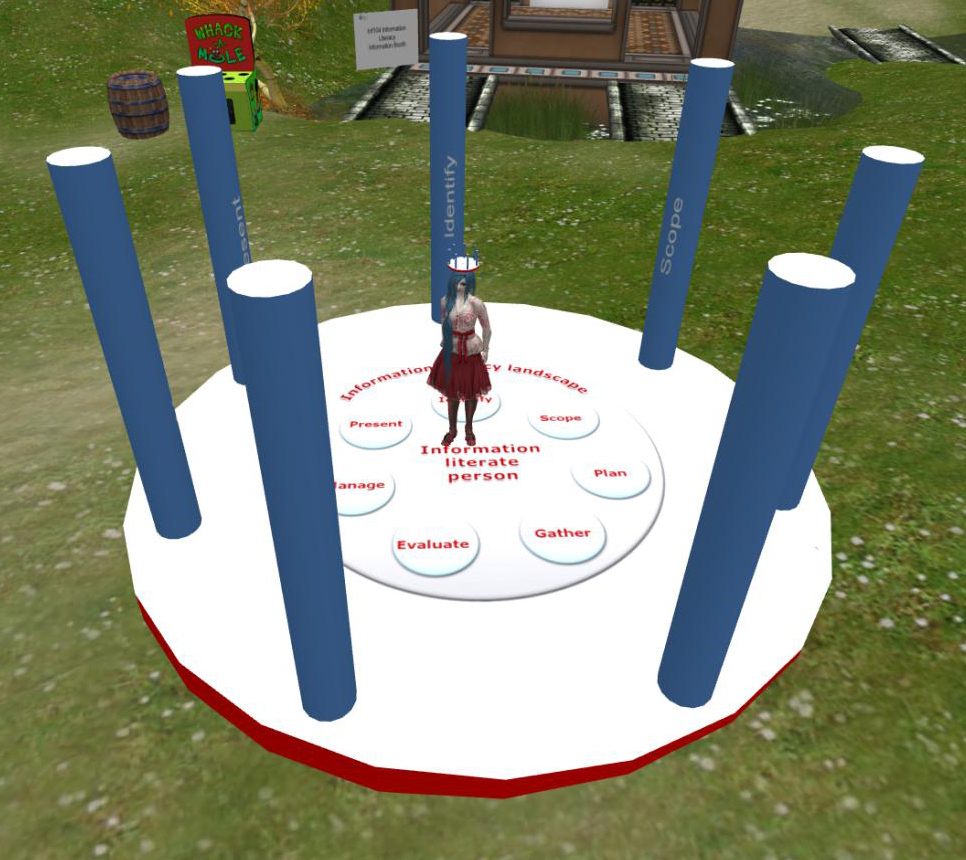
Picture is of me in Second Life with one of my 3D models of the SCONUL 7 pillars of information literacy.

Monday, October 31, 2011

Presentations from Internet Librarian International 2011

ILI 2011 took place 27-28 October and there are some presentations at http://lanyrd.com/2011/ili2011/
including 2 from Karen Blakeman (Visual search: Web Search Academy Internet and Searching without Google) and What's On the Technology Horizon? from Brian Kelly. The main website for the conference was http://www.internet-librarian.com/2011/
Photo by Sheila Webber: Autumnal creeper, October 2011

Insideyoursearch.com

Thanks to Penelope Dunn, who posted this link:
http://www.insideyoursearch.com/ - you can either type in your own search words once the search box emerges (I will say no more if you haven't seen it before), or if you just wait, a variety of searches get typed in for your amusement.

Sunday, October 30, 2011

Miriam Dudley Instruction Librarian of the Year Award

The ACRL Instruction Section is accepting nominations for the Miriam Dudley Instruction Librarian of the Year Award. "This award recognizes an individual librarian who has made an especially significant contribution to the advancement of instruction in a college or research library environment." Submission Deadline is December 2, 2011. There is more information at http://www.ala.org/ala/mgrps/divs/acrl/awards/miriamdudley.cfm Please send your nomination to Polly Boruff-Jones at pboruffjones@drury.edu
Photo by Sheila Webber: Red devil, October 2011

Saturday, October 29, 2011

Student exhibits on Facebook, Google, Wikipedia in Second Life

On 27 October I presented at the at the M2N4SL – Midnight to Noon Conference for Second Life Educators and Researchers conference in Second Life. I gave brief details about the class "Information Literacy" that is core to the BSc Information Management programmes at the University of Sheffield Information School & which I coordinate. After giving this introduction to the pedagogic approach and design for the class, I took delegates over to our SL island, Infolit iSchool, where my students have mini-islands with their presentations about "Should Facebook users be concerned about privacy", "Is wikipedia reliable" and "Are the Google generation really bad at searching and evaluating information". If you have a SL avatar you can visit (the mini-islands will be there until February 2012) http://slurl.com/secondlife/Infolit%20iSchool/162/187/21/

Friday, October 28, 2011

Watch it online 2 Nov: Supporting undergraduate students of the future: developing a new curriculum for information literacy

Jane Secker and Emma Coonan will give seminar on 2 November at 2pm-3.30pm UK time (see http://tinyurl.com/5uezn23 for times elsewhere in the world) on the research they undertook as part of the Arcadia Programme at University of Cambridge to develop a "new curriculum" for information literacy. The event will be live streamed and the details are at http://clt.lse.ac.uk/events/networkED-seminar-series.php The seminar will also be recorded and available from the website after the event.

Thursday, October 27, 2011

Journal of Academic Librarianship latest

The latest issue (Volume 37, Issue 5) of Journal of Academic Librarianship (homepage http://www.sciencedirect.com/science/journal/00991333) includes:
Heather Sanderson: Using Learning Styles in Information Literacy: Critical Considerations for Librarians (pp376-385)
Ben Hunter, Robert Perret: Can Money Buy Happiness? A Statistical Analysis of Predictors for User Satisfaction (pp402-408)
Ellen I. Shupe, Stephanie K. Pung: Understanding the changing role of academic librarians from a psychological perspective: A literature review (pp409-415)
Photo by Sheila Webber: Farmers' market, October 2011

Wednesday, October 26, 2011

3Ts 2012: Engaging Students with Teaching, Technology, and Transliteracy

March 16 2012 is the date of 3Ts 2012: Engaging Students with Teaching, Technology, and Transliteracy. It takes place in Albany, NY, USA and co-Sponsored by CPD, FACT2, SUNY Librarians Association Working Group for Information Literacy (SUNYLA WGIL). More info at http://threetees.weebly.com/
This website also has presentations from last year.
Photo by Sheila Webber: autumn squash, October 2011

Tuesday, October 25, 2011

New articles

The latest issue of Reference Services Review (Volume 39 issue 4) includes:
- Anna Marie Johnson, Claudene Sproles, Robert Detmering: "Library Instruction and Information Literacy 2010" (this is their annual annotated bibliography)
- Li Wang: "An information literacy integration model and its application in higher education"
- Erin L Davis, Kacy Lundstrom, Pamela N. Martin: "Librarian Perceptions and Information Literacy Instruction Models" (the "models are "for-credit courses and course-integrated library instruction")
- Michelle Kathleen Dunaway: "Connectivism: Learning Theory and Pedagogical Practice for Networked Information Landscapes"
This journal is priced: the home page is here.
Photo by Sheila Webber: Ripe red devil apple, October 2011

Monday, October 24, 2011

LOEX call for posters

There is a call for posters for the LOEX (US information literacy) conference taking place in Columbus, Ohio, USA, May 3-5, 2012. The call is open to graduate students in library and information science programs and library fellows and residents. The deadline to submit poster session proposals is January 27, 2012. More info at http://www.loexconference.org/posters.html
Photo by Sheila Webber: Autumn in Weston Park, October 2011

Friday, October 21, 2011

Research supervisors and information literacy

The Research Information Network has just released its report on Research supervisors and information literacy. Undertaken earlier this year, the study was "investigating the place and role of PhD supervisors in the drive to ensure that research students possess the necessary level of information literacy to pursue their careers successfully in academia and beyond." The consultants were Curtis+Cartwright Consulting and Cardiff University. You can download:
- The main report, including an executive summary;
- The summary of the questionnaire-based surveys (382 supervisors and 907 research students responded)
- The summary of five institutional case studies from 5 different UK universities.
http://www.rin.ac.uk/our-work/researcher-development-and-skills/information-handling-training-researchers/research-superv
Photo by Sheila Webber: autumn leaves, October 2011

Embedding information literacy

Hine, A et al. (2002) "Embedding information literacy in a university subject through
collaborative partnerships." Psychology Learning and Teaching, 2(2), 102-107.
"An innovative and multifaceted approach to the development of information literacy has been implemented at an Australian tertiary institution. The approach which involved collaboration among the university’s academic teaching staff, professional developers, academic learning skills advisers and librarians aims to empower students from a variety of backgrounds to confidently utilise a range of information literacy strategies. Scaffolded academic tasks afforded students the opportunity of acquiring skills in information gathering, recognising relevance, critical thinking and reflection. The project contributed to the development of independent, confident, critical thinking students who were able to meaningfully evaluate and utilise information in a variety of contexts."
http://www.wwwords.co.uk/pdf/validate.asp?j=plat&vol=2&issue=2&year=2002&article=6_Hine_PLAT_2_2_web

Wednesday, October 19, 2011

Information Literacy: esssential skills for the information age

The first edition of this book is available full text (a scanned text, so the quality isn't brilliant). Not something new, but I don't think I've blogged it before. It's good for the history of IL (with bias towards developments in North America) and for summarising the state of the art up to the point it was written.
Spitzer, K. , Eisenberg, M. and Lowe, C. (1998) Information Literacy: esssential skills for the information age. ERIC Clearinghouse.
http://eric.ed.gov/PDFS/ED427780.pdf

Photo by Sheila Webber: late blackberries, October 2011

Tuesday, October 18, 2011

Information Literacy in Romania

This week, in the class I coordinate Information Resources and Information Literacy, I asked class members to link to an item about information literacy in their own language (using the team blogs they are maintaining in this class). Today they showed each other the material they had found. This Masters-level class is very international: about 115 students, over which over 60 come from China, and there are many other countries represented too. The students identified some interesting items, and I will be highlighting some of them in this blog.
The first up is a report on a Romanian Information Literacy conference, found by Cristian Dragu, from Romania. He says thatInformation Literacy can be translated as "Cultura Informatiei" in Romanian. This is his blog post that links to the item: http://w-teaminf6350.blogspot.com/2011/10/information-literacy-or-cultura.html Of course it is in Romanian, but there is always Google Translate ;-)
This rather blurred picture is of the session today when the class is starting to prepare posters for the "Information Literacy in my future career" exhibition

Monday, October 17, 2011

Our Space: Being a Responsible Citizen of the Digital World

A substantial online resource: Our Space: Being a Responsible Citizen of the Digital World has been produced by The GoodPlay Project, Project Zero, Harvard Graduate School of Education, USA (which includes luminaries such as Howard Gardner) and Project New Media Literacies, Annenberg School for Communication, University of Southern California, USA. "Our Space is a set of curricular materials designed to encourage high school students to reflect on the ethical dimensions of their participation in new media environments [e.g.Facebook, Wikipedia]. Through role-playing activities and reflective exercises, students are asked to consider the ethical responsibilities of other people, and whether and how they behave ethically themselves online. These issues are raised in relation to five core themes that are highly relevant online: identity, privacy, authorship and ownership, credibility, and participation." http://www.goodworkproject.org/practice/our-space/
Photo by Sheila Webber: Bindweed fence, October 2011

Friday, October 14, 2011

Information Literacy Month mascot #nationalforum

The US Information Literacy Awareness Month has the hashtag of #nationalforum. It also has an honorary mascot in Barkley the Secret Service Dog http://infolit.org/nfil-news-and-events/national-information-literacy-awareness-month/meet-barkley-secret-service-dog/
Photo by Sheila Webber: Sculpture by Dhara Brivera, Puerto Rico, August 2011

Thursday, October 13, 2011

Information Literacy in Academic Libraries: Conceptions and Practice

On November 11 2011 Purdue Libraries (West Lafayette, USA) Information Literacy Research Symposium Information Literacy in Academic Libraries: Conceptions and Practice will "feature Dr. Paulette Kerr, librarian and lecturer in LIS at the University of the West Indies, Mona. Dr. Kerr will discuss her dissertation, "Conceptions and Practice of Information Literacy in Academic Libraries: Espoused Theories and Theories-in-use." She will also facilitate a workshop based on a model she developed." For more info go to http://www.conf.purdue.edu/ILRS. Registration closes November 4.
Photo by Sheila Webber: picked apples, October 2011

Wednesday, October 12, 2011

Infolit and business / management studies

A new special issue of the Journal of Business & Finance Librarianship focuses on Information Literacy. It is a priced journal.
- Kellya, A. et al (2011) "Course-Integrated Information Literacy Instruction in Introduction to Accounting." Journal of Business & Finance Librarianship, 16 (4), 326-347
- Campbell, D.K. (2011) "Broad Focus, Narrow Focus: A Look at Information Literacy Across a School of Business and Within a Capstone Course." Journal of Business & Finance Librarianship, 16 (4), 307-325
- Julien, H. et al (2011) "Preparing Tomorrow's Decision Makers: Learning Environments and Outcomes of Information Literacy Instruction in Business Schools." Journal of Business & Finance Librarianship, 16 (4), 348-367
- Fiegen, A.M. (2011) "Business Information Literacy: A Synthesis for Best Practices." Journal of Business & Finance Librarianship, 16 (4), 267-288.
The journal's homepage (with abstracts) is here
Photo by Sheila Webber: autumn daisies (photoshopped) October 2011

Tuesday, October 11, 2011

ISIC2012: The Information Behaviour Conference cfp

2012's ISIC: The Information Behaviour Conference will be held 4-7 September 2012 at Keio University, Japan. Deadline for submission of full papers is January 10, 2012.
Themes of the conference include:
1. Theories and models of information seeking and searching:
2. Research approaches and methodologies
3. Information seeking, searching, use and sharing in specific contexts
4. Organizational structures and processes and information seeking, searching and use.
5. Information seeking and searching in virtual social networks, including gaming and virtual worlds as arenas for information exchange.
6. Information behaviour in everyday life
7. Integrating studies on information seeking and interactive retrieval.
8. Information use: the nature of information and how information is used to help solve problems, aid decision making or satisfy an initial need.
9. The mediation of information behaviour
10. The design of information delivery systems to meet information needs
11. Information seeking and information requirements – integrating information science and information systems.
12. The communication of information to users:
13. Collaborative information seeking and searching in diverse contexts such as work teams or learning environments.
More information at http://www.slis.keio.ac.jp/isic2012/
Photo by Sheila Webber: Autumn red devil apple, October 2011.

Monday, October 10, 2011

Libcampuk11 sessions

Last Saturday saw Libcampuk11 in Birmingham, UK, there is a wiki at http://libcampuk11.wikispaces.com/ and one session which was particularly relevant to this blog was on Managing the Transition between School and University, facilitated by Jo Alcock and Jean Allen. There are some notes on the session linked from this page http://libcampuk11.wikispaces.com/Session+notes (scroll down it a bit to see that session)
Photo by Sheila Webber: Another red devil, October 2011

Friday, October 07, 2011

Singeporean study on information literacy

Today carries a report about a study into Singeporean school children's information literacy. "Conducted by the Wee Kim Wee School of Communication and Information (WKWSCI) at Nanyang Technological University, the "National Information Literacy Survey for Singapore Schools 2010" involved more than 3,000 secondary school students. The findings showed that the overall score across all info-literacy competencies stood at 38.7 per cent - some way off the ideal score of at least 50 per cent." The article includes comments from the Minister for Education, which do recognise information literacy (and it is IL that is being talked about) as important.
Ng, J. Y. (2011) "Information literacy needed for Singaporean student." Today, 6 October.
http://www.todayonline.com/Singapore/EDC111006-0000061/Information-literacy-needed-for-Singaporean-students
The page for the research group is at http://www.wkwsci.ntu.edu.sg/Research/ResearchClusters/Pages/InformationLiteracyResearchCluster.aspx
Photo by Sheila Webber: Michaelmas daisies, Sheffield, October 2011

Ada Lovelace day

Today is Ada Lovelace Day, celebrating women in Science, Tecnology, Engineering and Mathematics. There is a website at http://findingada.com/. You are encouraged to blog or Twitter (#ALD11) about a women in STEM you admire. I will name Pauline Duckitt, who was an specialist information consultant with energy, enthusiam, expertise and style.
Ada Lovelace (1815-1852) is often cited as the first computer programmer.

Wednesday, October 05, 2011

Learning Resources Conference 2011 Empowering the Digital Natives

This conference is being held on 20th October 2011 in York, UK: Learning Resources Conference 2011 Empowering the Digital Natives, organised by the JISC Regional Support Hub Yorkshire and Humberside. The website is at http://lanyrd.com/2011/lrcon11/. Talks include:
Phones, Slates, Netbooks & Desktop Computers: information use across devices (Andrew Walsh)
Social Media Feet First - Managing your digital footprint and identities (Kev Campbell-Wright)
Think before you click: steps on the road to independent learning (Anthony Beal and Eleanor Johnston
Developing a New Curriculum for Information Literacy: theory and practice (Jane Secker and Emma Coonan)
Photo by Sheila Webber: more red devils, October 2011

"Health literacy skills of people who access health information in virtual worlds

On 5th October at 12 noon Second Life time (see http://tinyurl.com/67md62f for times elsewhere) there will be an event Health literacy skills of people who access health information in virtual worlds. It will take place in the virtual world, Second Life.
Evelyn McElhinney, Lecturer in Advanced Practice, School of Health and Life Sciences, Glasgow Caledonian University, Scotland (Kali Pizzaro in SL) has started to collect data for Phase 1 of her PhD project "Health literacy skills of people who access health information in virtual worlds and the impact on real life health behaviour?" She will briefly introduce the project.This is a Centre for Information Literacy Research event.
Where: Infolit iSchool http://slurl.com/secondlife/Infolit%20iSchool/49/30/20/

Monday, October 03, 2011

Truth, lies and the internet

A report from the British think-tank Demos was released a few days ago
Bartlett, J. and Miller, C. (2011) Truth, lies and the internet. Demos. http://www.demos.co.uk/publications/truth-lies-and-the-internet. "examines the ability of young people in Britain to critically evaluate information they consume online. The report reviews current literature on the subject, and presents a new poll of over 500 teachers. It finds that the web is fundamental to pupils’ school lives but many are not careful, discerning users of the internet"
Little of the "current literature" is from the large body of information literacy literature (though actually there isn't a huge amount of research literature reviewed at all). The terminology in the report is a little confused, in that they conclude at one point that their survey shows that there is insufficient information literacy taught, their survey apparently referred to digital literacy (what it was asking teachers about was pupils' ability to deal critically with information on the internet) and their recommendations call for "digital fluency" to be made a priority in the curriculum.
With initiatives like this it's always difficult to tell whether different terms have been used in order to make the initiative seem different/ new or simply because people were unaware of all the existing work that has been done. It may seem carping, but it does make campaigning more difficult when people are using lots of different terms to describe the same thing, as you have to waste time explaining that X, who talks about Y, is actually arguing for the same thing as you are.
Anyway, the survey of teachers (gathered using a snowball approach to sampling) does add some new data, indicating that teachers think that their pupils are not very good at judging the accuracy etc. of material on the internet.
This is an area that is being directly addressed by the project here on Deep critical information behaviour"
Photo by Sheila Webber: Autumn heat in Sheffield town centre, last Saturday

2 articles in Portal

Townsend, L., Brunetti, K. and Hofer, A. (2011) "Threshold concepts and information literacy." Portal, 11 (3), 853-869 .
"What do we teach when we teach information literacy in higher education? This paper describes a pedagogical approach to information literacy that helps instructors focus content around transformative learning thresholds. The threshold concept framework holds promise for librarians because it grounds the instructor in the big ideas and underlying concepts that make information literacy exciting and worth learning about. This paper looks at how this new idea relates to existing standards and posits several threshold concepts for information literacy."

Oakleaf, M., Millet, M.S., and Kraus, L (2011) "All together now: Getting faculty, administrators, and staff engaged in information literacy assessment." Portal, 11 (3), 831-852
"Trinity University has established effective strategies for engaging faculty, administrators, and staff in information literacy instruction and assessment. Succeeding in an area in which many libraries struggle, the Coates Library at Trinity University offers a model for libraries seeking to actively engage their campuses through 1) establishing a common definition of information literacy; 2) developing workshops and grants; and 3) engaging in campus-wide information literacy assessment using rubrics. Furthermore, a survey of Trinity faculty, administrators, and staff reveals facilitators and impediments to campus acceptance of collaborative information literacy activities that can inform the evaluation efforts of librarians at other institutions."
Photo by Sheila Webber: Red Devil apple, October 2011

Sunday, October 02, 2011

Journal of Community Informatics

Open access journal with a new double issue on The Internet and Community Informatics in Brazil is The Journal of Community Informatics at http://ci-journal.net/index.php/ciej
Articles include:
Participatory Development of Technologies as a Way to Increase Community Participation: the Cidade de Deus Web Portal Case by Celso Alexandre Souza de Alvear and Michel Thiollent
Situating Learning for Digital Inclusion in the Social Context of Communities by Fabio Nauras Akhras
Garden of Literacies: ICDT Contributing to the Construction of New Realities for Digitally-Excluded Senior Citizens by Ivan Ferrer Maia and José Armando Valente
Photo by Sheila Webber: backwards clock on Thornton's chocolate cabin, October 2011

Friday, September 30, 2011

WILU 2012

The WILU 2012 (major IL Canadian) conference will held at Grant MacEwan University, Edmonton, Alberta, Canada from May 23-25, 2012.
"The Workshop for Instruction in Library Use (WILU) is an annual conference that highlights the latest the research, education, and innovations in the areas of information literacy, library instruction, and research skills. This is the 41st annual WILU conference.
This year the conference theme is “Vigour, Thrift, and Resourcefulness” which "encourages participants to reflect on how we might ensure sustainable, accountable information literacy programs that build on past successes while embracing growth and change." http://sites.macewan.ca/wilu2012/
Photo by Sheila Webber: Autumn leaves, September 2011

Thursday, September 29, 2011

National Information Literacy month in the USA

National Information Literacy Month 2011 BadgeOctober 2011 will be National Information Literacy month in the USA. The Governor of Massachusetts has already issued a proclamation endorsing the importance of information literacy in that state. A number of libraries are already planning events to celebrate the month. The initiative was pushed forward by the National Forum on Information Literacy in the USA. There is more information at http://infolit.org/national-information-literacy-awareness-month/
including a link to this badge, which they are encouraging people to display during the month.

Tuesday, September 27, 2011

New issue of Information Research

There's a new issue of the open access journal Information Research http://informationr.net/ir/16-3/infres163.html
It is a special issue, edited by Sanda Erdelez and Stephann Makri, on opportunistic discovery of information. Articles include:
Ágústa Pálsdóttir: Opportunistic discovery of information by elderly Icelanders' and their relatives
Victoria L. Rubin, Jacquelyn Burkell and Anabel Quan-Haase: Facets of serendipity in everyday chance encounters: a grounded theory approach to blog analysis
Borchuluun Yadamsuren and Jannica Heinström: Emotional reactions to incidental exposure to online news
Makiko Miwa et al.: A method to capture information encountering embedded in exploratory Web searches
Abigail McBirnie and Christine Urquhart: Motifs: dominant interaction patterns in event structures of serendipity
Xu Sun, Sarah Sharples and Stephann Makri: A user-centred mobile diary study approach to understanding serendipity in information research
Lori McCay-Peet and Elaine Toms: Measuring the dimensions of serendipity in digital environments
Sanda Erdelez, Josipa Basic and Deborah D. Levitov: Potential for inclusion of information encountering within information literacy models
Photo by Sheila Webber: autumn roses, Blackheath, September 2011

The keyword search capabilities of Twilight's Bella

In a discussion on the ili discussion list Tasha Bergson-Michelson highlighted her own post about the search capabilities of Twilight's Bella: http://searchme.typepad.com/search-me/2010/04/a-searchers-review-of-twilight-book-vs-movie-through-the-eyes-of-a-search-geek.html. I found it entertaining, and it is also an example that might be used with teens.

Monday, September 26, 2011

DREaM workshops

There is a series of workshops for the DREAM project which "aims to establish a sustainable network of LIS (library and information science) researchers". People have to commit to all three; they are in Edinburgh (Scotland) on Tuesday 25th October 2011; in London on Monday 30th January 2012; and in Edinburgh on Wednesday 25th April 2012. Each of the workshops includes a session on: a broad research approach; a specific quantitative research technique; a specific qualitative research technique; a research “practicality” (e.g. ethics, dissemination, influencing policy). For more information go to: http://lisresearch.org/dream-project/dream-event-2-workshop-tuesday-25-october-2011/
Photo by Sheila Webber: Crows on Blackheath, September 2011

Saturday, September 24, 2011

Association for Learning Development professionals in Higher Education cfp

There's a call for papers for the ninth ALDinHE (Association for Learning Development professionals in Higher Education) Annual Conference, to be held in Leeds 2-4 April 2012. The theme is Learning Development in a Digital Age: emerging literacies and learning spaces so it seems to me there should be opportunities for papers about Information Literacy!
Keynote Speakers are Professor Gráinne Conole and Paul Andrews. Proposals for paper presentations, workshops, and posters are welcomed. "Contributions should address the conference theme and focus on the many ways in which learning development operates in a digital age." Deadline for proposals is Monday November 21st 2011. Further details can be found on the website at http://www.aldinhe.ac.uk/leeds12.htm

Friday, September 23, 2011

ACRL immersion programme

The Association of College and Research Libraries (ACRL) is accepting applications for its Information Literacy Immersion ’12 Program. "Immersion" is an intensive residential course about teaching & managing information literacy. Immersion ’12 will be held July 22-27, 2012 at Champlain College in Burlington, USA. Details and application materials are online: http://www.acrl.org/ala/mgrps/divs/acrl/issues/infolit/professactivity/iil/immersion/immersionprogram.cfm The application deadline is
Dec. 2, 2011, and notifications will be issued in February 2012.
Photo by Sheila Webber: windfalls, September 2011