Monday, July 03, 2006

Business and IL

As one of the final reports from the Lifelong Learning conference I’ll mention a talk by Lisa Pedey, who works at the State Library of Victoria in Melbourne. They run a service called Express Information, which is a fee-based information service for business. As part of their efforts to meet the needs of business, they have developed a training programme. There are training sessions on topics such as Australian company information, and they also do one-to-one training “bite sized” over the phone. The training sessions are priced, and the one-to-one sessions would have the business person using a hands free phone and going through some of the same material as would be used in face-to-face training. Librarians have also attended some of the training sessions.

As well as raising awareness of sources and improvomg skills, the sessions also have the benefit of making people more aware of the resoures held by the State Library. In due course her ppt will become available on the conference website. Lisa’s paper is:
Peddey, L. (2006) “Evaluation of the lifelong learning business and statistics program at the State Library of Victoria.” In: Orr, D. et al (eds) Lifelong learning: partners, pathways and pedagogies. Rockhampton: CQU. pp257-262.
She also referenced:
Business Victoria. (2006) Express Information. Showcasing small business. 14 (Summer), 4. http://www.business.vic.gov.au/busvicwr/_assets/main/lib60128/sbnews-dec.pdf (a very short item, but it also gives an idea of some of the other services available to small business in the state)
Sensis (2005) Sensis e-business report: the online experience of small and medium enterprises. http://www.about.sensis.com.au/media/pdf/SBA-Archive/sba/tae/2005SepSensise-BusinessReport.pdf
This all brought back memories of when I was Head of the British Library Business Information Service (1988-92), though we did just did ordinary training sessions, also later on when I was doing a lot of training sessions on business information on the internet. The report from the research project I led in the latter area is on the web at Sheffield now: Allcock, S. et al (1999) Business information and the internet. http://dis.shef.ac.uk/business/final.html

Photo by Sheila Webber: Great Keppel Island Beach, June 2006.

Lindt cafe and shop

There's been an interruption in my postings as I've been spending the weekend on holiday in Sydney (I'm now in Brisbane again ready for the ANZIIL IL symposium tomorrow). As a sort of public duty I feel I must interrupt the flow of IL related items to report to fellow chocaholics something I discovered for the first time on this visit to Sydney, namely the Lindt cafe and shop at 53 Martin Place, Sydney (near the channel 7 TV building). A Lindt Opera cake is something to be experienced, likewise the peanut butter Lindor balls and the 99% (99%!!) cocoa Excellence chocolate bars (see right for part of the display). Though it must be said that Max Brenner (http://www.maxbrenner.com.au/, cafes in Sydney and Melbourne) has the edge when it comes to dark chocolate mocha drinks.

IL tests

Another draft posting I've had around for a while is one mentioning James Madison's Information Literacy Test at the Center for Assessment and Research Studies http://www.jmu.edu/assessment/ (Choose Assessment Resources and then Information Literacy Test). You have to pay to use it. It is a "computerized, multiple-choice test ... designed to assess the ACRL Information Literacy Competency Standards for Higher Education."

Photo by Sheila Webber: Bee on flower, Port Julia, South Australia, June 2006.

Thursday, June 29, 2006

Musical information literacy

One paper at the Lifelong Learning conference that was very interesting, but that I’ve only got a few notes on was by Mandy Lupton, talking about early findings from her research into music students’ “ways of experiencing the relationship between information literacy and learning.” I’ve not got many notes partly because it wasn’t a paper in the proceedings and partly because I was chairing the session, so I was trying to keep alert as to timing and so forth and trying to think of a question to ask in case non-one else did (but actually there was lots of discussion on this). Mandy’s research shows, like our own, that “information” is experienced very differently depending on which discipline you are working in, and also that there is variation between different people’s experience (she is also using phenomenography as her research approach). So for music students, information can be in sounds and patterns, as well as more conventional sorts of things: therefore also information literacy is experienced differently. I may be seeing Mandy again next week, so I might be able to ask her more then. A book by Mandy that I’ve mentioned before is The learning connection, published by Auslib Press, based on her work for her research masters.

Photo by Sheila Webber: Port Julia cliff/beach, South Australia, June 2006.

Pherotones

Some weeks ago I drafted an entry about a site that people might have taken seriously, but was actually a marketing ploy. I held it up as the site seemed to disappear ... but now it's back. It purports to tell you about scientific research which has resulted in being able to download ringtones that make you irrestistable to the opposite sex. I think the NYT article will be there, anyway. The Pherotones website http://www.pherotones.com/index.php originated as a blog, that for a short while people took seriously, and eventually emerged as promotion (example of buzz marketing, because people were linking to it and telling each other about it) for Oasys Mobile. Also an article about it:
Bosman, J. (2006) Fakin' it: a marketer intends to tease consumers New York times, 16 Feb.
Wikipedia was conned by it for a while but I now can't even find the page where it said that the information had been removed.

Photo by Sheila Webber: Yellow roses, , back in Sheffield, UK, June 2006.

Tuesday, June 27, 2006

Evaluating information literacy

On the first full day of the Lifelong Learning conference in Yeppoon, Vivienne Bernath gave a presentation authored by her and Joyce Jenkin, from Monash University Library, Evaluation in curriculum development for information literacy: an Australian example using a Canadian questionnaire. They wanted to assess the skill levels of incoming students to a Health Sciences course. With permission, they adapted the multiple-choice questionnaire which was developed by Diane Mittermeyer and her colleagues and administered to incoming students at universities in Quebec, Canada. The adapted questionnaire retained a number of the same questions, but with some tweaking to make them suitable for Australian rather than Canadian students. The questionnaire targets different areas of information literacy with different questions e.g. some aim to reveal students knowledge about search strategy.

At Monash the questionnaire was administered at the start and finish of a module that included some information literacy education. The results of the first test were also fed back to students and used to lead into a session on scholarly information. This use of the results to help students reflect and understand seems to me a more valuable way of using tests like this than trying to draw too many conclusions about what the tests say about the students’ information literacy. In the paper of their talk, Vivienne and Joyce say that you have to be careful in interpreting results, as it is not certain that the questions are necessarily measuring what was intended “Terminology [used in the questionnaire], ambiguity, and a “librarian perspective” in setting questions and answers can affect the results while not discriminating between levels of information literacy”.

When comparing the pre and post tests, some students’ knowledge about scholarly literature and about acknowledging sources appeared to have improved in particular, but (as expected) it showed that understanding in all areas cannot be achieved by IL education embedded into one module. Apart from helping students to reflect on their IL, the tests were also useful in raising academics’ awareness of IL needs. The authors said that “Perhaps the most useful outcome of the present evaluation process has been its contribution to the review of IL in the curriculum of another course” where academics would otherwise make assumptions about students’ IL levels.

Monash University (2005) Evaluation of information literacy 2005. http://www.lib.monash.edu.au/reports/infolit-evaluation-2005/

Mittermeyer, D. and Quirion, D. (2003) Information literacy: study of incoming first year undergraduates in Quebec. http://crepuq.qc.ca/documents/bibl/formation/studies_Ang.pdf

Photo by Sheila Webber: Footsteps in the sand (mine) on Great Keppel Island, Queensland.

Various types of blogging

A quick musing-about-blogging entry. I can't remember whether I said that earlier in the year I discovered that there was someone in the Education Department of Sheffield University who is also a Blogger on Blogger at http://drkatesartyfacts.blogspot.com/
It's quite exciting discovering a fellow blogger, I think. Anyway, looking at her blog and blogs she links to and the comments theron made me think how this blog looks a lot less personal and passionate than blogs where there is more of a personal thread and more frequent commenting between bloggers.

With this blog, although I know there are people who find it useful, like the photos etc., I wouldn't expect them to keep saying "this is useful" , and indeed when I find other similar blogs (like the ones linked on the right) useful, I don't usually actually comment on the blog itself. What I would rather tend to do is make an entry linking to the other blog. Obviously this has a lot to do with the nature of this blog i.e. that it is more of a "knowledge blog" focusing on a subject area. On the other hand, I do feel quite ...um ... passionate about this blog (or do I mean obsessive), and also the photos provide a parallel, more personal, thread, since they at least give an indication of where I am geographically. Anyway, I still think blogging is an interesting medium, and it's fascinating to see different approaches and conventions arising about how people use them.

Photo by Sheila Webber: Early morning, Port Julia, South Australia.

Saturday, June 24, 2006

University of Queensland

On Thursday night I had dinner with Keith Webster who has just started as Director of Libraries and Learning at the University of Queensland, Brisbane. He used to be Librarian at Wellington University in New Zealand, but I know him from before that when he was in the UK and we were both heavily involved in the Institute of Information Scientists. Therefore there was a little bit of nostalgia (especially as the IIS got swallowed up in a merger with the Library Association to form CILIP) but also more recent catching up. Like the other universities in Bribane, there is a good deal of information literacy activity at UQ. As a web link I'll give you their "How to" guides page: http://www.library.uq.edu.au/useit/index.html
I'm blogging at the moment from a dial-up connection in my aunt's in Port Julia, South Australia - it's a lovely place, but gosh, dial up seems slow, I'd forgotten!

Photo by Sheila Webber: Noisy Miner bird on a Bird of Paradise flower, Brisbane, June 2006.

Student centred learning?

Ann Luzeckyj, from the University of South Australia, (pictured right with Li Wang (left) from Aukland University) was one of the winners of the “best conference paper” awards at the Lifelong Learning conference in Yeppoon. Her presentation was called What is at the centre of the discourse about student centred learning?. It was based on work she is doing for her doctorate, and she was looking at the ways in which the terms “lifelong learning” and “student centred learning” were being used and interpreted. She is using critical discourse analysis for this part of her work - so that involves close analysis of the literature and documents that are using the terms.

Obviously “Lifelong learning” is a concept that people often revisit in this conference! I think I already mentioned André Grace’s keynote, which included tracing the changing meaning of lifelong learning, varying between education for social and educational empowerment, to a means of readying the workforce etc. Ann identified the way in which current educational bodies refer to education like a commodity which can be grown, developed, exported etc. - a shift away from seeing it as a “democratic entitlement.” In this context, lifelong learning becomes a a way of training “human capital” to support economic development.

Ann explored the concept of “student centred learning”, where institutions are seen as responsible for preparing students to be active learners, and then the responsibility for learning is placed on the individual learner. Ann cited Rose talking about the “responsibilisation of individuals” with people being seen as having a duty to improve their lot and contribute to the wellbeing of the country. Ann also linked this in with an interesting critique of the “sage on the stage vs. guide on the side” view of teaching - but I think I’ll save that for another posting. I must say I enjoy the lifelong learning conference as it does allow for more reflective discussion about what’s happening in education, rather than focusing just on “practical” issues.

The Rose reference is: Rose, N. (1999) Reframing political thought. Cambridge: Cambridge Uni Press. (nb I haven’t read this myself!)

Thursday, June 22, 2006

IL strategy

Another report of a paper from the Lifelong Learning conference in Yeppoon, Australia (see right for photo of fisherman on the Yeppoon beach). Clare Granville presented a paper by her and Rae-Anne Locke of Griffith University. They undertook a survey of the information literacy activities of librarians at their university and also interviewed them about what they would like to be doing. They found that librarians reported involvement in roughly a third of the degree programmes at Griffith. 52% of activities were in timetabled lectures and 34% in workshops or tutorials. There was a lot of involvement in first year, but less evidence of activities that were progressing information literacy through degree programmes.

In the interviews, librarians said they would like to do more e.g. “The approach I’d like to see is more integration with the curriculum, more developmental.” However, there wasn’t a clear strategy of how to achieve this. To move forward from this position, a planning day was held for Griffith librarians, with involvement of the educational developers at Griffith too. They reflected on the results of the IL surveys, started to reformulate their definition and vision for IL at Griffith, and identified strategies and targets for IL. One of the lessons for me is that you need to keep working on and revisiting your strategy for IL even if it feels like you are doing quite well, as Griffith had developed a “Blueprint for IL” relatively early (1994), has done a good deal of work in this area, and, as can be seen from the survey, has achieved quite a bit compared with some universities. You might like to look at their Information Literacy toolkit at http://www.griffith.edu.au/centre/gihe/
griffith_graduate/toolkit/infoLit/why.htm
which has quotes from students, examples of assessment etc.

The paper was called “Crossing the divide: information literacy values and practices of Griffith University librarians.” In due course the ppts will be made available on the LLL conf website

Wednesday, June 21, 2006

ALA conference sessions

At the lifelong learning conference last week someone pointed out that there was a session at the American Library Association conference in New Orleans on June 26th The Emperor Has No Clothes: Be It Resolved That Information Literacy Is a Fad and Waste of Librarians' Time and Talent. "Two teams will debate the relevance of information literacy as we know it. Is information literacy a concept created by academic librarians to make themselves more relevant to the curriculum or is it one of our more important roles? This debate will test our assumptions and beliefs about a core element of the academic librarians' role in the educational process." Personally I think this is a bit pointless (haven't we got past the point of being defensive about it?), but there you go.

There is another session on the same day that sounds more interesting Doing Information Literacy Differently: The View from Interdisciplinary Studies "Interdisciplinary subject areas like women's studies, African-American studies, Chicana/o studies, and American Indian studies present unique opportunities for adapting and using the ACRL Information Literacy Competency Standards. Panelists will discuss using and adapting the standards in interdisciplinary areas focusing on undergraduate credit bearing courses, online modules, and work with graduate students. After the panel, break-out groups will brainstorm further ideas for using and adapting the standards in interdisciplinary areas." There are other IL sessions on previous days of the conference too. See http://www.ala.org/ala/acrl/
acrlevents/acrlatannual/ACRLannprog.htm


Photo by Sheila Webber: Lorikeets on Great Keppel Island, June 2006.

Tuesday, June 20, 2006

Central Queensland University

Today I'm visiting Central Queensland University, which is a 35 min bus ride from Yeppoon. It's a university with a good number of distance learning students and international students. The visit was with Leone Hinton, who manages the Educational Services and Learning Support section here. She gave a presentation at the lifelong learning conference in which she reflected on approaches to information literacy and librarians in the curriculum. One of her ideas for the future is having a librarian seconded to work within the educational development unit and as part of academic teaching teams.

A random paper by Leone that I found via Google ;-) reflecting on use of Blackboard:
Rossi, D. and Hinton, L. (2005) "Reflections on Practice: Course Development & Online Teaching." Studies in Learning, Evaluation, Innovation and Development, 2 (2). http://sleid.cqu.edu.au/viewarticle.php?id=57

You can also see Leone in some nice little video clips which are in an online tutorial on the literature review at http://www.library.cqu.edu.au/tutorials/litreviewpages/index.htm (in a couple of the Stages of the Literature review) . The contact for this tutorial, by the way, is Debbie Orr who is in the library at CQU and who was one of the key people organising the Lifelong Learning Conference.

Photo by Sheila Webber: Leaf, Yeppoon, June 2006, when it was still sunny.

Monday, June 19, 2006

Panning for Gold

Am getting my breath after the conference ... by walking on the beach here at Yeppoon, which is a rather pleasant way to do it. I've also discovered where to plug my memory stick in the internet/book shop computer... (see below) ... so on with the postings. On Thursday at the conference Sylvia Edwards launched the book which is based on her doctoral work. It’s:
Edwards, S. (2006) Panning for gold: information literacy and the net lenses model. Adelaide: Auslib Press. ISBN 1875145605. Price $55 Australian plus postage and packing. The Auslib Press website is at http://www.auslib.com.au/

Sylvia undertook phenomenographic research into the ways in which university students approach internet searching. She identified four categories, with information searching seen as 1) looking for a needle in a haystack; 2) finding a way through a maze; 3) using the tools as a filter; 4) panning for gold. Her book describes her research journey, the phenomenographic approach to research, and the ways she has applied the research in her teaching (e.g. in assessment and in devloping an online environment), as well as the research outcomes. On the right, Sylvia is pictured with the book. You can access some of Sylvia’s papers online on the Queensland University of Technology website (where she is a lecturer) http://eprints.qut.edu.au/view/person/Edwards,_Sylvia.html

Saturday, June 17, 2006

Distance learning and business blogging

I was intending to upload a photo and item about the Yeppoon Lifelong Learning conference from my memory stick, but I can't find the place to stick it in this computer in an internet/bookshop .... so I'll post an Entry I Prepared Earlier, namely: the latest issue of Freepint has got an article on distance learning ("Distance learning as a collaborative enterprise: Tips on teamwork to make the class work") and an interview with IBM's chief blogger. As someone who also teaches marketing, I find these business perspectives on blogging interesting, and I think it's also helpful for consumers to think about what businesses like IBM are aiming to do with their blogs. The issue (no.207) is at http://www.freepint.com/issues/080606.pdf

Photo by Sheila Webber: Tree at the end of my road, Sheffield, UK, June 2006.

Thursday, June 15, 2006

LLL day 2

I am spending too much time at the conference to be able to blog it ... today was the information literacy "symposium" with 9 different presentations, mostly relating to IL research in different contexts. The end of the symposium was a "talking circle" in which we talked about why we continued engaging with IL and what our dreams were ... lots of interesting thoughts, including ones to do with empowering students, making connections, learning from others, helping people to learn, helping people to do their jobs, being subversive... I'll blog about the actual papers in the future

Photo by Sheila Webber: A brolga in the grounds of the Rydges resort, where the conference is taking place. The brolgas mostly seemed interested in stealing people's lunch.

Wednesday, June 14, 2006

Lifelong Learning day 1

A quick report during the first full day of the Lifelong Learning Conference being held in Yeppoon, Australia. On the right is a rather poor photograph of the poolside reception last night (the announcement had just been made that we could progress to the tables to eat, which is why people are turning eagerly away).

The first keynote paper was from Andre Grace, Alberta University, Canada, "Reflecting critically on lifelong learning in an era of neoliberal pragmatism: instrumental, social and cultural perspectives." It was a very interesting paper in which he considered the development of the concept of lifelong learning, and critiqued keynotes given at previous keynotes at the conference. This is the 4th LLL conference: previous ones were in 2000, 2002, and 2004. I've been to all of them from 2002 onwards, and it was valuable to be reminded of talks from previous years, but with the added critical perspective.

In terms of Andre's perspective on Lifelong Learning, he was noting the way in which the economic/vocational (rather than the personal, transformative) view of LLL often now dominates in international & national government discourse. This is where neoliberalism (if you focus on the economic perspective, other good things will follow) and pragmatism (focus on skill development for the knowledge economy) come in. In contrast, Andre saw the need for educators and "learner workers" to exercise their critical intelligence and not just see LLL as a means to being economically productive. Paulo Freire seems to get mentioned increasingly often, and Andre quoted his definition of critical intelligence "wakeful capacity for comprehending the new" (from Freire's Pedagogy of indignation.) All the ppts from this conference normally get put online, so in due course you'll be able to see this presentation.

I will postpone writing about the next session I attended as I'm shortly due to give a short talk about Information Literacy in the UK. I'm basing this in part on a paper I did with Claire McGuinness on IL in the UK and Ireland, for the UNESCO project on IL around the world at http://www.uv.mx/usbi_ver/unesco/ If you go to this site and click on Documents you'll see you can download the draft version of the "State of the art report" and my draft report is in that (I just submitted the updated version). It has reports on some other countries as well, obviously.

Tuesday, June 13, 2006

Lifelong learning conference

Just a quick posting to say that I've just registered at the Lifelong Learning Conference in Yeppoon, Australia. More reports will follow! I must say that good though the LILAC conference, for example, was, Yeppoon has certain benefits (e.g. sun, sea - see right photo from the terrace outside my room) that Leeds doesn't!

Sunday, June 11, 2006

IL and Law

Here's a short article written by a couple of colleagues in the law school here at Sheffield. They are talking about a CILASS (Centre for Inquiry Based Learning in the Arts and Social Sciences) project. Like me, Mark (Taylor) was on the CILASS development team. The IL bit is very short, but it may be of interest to you.

Semmens, N. and Taylor, M. (2006) "CILASS: promoting inquiry-based learning and information literacy" Directions, (12).
http://www.ukcle.ac.uk/directions/previous/issue12/cilass.html

Photo by Sheila Webber:Wild rose at the end of the road, Photoshop smudge stick effect (as it was a bit blurred)

i-skills follow-up

The following is copied from a posting by Helen Conroy to the lis-infoliteracy list. "JISC has funded Netskills to run a series of free workshops as part of the Staff Information Skills Set programme, aimed at university/ college managers and administrators. Two projects (based at Leeds and Loughborough Universities) have also been funded to exemplify the 'i-skills' model in specific job roles. The Netskills programme aims to disseminate the JISC 'i-skills' publications (http://www.jisc.ac.uk/cpdresources), along with promoting the importance of these skills in the workplace. A self-assessment will form part of the core materials of the day, which will later be made available to institutions as a 'toolkit'. The toolkit will include pointers to development opportunities and relevant resources, which institutions could tailor to job roles and to point to their own resources. " Details of the events at :
http://www.netskills.ac.uk/cgi-bin/stop-press?168

Photo by Sheila Webber: Frog detail on building, central Stockholm, April 2006.

Friday, June 09, 2006

Social software and learning

An interesting (from a quick skim) report from Future Lab: Social software and learning (Martin Owen, Lyndsay Grant, Steve Sayers and Keri Facer). There are explanations of the terms, commentary and useful links/references. Apparently we may be moving from e-learning to c-learning. One minor quibble is that I think people ought to stop illustrating reports like this just with moody shots of young urban males - as if old rural females didn't engage in learning & use social software too (oops, will attempt to get out of grumpy old person mode). Links from: http://www.futurelab.org.uk/
research/opening_education.htm


Photo by Sheila Webber: Purple marguerites in someone else's garden, June 2006.

Thursday, June 08, 2006

ANZIIL Symposium: Transitions


The programme of the sixth ANZIIL symposium has been announced. The symposium is taking place in Brisbane, Australia, 5-6 July 2006, and the theme is Transitions, in particular the transitions between different kinds of education and between education and work. It has an excellent range of speakers, including me ;-) I'm off to Australia in a couple of days, so you will start to see photos of sandy beaches appearing on the blog shortly (I hope) as first stop for me is Yeppoon, Queensland, for the Lifelong Learning conference.

The programme for the ANZIIL conference is at
http://www.anziil.org/events_meetings/
2006/events/symposium-series-six/overview.htm


Photo by Sheila Webber: Rose in neighbour's garden, June 2006.

Tuesday, June 06, 2006

The Long Road Ahead: Information Literacy Instruction in Canada’s Public Libraries

Dr. Heidi Julien at the University of Alberta has made available a presentation she did for the Canadian Association of Information Scientists, entitled: "The Long Road Ahead: Information Literacy Instruction in Canada’s Public Libraries".

The presentation looks at the following questions regarding Canadian public libraries and information literacy:
  • What is happening in Canadian public libraries in terms of information literacy training?
  • How are customers using Internet access provided in public libraries?
  • How are public library customers becoming information literate?
  • How do public library customers experience being information literate?
  • Do public libraries play a role in the development of their customers’ information literacy?

The full presentation is available here.

Integrating Information Literacy in a First-Year University Course: A Case Study From Canada

Ganga Dakshinamurti and Lena Horne of the University of Manitoba presented an interesting paper in Seoul at IFLA 2006 entitled: "Integrating Information Literacy in a First-Year University Course: A Case Study from Canada". The case study describes the steps taken by the authors to integrate information literacy skills in a new curriculum and arrives at a listing of benefits for both the academic and academic librarian involved.

Full paper available here.

Sunday, June 04, 2006

Usability maturity

Thanks to Richard Wakeford for sending me an interview with web usability guru Jakob Nielsen, which appeared in the Guardian. It reminded me to revisit his website http://www.useit.com/ where I read about a couple of recent-ish surveys on how users use and scan web pages.However, it was the two short articles on the 8 stages of Usability Maturity that particularly caught my eye (these are in the Alertbox entries for April 24 and May 1st 2006). We used to use Nielsen’s usability heuristics as an exercise in the information literacy class at Strathclyde, as part of evaluating a website from different perspectives (see http://www.useit.com/papers/heuristic/heuristic_evaluation.html).

The 8 stages of Usability Maturity are: Stage 1: Hostility Toward Usability, Stage 2: Developer-Centered Usability; Stage 3: Skunkworks Usability (“What distinguishes this stage from higher levels is that there's no official recognition of usability, nor is there an approved budget allocated in advance. All usability activities are ad hoc and driven by user advocates who want a bit more data to improve the quality of the one thing they're working on at the moment.”); Stage 4: Dedicated Usability Budget (but management still “mainly views usability as a magic potion that's sprinkled sparsely over a user interface to shine it up”); Stage 5: Managed Usability; Stage 6: Systematic Usability Process (by this stage there is a more holistic approach to usability, and attention to usability is better integrated into business processes); Stage 7: Integrated User-Centered Design; and Stage 8: User-Driven Corporation.
Anyway, I thought that some of the elements could be applied to “information literacy” maturity as well. This ties up a bit to some work I did after my trip to Australia in the summer of 2002, when I used information and observation from interviews with Australian librarians to start developing stages towards the Information Literate University mentioned in my previous post.

Friday, June 02, 2006

Recognising the need

This week has been very hectic and I realise that I still haven't posted up my PowerPoint from the conference at Staffordshire University. In fact my ppt, together with that of some of my copresenters are available now on the conference website at http://www.staffs.ac.uk/infolitconf/ You click on the speaker name to get to a page with links (for Andretta, Corrall, Boden, Bent or Webber). Susie Andretta's page also has reports from the breakout sessions. There some conference pictures: this one http://www.staffs.ac.uk/infolitconf/photos/infolit3.jpg includes me (third from the right with the long hair, my colleague Sheila Corrall is to my right). I have posted my own ppt Working towards the Information Literate University, as a pdf as well here. Pam McKinney (who had a poster about CILASS at the conference) wrote a little about Susie's talk (here). Moira Bent was talking mostly about the Information Literacy Forum at Newcastle University, which has encouraged academic staff to take more of an interest in developing information literacy initaitives. Debbie Boden talked about the need for librarians to have skills to support information literacy, and the virtual learning environment they have developed at Imperial College for this purpose. Sheila Corrall was identifying how startegic management theories could be applied to develop information literacy (afterwards a management lecturer from the audience came up and said how refreshing it was to see theory being advocated as practice!)

There was a book published of the proceedings: Walton, G. and Pope, A. (Eds) Information literacy: recognising the need. Staffordshire University, Stoke-on-Trent: 17 May 2006. Oxford: Chandos. ISBN 184334243X. £20 (for 63 pages) In my chapter, as well as expanding on what I talk about in the ppt, I list some factors or characteristics of universities at different levels of information literacy. This was something I worked on after I came back from Australia in 2002 but never got round to writing up properly. "Recognising the need" is the first of the SCONUL 7 Pillars of IL, by the way.
Photo by Sheila Webber: Mosaic water feature near Sheffield Hallam University.

Thursday, June 01, 2006

Teaching Large Groups

There is a CILIP Workshop: Teaching large groups, on 5 July 2006, London, UK. The workshop leader is Barbara Allen. For more information go to http://www.cilip.org.uk/training/
training/2006/tl/
teachinglargegroupsprog


Photo by Sheila Webber: Betty's organic mouse bread.

Wednesday, May 31, 2006

Subject librarians & teaching

A new book published in the UK is:
Dale, P., Holland, M. AND Mathhews, M. (2006) Subject Librarians: enagaging with the learning and teaching environment. Aldershot: Ashgate. $99.95/£50.00. ISBN: 0 7546 4095 7 Further information and online shop at https://www.ashgate.com/shopping/title.asp?key1=&key2=&orig=results&isbn=0%207546%204095%207
The book "assesses trends and challenges in current practice, and aims to encourage renewed thinking and improved approaches. Its editors and authors include experienced practitioners and academics."

Photo by Sheila Webber: Wild roses, Sheffield, May 2006.

Tuesday, May 30, 2006

LILAC presentations

Presentations and posters from LILAC (Librarians' Information Literacy Annual
Conference) 2006
, held at University of Leeds , UK, 27th-29th March have been loaded onto the CILIP Information Literacy Group website. Lots of good material, including for people like me who went to the conference, since there were several parallel sessions. It's ppts rather than papers, since the papers will be going in the new Journal of Information Literacy (Editor = me ;-)
Further goodies on the website include a conference report from a student here at Sheffield, Clare Pike, who has been taking my Information Literacy Research class.
The material is at http://www.cilip.org.uk/specialinterestgroups/
bysubject/informationliteracy/lilac/lilac2006


Photo by Sheila Webber: Cherry blossom, Sheffield May 2006 (gone now, alas)

Monday, May 29, 2006

Iranian Pedagogy site

Thanks to Yazdan Mansourian for alerting me to an interesting Iranian site focusing on pedagogy at http://www.pedagogy.ir/. It is "is a open window toward learning and knowledge construction. Pedagogy.ir main objective is to introduce and discuss new conceptual models and educational paradigms related to pedagogy and technology." The site is in English, and highlights in particular news, articles and articles, with useful links and categories.

Photo by Sheila Webber: Retiro park, Madrid, May 2006: this is the famous park in Madrid and greenest I've seen it. While I was there, there was a concert - see http://www.zarzuela.net/ref/
reviews/banda_0605.htm
(photos by me ;-)

Saturday, May 27, 2006

Most of IT to Support Learning and Teaching

An Education Librarians Group workshop Making the Most of IT to Support Learning and Teaching takes place at the University of Worcester, UK, on 12th July 2006
"A practical workshop on making the most of quick and easy, freely available IT methods and software to produce teaching and learning materials, tutorials and presentations to enhance your information skills teaching. There will be demonstrations and time to try out the suggestions and to start producing your own materials." It includes tiopics such as the use of INFORMS software and interactive whiteboards. Cost: £60 + VAT . For more info see http://www.cilip.org.uk/specialinterestgroups/
bysubject/education/events


Photo by Sheila Webber: Garden in El Pardo palace, Spain, May 2006.

Friday, May 26, 2006

Spanish information literacy

As I said below, I was away on holiday in Spain for a few days (and thanks to Stuart for posting a couple of posts I'd "prepared earlier" as well as his own, while I was away). Coincidentally there is a Spanish flavour to some of the entries at the moment. Via the FORMIST blog (see right) I learnt about a recent meeting in Toledo, Spain in February: presentations from this have been put on the web (all in Spanish, covering various aspects of information literacy). The conference website is at http://travesia.mcu.es/S_ALFIN/index.html

Presentations were: Conceptualización de la ALFIN (Cristóbal Pasadas, Universidad de Granada; La aplicación de la ALFIN (José Antonio Gómez Hernández, Universidad de Murcia); La evaluación de la ALFIN (Judith Licea, Universidad Autónoma de México); La integración de la ALFIN en las políticas (Daniel Pimienta, FUNREDES, República Dominicana); Conferencia de clausura (Miguel Pereyra); and then conclusions from various working groups. The delegates also produced the Declaración de Toledo "Bibliotecas por el aprendizaje permanente" (which I think could be translated as "libraries for lifelong learning") at http://travesia.mcu.es/S_ALFIN/ficheros/Declaracion_Toledo.pdf

Photo by Sheila Webber: The "Biblio Metro" public library inside the Madrid (Spain) metro (underground). It has 2 library assistants inside and people were borrowing books as I watched last week.

Thursday, May 25, 2006

IL in the health sector

Thanks to Chris Armstrong for highlighting a new article on IL in the health sector in FreePint
Verlander, P. (2006) "Beyond the library walls - establishing an information literacy programme for a dispersed user group" FreePint (206)
http://www.freepint.com/
issues/180506.htm#tips


Phot by Sheila Webber: Plane tree in Aranjuez gardens, Spain, May 2006.

Wednesday, May 24, 2006

Spanish information literacy blog

Hola to a new information literacy blog in Spain, in Spanish, ALFIN: Alfabetización informacional. José Antonio Gómez Hernández. Unfortunately my Spanish doesn't extend that far beyond "Hola" so I can't tell you too much more about it. http://alfin.blogspirit.com/
I think this blog also has an entry describing a double blog (one blog in Catalan and one in Castillian Spanish) dealing with IL in secondary education Alfabetització informacional (ALFIN) en l´educació secundària and Alfabetización informacional (ALFIN) en la educación secundaria

Photo by S. Webber added on 25th May: Back from a few days holiday in Madrid, including a little trip to Aranjuez, a short ride on the train. The palace gardens are famous (as in de Falla's "Nights in the gardens of Spain") and this is a fountain in the Jardin de la Isla. Except because of water restrictions, it is a fountain with no water...

IBL Blog

I came to discover the IBL Blog (http://cilass.group.shef.ac.uk/) in a backward sort of way, while visiting some other IL blogs. The IBL Blog or Inquiry-based Learning in Higher Education is the blog for the CILASS (Centre for Inquiry-based Learning in the Arts & Social Sciences) at the University of Sheffield.

Information literacy is a point of interest for CILASS and so it is no surprise that their blog contains IL news (and a nice link to this website!). The centre's remit is an interesting one and I wanted to bring people's attention to it. These are early days for CILASS, but I am sure that the centre and its blog will both be ones to watch. This is going to be one to add to your bookmarks or your blogroll.

Check it out!

Tuesday, May 23, 2006

BIG

BIG (The Atlanta Area Bibliographic Instruction Group) is running their Summer 2006 meeting Collaborate to Innovate! Information Literacy Partnerships across the Community on July 28th 2006 at mory University, Atlanta, Georgia, USA. Attendance is free. Register by July 19th by emailing BIG at atlbig@gmail.com More info at http://www.atlbig.zoomshare.com/ and there is a discussion group http://listserv.uga.edu/archives/big-l.html

Photo by Sheila Webber: Rose leaves after rain, May 2006.

Monday, May 22, 2006

Institute for Library and Information Literacy Education

Something I feel I ought to have known about is the US Institute for Library and Information Literacy Education which "provides local, regional and national leadership in fostering valuable collaboration among teachers, school library media specialists and academic faculty who work together to promote information literacy in the K-16 classroom." There is a particular emphasis on initiatives for Ohio. They provide various resources, such as the "toolkit" to help school librarians persuade parents to support and get involved in information literacy educationand some "pathfinders" for resources in different subjects that might come up at school. Then there is the things that alerted me to ILILE which is TRAILS "Tool for Real-time Assessment of Information Literacy Skills", which has been developed to help in evaluating the skills of students going to college. You can register to use it (I haven't tried it yet). The ILILE website is at http://ilile.org/ and teh TRAILS website at http://www.trails-9.org/index.php

Photo by Sheila Webber: Apple Blossom after rain (the petals and stamens really looked like that, it was the effect of the rain), Sheffield, May 2006.

Friday, May 19, 2006

Google

There is a sort of competition for US librarians to submit their stories of how Google helped. The "prize" is getting included in a video about how cool Google is. See http://services.google.com/feedback/librarian_tips
The third Google Librarian newsletter was also published last month, and focuses on Google Earth. You can access the newsletter from the still rather homely-looking "Librarian Center" page http://www.google.com/librariancenter/index.html

Photo by Sheila Webber: Fallen blossom, York, May 2006.

Thursday, May 18, 2006

IL things

I've quite a lot to blog about - attending a meeting on the HEA/SCONUL project last Friday and a very good one-day conference at Staffordshire University yesterday (I and my colleague Sheila Corrall both gave talks) but am in "argh" mode at the moment trying to finish some things up before going on a few days holiday. Those sorts of posts take longer than the "here's a nice site/ conference call" ones, so I won't be writing my experiences up til next week (by which time it's possible the presentations from the conference may be up, so there may be a logic in waiting ;-)

Photo by Sheila Webber: Lady's mantle after rain, May 2006 (lot of rain at the moment!!)

ICT4D

The ICT4D collective is based at Royal Holloway, University of London and carries out research and other activities. ICT4D is "the appropriate use of ICT to support poor and marginalised communities across the world; not just giving people ICT skills, but helping them use the potential of ICT to transform their lives." They are hosting a postgraduate symposium on ICT4D in London on 14th and 15th September 2006. The website, which information about what they do and who is involved, plus some useful links, is at http://www.ict4d.org.uk/

Photo by Sheila Webber: Blossom carpet in York, May 2006.

Reporters without borders

REporters Without Borders is an association based in France which concerns itself with the freedom of the press. It published its annual report on World Press Freedom Day, 3rd May, in which it described the situation in different countries, including journalists being killed or imprisoned. The website is at http://www.rsf.org/rubrique.php3?id_rubrique=20

Photo by Sheila Webber: Icelandic poppies near my dustbin, after rain (pretty much everything is "after rain" or "during rain") Sheffield May 2006.

Tuesday, May 16, 2006

World Information Society Day

It is World Information Society Day on 17th May. This mostly seems to be related to the "Technology" aspects of the information society, but still... see http://www.itu.int/wisd/
2006/index.html


Photo by Sheila Webber: Glasgow Botanic Gardens, April 2006.

Monday, May 15, 2006

Computer games and IL

In a recent posting to the lis-infoliteracy discussion group, Andrew Lewis highlighted an interesting literature review that was published last December. As well as providing some thoughts and recommendations on the current potential use of computer gaming and computer games technology in public libraries, the bibliography contains some good material. There will be information about Andrew's own project, I think part of the Multi-Lib project, trying out a gaming approach to children's information literacy education, in due course!

Lewis, A. (2005) Computer Games Technology and Public Libraries: A background literature review. Library and Information Services, The Royal Borough of Windsor and Maidenhead. (Multi-Lib Phase 2 Report; 2) http://www.rbwm.gov.uk/public/
051201_libs_rbwm_multi-lib-2-2_computer-games-libraries_302.pdf


Photo by Sheila Webber: Apple blossom, broom and clemetis in the background (after rain - or rather, during drizzle), May 2006.

Sunday, May 14, 2006

Call for papers

There is a Call for Papers for the Canadian Journal of Information and Library Science Ton the topic of "The Global Challenge of Information Literacy." The deadline for submission is June 29, 2007. Complete manuscripts of approximately 5000 words should be sent to Heidi Julien, School of Library & Information Studies, University of Alberta http://www.cais-acsi.ca/journal/special.htm

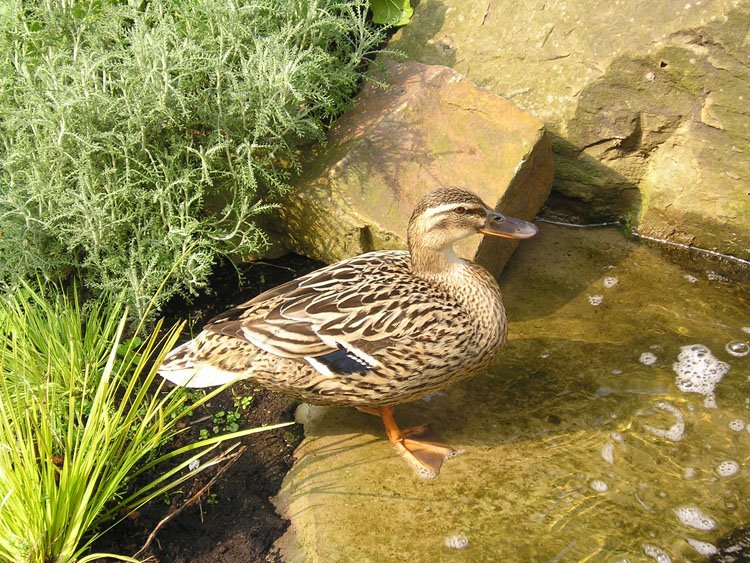
Photo by Sheila Webber: Duck enjoying a water feature in Sheffield University campus, May 2006.

Saturday, May 13, 2006

LOEX

The LOEX (US information literacy) conference took place 6-7 May 2006. On the website you can read abstracts of papers and student posters, and there are ppts of two keynote speeches: Scott Walter on Teacher/librarian 2.0 and Joan K. Lippincott on the Net Gen.
http://www.lib.umd.edu/loex2006/index.html

Photo by Sheila Webber: Daffodils, Sheffield, April 2006.

InfusionS

InfusionS - Information Skills Training in Scotland http://www.infusions.org.uk is running workshops in Edinburgh at Queen Margaret University College. They include "Net Navigator" and "Informed web searcher" sessions. InfusionS is a training partnership between the Department of Information Management,The Robert Gordon University, Aberdeen and School of Social Sciences, Media and Communication, Queen Margaret University College.

Photo by Sheila Webber: Hill House, Helensburgh, April 2006.

Thursday, May 11, 2006

Clear blue sky

The sky was such a perfect blue today I couldn't resist photographing it on my way into work (right). Unfortunately I didn't get to see much of it, especially as my room has practically no natural light. Today included talking to individual students about their business information assignments which are due on Monday, having a good meeting with Moira Bent from Newcastle University about her IL projects (see earlier blog entry), and giving a lecture on information literacy in the workplace to 2nd year students. In particular, I was linking IL with Knowledge Management (which is a key topic of that class). Unsurprisingly, I stressed how effective KM (of whatever flavour or school) is difficult if you don't have information literate staff. Three recent papers I cited were:

Crawford, J. (2006) “The use of electronic information services and information literacy: A Glasgow Caledonian University study.” Journal of librarianship and information science, 38 (1), 33-44. (Includes results of an alumni survey - alumni thought IL was v. useful in their jobs)

Lloyd, A. (2005) "Information literacy: different contexts, different concepts, different truths?" Journal of librarianship and information science, 37 (2), 82-88. (reporting on her "information literacy of firemen" study, which identifies "information in the body" - e.g. how colleagues handle and use equipment in an actual fire - as a vital element that they have to be literate with)

Wang, M-Y. (2006) "The impact of information culture on managing knowledge: a double case study of pharmaceutical manufacturers in Taiwan." Library review, 55 (3), 209-221. (Includes discussion of IL in the two companies)

Report from WILU

I just noticed that Sylvie Chevillotte is blogging the Canadian WILU information literacy conference. WILU was excellent last year and sounds good this year too. If you can understand French at all, do go to her blog at http://blogformist.enssib.fr/

Photo taken in the Arboretum at Guelph University, after last year's WILU.

Wednesday, May 10, 2006

ISL & Survive and thrive

The 2006 Improving student learning conference takes place in Bath, UK on 4-6 September 2006. The theme is Improving Student Learning Through Teaching and subthemes include diversity, course and programme design, institutional strategies, e-learning etc. http://www.brookes.ac.uk/
services/ocsd/1_ocsld/isl2006/


The Council for Learning Resources in Colleges (CoLRiC) is having its conference on 9 June 2006 in manchester, UK : “Survive and Thrive”: Learning Resources for the Future. One of the breakout sessions focuses on information literacy. http://www.colric.org.uk/

Photo by Sheila Webber: Warmer weather is arriving, and unfortunately so are the dandelions. Although if you look at them individually, they are pretty.

Information Literacy Online (NZ)

The Information Literacy Online (NZ) website offers a unique approach to studying IL with it's "Three Doors to Information Literacy" resources. Aimed primarily at students, the website also provides resources for educators and librarians. A list of topical readings and an Information Literacy Forum are also available on the website.

For more inforation, visit Information Literacy Online.

6th Annual Augustana Information Literacy in Academic Libraries Workshop

The 6th Annual Augustana Information Literacy in Academic Libraries Workshop will be held on November 16, 2006 at the Augustana Faculty, University of Alberta (Camrose, Alberta) and this year's theme is "Supporting Undergraduate Research Experiences". The first presenter is listed as Elizabeth Dupuis, who is the Head of Instructional Services at University of California, Berkeley.

Registration for this one-day workshop opens in August, 2006, and more information can be found on the Augustana website.

Tuesday, May 09, 2006

Seneca College (Canada) is building an Information Literacy Repository and is seeking an existing IL or BibI controlled vocabulary to use in the repository to describe their resources. If you have any information or a vocabulary to share please contact: jennifer.peters-lise@senecac.on.ca

Photo by Sheila Webber: Reflections of the outside world (& 2 observers) in the CN Tower, Toronto, Canada, May 2005.

NIACE events

There are some interesting events run by NIACE (The National Institute of Adult Continuing Education - England and Wales) e.g. Future Learning: Exploring the digital opportunities for adult learners, on 13th June. For details go to: http://www.niace.org.uk/Conferences/Conferences.htm

Photo by Sheila Webber: Fallen cherry blosson in Weston Park, May 2006 (most of the white blossom has been washed off by the rain by now)

Monday, May 08, 2006

Peer support for learning and teaching development

Together we are strong: peer support for learning and teaching development is an interesting one-day conference for library and information professionals, to be held at De Montfort University, Leicester, UK, 8 June 2006. The event is organised by two National Teaching Fellows, and supported by HEA SPS funding and the 'Infoteach' NTF project (http://www.infoteach.org/) To book, contact Chris Powis, Learning Support Co-ordinator, Rockingham Library, University of Northampton, tel. 01604 892229, email chris.powis@northampton.ac.uk

Photo by Sheila Webber: Horse chestnut flowers and leaves, May 2006.

A few recent articles

All in priced journals, I'm afraid.
- Loo, A. and Chung, C.W. (2006) "A model for information literacy course development: a liberal arts perspective." Library review, 55 (4), 249-258. (Describes the design and content of a year 1 information literacy course developed at Lingnan UniversityHong Kong (total no. of students 2,200).
- Wang, M-Y. (2006) "The impact of information culture on managing knowledge: a double case study of pharmaceutical manufacturers in Taiwan." Library review, 55 (3), 209-221. (Includes consideration of the staff's information literacy).

Reference services review, 34 (1), 2006: has, as usual with this journal, numerous articles about information literacy, including:
- Matoush, T.L. "New forms of information literacy" pp156- 163. (Describes information literacy programs at San Jose State University King Library.)
- Choinski, E. and Emanuel, M. "The one-minute paper and the one-hour class: Outcomes assessment for one-shot library instruction" pp148- 155. (Describes the use of a one-minute paper to evaluate short sessions aimed at students of Spanish and Biology.)
- Walker, B.E. "Using humor in library instruction" pp117- 128. (Personally I think that you have to be v. cautious in your use of humour with students, unless you know them, or they might just think you are pathetic. Walker outlines some issues).
- Sharkey, J. "Towards information fluency: applying a different model to an information literacy credit course." pp71- 85. (Discusses "the application of the information fluency model, created by the Associated Colleges of the South, to the Purdue University Libraries one-credit information literacy course.")

Photo by Sheila Webber: Glasgow Botanic Gardens, April 2006.

Sunday, May 07, 2006

Susan Greenfield

Bill Johnston (see his photo of Fremantle horbour, right) drew my attention to an recent speech by (Baroness) Susan Greenfield in the House of Lords. I once shared an Australian news column with her (couldn't resist mentioning this: it was an article about information literacy and had some quotes from me, Ralph Catts and her). Her speech to the Lords is about new media and young people's interaction with it, and how we don't actually know what effect all this is having on people's brains. She also mentions increasing prescription of mood altering drugs.

A few quotations: She feels that when people are no longer familiar with the experience of engaging with an extended narrative or argument, then, when they encounter multimedia "The most immediate reaction [...] would be to place a premium on the most obvious feature, the immediate sensory content-we could call it the "yuk" or "wow" factor. You would be having an experience rather than learning." "The [National] Literacy Trust pointed out that reading from the screen was just as legitimate as reading from a book, but we might ask how long this trend will continue. Already the visual icon is often substituting for the written word. Soon the spoken word will be increasingly available. If we soon have voice-interface computers-such computers are in the near future-embedded in our clothing or personal effects, you might simply need to ask your watch for the date of the Battle of Hastings." "We must surely choose to adopt technology that will ensure that the classroom will fit the child, and buck the growing trend for technology to be used to make the 21st-century child fit the classroom. The educational needs of the individual are changing and the very nature of the classroom needs to change too. "

You can find the complete text on the Hansard for 20th April 2006, scroll down a bit to 3.18pm (for overseas readers, Hansard is the verbatim record of proceedings in the Houses of Parliament) http://www.publications.parliament.uk/pa/
ld199900/ldhansrd/pdvn/lds06/text/60420-18.htm

She also mentions the ESRC funded seminar series Collaborative Frameworks for Neuroscience and Education - see http://www.bris.ac.uk/education/research/sites/brain/