Friday, April 21, 2023

Information Literacy and podcasting: teaching and learning through conversation #LILAC23 @pedagodzilla @UKCopyrightLit

This is Sheila Webber, catching up on the last session I attended yesterday (my laptop battery ran out before the session did - as a sidenote, why do modern university building still not have enough sockets for recharging?) 

This presentation was run as a podcast of Chatting Infolit (Bethan Morgan, Josh Rodda & Ella Wharton), with guests Mark Childs, one half of the Pedagodzilla podcast (combining pedagogy and pop culture) and Chris Morrison and Jane Secker who produce Copyright Waffle. Having experienced the event it will be fascinating to hear what makes it through into the actual podcast! It was a really lively session, and these are my impressions of what went on.

Childs said how the idea for Pedagodzilla came up in conversation with Mike Collins about education, and thinking about how to explain theories and models relevant to education in an accessible and engaging way. It also exploited their interest in comics, films etc. Similarly Secker and Morrison wanted to make copyright literacy easier to understand and more interesting, and find out what made it interesting to other people.

They all agreed that you don't have to have expensive kit e.g. you can use the free app Audacity for editing (although they all had good microphones). In terms of inviting people to your podcast, Childs said it was a good idea not to start out by inviting in "big names" but get a structure and format that works for you before inviting people who are going to make you nervous. Finding people who are going to be enthusiastic is going to make the podcast more interesting, and both Copyright Waffle and Pedagodzilla have people offering ideas for podcast episodes.

In terms of challenges - Childs said he didn't really have any, as Collins had the technical expertise, and also, because community engagement was part of the job for them at the Open University, then they could do a lot in work time (though Childs has now moved to Durham University). The podcasters agreed that time (editing etc.) was an issue. Morrison said that they had worried about being too self indulgent, but the point was made that if you don't want to listen, you don't have to.

Childs advised not worrying about an audience for your podcast initially, because it will build exponentially as you create more episodes. However, getting to know how to put the podcast on different platforms (which is a good way of extending your audience) requires some effort. They also talked about things like listing the podcast in your email signature. 

There was a question about the connection with pedagogy and information literacy. The podcasters talked about learning through conversation and dialogue, and podcasting seeming perhaps more direct and intimate than a video. Secker felt that podcasting was particularly useful for exploring big issues for example in information literacy. They see Copyright Waffle as not being about giving step by step guides through a topic but, for example, helping people understand that there are people that can give them advice, getting people interested in the topic, getting people motivated to find out more for themselves. 

There was a question about how podcasting had affected other parts of their professional lives. Morrison said that he could refer people to specific podcasts and podcast guests - particularly to answer questions that come up again and again. Secker said that it had made her more confident in her teaching. Childs said that he has found it as an outlet for a creative and authentic self. It could also be seen as evidence of your impact, particularly if you have statistics to show that people from many countries are listening to your podcast. Morrison and Secker saw podcasting as part of open educational practice, and have a creative commons license.

There was a question about how long something had to b, to count as e a podcast: the feeling was - 10 minutes, but it had to be conversational with the dialogue element. A follow up question was the difference between an audio file and a podcast. This seems to be an evolving question, as an older definition just mentions the audio file part. There was agreement that it has to be disseminated via rss and have episodes. Then there are additional elements such as brand, marketing, narrative, show notes etc. The element of conversation and dialogue was mentioned again. The podcasters were asked whether their interviews were like research interviews. Morrison said they have a conversation with interviewees beforehand, but they don't have a set list of questions, making it more organic and a conversation rather than an interview. Childs said that over preparation makes it sound stilted, but you had to make some preparation or (speaking from experience) it could go wrong. I blogged recently that I have done two Pedagodzilla podcasts and from my perspective it didn't seem like an interview, but was joining in a fun conversation. 

This was a fun and useful session and may well result in more podcasters!

Thursday, April 20, 2023

#LILAC23 Are western referencing styles a form of oppressive academic practices?

Pam McKinney here live blogging from the #LILAC23 conference at the final session of the day which is a panel session with Caroline Ball, Tom Peach, Diane Pennington and Ludi Price. The panel spoke about the research they had done to prepare for the panel, and there’s a lot of research about the politics of citation, and the way that certain types of knowledge are neglected by referencing systems, and question the process of referencing. So many referencing styles are rooted in a western cultural environment, western meaning structures, and  designed largely by UK and US. universities. Academics are often very opinionated about referencing systems, and have wildly differing views about the breadth and applicability of specific referencing systems.

Disabled students in particular find it really difficult to engage with referencing. For example referencing that uses footnotes is really hard to use with a screen reader. All academic structures, not just referencing but also journal databases and information products uses the western alphabet and western naming conventions.. Chinese characters for names can be translated in very different ways in the Roman alphabet sometimes the family name is capitalised, but this isn’t necessarily used by everyone, and it can be impossible, for example, to tell what a person’s gender is from the western translation of their name.In an environment of scholarly publishing that prizes metrics, if non-western authors can’t track their citations they are disadvantaged. Students sometimes avoid referencing non western authors because they are scared of getting the name wrong and being penalised for poor referencing.

Very few referencing systems can deal with oral or traditional knowledge. Often it’s passed as “personal communication” but this downgrades the value of this information. A chat you have with someone is not the same authority as knowledge that has been handed down through generations in a particular community. Wikipedia is currently examining its practice of supporting entries with written citations which is exclusionary for certain types of knowledge. 

The idea that information can be owned by a person, and by copyrighted is actually quite a western concept, and other cultures have a more shared conception of knowledge, that it is owned by a community.

While there is recognition that there might be some issues with the exclusionary nature of referencing styles, there are barriers to change. Any new mode of referencing must be flexible, and we have to recognise the time burden in effecting meaningful change. What if all references were replaced by hyperlinks? What if everyone had an ORCID ID? But not everyone has an internet connection, not everyone has an ORCID ID. The panel found that every solution they came up with had significant practical issues.
Photo Pam mcKinney: LILAC lanyards

Authority of knowledge: historians on Wikipedia in higher education #LILAC23

In this session Dr Delphine Doucet (University of Sunderland) presented insights from her research exploring the relationship between history academics’ conceptions of knowledge and authority in their fields of research and their assessment of Wikipedia’s authority and credibility as a teaching resource.

She talked about her context - until recently she was a history lecturer, with a focus in intellectual history16th-18th, and one of the questions in that field is how authority is created, and what tools people use to mark authority. Then on the LISM course at Sheffield iSchool (where I was her dissertation supervisor) she got interested in the issue of Wikipedia and authority (stimulated by work by Diana Park & Lauri Bridges - see e.g. here).  Doucet talked about the way in which wikipedia has entered the academic discourse, and how the literature shows that academics in some disciplines (e.g. health) have been more positive than others. She discovered that history articles are the most consulted, and all this led to examining history academics' opinions and practice concerning Wikipedia. 

Doucet interviewed 8 academic historians, from different types of university and at different stages of their career.These are some insights. Firstly there was the definition of authority. There are some traditional types of marker (such as publication, academic position) but also authority is seen as cultural and situated and as one interviewee said "bound up with kind of cultural assumptions and social assumptions we make". 

Doucet asked each historian to evaluate 2 Wikipedia pages related to their subject specialism: one broader and one more specialist. There was consensus that the pages were factually accurate - however they were also problematic. One problem was giving too much prominence to particular aspect - so inaccuracy which distorts the subject, but not factual inaccuracy. Another problem was the structuring of articles which was needed to make them better relect current thinking. A further problem is in niche areas - for example a topic where the published information is in old encyclopaedias, so (as one interviewee said) a 21st century medium presenting 19th century ideas. There may be too much influence from the niche enthusiast with a particular viewpoint. While Wikipedia was good with factual information, it was not good in areas where there were different perspectives (which a historian would want represented) - this was a problem partly because of Wikipedia's emphasis on consensus. There was also a cultural/linguistic issue (e.g. French vs. English Wikipedia).

In terms of teaching with Wikipedia, two interviewees were reluctant to see Wikipedia as a teaching tool, and the others were interested (one was using it already) and wanted to move away from the old "don't use wikipedia" position. They might recommend the Wikipedia article as a starting point, but caveats included the fact that references in Wikipedia articles might not be accessible (e.g. referring to older textbooks etc.) and might not reflect the best reading recommended for that topic. The interviewees used it themselves for leisure, but for historical practice it was used mainly to check dates. They considered using wikipedia editing as part of teaching and assessment, but there were tensions which she illustrated in a model (see the image above). Problems included the question of whether editing in wikipedia would develop historical writing skills (as required elsewhere in the programme) and at what stage of education it would be feasible/ usable. However Wikipedia can be useful to develop other information and writing skills.


Information Literacy as a practice for survival #LILAC23

Today I (Sheila Webber) participated in a panel at the LILAC (Information Literacy) conference, together with Drew Whitworth, Geoff Walton, Alison Hicks and my colleague & fellow blogger Pam McKinney. The session starts with a short "provocation" from each of us, and mine is on older people, infolit and survival. I thought I'd blog my slide since in particular I want to identify that the age positive logo is from the Centre for Ageing Better's image bank (the other photo is one I took of a British street sign).

Firstly I identify two common ways that people talk about older people: the first is portraying older people as a burden, a problem, a dead weight that is threatening the survival of anyone younger; the second portrays older people as in need of saving, as lonely and helpless poor things. In the context of information literacy this means seeing them as needing others to remedy their deficiencies in finding and using information (e.g. health information) and deficiences in being able to use technology to communicate. 

This stereotyping is harmful to older people who want to survive, but also do more than just "survive". In the bottom half of the slide I present the three roles which Bill Johnston and I have identified for Age Friendly media and information literacy. The first role is for everyone: avoiding steroetyping and disinformation in portraying older people. The second involves giving older people a role as consumers of information - finding out their preferences and practices (and not assuming that their practices are "wrong" because they aren't the same as younger people's). The third role is about agency and creativity - seeing older people as being entitled to opportunities to exercise their creativity with information and media.slide for LILAC described above

The Image: Centre for Ageing Better https://ageingbetter.resourcespace.com/?r=8601&k=ccab450b22

Mind the gap! Embedding IL framework principles across a complex institution #LILAC23

Tilley slide showing types of learning outcome, Managing Information comes highest

Sheila here, liveblogging a presentation by Elizabeth Tilley (the presenter), Paul Cooke, Laura Jeffrey and Clare Trowell (Cambridge University, UK). She started by giving some context about Cambridge University, in particular that there aree 31 colleges, and teaching and student experience focuses on a student's college. There are a lot of libraries: subject libraries, college libraries and the main university library. This means there is a big variation of spaces and many library staff (450).  

The librarians have colbaoratively developed the Cambridge Information Literacy Framework (ILF) https://camiln.wordpress.com/information-literacy-framework/ which has already been revised 2 or 3 times. It was created in 2016, and the question was raised - how much is it being used? This was partly stimulated by the creation of the the Library Study Skills Catalogue (LSSC), which includes entries for library sessions (the first time they've brought together things going on across the university). Another stimulus was Hicks & Lloyd (2022) (reference below) which categorises learning outcomes as being about "mapping" or "applying". 

The research question was "How far does the IL Framework inform the practice of teaching at Cambridge?". Tilley used Critical Discourse Analysis using ILF and LSSC texts using nVivo text analysis software. The outcomes were also categorised using Hicks & Lloyds - plus there was some additional work e.g. triangulating with library staff.

The first photo shows what kinds of learning outcomes emerged from the learning outcomes given for actual training etc. (entries in the LSSC). There were some learning outcomes that didn't have a good match with the ILF - sometimes because they may be peripherally related to IL, or in some cases it is possible the ILF is not inclusive enough.

Tilley slides showing nVivo relationship map

There was a strong positive correlation (between the language in the ILF and the outcomes named in training they are offering)with (1) Use/understand/learn and (2) search/find/discover. There was a stronger negative correlation with (1) create/develop/process (2) criticality (3) reflect/assess. Comparingwith the Hicks & Lloyd categories - neither outcomes nor the ILF focus on compliance, authority or reflection, and a larger percentage of learning outcomes relate to mapping dimensions.

Observations included: there is a strong focus on search; there is language used in Leraning Outcomes (for actual teaching) that isn't in the ILF; there are 2 different vocabularies - controlled vocabulary (in the ILF or Hicks & Lloyd) and the local social/culturally created language. Coming out of this there is an issue of whether the language used to describe training matches well with students' or academics' language. There are follow up questions and actions - such as usability work on the LSSC language and examination of potential omissions.

Hicks, A., & Lloyd, A. (2022). Reaching into the basket of doom: Learning outcomes, discourse and information literacy. Journal of Librarianship and Information Science, 0(0). https://doi.org/10.1177/09610006211067216 


#LILAC23 Embracing the bias: using theory to teach positional knowledge

Pam McKinney live blogging from #LILAC23: Melissa Johnson and Thomas Weekes from Augusta University, Georgia, USA, spoke about the different skill levels of their incoming undergraduates. They have preconceived notions of authority and bias, and some are reluctant to use peer reviewed journal articles because the authors are experts and therefore biased. Is all bias inherently bad? The position these presenters have is that students need to engage with bias in order to understand it. Many of us are familiar with the concept of bias in the media, particularly relating to political views. There is also bias in health science research, for example selection bias, or detection bias. In social science research there is an inherent bias between qualitative and quantitativ research, and bias generally in academia e.g. citation bias and publication bias.

As librarians, how do we help students navigate bias? Simplistic definitions of bias can be seen in models of information evaluation e.g. the CRAAP test. Unfortunately, bias is not well defined, so librarians could do more to help users navigate bias. Using theory is a better way to help students understand bias, for example epistemic injustice, which is defined as the wrong done to one in their capacity as a knower (Fricker 2007). We have to be aware of whether the academy marginalised non-scholarly voices because they experience the world in a different way. Students tend to think of bias simply, but it can lead them to define other people as biased due to their own prejudices.  

Examining one’s positionality is an important activity to address this. Positionality is linked to the ACRL Framework of information literacy dispositions, students as researchers need to understand their position. Students occupy a specific social position due to their gender, class, background etc, and have a limited vantage point from which to understand the world. Our position gives us certain ways of thinking that prejudice us towards certain ways of knowing and understanding. Teaching students about this is hard, as students find this challenging of their world view uncomfortable. We need to move beyond the checklist approach when teaching bias, and teach them to reflect on their own positionality when evaluating bias, however this is challenging in the context of the one shot library induction session. Using flipped learning can help, and building credit bearing library courses, and using continuous reinforcement.
Photo Pam McKinney, Cambridge Zoology Museum

Supporting Faculty to Decode Information Literacy #LILAC23

Sheila Webber, liveblogging at LILAC. In this workshop Amanda Folk, Katie Blocksidge and Jane Hammons (Ohio State University Libraries, USA) were introducing a workshop for academics that uses Decoding the Disciplines and Writing to Learn. They have made material available online at https://go.osu.edu/lilacIL which you could also use to develop academics' ability to teach information literacy, in your own institution. It is well worth investigating this.

They ran through some key stages of the workshop that they run for academics, for example starting by asking us to identify information literacy problems that we encounter with students, sharing our thoughts on a jamboard. I put "Finding words and phrases (on search engines, databases) that will bring up the articles they want (especially when English is not their first language)" as I know this can be really challenging for learners who haven't had to search for much literature before and aren't very familiar with their subject yet.

The workshop leaders then introduced the ACRL Framework and the definition of IL that it uses. They talked about threshold concepts and ways of thinking and practising in the discipline, and how academics will have internalised the values and norms of their discipline, and not explicitly teach the students about issues (such as how to cite and write) that are familiar to the academic but not to the student. "Bringing these expectations to the surface is a driver of the work we do with faculty". They emphasised that working through academics was scalable, sustainable and enabled the librarians to expand their research (as there weren't enough librarians to reach all students directly).

After this the team introduced Decoding the disciplines (the wheel is shown above, from the Decoding the Disciplines website (linked above). We were asked to work through some of the steps, based on the problem we had thought about for the jamboard exercise. Step 2 "Uncover the mental tasks" included identifying a relevant ACRL frame and the dispositions and knowledge that need to be taught more explicitly (e.g. I think "Searching as Strategic exploration - understand that first attempts at searching do not always produce adequate results" is relevant although I couldn't really find a disposition or knowledge practice that corresponded to the very basic linguistic problem).  

The team then introduced the idea of writing to learn ("short, impromptu or otherwise informal and low-stakes writing tasks that help students think through key concepts or ideas presented in a course.") for steps 3 and 4 from the Wheel - there is a booklet on this as part of the material at https://go.osu.edu/lilacIL. I selected "Writing definitions"  (to help understand what words to use and what concepts they are searching for).

The team have written articles about these programmes e.g. Folk, A. & Hammons, J. (2021). Expanding Our Reach: Implementing Instructor Development Programming, International Information & Library Review, 53(1), 69-78. https://doi.org/10.1080/10572317.2021.1869451

#LILAC23 The social turn in literacy development and education strategy: impact on library practice

Pam McKinney here live blogging from the second day of the #LILAC23 conference in cambridge. This session is led by Professor Sheila Corrall, who presents the results from a research project to investigate the range of “literacies” taught by academic librarians, and how pedagogies and roles have developed to take account of the breadth of new literacies. The social turn is a term in use since the 1970s to encompass increase in socially engaged practices, it is associated with an increase in collaborative pedagogies and constructivist theories of education, use of critical theory, and embodied activism characterised by a nuanced sense of the intersection between the personal and the political. The social turn is also related to participatory culture, which is has low barriers to artistic expression and civic engagement, where societies work together with a greater sense of community. 

Citizen science and citizen journalism are examples of the social turn from the wealth of nations to the wealth of networks. The democratisation of professionalism is exemplified by the move from librarians doing online searches on behalf of library users in the early days of the Internet, to a situation where users do their own searching but librarians work alongside users to support search activity. Universities have moved from elite institutions only accessible by the elite (e.g. in the UK in the 1950s only 5% of the population went to university) to a transformative socially inclusive model of education, with a widening participation agenda. More recently we see a move from the university as a purveyor of entrepreneurship support, to one where the university is a force for civic engagement and citizenship education. Academics engaging in research in partnership with community groups, and support life wide learning.

Looking more specifically at academic libraries, the social turn is evidenced by a move towards personal and first-year librarians, who are engaged in pre-arrival programmes and resources, manage recreational reading resources, are engaged in sustainably development and decolonisation projects and deliberative forums and civic literacy. There is recognition of the need to tailor resources to different students, and educate the whole student, addressing the social issues that affect students in higher education today. Library spaces are used to support health and well-being, which has been a growing concern even before the pandemic, libraries have played a major role as a learning space on campus where students can go for support, working in partnership with student support departments.

The social turn  in literacy thinking in practice has moved from thinking about literacy as a basic skill set to thinking about literacy as a suite of skills that enable people to engage in society, it is a situated practice, best understood as a social constructivist process of meaning making. This is related to the shift from skills based conceptions of information literacy to a much more learning related framework, based on knowledge dispositions and threshold concepts in learning.  Sheila presented a table from her new book which summarises the literacies taught or facilitated by academic librarians, which she categorises into multiliteracies taught from the 1980s, infoliteracies  taught from the 1990s such as critical literacies, digital and information literacy and the 21 century literacies which are characterised by lifelong and life wide literacies that students need to engage in modern society, for example quantitative literacy and financial literacy. 

The pandemic really put the spotlight on how important information literacy is in everyday life, for example the data shared on TV about the pandemic statistics showed how important it is to have data literacy. Koltay has chacterised core and derived literacies for living with a pandemic which is a complex-pluralist literacy landscape.

The educational practices of academic librarians are in constant development. Librarians adjust their pedagogies to reflect trends and developments in teaching practice generally, and how students learn in these new environments. For example pedagogies developed for maker spaces in libraries, social justice education, identity conscious strategies, contemplative strategies etc. Librarians have a vital part to play as 3rd place professionals who can work across the university to support learning. Library pedagogies have evolved from behaviourist transmissible models of education to collaborative interactive, inclusive and participative centred models. A side by side approach to supporting users can be more welcoming and inclusive, and we have to recognise that while self service is great, people still need support. 

Professional development frameworks need to be revised and expanded to develop collaborative capacity, focusing on relationship management, cultural competence and critical reflection. Academic libraries are moving from collecting to connecting, and information literacy practitioners are leading the way here.
Photo Pam McKinney, Cambridge Zoology Museum (where the reception was held)


Accessibility – what does it mean for libraries and education #LILAC23

Sheila Webber here - I'm attending LILAC today and the first session I'm liveblogging is the day's keynote from Maria King (Edinburgh Napier University, Scotland): Accessibility – what does it mean for libraries and education. Last year she presented on Inclusive Teaching Practices to Improve the Learning Experience for Neurodivergent Learners and the slides are here. This year King had prepared a video going through some key guidelines and questions, which will be generally available after the conference. The session itself focused on answering questions from conference participants, mostly submitted in advance. The notes that follow are my impressions as I liveblog, so I apologise if I misinterpreted, and also I couldn't capture all the responses so apologies if my description is unbalanced.

The first question was asking whether accessibility work was distributed equally through the workforce. King's answer was no, there seemed to be a lot of assumptions that people in the accessibility team would be dealing with this, and also people who have a personal interest might take up the issues. When people take up EDI work this can be seen as something "extra" and not scheduled properly into the workload. This is not satisfactory. This can vary depending on individual managers or organisations - whether they acknowledge this workload and whether they realise that accessibility is everyone's issue. The solution has to be at management level, so it is embedded in the work of a team, this means the work is seen as part of the job and doesn't stop because an interested person leaves. Also people can make sure they aren't leaving everything to their colleague. 

A related question was how you deal with the situation where you know a lot about accessibility, and a colleague who needs to learn more about accessibility is given responsibility for accessibility. King said that having material that can help people learn about accessibility, to carry out their job better is one obvious thing. She also said that her approach would also be to draw attention to the fact that this issue is not being prioritised enough, if need be. 

The second main question raised was that there was much more attention paid to accessibility for students, without taking account of staff's needs. King said that, yes, accessibility teams generally have a remit to look at the student experience without there being an aquivalent team for staff accessibility. This didn't take account of the fact that there will be staff, researchers and external visitors who need adjustments and accessibility. There can be nothing on a website aimed at these people. Obviously this is something that needs addressing. 

How librarians can signpost assisstive technology so it can be more easily known about by disabled people, was another question. King said that including reference to assistive technologies and accessibility features as routine when you are doing training sessions and demonstrations is an answer - so it is just part of explaining the features of the database, search engine etc. to help everyone, including disabled people, to get the best out of services.
The next question was about the use of AI and how it could be useful in generating text descriptions of images. King said that you have to be cautious because automatically generated text for an image can be variable in the quality of the text generated and also it won't know the context in which the image is being used. 

A question about appropropriate pedagogy had been posed. King said it should be student centred, flexible, active learning, where people can tailor to their own needs - basically anything coming from a more constructivist approach to pedagogy. King said a little about "punk pedagogy" which she positioned as a critical constructivist pedagogy which questions, critiques, enables people to decide how they want to learn. From an accessibility point of view, enabling engagement in multiple ways was important - she gave the example of the keynote itself where you could use the QR code, submit a question in advance or raise a question on the day in person. Another one was thinking about how some people are anxious about working in a group, so activities should be clear and have options to engage in different ways. A big thing was sending out materials in advance, so that people can take the time they need to engage with it. 

Next there was a question about how you can persuade academics to do what they need to about accessibility. One option is training courses on accessible teaching methods, although there can be variable takeup. King also talked about how having a requirment for academics to evidence that they are teaching in accessible way was effective. Also having people who has personal experience involved in training can have a big impact and help people to take it more seriously - as well as enabling staff who may have accessibility needs realise that they can admit this. A later related question was about giving academics the time to be able to cover this work, and there was a specific question about reading lists and how information about particular needs (e.g. needing print rather than electronic) gets to the people who need to act on it.

Then there was a question about the impact of making ebooks, IL education etc. accessible, how it affected the student experience. King said that anything which shows that you are being considered will help to make you feel that you belong and that you want to be engaged. This means thinking about accessibility right from the start - so that that the disabled person doesn't have to do the emotional labour of having to ask for adjustments constantly and waste time getting the services, applications and information usable. This includes physical and virtual spaces, so people don't feel "this space is not designed for me, I don't belong here". This extends to staff as well - so you need to think about recruitment practices too.

There was a question about intersectionality - King talked about the problems with the diagnosis system, including long delays in getting diagnosed, diagnosis being biased towards symptoms presented by a particular group (e.g. white males).
There followed a question about use of applications which are good for some types of accessibility but not others. Also King raised the problem of institutional applications which have accessibility issues, especially where there isn't an alternative.
King advised using "identity first" terminology (e.g. disabled people) although individuals might have personal preferences.

A final question was whether the overall approach to information literacy was that people were not disabled. King said that this was a general problem, thinking about non-disability being the default. She returned to her advice of designing the learning to enable people to tailor their experience, and offer alternative ways of learning.

Photo Sheila Webber: cherry blossom on Cambridge University Sidgewick campus, April 2023

Wednesday, April 19, 2023

#LILAC23 Social class equity and recruitment: content analysis of teaching librarian postings using critical social psychology

 Pam McKinney here live blogging the final session from day 1 of the #LILAC23 conference, this session wasled by Darren Flynn who is a PhD student at UCL, as well as working in a library context. Darren’s study is informed by the psychology of social class, which tries to understand how people socialise within a social class, and how this affects their behaviour, and differences in values, behaviours, predispositions and preferences.
Middle class norms negatively impact on working class people, for example in the UK school system the concept of school choice is exploited by middle class people but can negatively affect working class people who cannot exercise their choice in the same way. Darren spoke about the spectrum between interdependence and independence. People from working class backgrounds are more likely to rely on their communities and act in a more interdependent way. People from middle class backgrounds tend to focus on the development of personal preferences and choice, and independence. People from working class backgrounds tend to show more empathy, and recognise others’ emotional state. People from a middle class backgrounds tend to be more self-reflective and focus on the self in relation to events.
Generally people from working class backgrounds have less power, and are more constrained by rules and procedures, so learn to overcome and navigate systems and processes. This leads to a pessimistic outlook on life. People from middle or upper class backgrounds have a higher belief that  they can change their environment, and are more politically active, they are less likely to put up with situations they don’t like.
The distinction between pro-social and pro-self: people from working class backgrounds are more pro-social they give more money to charity and people from middle class backgrounds tend to be more driven by individual goal setting, and have a more transactional attitude to help giving. These dispositions are not mutually exclusive, but equity is related to the balance between them.  Darren looked at 197 job advertisements published between November 2021 and October 202, and all mentioned teaching or training related to information literacy. The research looked at 50 person specifications that were included in the job advertisement. All the data were anonymised and the institutions removed, then analysed each was scored against the criteri explained above.
For example working in a team and collaborative working was evidence of interdependence, and negotiation skills were evidence of an influential mindset..  Darren performed some quantifiable analysis on the data using SPSS, to analyse the individual pairs of dispositions and the correlation between pairs. The results showed that the job adverts and  job specs analysed skewed towards independence and reflective skills, which are more middle class dispositions. They were skewed towards pro-self and the more influential rather than adaptive, again the more middle class dispositions. Based on this data, there is evidence that person spec criteria are biased towards dispositions that are more middle class, which influences entry into the profession and career progression.
This affects sector diversity, but could be for a variety of reasons e.g. there is a lot of re-use of job specs without much critical analysis.  Cultural reproduction is the concept that the views and dispositions of a dominant group are reproduced, so if middle class people are writing job descriptions then they will enshrine middle class dispositions. So people from marginalised backgrounds experience jarring consequences of these dispositions and has consequences for the structures in libraries. If recruitment and promotion is biased towards middle class people, are the solutions we present to students also biased towards the middle class?
Photo of the conference venue by Pam McKinney

#LILAC23 How university students use TikTok to search for information

Student award winners

Pam McKinney here live blogging from the #LILAC23. This presentation was led by Elizabeth Brookbank from Western Oregon University, reporting initial results from a study to understand how TikTok might influence IL teaching.
Google are worried about the impact that TikTok could have on their business model, as GenZ are increasingly turning to these new social media for information discovery rather than search engines like Google. In response, Google are changing their algorithm to show more TikTok videos in their search results, and more videos overall. 

Initial conversations took place with students, who reported that it was a lot easier to see what content was paid for on TikTok than on Google. Some thought that using search was pointless on TikTok because of the way the algorithm works, in that it only shows you content in your filter bubble, that you’ve already shown an interest in. It doesn’t allow you to sort results by date, but is useful if you need practical advice on how to do things. There is little published research on how people search on TikTok but one study showed that relevant content is returned faster than on Google, and video content was thought to be easier to engage with than text. The participants didn’t care much about misinformation, and avoid material that is perceived to be risky e.g. health. 

Elizabeth conducted 3 focus groups with students, and these have not been analysed fully; she reported interim results only at the conference. Participants were concerned about spending too much time on the app, and have concerns about the amount of information it harvests. It was seen to be a good way to entertain oneself, and is relaxing. Some participants were TikTok  creators, and used this as a way to share their problems and self-care. Connecting with friends was seen to be a positive aspect of the app, and to find out about the news.
Students were asked if they used TikTok to search for information and half said yes they did, which seemed a little contradictory to Google’s panic about genZ all changing their search interface. TikTok is searched for “how to” videos e.g. for recipes, cleaning, or fixing things or crochet etc. one student used it in a class. Participants were asked about “searching” versus “scrolling”, and reported that TikTok would present them with relevant information if they had been searching for information on other platforms. Students would subscribe to certain hashtags if they had ongoing information needs. Some thought that searching didn’t really work on TikTok.
Comments on other peoples’ videos were useful for gaining a consensus on a topic, and TikTok was seen as a good place to start looking for information, that would be followed up on other platforms. There was a sense that participants were able to judge the authority of content creators, and were sensitive to the lived experiences of certain creators. Aspects such as camera quality, and the look of the video were important ways to judge the quality of the information presented. Political and health information was rarely trusted, generally the participants liked to search for low stakes information on TikTok.
Photo Pam McKinney

Student perceptions of librarian-teacher identity #LILAC23

Poster advertising LILAC

Pam McKinney live blogging from #LILAC23, this session is led by Heather Lincoln and Tiffany Chiu from Imperial College, reporting the results from a Masters in higher education dissertation research project. The study focused on business students’ perceptions of the role of the librarian and how they support learning. Much of the literature focuses on librarians’ perceptions of their role so this is a useful addition to the research base, and could lead to service development. Librarians can suffer from imposter syndrome in relation to their teaching identity. 

Heather conducted 6 focus groups with students studying a variety of programmes in the business school, and analysed the data thematically. Students thought that librarians were approachable, and helped them when they needed it. Students liked their IL teaching, and thought the librarian seemed ‘fun’ and enthusiastic, teaching sessions enabled students to ask questions, which was important to them. Students thought that librarians seemed knowledgeable, and saw their role linked to the library resources and providing access to them. Librarians have an enabling role linked to helping students achieve their learning outcomes. 

Heather framed her research using Lave & Wenger’s theory of communities of practice, saying that librarians were not perceived as part of the students’ academic community of practice. Librarians are seen as “experts” and not part of the community they are mastering. Students were conscious that they could make the librarian feel uncomfortable if they ask about something that the librarian isn’t an expert in. If we look at knowledge as co-constructed, it is useful to think of students as partners in learning, not passive apprentices. In conclusion librarians need to make their areas of expertise obvious to students, and use an approach the co-constructs knowledge with students.
Photo: Pam McKinney

First #LILAC23 Keynote: new professional panel

 Pam McKinney here live blogging from the #LILAC23 Conference. The first keynote is a panel session with new professionals Naomi Cassidy, Tom Peach, Naomi Smith and Kristabelle Williams, chaired by Katie Wise. The panel members work in a variety of sectors and roles, but all are recently qualified and were keen to share their views with the LILAC community.
The first question related to the lack of empathy that some academics have for the IL problems students face. Tom acknowledged that it is really tricky to challenge academics, but that it is useful to approach this problem from the position of seeking to understand. Sometimes institutional policy, departs mental culture and other aspects influence academic opinions, so trying to understand these is useful. Fostering empathy without alienating people is challenging, but is an aspect of successful liaison. It is important that librarians don’t try to adopt all the responsibility for others’ opinions, that is impossible. Tom said that working in an environment where challenge was supported was helpful, and good modelling from his colleagues really helped. 

The second question related to how colleagues respond to particular areas of interest from new professionals. Kristabelle said that her colleagues were really helpful, and that it helped to be opportunistic about promoting IL, for example the Extended Project Qualification taught in UK secondary schools is a good platform for engaging teachers. Kristabelle is a union lead for the National Education Union, and this has helped build relationships with teachers. Naomi Smith  is interested in anti racism and uses strategies such as creating inclusive reading lists and employs arguments such as “this is good for the university image” to encourage academics to engage with this practice.
Naomi Cassidy spoke about how it can be tricky to challenge if you are a member of a minorities group, and be thought of as unlikeable  even though you might just be trying to be assertive. Sometimes it doesn’t benefit senior management for there to be challenge, so that can be hard as a new professional. Any work touching on Equality and Diversity is important, and the role of librarians is to welcome students with protected characteristics into the library. 
Naomi Smith spoke about how important it is to speak openly about diversity, and this is part of institutional culture. Managers should support staff with protected characteristics, and enable discussions e.g. about how race might affect participation in the IL classroom. Naomi Cassidy spoke about how important it is to be bold, as lots of librarians are quite introverted, it sometimes takes one person to speak up to encourage others to say they have aligned values.  

There was a question about students’ use of non traditional academic sources, where the formal literature is seen to be the only valid source  that students could use. This is tricky when university structures do privilege this kind of resource. Naomi Smith spoke about decolonising the library, and including oral tradition as a valid resource is a radical change of direction for the university. Students want to use TikTok, and reference information they have found on that platform, but the librarian has to advise students to ask their lecturer if this is a valid source or not. Some things are beyond the power or role of librarians to control, but librarians can have influence. Naomi Cassidy spoke about the fetishising of peer reviewed research in the health sphere, but it has been proven that some of this literature is harmful for marginalised populations. It’s important to open up these conversations with academics.  

The panel were asked about the lack of diversity in pedagogical structures, Kristabelle spoke about the situation in schools, which have a recruitment and retention crisis. There are gaps and weaknesses in the school curriculum, where information literacy is not well covered. Schools could support transition to university much more comprehensively, if school librarians and university librarians could work more closely with each other.  It is important to involve the student voice in defining what information literacy teaching should look like in schools. In the UK there is a big discrepancy between the library provision in private schools and state schools, and a need for more development opportunities for school librarians. Naomi Smith spoke about how challenging it is to teach critical IL in a one hour class, when lecturers just want simple classes that cover the basics of engaging with the literature. It is hard to speak out from a marginalised position, so allies from more privileged backgrounds are really important. Naomi Cassidy spoke about the difficulties busy medical students face in engaging with information literacy when their courses are very full.
This was a really interesting panel!

Laura Woods: reading between the lines - information literacy in engineering education standards #LILAC23

Photo of Laura Woods

Pam McKinney at #LILAC23: this second session is led by a PhD student that Sheila and I supervise, Laura Woods, who is also a subject librarian at University of Huddersfield. Laura is presenting about how IL is represented in engineering education standards, and this is linked to Laura’s PhD topic of the information worlds of women engineering undergraduate students

In order to understand womens experiences in this area it’s useful to take a step back and look at the overall picture of students experiences in engineering with regards to information. The standards give us a sense of the expectations n this field and the outcomes students are expected to meet. The engineering council accredits engineering degree courses in the UK, and departments have to say how they meet these standards. Also we have standards for IL, the SCONUL 7 Pillars, and the ACRL framework for IL, both widely used in UK universities. The ACRL have a set of documents that are companions to the ACRL IL framework, for specific disciplines, and there is one recently published that is specific to STEM subjects. 

Laura has reviewed the literature on the intersection between IL standards and engineering standards, but only one study has previously been published from the context Bradley (2013), who compared accreditation standards from the UK, US, Canada and Australia for nursing, social work and engineering. Much of the language that Bradley found relating to IL in the engineering standards has now been removed, which has made the information skills required for engineers much more opaque. One statement explicitly identifies IL  needed “students should be able to select and evaluate technical literature “ but this ignores the activity needed to search for literature. Laura maps these competencies onto the SCONUL 7 pillars model and the ACRL framework. There are partial matches with the competencies in both IL frameworks, but also competencies that aren’t covered by the engineering standard. Slide from Laura Woods presentation

This was a useful exercise as it is good to understand the competencies that accrediting bodies require from their students and the courses they study. Information use is rarely mentioned, but is present as a hidden first step rather than a skill that students need to develop. There is a lack of recognition that IL needs to be taught and developed, it is seen as something that either they know already or can just “pick up” during their course. So what should librarians do to address this gap in conceptualisation of IL between librarians and academics? Laura’s PhD study should help answer this question! An association of engineering librarians in UK universities could also help.
Photos: Pam McKinney

Live blogging from Pam Mckinney at #LILAC23

 It’s Pam McKinney here live blogging from #LILAC23 at the university of Cambridge. The first session today is “why don’t they like me? The trials and tribulations of a newly qualified science librarian” by Eva Garcia Grau. Eva spoke about the challenges of starting her role during the covid pandemic, and the dissertation research she undertook while studying a masters at Aberystwyth university. She analysed over 200 published journal articles to understand the barriers to integration of IL teaching in the university curriculum. 

Central barriers were reluctance of academics to give time in their packed curriculum, a lack of institutional support, poor perceptions of librarians, librarian confidence in pedagogy.  There is a need to make IL teaching subject-specific, and teach within the disciplinary context. However close working with academics can facilitate this. Alternative strategies were for academics to do the IL teaching, which positions the librarian as “expert” consultant in IL. Stand-alone IL models are also used, as well as online IL courses. Recommendations coming from the review are to speak the language of academics, and link IL to to the capabilities that students need. Librarians need to be brave, and engage with the acadmicsin the disciplines you support. 

Be confident in librarian teaching identity is also important. Eva’s strategies. Were to adopt  a ‘drip-drip’ approach, and be visible. She made sure she was invited to committees in the academic departments, attending social events and really getting to know the academics socially. She developed good relationships with the professional services colleagues in departments. She found that Demonstrating her knowledge of research helped, and how she could save academic staff time. Word of mouth is helpful for marketing services. 

Barriers were when colleagues left the institution which meant that there was a decrease in engagement, and it is hard to devise IL teaching that is appropriate for Maths. Evidence of success can be seen in an increase in teaching, increase in student appointments, academics seeking her out for support, being invited to events, teaching being booked well in advance, and feeling more confident in her abilities.

It's #LILAC23 !

 Look out for posts from my colleague Dr Pam McKinney who will be liveblogging here through the LILAC conference, and I will be joining her tomorrow!

Tuesday, April 18, 2023

Supporting Library Instruction with Learning Tools Interoperability

The latest Tips and Trends article from the ACRL Instruction Section, Instructional Technologies Committee is Supporting Library Instruction with Learning Tools Interoperability (LTI) by Kelly Safin. "The issue reviews the benefits of utilizing LTI to connect already developed library resources (i.e. LibGuides) within learning management systems such as Canvas." You can find it in pdf https://acrl.ala.org/IS/wp-content/uploads/Spring-23-Tips-and-Trends.pdf and linked from the Tips and Trends home page https://acrl.ala.org/IS/instruction-tools-resources-2/technology/tips-and-trends/
Photo by Sheila Webber: cherry blossom, April 2023

Monday, April 17, 2023

ACRL Science Technology Section's virtual idea exchange

The ACRL Science Technology Section's Information Literacy Committee has organised a free virtual idea exchange. It is on 24 April 2023 at 15.00 US Central Time (which is, e.g., 21.00 UK time). "This session will focus on how to use the ACRL Framework Companion Document for STEM https://www.ala.org/acrl/sites/ala.org.acrl/files/content/standards/Framework_Companion_STEM.pdf and will provide opportunities for participants to drop into different break out rooms based on each Frame to exchange ideas. No need to have attended previous sessions in order to participate." You must register at https://uncw.zoom.us/meeting/register/tZMuf--przstGdOC31GKzUoEM9hEfAgHBYO5#/registration
Photo by Sheila Webber: sunbeam and cherry blossom, April 2023

Saturday, April 15, 2023

Alternative search engines

A short article highlights"new search engines like Brave Search, Neeva and You.com" and how they differ from Google et. al.
Lewandowski, D. (2023, 7 March). Search engines that give users control over their results. https://www.infotoday.eu/Articles/Editorial/Featured-Articles/Search-engines-that-give-users-control-over-their-results-157358.aspx
Photo by Sheila Webber: Greenwich Park, April 2023

Thursday, April 13, 2023

New articles about health literacy

The priced journal Health Information and Libraries Journal (vol. 40 issue 1, 2023) has a special issue on health literacy:
- Health literacy and consumer health information by Maria J. Grant PhD (Editorial; Open access)
- Patient education information material assessment criteria: A scoping review by Khadijeh Ahmadzadeh MSc, Masoud Bahrami PhD, Firoozeh Zare-Farashbandi PhD, Payman Adibi Md-PhD, Mohammad Ali Boroumand MSc, Alireza Rahimi PhD
- A survey of health information seeking by cancer patients indicates some problems over medical explanations and terminology by Mahmut Akbolat PhD, Mustafa Amarat PhD, Özgün Ünal PhD, Gülcan Şantaş PhD - Information seeking behaviour differences indicate which US population groups lack information about human papilloma virus and associated cancer risks by Bahareh Ansari MBA
- Caregivers of children feel confident about using the Internet for health information by Emma Delemere M.sc, Rebecca Maguire PhD CPsychol
- Study of health information needs among adolescents in Croatia shows distinct gender differences in information seeking behaviour by Ivana Martinović PhD, Sung Un Kim PhD, Snježana Stanarević Katavić PhD
- Few changes shown in cancer information-seeking behaviour among young adults in China between 2012 and 2017 by Shaohai Jiang PhD, Piper Liping Liu PhD
- The prevalence of low health literacy in undergraduate students in Pakistan by Aziz-ur Rehman PhD, Salman Bin Naeem PhD, Anthony Faiola PhD
Go to https://onlinelibrary.wiley.com/toc/14711842/2023/40/1
Photo by Sheila Webber: Cherry blossom, April 2023

Wednesday, April 12, 2023

Library Instruction Together @LibInstruct

The conference Library Instruction Together (LIT) 2023 is being held in two parts. There is a virtual conference on 24 May 2023 and an in-person conference on 19 May 2023 in Nashville (Tn.), USA. Both parts are free but registration is required for each.
"The sessions reflect this year's theme, Better Together. This theme reflects the restructuring of LIT to reflect its growth from a small, regional conference named Library Instruction Tennessee to one that was renamed Library Instruction Together this year in recognition of its expanded reach to librarians from all over."
- Registration form for the virtual event, May 24, 2023 https://www.tnla.org/events/register.aspx?id=1738917&itemid=31ca0bd3-5876-40e2-b954-5851e12522d4 and this is the programme https://libraryinstructiontn.files.wordpress.com/2023/04/lit-virtual-conference-program-2023-1.pdf
- Registration form for the in-person event, May 19, 2023 is here and the programme is here ·

Tuesday, April 11, 2023

Call for proposals: Let’s Work Together to Develop Critical Thinkers in the ChatGPT Era

There is a cfp from the IFLA Information Literacy Section (ILS): this is for a session at the IFLA World Library and Information Congress (WLIC) in Rotterdam, Netherlands, August 21-25, 2023 (so you have to be a delegate at the conference to present). The theme is Let’s Work Together to Develop Critical Thinkers in the ChatGPT Era. The deadline for proposals is 1 May 2023. Presentations will be 10 minutes, with a 10-minute Q&A.
"As we continue to move into a more digital age, it is becoming increasingly important to develop critical thinking skills to navigate the vast amount of information available. Libraries should be working together to 1) develop policies, lesson plans and strategies while embracing ChatGPT and related AI technologies; 2) address issues and concerns about the use of AI in libraries through critical lenses; 3) prepare learners for a sustainable future.
"ChatGPT can be a powerful tool for teaching and developing information literacy skills, but it can also be a source of misinformation. It is important for users of ChatGPT to be aware of its limitations and to critically evaluate the information it provides. We are looking for innovative and practical solutions that can equip individuals with the necessary skills to navigate and evaluate information in an era where machine-generated content is ubiquitous.
"Possible sub-themes may include, but are not limited to:
- policies, best practices, and issues with including AI in academia and library information literacy instruction
- strategies to develop critical thinkers collectively in the ChatGPT era
- research on combatting misinformation and disinformation in media, including machine-generated content
- best practice in using ChatGPT and other AI technologies and the ethical implications of using them.
There is full information about how to submit a 500 wotrd abstract at https://www.ifla.org/news/information-literacy-section-call-for-papers-lets-work-together-to-develop-critical-thinkers-in-the-chatgpt-era/
Photo by Sheila Webber: flowerbed, Greenwich Park, April 2023

Monday, April 10, 2023

Generative #AI and search: two articles

Firstly, an article by Phil Bradley on AI and search engines, with some tips on how you can use one on the other, and how AI will be a "Google evolver":
Bradley, P. (2023) The Future of Search Is Intelligent. Computers in Libraries, 43(3). https://www.infotoday.com/cilmag/apr23/Bradley--The-Future-of-Search-Is-Intelligent.shtml

Secondly, some interesting insights from:
Chiang, T. (2023, 9 February). ChatGPT is a blurry jpeg of the web. The New Yorker, https://www.newyorker.com/tech/annals-of-technology/chatgpt-is-a-blurry-jpeg-of-the-web. (n.b. you only get a limited number of stories free, so whether you can access all of this will depend on how many New Yorker articles you accessed previously)
Some quotes (in which I take the Google rather than the ChatGPT approach - you have to guess whether I understood the quotes or not!) "The fact that ChatGPT rephrases material from the Web instead of quoting it word for word makes it seem like a student expressing ideas in her own words, rather than simply regurgitating what she’s read; it creates the illusion that ChatGPT understands the material. In human students, rote memorization isn’t an indicator of genuine learning, so ChatGPT’s inability to produce exact quotes from Web pages is precisely what makes us think that it has learned something."
[having identified that ChatGPT is good at generating filler "content"] "I’d say that anything that’s good for content mills is not good for people searching for information. The rise of this type of repackaging is what makes it harder for us to find what we’re looking for online right now; the more that text generated by large language models gets published on the Web, the more the Web becomes a blurrier version of itself."
Photo by Sheila Webber: fallen cherry blossom, April 2023

Sunday, April 09, 2023

Chatting Info Lit podcast @infolitgroup

The Information Literacy Group New Professionals Sub-Committee has launched a Chatting Info Lit  podcast series. "We will be inviting both new and experienced professionals across multiple LIS sectors to hear about their exciting information literacy projects and to find out what information literacy means to them. We will also be exploring the experience of being a new professional and all the challenges that come with it." There are 2 episodes so far:
(1) Ella Wharton (University of Nottingham, UK) chats to Katie Wise (Berkshire Healthcare NHS Foundation Trust, UK), about the importance of health literacy and about Conversations of Care, a communication training project developed at Royal Berkshire Hospital.
(2) Bethan Morgan (Manchester University NHS Foundation Trust, UK) chats to Frankie Marsh (University of Cambridge, UK) about the link between information literacy and decolonisation in academic libraries.
Apple: https://podcasts.apple.com/gb/podcast/chatting-info-lit/id1673423506
Soundcloud: https://soundcloud.com/chatting-info-lit-podcast
Spotify: https://open.spotify.com/show/18iLL0XJhLMg9YW8IXcPSi
If you want to propose a podcast episode fill in this form https://docs.google.com/forms/d/e/1FAIpQLSebmI12uRP3hstq04_MEhor0xpTw8hNBPVBoU7zDVUwC2wjqw/viewform

Photo by Sheila Webber: Greenwich Park, April 2023

Friday, April 07, 2023

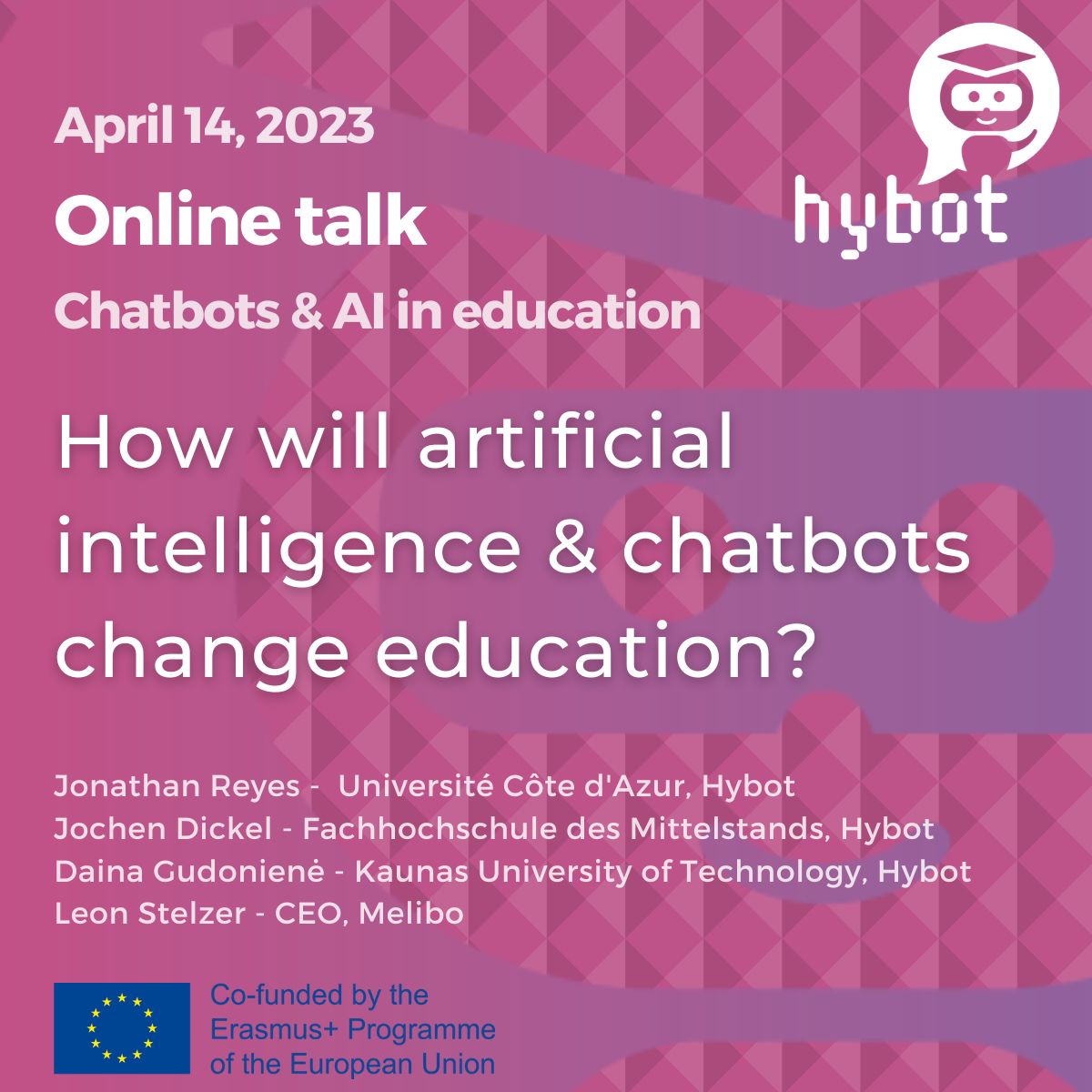
Webinar: How will artificial intelligence and chatbots change education?

Free webinar on 14 April 2023 at 11.00 CET (10.00 UK time) How will artificial intelligence and chatbots change education? This "will discuss technological, pedagogical, and ethical implications of using AI & chatbots in education." The Hybot project (Enhancing hybrid teaching in higher education through chatbots) "aims at creating specific learning spaces through interlinking physical and digital learning environments. In these spaces, various teaching and learning scenarios can be implemented, with variety of time, place, number of students, collaborative and individual tasks." Melibo also creates custom chatbots to answer customer queries etc. Join zoom at https://lnkd.in/e_xjrN9K

Thursday, April 06, 2023

Poscast: Why is Spectrum not a Learning Organistion? @pedagodzilla

My 2nd contribution to the podcast that combines pedagogy and pop culture, Pedagodzilla, is Why is Spectrum not a Learning Organistion? (Ft. Captain Scarlet) Pedagodzilla (Pedagogy = Godzilla!) is run by Mike Collins (The Open University) and Mark Childs (Durham University). In this case I was drawing on my understanding of the learning organisation and applying it to the problematic working culture that pervades the series Captain Scarlet and the Mysterons (spoiler alert, due to the complete inability of Scarlet's employer organisation, Spectrum, to learn anything ever, the result of most episodes is Spectrum nil, The Mysterons 10). To listen to the podcast go to https://www.pedagodzilla.com/why-is-spectrum-not-a-learning-organistion-ft-captain-scarlet/
Photo taken by Sheila Webber in the 3D virtual world Second Life, at the Second Life Sci-Fi Convention, April 2023

Wednesday, April 05, 2023

Webinar: Using Kahoot! to Transform Library Instruction

Another useful free webinar from LiLi (Lifelong InformationLiteracy) is Using Kahoot! to Transform Library Instruction on 19 April 2023 at 10.00-11.00 US Pacific time (which is, e.g. 18.00-19.00 UK time)
"Turn passive library instruction into active learning opportunities by gamifying them, using Kahoot! Build in excitement, engage students, and increase retention by employing low-stakes competition, putting participants in the driver’s seat and bringing high energy to synchronous sessions." Led by Melissa Johnson (Instructional Design Librarian at Southern Methodist University, USA) and Tracey Rinehart (Instruction Coordinator and Business Graduate Programs Librarian at Southern Methodist University, USA). If you are attending, register here. If you just want the recording, register here
Photo by Sheila Webber: another spring/winter tree, March 2023 

Tuesday, April 04, 2023

New articles: Groupwork; information avoidance; use of streaming video

The latest complete issue of the Journal of Academic Librarianship (a priced publication), Volume 49 issue 2 (2023), includes the following: 
- Information literacy problems in groupwork: Interpretations of the ACRL Framework by G. Arave, Ilana Stonebraker ("What problems does groupwork pose for information literacy, and how can the ACRL Framework help us to address them? This paper addresses gaps in the scholarly literature to examine how groupwork problematizes our understanding of information literacy. We explore ramifications of what it means to be information literate as a group versus as an individual. The ACRL Framework is explored for areas of potential opportunity.")
- Exploring the Influence Mechanism of Chinese Young Researchers' Academic Information Avoidance Behavior by Jianing Zhang, Xiaofei Hu, Dawei Wu, Haijuan Yan
- How ethnic studies faculty use streaming video: Instructional needs, applications, and challenges by Keri Prelitz et al. (this article is open access)
Go to https://www.sciencedirect.com/journal/the-journal-of-academic-librarianship/vol/49/issue/2
Photo by Sheila Webber: cherry blossom nranches, March 2023

Monday, April 03, 2023

Podcast: Could phenomenography increase the happiness quotient in Say Yes To The Dress? @pedagodzilla

I was excited to contrubute to two episodes of the podcast that combines pedagogy and pop culture, Pedagodzilla, run by Mike Collins (The Open University) and Mark Childs (Durham University). My first episode is Could phenomenography increase the happiness quotient in Say Yes To The Dress? which combines two areas of my expertise i.e. the research approach phenomenography and the series of many episodes and spinoffs, Say Yes To The Dress (in which brides and their entourages do or do not buy a very expensive wedding dress). The podcast includes explanations about SYTTD and phenomenography, how you can apply the latter to the former, and also how phenomenography can be useful in your educational practice. To listen to the podcast go to https://www.pedagodzilla.com/could-phenomenography-increase-the-happiness-quotient-in-say-yes-to-the-dress/
Photo taken by Sheila Webber in the 3D virtual world Second Life in 2021

Saturday, April 01, 2023

Recent articles: Misinformation; Privacy literacy; Credibility

The latest issue of open access IFLA Journal (Volume 49, No. 1, March 2023) includes
- Strategies for checking misinformation: An approach from the Global South by Anup Kumar Das and Manorama Tripathi
- Croatian adolescents’ credibility judgments in making everyday life decisions by Alica Kolarić
- A review of international education literature: Interdisciplinary and discovery challenges by Shanna Saubert and Liz Cooper
Full issue available at: https://repository.ifla.org/handle/123456789/2540

Hartman-Caverly, S., Chisholm, A., & Glenn, A. (2023). Digital Shred: Case Study of a Remote Privacy Literacy Collaboration. College & Research Libraries, 84(2), 238. https://doi.org/10.5860/crl.84.2.238 "This qualitative, evaluative case study details the conceptual framing, development, delivery, and assessment of a privacy literacy workshop called Digital Shred. The workshop is a multi-institutional effort offered initially in-person in fall 2019 and adapted to virtual delivery in fall 2020. The conceptual framework underlying the workshop includes reputation management, behavioral surplus, data doubles, data governance, and information security damage assessments. " 
Photo by Sheila Webber: winter spring sky, March 2023