Friday, April 08, 2022

Recent articles: librarians' beliefs; IL for inclusion; Synthesis; Remote reference; anti-racism LibGuides

Apologies for not spotting earlier the latest issue of open access journal Communications in Information Literacy (CIL) (volume 15 no. 2) which includes:
- Exploring Teaching Librarians' Beliefs about Undergraduate Student Learning by Ashlynn Kogut
- An Investigation of Anti-Black Racism LibGuides at ARL Member Institutions by Gemmicka Piper, Mahasin Ameen, and M. Sara Lowe
- Information Literacy for Global Inclusion: Designing an Annotated Bibliography for Global Search and Selection by Pamela A. Espinosa de los Monteros and Elizabeth L. Black
- BEAM Me Up: Teaching Rhetorical Methods for Source Use and Synthesis by Ashley Roach-Freiman
- Remote Reference Consultations Are Here to Stay by Emily Reed
Go to https://pdxscholar.library.pdx.edu/comminfolit/vol15/iss2/
Photo by Sheila Webber: daffodils in the snow, March 2022

Thursday, April 07, 2022

Recording: Work of the UK Information Literacy Group

There is a recording of a webinar on 1 April 2022, organised by the LIANZA (New Zealand library association) TEL (Tertiary Libraries) SIG on Information Literacy in the UK: The Media and Information Literacy Alliance (MILA) and work of the CILIP Information Literacy Group. You can find the recording here: https://youtu.be/XSgF3Ugz-xs

Wednesday, April 06, 2022

Recording: Global communications and audiences: Propaganda, fake news & AI censorship

There's a recording of the Webinar: Global communications and audiences: Propaganda, fake news & AI censorship which was held on 28 March 2022, organised by the Data to Power project. It was hosted by Professor Corneliu Bjola (Head of the Oxford Digital Diplomacy Research Group) and the panellists were Grey Yeoh (International Development Consultant (Asia) for the Australia Council for the Arts); Lizzy Jongma (Senior Project Lead for the Network for War Collections WW2 in Amsterdam); Sheldon Paquin (Partnerships Manager with the Science Museum Group). "The panel will explore how a rise in new disinformation and propaganda tools, bots and fake news might affect museum global communications by disrupting the flow of global information exchange and accelerating anxiety, negative sentiment and cross-cultural misunderstanding among online participants." This is in the first 55 minutes of this recording (the 2nd half is an Interactive Data Panel) https://youtu.be/9zHu2n6JeI8

Photo by Sheila Webber: birthday coffee, with cake from Betty's, April 2022

Tuesday, April 05, 2022

Webinar 6 April: Media and Information Literacy and Artificial Intelligence in News Literacy

The Greek National Centre of Audiovisual Media and Communication-EKOME has organised a webinar on Zoom Media & Information Literacy & Artificial Intelligence in News Literacy on 6 April 2022, 16.00-17.00 EET (Athens time: this is e.g. 14.00-15.00 UK time). Speakers from the EU Sub Chapter Mediterranean Group of UNESCO MIL Alliance (see photo) will focus on trends and challenges. Register here https://us06web.zoom.us/webinar/register/WN_u-wAdWG6QQSiSBo2wqOUXw. The webinar will be also livestreamed through EKOME Facebook, @ekomemedia. "All webinars are organized by EKOME under the theme Raising MIL Skills in the Mediterranean: Partnerships & Projects in partnership with the EU Sub Chapter Mediterranean Group of UNESCO Media and Information Literacy Alliance as part of EKOME’s action plan on awareness raising and e-learning on Media and Information Literacy in the Mediterranean and beyond." More about EKOME’s Media and Information Literacy activity here: https://www.ekome.media/audiovisual-literacy-educate/

Monday, April 04, 2022

Short course: Working with Patients with Limited Health Literacy

A MOOC (massive online course) from FutureLearn is Working with Patients with Limited Health Literacy, a 3 week course led by the University of Groningen "On this course, you’ll be introduced to the concept of health literacy. You’ll consider the consequences of limited health literacy, why it happens, and where it happens as you examine Europe-wide patterns. You’ll also identify ways in which health professionals can help those with limited health literacy, and learn strategies for addressing unmet health literacy needs." For free, you can have access to the course (including engaging in discussion) for 3 weeks, and usually you can also download some material whilst you have access. As with most FutureLearn MOOCs, you have to pay if you want longer term acess and a certificate. https://www.futurelearn.com/courses/working-health-literacy
Photo by Sheila Webber: stream, Chapelgarth, March 2022

Sunday, April 03, 2022

Ross J. Todd 1951 - 30 March 2022

I was very sad to hear of the death of Professor Ross J. Todd, who made a great contribution to information literacy. I met him at many conferences: I think the first was the 2004 LIDA conference and the photo on the right was taken in Dubrovnik on a tour during that conference (when he and I were a good deal younger...) The 2nd photo, below, is of him and Theresa Anderson taking photos in the Town House, Aberdeen, at the 2011 i3 conference. 

His work on information literacy schools was particularly notable and influential, and there is much evidence of this in the website of the Rutgers Center for International Scholarship in School Libraries (CISSL): https://cissl.rutgers.edu/ (I would pick out the research with the New Jersey Association of School Librarians- see here). There is an obituary for Riss Todd on the Rutgers University website, here: https://comminfo.rutgers.edu/news/memoriam-ross-j-todd-associate-professor-library-and-information-science 

Here are some links to his work. Firstly, he gave a lot of invited talks and courses: a couple of his talks that I liveblogged:
- his keynote on Uncovering Information Literacy: mythology, myopia and movement at the i3 conference at the Robert Gordon University in Aberdeen in 2011, here 
- his invited talk at the 2014 European Conference on Information Literacy, on Collaborative Inquiry In Digital Information Environments: Expanding Perspectives on Information, here

Secondly, links to some of his open access articles:
- Gordon, C. A., & Todd, R. J. (2009). Weaving Evidence, Reflection, and Action into the Fabric of School Librarianship. Evidence Based Library and Information Practice, 4(2), 4–7. https://doi.org/10.18438/B88S4P
- Kuhlthau, C.C., HeinstrÖm, J. & Todd, R.J. (2008). The 'information search process' revisited: is the model still useful? Information Research, 13(4) paper 355. http://InformationR.net/ir/13-4/paper355.html
- Li, X. & Todd, R.J. (2016). Information practices during 3D modelling in a public library makerspace: generating ideas, seeking help and iterative trial and error. In Proceedings of ISIC, the Information Behaviour Conference, Zadar, Croatia, 20-23 September, 2016: Part 1, Information Research, 21(4), paper isics1601. http://InformationR.net/ir/21-4/isic/isics1601.html
- Todd, R. J. (2008). The Evidence-Based Manifesto for School Librarians. School Library Journal, 54(4), pp.38-43. https://www.slj.com/story/the-evidence-based-manifesto-for-school-librarians
- Todd, R.J. (2006). From information to knowledge: charting and measuring changes in students' knowledge of a curriculum topic. Information Research, 11(4) paper 264. http://InformationR.net/ir/11-4/paper264.html
- Todd, R. (2017). Information Literacy: Agendas for a Sustainable Future. Journal of Information Literacy, 11(1), 120-136. https://doi.org/10.11645/11.1.2233
- Todd, R. J. (2009). School Librarianship and Evidence Based Practice: Progress, Perspectives, and Challenges. Evidence Based Library and Information Practice, 4(2), 78–96. https://doi.org/10.18438/B8BS62
- Todd, R. J. (2014) School library advocacy, evidence and actions in the USA: Principles for planning and implementing advocacy initiatives. Paper presented at: IFLA WLIC 2014 - Lyon - Libraries, Citizens, Societies: Confluence for Knowledge in Session 213 - School Libraries. In: IFLA WLIC 2014, 16-22 August 2014, Lyon, France. http://library.ifla.org/id/eprint/852

Friday, April 01, 2022

Call for proposals: Connecting & Inspiring Reference and Information Professionals in a post-pandemic world

The IFLA Reference and Information Services Section is seeking proposals for panels in their Open Session at the IFLA World Library and Information Congress (WLIC) 2022 in Dublin, Ireland, July 26-29. You will need to be registered for the whole WLIC conference and attend in person. Deadline for proposals is 30 April 2022.
"The pandemic has forced libraries and information professionals to find innovative ways to help users with reference, research, and information requests and heightened the need to discontinue legacy practices related to reference services and staffing models. This session is designed to spark a conversation about how best to respond to the shifting priorities and emerging trends. The panel discussion is an opportunity to hear various voices about differing perspectives and real-life experiences from librarians across the world in response to changing expectations of reference work and adapting to an altered reference and information landscape.
"Participants will hear from the panellists and have a chance to add to the discussion about how to sustain or change reference and information services in a post-pandemic world. We would like to invite panels particularly, but not exclusively, on the following sub-themes: New and virtual modes of services; New policies and/or services introduced during the pandemic; Training for new technological needs in references and information services. Each presentation will be 15 minutes and in English. Time for Q&A will be scheduled after the panel."
Proposals should include: Title of the proposed presentation; Style of presentation (paper or panel); Abstract of the proposed paper (no more than 500 words); Name(s) of presenters and positions and or titles; Employer or affiliated institution; Contact information including email address and telephone number; Short biographical statement of no more than 100 words; Note a willingness to comply with IFLA’s Authors’ Permission; Confirmation that you can attend the IFLA congress and present in person if selected. Email the proposal by 30 April 2022 to Kimberley Bugg kimberleybugg@gmail.com

Thursday, March 31, 2022

New articles: privacy literacy; online teaching; primary source literacy; relational teaching; trauma-informed practice

I thought I should mention other articles (in addition to the one mentioned yesterday) in the latest issue (volume 22 no. 1) of priced publication portal: libraries and the academy. It includes:
- “Making It Happen”: Building Relational Teaching into the Online World of COVID-19 by Carol A. Leibiger, Alan W. Aldrich
- Privacy Literacy: From Doomscrolling to Digital Wellness by Alexandria Chisholm, Sarah Hartman-Caverly
- Primary Source Literacy in the Era of COVID-19 and Beyond by Heidi Craig, Kevin M. O’Sullivan
- Keep Teaching: Leveraging Disruption as a Catalyst for Change by Rachel W. Gammons, Suzanne Wilson, Lindsay Inge Carpenter, Benjamin Shaw ("In response to the COVID-19 global pandemic, the University of Maryland (UMD) Libraries quickly switched to online teaching and learning. This disruption created a chance for innovation, allowing the UMD Libraries to scale back nonessential functions and focus on improving mission-critical work.")
- Reexamining Geospatial Instruction through the “Digital Place” by Méch Frazier, Kelsey Rydland ("This article discusses how the authors changed their approach to geospatial and data analysis instruction during the COVID-19 pandemic.")
- Imperfect and Flexible: Using Trauma-Informed Practice to Guide Instruction by Katherine Nelsen, Kate Peterson, Lacie McMillin, Kimberly Clarke - Bridging the Digital Divide: Wi-Fi Hot Spots as a Means of Digital Equity by Meghan Salsbury, Mary Anne Hansen
- Fish, Not Fishing Lessons: A Pragmatic Reprioritization of Reference Services by Sarah E. Fancher, Sarah H. Mabee ("Reference services in academic libraries often focus on user education and giving students the skills to perform their own searches. This article describes a new Research Concierge Service established in response to the COVID-19 pandemic by Ozarks Technical Community College (OTC) in southwest Missouri. The service entails library staff curating a small number of sources in response to a student’s research request. In many cases, the librarians’ guidance has led to sustained interactions with students, refining their questions and helping them to focus their research interests. The Research Concierge Service has become so popular that the high level of individual contact it requires may eventually exceed the capacity of OTC’s limited staff. OTC librarians believe, however, that such personal interactions are more valuable than any of their current opportunities for group tutorials or library instruction.")
Go to https://muse.jhu.edu/issue/47125

Photo by Sheila Webber: windows in my room, Chapelgarth, March 2022

Wednesday, March 30, 2022

A Compassionate Approach to IL Instruction: What We Can Learn from the COVID-19 Pandemic

I realise that I missed advertising an ACRL webinar today which was on Incorporating Compassionate Teaching Strategies into Information Literacy Instruction (sorry! - watch out to see if it appears in the ACRL Youtube channel). However, I had at least noted an article by the presenter on the same topic, so here it is:
White, E.B. (2022). A Compassionate Approach to IL Instruction: What We Can Learn from the COVID-19 Pandemic. portal: Libraries and the Academy, 22(1), 151-175. http://doi.org/10.1353/pla.2022.0004
"This article explores the pedagogy of teaching during a pandemic, with an emphasis on compassionate teaching. It identifies the educational barriers that college students faced with the rapid shift to online learning and considers how their experiences might provide insights for librarians. The recommendations for library practice include selecting a small number of essential learning outcomes for each instruction session, supplementing in-person or synchronous online sessions with asynchronous materials, and establishing a sense of community within the classroom. In addition to these suggestions, the author shares a narrative of her experiences incorporating compassionate pedagogy into online library instruction."

Monday, March 28, 2022

Short course: Critical Information Literacy Instruction in an Age of Misinformation

There is a short course running 2nd-27th May 2022: Critical Information Literacy Instruction in an Age of Misinformation. The tutor is Sarah Morris.  The course is on Moodle and is primarily asynchronous. "This four-week course will consider what information literacy instruction can be in a world increasingly beset by misinformation and disinformation, with a particular focus on ways to take a more holistic approach to information literacy instruction by integrating critical information literacy, metaliteracy, and mindfulness into our pedagogical work. Critical information literacy, with its focus on the context in which information is produced and disseminated, metaliteracy, with its focus on empowering individuals to consider their own unique role in an information ecosystem, and mindfulness, with its focus on self-reflection and self-awareness, can all be incredibly powerful ways to gain a deeper understanding into how misinformation functions. ...
"Learning Outcomes:
- Define and discuss misinformation and the challenges it can pose for information literacy instruction approaches
- Examine and consider different, holistic approaches to information literacy instruction that incorporate theories such as critical information literacy
- Develop an action plan for developing approaches to information literacy instruction that address misinformation
Cost: ACRL member: US $135.85; ALA member: $188.10; Nonmember: $209.00
More infrmation at https://www.ala.org/acrl/onlinelearning/ageofmisinformation
Photo by Sheila Webber: log, Chapelgarth, March 2022

Sunday, March 27, 2022

New articles: hate speech

The new issue of the open access journal Comunicar (vol 30 no. 71, 2022) has a focus on Hate speech in communication: Research and proposals. Articles are in English and Spanish - if you want to change the language, click the flag on the top right of the screen (e.g. a Union Jack for English). Articles are:
- Adolescents’ motivations to perpetrate hate speech and links with social norms by Sebastian Wachs, Potsdam (Germany), Alexander Wettstein, Berna (Switzerland), Ludwig Bilz, Senftenberg (Germany) & Manuel Gámez-Guadix, Madrid (Spain).
- Hate speech and social acceptance of migrants in Europe: Analysis of tweets with geolocation by Carlos Arcila-Calderón, Salamanca (Spain), Patricia Sánchez-Holgado, Salamanca (Spain), Cristina Quintana-Moreno, Salamanca (Spain), Javier-J. Amores, Salamanca (Spain) & David Blanco-Herrero, Salamanca (Spain).
- Hate speech analysis as a function of ideology: Emotional and cognitive effects by Natalia Abuín-Vences, Madrid (Spain), Ubaldo Cuesta-Cambra, Madrid (Spain), José-Ignacio Niño-González, Madrid (Spain) & Carolina Bengochea-González, Madrid (Spain).
- A systematic literature review of the representations of migration in Brazil and the United Kingdom by Isabella Gonçalves, Mainz (Germany) & Yossi David, Mainz (Germany).
- When negativity is the fuel. Bots and Political Polarization in the COVID-19 debate by José-Manuel Robles, Madrid (Spain), Juan-Antonio Guevara, Madrid (Spain), Belén Casas-Mas, Madrid (Spain) & Daniel Gómez, Madrid (Spain).
- Twitter and human trafficking: Purposes, actors and topics in the Spanish-speaking scene by Alba Sierra-Rodríguez, Granada (Spain), Wenceslao Arroyo-Machado, Granada (Spain) & Domingo Barroso-Hurtado, Cáceres (Spain).
- Special Education Teacher’s professional development through digital storytelling by Ozgur Yasar-Akyar, Ankara (Turkey), Cinthia Rosa-Feliz, Santo Domingo (Dominican Republic), Solomon Sunday-Oyelere, LuleÃ¥ (Sweden), Darwin Muñoz, Santo Domingo (Dominican Republic) & Gıyasettin Demirhan, Ankara (Turkey).
- Detection of traits in students with suicidal tendencies on Internet applying Web Mining by Iván Castillo-Zúñiga, Aguascalientes (Mexico), Francisco-Javier Luna-Rosas, Aguascalientes (Mexico) & Jaime-Iván López-Veyna, Zacatecas (Mexico).
- Booktokers: Generating and sharing book content on TikTok by Nataly Guiñez-Cabrera, Chillán (Chile) & Katherine Mansilla-Obando, Santiago (Chile).
- The relationship of Twitter with teacher credibility and motivation in university students by Facundo Froment, Sevilla (Spain), Alfonso-Javier García-González, Sevilla (Spain) & Julio Cabero-Almenara, Sevilla (Spain).
Go to https://www.revistacomunicar.com/index.php?contenido=revista&numero=71&idioma=en Photo by Sheila Webber: trees, Chapelgarth, March 2022

Friday, March 25, 2022

Call for chapters: Libraries Empowering Society through Digital Literacy

There is a call for Chapters for a book to be published as part of the IFLA/De Gruyter Library Publication Series. The title is Libraries Empowering Society through Digital Literacy, edited by Prudence Dalrymple, Heather Todd, Luisa Marquardt and Charles Wanjala. Abstracts, maximum 200 words are due by 31 March 2022. If accepted, draft chapters are due by 1 August 2022.
The book will be "about the need for, and impact of, digital literacies in libraries to support lifelong learning and empowerment. The term 'digital literacy' includes media literacy, digital capability along with information literacy. This book will examine ways in which all types of libraries can ensure that information in multiple digital formats is used effectively in many settings by various groups of learners.'"
The book is aimed at "educators and information professionals who are committed to creating a digitally capable society in school, public and academic libraries. ... The book’s goal is to share best practice and disseminate successful approaches to accessing, understanding and using information, using different tools, media, and platforms, in various learning environments, both in person and virtually."
There is more detail about topics and submission at https://www.ifla.org/news/call-for-chapters-book-on-digital-literacy/
Photo by Sheila Webber, taken in Second Life, February 2022

Thursday, March 24, 2022

Call for proposals: Infodemic Management: Strategies for Combatting Health Mis/Dis/Malinformation

There is a call by the IFLA Health and Biosciences Libraries Section for a one-hour session at the WLIC 2022 (World Library and Information Congress: IFLA conference): Infodemic Management: Strategies for Combatting Health Mis/Dis/Malinformation. WLIC will be held in Dublin, Ireland, 26-29 July 2022. The deadline for proposals is 4 April 2022.
There will be a panel with 4 speakers "who will address Strategies for Combatting Health Misinformation, Disinformation, and Malinformation ... we welcome diverse perspectives and encourage submissions that cover practices across different health-related areas and different regions of the world and that highlight successful interventions for improving people’s access to and use of quality and accurate health information. Infodemics occur when rapid flows of information combine with information voids and conflicting or confusing messaging to make it difficult for people to find information and make informed decisions to protect their health and the health of their communities. Librarians play a critical role in improving the information ecosystem and strengthening public health response by ensuring people have access to accurate health information, in a usable format, from a trusted messenger, at the right time to promote healthy and informed decision making. ...
"Using the World Health Organization’s Public Health Research Agenda for Managing Infodemics as a reference, we seek proposals that recommend strategies for
1. measuring and monitoring the impact of infodemics during health emergencies,
2. detecting and understanding the spread and impact of infodemics,
3. responding and deploying interventions that protect against the infodemic and mitigate its harmful effects,
4. evaluating infodemic interventions and strengthening the resilience of individuals and communities to infodemics, or
5. promoting the development, adaptation, and application of tools for managing infodemics."
Possible topics include: Strategies for listening to community concerns and risks; Strategies for promoting understanding of risk and health expert advice Strategies for building resilience to mis/dis/malinformation; Strategies for engaging and empowering individuals and communities to take positive action
Note that you have to register for the WLIC conference and be present in Dublin to give the talk. Instructions: submit an abstract of 350-500 words by April 4, 2020 and send it to Bethany McGowan (bmcgowa@purdue.edu) together with this information: Presenter’s Name; Presenter's Title; Institutional affiliation; Country; Email address; Presentation Title. You also have to include the statement "I understand that if my presentation is accepted that I will be expected to make this presentation by attending the WLIC in Dublin and will assume all financial responsibilities to do so"
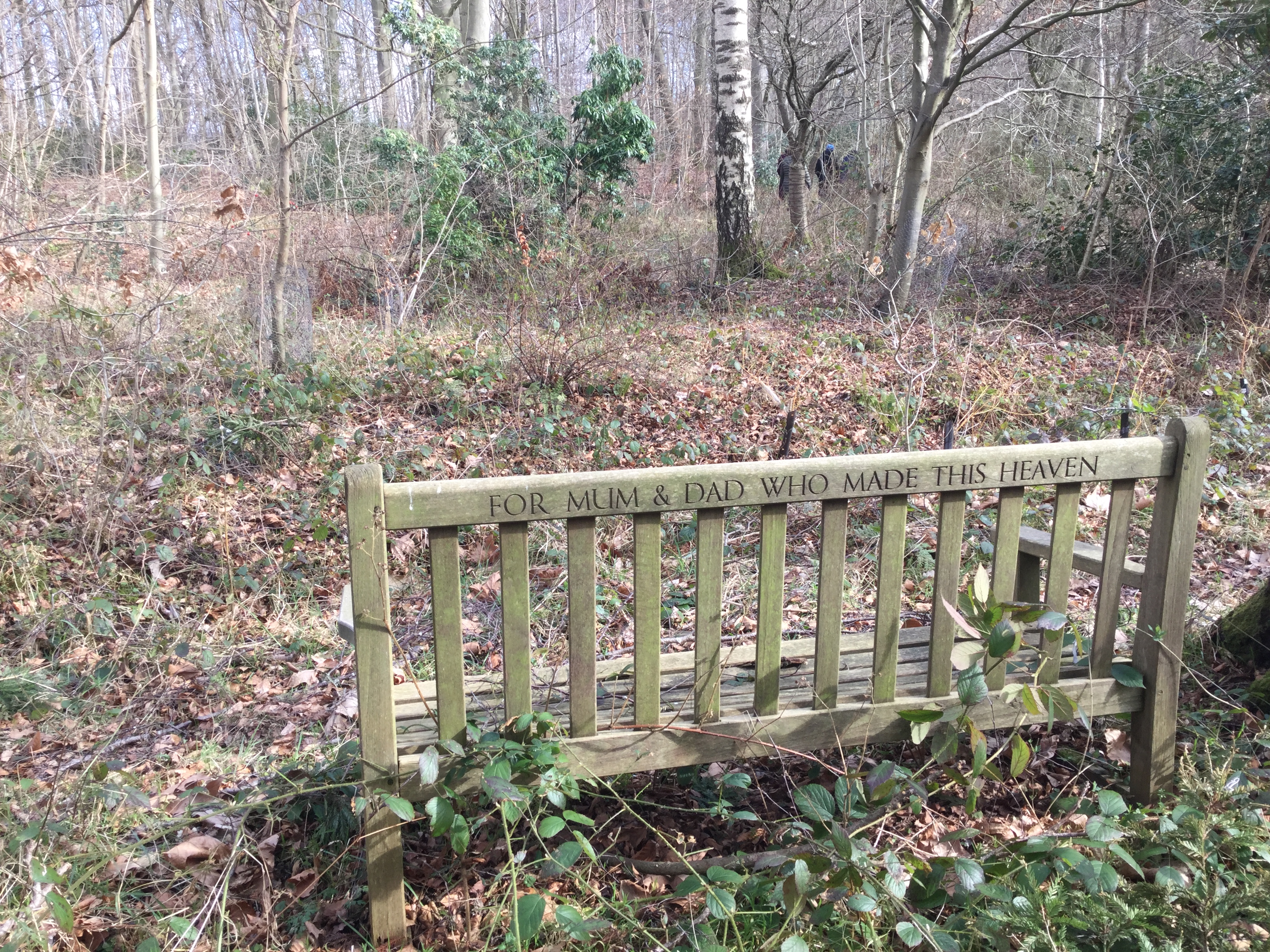
Photo by Sheila Webber: Bench, woods, Chapelgarth, March 2022
Wednesday, March 23, 2022

Fact-checking, multiliteracy and up-to-date evaluating skills

In a blog post for IFLA CPDWL, Jarkko Rikkilä (coordinator, Tampere City Library – Regional Development Task, Finland) describes a Finnish training programme for librarians about fighting misinformation.
Rikkilä, J. (2022, March 21). Future-proof librarian, part 1: Fact-checking, multiliteracy and up-to-date evaluating skills. https://blogs.ifla.org/cpdwl/2022/03/21/future-proof-librarian-part-1-fact-checking-multiliteracy-and-up-to-date-evaluating-skills/
In a further blog post, Rikkilä interviews Malin Klintholm and Victoria Lagerqvist about a Swedish project working with Wikimedia.

Tuesday, March 22, 2022

Presentations from The Innovative Library Classroom 2021

They are publicising the 2022 The Innovative Library Classroom (TILC) conference (to be held on 3 June 2022 at William & Mary (university), USA), so I thought I'd highlight the posters and presentations that are uploaded from the 2021 TILC, which can be found at https://theinnovativelibraryclassroom.weebly.com/2021-conference.html I assume that the universities are all in the USA as they don't mention the country.  

*** Posters [NB - scroll to the bottom of the poster and click on "Click here to enlarge poster" to get a legible version - that may seem obvious, but to start with I zoomed in on the poster, which doesn't work]
- Bringing Inclusive and Accessible Teaching Strategies to the One-Shot by Dayna Durbin & Jade Bruno (UNC-Chapel Hill)
- DIY Web Design for a Small Academic Library by Kelsey Molseed (Randolph College)
- Everybody In! User-centered Design of a University Libraries’ Tutorials Page by Valerie Linsinbigler, Janna Mattson, Anna Murphy-Lang, & Christopher Lowder (George Mason University)
- "Adulting 101" in the Academic Library: Developing a New Workshop Series for Undergraduate Students by Cait Kennedy (UNC Chapel Hill)
- Give Them the Platform: Student Led Workshops by Colin Nickels & Malaka Friedman (NCSU)
- Needle in the Haystack: Using LEAP Principles and Practices to Help Students Navigate Information Overload by Barbara Petersohn & Amanda Nash (University of North Georgia)  

*** Presentations
- Building cultural competence through critical self-reflection: Tools for the instruction librarian by Chapel D. Cowden & Lu Gao (University of TN Chattanooga & SUNY Albany)
- Building Equity, Inclusion, and Diversity into the ACRL Authority is Constructed and Contextual Frame for information evaluation instruction by Sally Neal (Bulter University)
- Making the Virtual Library Classroom Accessible: Incorporating Universal Design for Learning into Video Conferencing and Embedded Librarianship by Samantha Peter & Kristina Clement (University of Wyoming)
- Failure as a Prime Directive: Kobayashi Maru: Librarian Edition by Mary K. Oberlies, Alexandra Flores, & Paul Showalter (William & Mary)
- “This Is Biased Because It’s About Immigration”: How an Exercise about Authority Became Something More by Sarah Reynolds (Longwood University)
- Gender-Affirming Library Classrooms and Other Spaces by Teresa Doherty (Virginia Commonwealth University)
- Active Learning in the Liaison Multiverse by Julie Arendt, Sergio Chaparro & Bettina Peacemaker (Virginia Commonwealth University) 

*** Lightning Talks
- How to Change (and Even Reduce!) Library Services Without Losing Friends by Jennifer A. Stout (Virginia Commonwealth University)
- Answering the Call: Teaching Synthesis through Reading Strategies by Joan Clark (US Coast Guard Academy)
- ¿Por Qué No Los Dos?: Emboldening Writing Center Peer Consultants in Providing Research Support by Carolina Hernandez (University of Houston)

Photo by Sheila Webber: early blossom, March 2022

Monday, March 21, 2022

New articles: Workplace IL; Information behaviour of people with aphasia; News literacy; Virtual communities; Model of information seeking

There is a new issue of the open access journal Information Research (volume 27 issue 1). It includes
 - Muhammad Asif Naveed, and Muhammad Kamran. Workplace information literacy: the case of investigation officers from Punjab Police, Pakistan.
- Kanwal Ameen and Salman Bin Naeem. Post-truth era: news behaviour and news literacy skills of university librarians
- Naresh Kumar Agarwal. Integrating models and integrated models: towards a unified model of information seeking behaviour
- Birgit Kvikne, and Gerd Berget. "My words were completely gone." A qualitative study of the information seeking behaviour of people with aphasia
- Hsiu-Hua Cheng, and Chi-Wei Chen. Why people lurk in theme-oriented virtual communities: integrating achievement goal theory and cognitive dissonance theory.
Go to https://doi.org/10.47989/irinfres271

Photo by Sheila Webber: Daffodils, March 2022

Sunday, March 20, 2022

Webinar: Online library instruction: Best practices for live synchronous teaching

A priced webinar from ACRL on 12 April 2022 at 2pm-3pm US Eastern time (which is, e.g. 7pm-8pm UK time) is Online library instruction: Best practices for live synchronous teaching. The tutor is Jason Puckett (Online Learning Librarian and Associate Professor at Georgia State University Library in Atlanta, Georgia, USA).
"Synchronous online library instruction -- classes delivered live via Zoom, Webex, or other conferencing platforms -- have become much more common in the past year, but most of us never learned in library school how to approach this teaching format. This session will help your live online classes become a little less nerve-wracking: learn how to take advantage of the live online classroom environment, discuss some advantages and limitations compared to the in-person classroom, and how to make the most of your time with students." It will cover: Advantages and disadvantages of synchronous online instruction; Moving from the classroom to the videoconference; Essential core competencies for online teachers.
Cost is: ACRL member: US $50; ALA member: $71; Nonmember: $79.
Register at https://www.ala.org/acrl/onlinelearning/onlinelibraryinstruction
Photo by Sheila Webber: yet more snowdrops, Chapelgarth, March 2022

Friday, March 18, 2022

Keeping Up With… Economic Data Literacy

The latest in ACRL's Keeping up with series is Keeping Up With… Economic Data Literacy. As usual it is a concise document, in this case outlining the competencies addressed in a microcredential in economic data literacy developed by the Library Services and the Economic Education team at the Federal Reserve Bank of St. Louis, USA. https://www.ala.org/acrl/publications/keeping_up_with/economic_data_literacy
Photo by Sheila Webber: crocus, Chapelgarth, March 2022

Thursday, March 17, 2022

Webinar: Designing Email Challenges for Remote Teaching and Learning

A webinar on 28 March at 13.00 US Central time, which is 19.00 UK time, organised by ACRL ULS PDC: Designing Email Challenges for Remote Teaching and Learning. The speakers are Jen Bonnet, Social Sciences and Humanities Librarian, University of Maine, USA and Senta Sellers, Business Librarian. Miami University, USA.
"Teaching and learning has changed as a result of the pandemic, and many of those changes are here to stay. As many of our institutions continue to embrace more online instruction, e-mail based challenges can provide a flexible way to meet the needs of varied learner populations. In an email challenge activity, participants receive a task each day, for five days, designed to build their skills around the challenge theme, such as advanced research techniques, finding funding, or identifying misinformation on social media. This approach to instruction allows for diverse participation by anyone with an internet connection and an email address regardless of their location, while also providing flexibility for asynchronous education. Whether you or the students you’re teaching are doing their work remotely, an email challenge may be the perfect fit for your library’s educational initiatives."
Register at https://ala-events.zoom.us/webinar/register/WN_X0-gI7FSSRaIyOSg5qE8Ag
Photo by Sheila Webber: more snowdrops, Chapelgarth, March 2022

Wednesday, March 16, 2022

Short online courses: credit-bearing IL class; Fake news; Inclusive learning design

Library Juice Academy short online courses in April 2022

- Developing a Credit-Bearing Information Literacy Course (cost US $200.00; Dates: April 4 - May 1). Tutor: Jessica Critten
"The one-shot is still the most common mode of teaching information literacy, so most library-focused professional development opportunities reasonably focus on that model. However, that leaves librarians who are asked to teach a semester-long information literacy course to seek strategies elsewhere. This class is designed to fill that gap, to translate skills honed in one-shots to a new format." https://libraryjuiceacademy.com/shop/course/125-developing-credit-bearing-information-literacy-course/ 

- Addressing Misinformation and Fake News: Resources and Strategies (cost US $200.00; Dates: April 4 - May 1). Tutor: Sarah Morris
"This course introduces librarians to the topic of misinformation and provides them with resources, definitions, approaches, and strategies they can employ in their institutions to address the topic of misinformation with patrons. Each section of this online course provides participants with resources, tools, studies, and readings they can explore, opportunities for hands-on exploration, and chances to apply what they learn about misinformation to their home institutions and programs." https://libraryjuiceacademy.com/shop/course/190-addressing-misinformation-fake-news/ 

- Inclusive Instructional Design (cost US $200.00; Dates: April 4 - May 1). Tutors: Kristina Clement and Samantha Peter
"This course is for librarians and archivists who: teach information, digital, archival, or data literacy sessions; designs tutorials, resources, or guides for users; and/or are interested in accessibility and inclusion in information literacy. Librarians and archivists encounter a diverse group of users in their work to share information; some of these users may include people with disabilities, first-generation students, adult learners, and more. In order to make our information literacy practice accessible to all, it is important to incorporate elements of Inclusive Instructional Design. Inclusive Instructional Design is a highly effective blend of Universal Design for Learning, Backwards Design, Accessibility, Community Building, and Reflective Assessment that can be incorporated into information literacy instruction and learning objects. Inclusive Instructional Design accounts for visible and invisible disabilities, learning styles, and communication styles to provide equitable access to information in any learning environment. As information literacy instruction and access to information is at the core of what many information professionals do, it is important to design instruction and learning objects to intentionally be as inclusive as possible. This course will introduce simple ways to incorporate Inclusive Instructional Design into information literacy instruction and guide participants through each of these pedagogical principles using readings, activities, and discussions." https://libraryjuiceacademy.com/shop/course/258-inclusive-instructional-design/

Photo by Sheila Webber: View from my woindow day 2, Chapelgarth, March 2022