Thursday, February 23, 2006

Current TV

Current TV has got it all - content uploaded by citizens, voting on which videos get broadcast, tag clouds (that's folksonomy) and a news bulletin that consists of picking up on some whacky site that is popular on Google. http://www.current.tv/ Could be an interesting focus for discussion to do with evaluating content, information economy etc.

Photo by S. Webber: Squirrel in Greenwich Park, Feb. 2006.

Georgia Conference on Information Literacy

The 2006 Georgia Conference on Information Literacy will be held on October 6-7 2006 at Georgia Soutern University, Savannah, USA. There is a call for papers which closes on April 3rd. More info at http://ceps.georgiasouthern.edu/conted/infolit.html

Wednesday, February 22, 2006

International Lifelong Learning Conference

Registration for the 4th International Lifelong Learning Conference, Rydges Capricorn Resort, Yeppoon, Australia, June 13-16 2006 is now open. This conference aims to explore the multiple ways in which lifelong learning is understood and facilitated by means of collaborative partners, effective pathways and successful pedagogies. All registrations received on or before April 14 will be eligible for the earlybird rate. More details, including online registration, at http://lifelonglearning.cqu.edu.au/
Photo by S. Webber: Rydges Capricorn Resort, June 2004. Nice, eh?

Tuesday, February 21, 2006

German information literacy project

The Library at the University of Konstanz (Germany) is carrying out a project on information literacy for graduates, department staff, university teachers, postdocs etc. (i.e. after the undergraduate stage) They would like to hear from you, either if you happen to know someone who might be interested in collaboration or has any other information on projects concerning their area of interest. They are interested in similar ongoing projects, mainly for sharing experiences and evaluating them for possible adaptation.

This DFG (Deutsche Forschungsgemeinschaft, German Research Foundation) funded project on information literacy took up its work in January. It is aimed at the training and instruction of teaching personnel and advanced students (graduates). The project goals are to explore und invent new possibilities of training specific target groups and to evaluate existing initiatives. These existing projects will be checked for possible modification, adaptation and costumisation for the German and (more generally) european university libraries. They wish to establish international links. More information at http://www.ub.uni-konstanz.de/ik/ (small amount of information in English, most - including some materials e.g. outline of a class - in German only) or email bernd.schmid-ruhe@uni-konstanz.de

Photo by S. Webber: Tree in Weston Park, Autumn 2005.

Saturday, February 18, 2006

school libraries autumn forum

The American Association of School Librarians (AASL) will focus on Assessing Student Learning in the School Library Media Center at its Fall Forum, to be held in Warwick, Rhode Island (USA) October 13–15, 2006.
http://www.ala.org/ala/aasl/conferencesandevents/
fallforum/2006fallforum.htm


Photo by S. Webber: Autumn leaves 2005.

Friday, February 17, 2006

Fostering excellence in college teaching

There is a call for papers for the conference on Fostering excellence in college teaching organised by the International Society for Exploring Teaching and Learning to be held in Palm Springs, California, USA, October 19-21, 2006. "We are especially interested in presentations that demonstrate practical and creative teaching and learning techniques based on personal experiences and/or research that will appeal to colleagues in several disciplines. "Proposals for papers are due by May 1st 2006. Submit proposals via the conference website at: http://www.isetl.org/

Photo by S. Webber: Greenwich Park, Feb 2006.

Thursday, February 16, 2006

Swedish workshop on pedagogic methods in libraries

If I guess correctly there is a workshop being run in 3 places on this topic, namely: Bålsta on 20 February, Skövde 27 February and Falun 25 April (in Swedish) organised by the Swedish Library Association's special interest group on library education, and I think this is based around their new book on teaching information literacy "Tänk om…! pedagogiska metoder i biblioteket."
"Workshop om pedagogiska metoder i biblioteket. ... Styrgruppen för Svensk Biblioteksförenings specialgruppen för bibliotekspedagogik vill för deltagarna levandegöra några av de pedagogiska metoder, som presenteras i skriften "Tänk om…! pedagogiska metoder i biblioteket." Vi kommer att belysa sex olika metoder mot bakgrund av konceptet informationskompetens." http://www.biblioteksforeningen.org/konferens/

Photo by S. Webber: Mariestad, near Skövde, April 2005.

Wednesday, February 15, 2006

Information Literacy Research class

I don’t blog too much about my classes, as I think it is fair on students to talk about them too much on a public blog like this. However, I’ll say a little bit about my new Information Literacy Research class, which started up last week. The aim for students is to deepen understanding of information literacy and of research, and the assessment consists of a seminar paper and a small group project in information literacy. There are weekly seminars. These focus on particular aspects of research (e.g. particular research approaches - such as grounded theory - or methods - such as interviewing) and also involve discussion of information literacy research (both previous research, and the research the students are doing for their projects). Several researchers, from inside and outside the Department, will be coming along to talk. From the Department’s (and my) point of view, it is also deepening our research-led activity.In the first session the students (there are about 10 of them, mostly Masters students, but including two PhD students) shared their experience and ideas about information literacy and about research. On the right is one of the posters produced from this discussion; one group’s thoughts on interesting aspects of information literacy.

Tuesday, February 14, 2006

One Entry to Research

There is a blog which has been set up to assess the citation databases Web of Science/Knowledge, Scopus and Google Scholar. This is part of a Swedish BIBSAM-project with the project title:"Analys av Google Scholar och Scopus i jämförelse med Web of Science" [Analysis of Google Scholar and Scopus in comparison with Web of Science]. The project ends in August 2006. The blog has reports of different nitty-gritty investigations. It also has FAQs for the 3 services and a reference list.
One Entry to Research - critical assessment of Web of Science, Scopus and Google Scholar. http://oneentry.wordpress.com

Photo by S. Webber: Camellia, Greenwich Park, Feb. 2006.

Monday, February 13, 2006

SCONUL Working Group meeting

Last Thursday I attended the SCONUL Working Group on Information Literacy, in London. I’ve been a member of this Group for a couple of years now (see http://www.sconul.ac.uk/activities/inf_lit/). We have meetings just a few times a year and its always interesting to meet up with other members. In part of the meeting we were looking at how we were going to develop a new position paper on information literacy, including reviewing what has been done with the “SCONUL 7 Pillars model” of information literacy.

Another item was a report from Gill Needham, at the Open University, who had been invited along to talk about the Evidence Based Librarianship conference that she had attended in Brisbane, Australia, late last year. The conference website has already been a link in the blog, but here it is again as there are a number of interesting papers: http://conferences.alia.org.au/ebl2005/conferencepapers.html In terms of evidence based librarianship, this is an area that we will be contributing to via the SCONUL/HEA research review (http://infolit-review.blogspot.com/) not least because the evidence based librarianship movement has tended to put most emphasis on experimental forms of research, and a good deal of good research in our discipline is qualitative research. Therefore there is lots of scope for helping people identify “good” from ... “less good” qualitative research (as opposed to dismissing it all because it’s not got statistics in it!)

Photo by S. Webber: Dusk, Oxford Street, London (the lanterns are part of the Chinese New Year celebrations), Feb 2006.

Multiple discoveries

The issue of scientists "discovering" things that have already been discovered (mostly because they haven't done a proper literature search!) is in the news again.
Kolata, G. (2006) "Pity the Scientist Who Discovers the Discovered." New York times, February 5th. http://www.nytimes.com/2006/02/05/
weekinreview/05kolata.html?_r=1&oref=slogin
(you need to register to see the full text) "Stephen Stigler, a statistician at the University of Chicago who has written about the phenomenon. Not only does it occur in every scientific field, he said, the 'very fact of multiple discoveries has been discovered many times.'"
Photo by S. Webber: Greenwich Park, Feb. 2006.

Sunday, February 12, 2006

Pam Bing at CILASS

Last week was actually a busy one for my information literacy, as I was taking the first class for my new module, Information Literacy Research, and also attending a meeting of the SCONUL Working Group on Information Literacy, in London. I’ll deal with them in future entries, but for this entry I’ll mention one of the participants (rather than students) for the class, Pam Bing (pictured right). Pam did an MSc Information Management in our Department, then went to work in the Learning Resources Centre at Sheffield Hallam University. In particular she was involved in information literacy activities such as tailoring of infolit modules in WebCT for individual programmes at Sheffield Hallam (which is the other university in Sheffield.

Pam now works as the information literacy expert in the team at CILASS (Centre for Inquiry-based Learning in the Arts and Social Sciences http://www.shef.ac.uk/cilass/). She coordinates activities to do with an “Information Literacy Network” we are developing with the library and this Department, and is involved in CILASS projects with other arts & social science departments. In my Department, Information Studies, she is doing work on an “Information Literacy audit”, a CILASS project which I’m leading. This will involve interviewing staff about the extent to which information literacy is covered (taught and assessed) in all the individual modules in this Department.

Pam came along to the Information Literacy Research class partly out of interest, but also because the coursework for this class is 75% working on a project in small groups. Two of these potential mini projects are related to this CILASS project, and she was able to explain the context, and she’s also a contact for these mini-projects. In due course, I’ll let you know how the CILASS project gets on.

Friday, February 10, 2006

Shambles Information Literacy

There is a good section of annotated links to a variety of material relevant to information literacy on the Shambles web site which is "designed to support the international school communities (teachers, support staff, administrators, students and families) in 17 countries in South East Asia." It is maintained by an educational consultant, Chris Smith, and the Shambles website seems a useful portal in general for the educational/ICT area. The information literacy Shambles page is at http://www.shambles.net/informationliteracy/


Photo by S. Webber: Snowdrop, Sheffield, Feb. 2006.

Research strategies special issue

There is a call for Papers for a Special Issue of Research Strategies: "Serving our Graduate Students Through Tradition, Innovation, and Collaboration."Proposals should identify the proposed article's connection to the overall theme of service to the university graduate student population, as well as the type of article proposed (e.g. research study, literature review, commentary). One-two page proposals for articles to be included in this collection should be submitted electronically to Gretta Siegel, guest editor, no later than March 15th, 2006 siegelg@pdx.edu

Tuesday, February 07, 2006

5th mexican information literacy conference

The theme is Assessment and Evaluation: Key Elements to Information Literacy Programs. The conference will be held on October 18-20, 2006 at Universidad Autonoma de Ciudad Juarez, Mexico. There will be simultaneous English & Spanish translation, so papers can be in either language.

There is a call for papers. Key topics are: Usefulness of evaluations; Shared responsibilities when evaluating; Librarians as instructors; Main theories on educational evaluation; Context that determines forms of evaluation; Evaluation methods and techniques; Most commonly used tools; Evaluation and the support of standards; Evaluation within different pedagogical models; Best moments for evaluation; Technology support.
Further information on the program from: Berenice Mears bmears@uacj.mx; Jesus Cortes jcortes@uacj.mx; Jesus Lau jlau@uv.mx . Registration information from: Jose Maria Palacios jmpalaci@uacj.mx Web site (in Spanish currently): http://www.uacj.mx/dhi

Photo by S. Webber: Deer in Nara park, Japan, July 2005.

Monday, February 06, 2006

Googleverse and the missed opportunity

I seem to have been the only person in the blogosphere to have overlooked the launch of the Google Librarian newsletter. "Google and librarians share the same mission: to organise the world's information and make it universally accessible and useful." The article in the first issue How does Google collect and rank results? is a straightforward summary of what one had gathered already, but nicely written and with a couple of "exercises" to use with students to help them understand the principles. There's also a link to the ever-amusing Pigeon Ranking spoof they did. http://www.google.com/newsletter/librarian/ librarian_2005_12/newsletter.html

The second issue at http://www.google.com/newsletter/librarian/ librarian_2006_01/newsletter.html starts with "It's only been a month since we sent the first issue, and already hundreds of you have written to tell us what you think" ;-) There is a short item following up on issue one to explain on what Google means by "most trusted" sites, plus an article Beyond Algorithms: A Librarian's Guide to Finding Web Sites You Can Trust by Karen Schneider (Director, Librarians' Internet Index) which is fine, but pretty much the usual stuff. The Google people also apologise in this issue for calling their first issue an "edition" and rather annoyingly they also don't seem to have cottoned on to the concept of a journal homepage. However, on the other hand, I suppose this could be seen as rather endearing. Were it not that they shared our mission " to organise the world's information and make it universally accessible and useful" Hmmm.

This venture might explain why I got an email before Christmas.... it arrived while I was away, then I didn't open it for ages because I thought it was a routine Google Friends email ... it turned out to be an email from someone at Google (addressed to me and a clutch of other people, some of whom I know) inviting me to send my CV to Google. Perhaps I was at a low energy point, but once I'd worked out it was (I think) for real I just felt a bit perplexed ... but if they are trying to build up contacts with the library and information community I suppose it is less baffling. I imagine it's a bit late to email and say "Hi! I just realised that email you sent 2 months ago was the opportunity of a lifetime! Yo Google!" On the other hand, I might get a free Google T shirt out of it.

Anyway, to round off, there is also the Google blog aimed at librarian and non-librarian alike http://googleblog.blogspot.com/. When I just looked at it it had something about the Superbowl, and is therefore pretty incomprehensible to me. However I scrolled down and they had a transcript of their statement on their presence in China, which is rather more interesting.

Photo by S. Webber: Apple blossom, April 2004, with Photoshop watercolour effect.

Credit bearing classes

In 2005 Karen Hunt compiled a list of credit-bearing information literacy courses in
Canadaian universities and colleges http://cybrary.uwinnipeg.ca/about/accessservices/il/cdn_credit.cfm

Friday, February 03, 2006

Tanzanian IL training

Mark Hepworth, of Loughborough University, has been involved in an information literacy training course in Tanzania. This experience has been written up in the following article, including a detailed description of the programme, the students' comments and the course and the approach to teaching and learning.

Hepworth, M. and Wema, E. (2006) "The design and implementation of an information literacy training course that integrated Information and Library Science conceptions of information literacy, educational theory and information behaviour research: a Tanzanian pilot study." Italics, 5 (1). http://www.ics.heacademy.ac.uk/italics/vol5-1/pdf/Hepworth&Evans_finalversion.pdf

Photo by S. Webber: Holly tree in Weston park, Feb 2006.

Review of "Ideas for librarians who teach"

There's a useful review by Stuart Hannabuss of the following book:
Lederer, N. (2005) Ideas for librarians who teach. Lanham: The Scarecrow Press.
at http://www.ics.heacademy.ac.uk/Books/Reviews/ Newreviews/Ideas%20for%20librarians.shtml

Thursday, February 02, 2006

Business information tutorial

Kognito Solutions LLC has produced an online information literacy tutorial to help university students develop business research skills. The Beginner’s Guide to Business Research was commissioned by Baruch College (City University of New York, USA) and developed with Louise Klusek from Baruch’s Newman Library. It's at http://www.kognito.net/infolit/
This is quite a jolly little tutorial, and I might show it to my business information students. I think the shortness is a virtue, in that some tutorials seem to go on for ever. You need Flash and (ideally) sound,however, and the non-web resources are tailored to Baruch's business subscriptions. The company is willing to tailor the tutorial to other institution's needs. There is a press release about it at
http://news.yahoo.com/s/ prweb/20060120/bs_prweb/prweb334573_3

Photo by S. Webber: another in the "blurred pictures of fauna" series: grey squirrel in Weston park, Feb. 2006

Asking questions as part of IL

This article uses the examples of questions to the "Free Pint bar" (a useful discussion board forfor information people) to point out that part of information literacy is knowing how to ask questions. This is something I do cover in my first year information literacy class here, but we are going to focus on this even more next year when we are introducing another 1st year class which is going to take a very enquiry-based approach to learning Information Management. Anyway, the article is:
Macoustra, J. (2006) "Bar Orphans: Getting your questions answered at the FreePint Bar." FreePint, (199), 13-14. http://www.freepint.com/issues/020206.htm? PHPSESSID=46bf859714ff75fe8b4c7feb9b3ea1ed#feature

Wednesday, February 01, 2006

Personal Information Management

Whilst checking to see whether the article mentioned in the previous entry was still in the "free issue" (answer, no) I discovered that the current free issue is also interesting, namely Communications of the ACM Volume 49 , Issue 1 (January 2006) which focuses on Personal Information Mangement. Articles include "Searching to eliminate personal information management" (you can search for everything! you don't need to manage it!), "Keeping encountered information" ("Utility, serendipity, and the pleasure of encountering what we save relies on more than search alone when using PIM tools") and an article by one of my colleagues (Professor Steve Whittaker) here, "Email in personal information management". Until it's replaced by the next month you will be able to get free access to this by going to http://www.acm.org/pubs/cacm/homepage.html, and clicking "Free issue" in the column on the left.

Photo by S. Webber: Bird (think it's an immature blackbird), Photoshopped ("drybrush" effect) as it was a bit blurred, Feb 2006.

Article by computing science lecturer on information use

Bruckman, A.S. (2005) "Student research and the internet." Communications of the ACM, 48 (12), 35-37. Accessible via http://www.acm.org/pubs/cacm/homepage.html, but I think only to subscribers.

Amy Bruckman is an associate professor in the College of Computing at the Georgia Institute of Technology, Atlanta, USA. She has written a short, readable article about issues concerning students finding good, relevant information for assignments.

Thanks to Thomas Hapke for drawing my attention to this. He writes "Aus Sicht einer Lehrenden ist hier das Thema Informationskompetenz und die Problematik Bibliothek und Internet fuer mich treffend charakterisiert. Dieser Aufsatz trifft den Punkt, um was es beim
Thema Informationskompetenz auch ueber die Aktivitaeten von Bibliotheken hinaus primaer gehen muss: um das ernsthafte Reflektieren ueber Information und deren Zuverlaessigkeit und
Seriositaet im Rahmen des Studiums."

Tuesday, January 31, 2006

6èmes Rencontres FORMIST: 15 & 16 Juin 2006

"Les 6èmes Rencontres FORMIST se dérouleront le jeudi 15 juin à l’enssib, et seront suivies le vendredi 16 par une demie journée d’ateliers. Thème de ces Rencontres: «Exploitation et usages de l’information». Ce thème, large devrait être abordé sous les angles méthodologiques, juridiques, techniques, cognitifs, pédagogiques… Plus d’infos dans les semaines à venir, sur le site Formist (http://formist.enssib.fr ) et Blog Formist Information (http://blogformist.enssib.fr)"
(This is an announcement of the annual information literacy conference in Lyon, France: Les Rencontres FORMIST, held on 15 June with workshops on 16 June)
Photo by S. Webber: pretty berries in Lyon, June 2006. [added 2nd Feb - oops, that should be June 2005, I haven't yet mastered time travel]

Monday, January 30, 2006

Asia-Pacific conference on LIS education

The Asia-Pacific conference on Library and Information Education, "Preparing Information Professionals for Leadership in the New Age" has information literacy as one of its themes. It is being held in Singapore, 3-6 April 2006 and the website is at http://www.ntu.edu.sg/sci/a-liep

Sunday, January 29, 2006

Library + Information update - IL articles

The latest issue of Library + information update has a number of articles about Information Literacy:
- Putting our own house in order: CILIP-accredited LIS courses, by Kerry Weller.
- Learning in spite of being solo: Humeyra Ceylan.
- Information literacy in FE: Alexandra Stearn.
- Begin at school: Christine Irving & John Crawford.
- Information literacy development in Australia: Angela Newton & Debbi Boden interview Christine Bruce.
- Raising the profile of information literacy in public libraries: Rónán O’Beirne.
and one of them is available free on the internet:

Todd, R (2006) "It’s all about getting ‘A’s." Library + information update, 5 (1/2).
http://www.cilip.org.uk/publications/updatemagazine/ archive/archive2006/january/toddjan06.htm "In a major US project, more than 10,000 pupils have been revealing how their school librarians have taught them how to get the most out of information sources. Ross Todd gives us the background."

Photo by S. Webber: Snow last year (Jan 2004) in Sheffield. No snow yet this January!

Friday, January 27, 2006

Student use of electronic information services in further education

There is less research about information literacy in further education than there is about IL in higher education, so I thought I'd highlight this article (not free, I'm afraid) which summarises results to do with further education, drawing on two major UK studies (JUBILEE and JUSTEIS):

Urquhart, C. et al. (2005) "Student use of electronic information services in further education." International journal of information management, 25 (4), 347-362.

"... Information skills and experience develop across work, home and study. There is a growing use of EIS in curriculum, but practice varies between institutions and disciplines. Tutors express concern about student's ability to evaluate and use the information that they find. Assignments can promote EIS use. The main categories of EIS used by students are search engines and organisational web sites. Search engines are the preferred search tools and search strategies are basic. Information skills are acquired through a variety of routes, with peer instruction, surfing and personal experience, instruction from tutors, and LIS induction and training all making an important contribution. The solutions to improving students’ information skills may include use of the Virtual Training Suites, but librarians need to adopt different roles in promoting and evaluating use of such tools. "

Photo by S. Webber: Man & dog on Blackheath, London, with the Paragon in the background.

Thursday, January 26, 2006

Link between secondary and tertiary education

John Crawford at Glasgow Caledonian University is leading a project Information literacy skills - the link between secondary and tertiary education. There is some information at http://www.learningservices.gcal.ac.uk/
ils/index.html
plus updates about the Scottish Parliament IL petition which has been mentioned on this blog. (And apologies if you were trying to get into this blog and failed on the 25/26 January ... Blogger had a "scheduled" outage of what was supposed to be 30 minutes, but I haven't been able to get into my blog for nearly a day... the penalties of free blogging...)

Photo by S. Webber: Apples in Blackheath farmers' market.

Wednesday, January 25, 2006

International Information Literacy Resources Directory

There is a project to collect information about information literacy initiatives around the world. The website is at http://www.uv.mx/usbi_ver/unesco/
The Information Literacy Section of the International Federation of Library Association and Institutions (IFLA) is carrying forward the project, on behalf of UNESCO, and the project is coordinated by the Section Chair, Jesús Lau. You can submit details of training courses, publications, websites, discussion lists, research etc. online once you have registered (which you can do instantly). There are just a few resources listed at the moment (as it is a new project), but in due course it should become very useful.
As you will see, I am the coordinator for the "Anglophone European Countries" ;-))

Photo by S. Webber: Squash at Blackheath farmers' market

Monday, January 23, 2006

Digital Information Fluency

Thanks to Yazdan Mansourian for reminding me about the Illinois Mathematics and Science Academy (USA) Digital Information Fluency website. I've not actually been back to it for a while (they linked to our Christmas Quiz a couple of years ago...) and I think the site has been redesigned since then. It has a lot of interesting content including "micro modules", little exercises, annotated bibliographies, lesson plans that teachers have submitted etc. http://21cif.imsa.edu/

Friday, January 20, 2006

Journal with some IL articles

A free online journal I've just come across is the Electronic Journal of Academic and Special Librarianship. It has some infolit articles e.g.
Kennedy, C. (2005) "Teaching Information Literacy to the Advanced Writing Class in Three Sessions." Electronic Journal of Academic and Special Librarianship, 6 (1/2)
Home page of the journal: http://southernlibrarianship.icaap.org/index.html

Photo by S Webber: Fountain in Oslo, Norway.

Thursday, January 19, 2006

LILAC conference programme

Th LILAC conference full provisional programme is available. The LILAC (information literacy) conference is being held at the University of Leeds, UK, 27th-29th March 2006.
Keynote speakers include:
Lynne Brindley - The British Library; Peter Brophy - Centre for Research in Library & Information Management, Manchester Metropolitan University; Philip Candy - Director of Education, Training and Development, NHS Connecting for Health; Jonathan Douglas - Museums, Libraries and Archives Council; Dorothy Williams - Dept. of Information Management, The Robert Gordon University.
Conference themes: Embedding and enriching; Information Literacy and citizenship; New areas of practice and research; Practical approaches to Information Literacy; Staff development and Information Literacy; Strategic approaches to Information Literacy.
Further details at:
http://www.cilip.org.uk/specialinterestgroups/ bysubject/informationliteracy/lilac/lilac2006

Wednesday, January 18, 2006

Journal of eliteracy

Vol 2 no. 2 of the Journal of eliteracy has been published at http://www.jelit.org/ tocDec2005.html
The lead papers are:
Peter Godwin: Making Life Easier for Academics: How librarians can help staff weather the technological storm
Amanda C. Elliott and Ruth A. Hunn: An E-Learning Tutorial for Vocational E-Literacy
Ruth Stubbings and Ginny Franklin: More to life than Google - a journey for PhD students

Photo by S. Webber: San Michele at dusk, Dec 2006.

Teaching and Research Relationship

There are numerous presentations online from the Higher Education Academy's conference on The Teaching and Research Relationship: Developing Institutional Policy and Practice, held in November 2005, at http://www.heacademy.ac.uk/3849.htm (including one from my colleague Dr Philippa Levy).

Monday, January 16, 2006

2006 eLit conference

The 2006 eLit conference will take place at the University of Loughborough, UK, 28th -30th June 2006. There are further details at http://www.elit-conf.org/

There are also links from this page to previous years' conference websites, which include some of the presentations (on eliteracy, information literacy etc.)

Photo by S. Webber: Sunset, the Lido, Venice, Dec 2005.

Sunday, January 15, 2006

Information society articles

There are some interesting articles in vol 1 issue 4 (2005) of the online journal International Journal of Education and Development using Information and Communication Technology
at http://ijedict.dec.uwi.edu/index.php, including

Martin, B. "The Information Society and the Digital Divide: some North-South comparisons." (which I skimmed through and found useful summaries of the situation and thoughtful discussion).

Macleod, H.J. "What role can educational multimedia play in narrowing the digital divide?" (highlights the value of multimedia e.g. in cultures which put more emphasis on oral traditions).

Friday, January 13, 2006

Teaching tips

The Haworth journal College and undergraduate libraries has a "teaching tips" column as well as articles about information literacy.
You can view abstracts via the home page at http://www.haworthpress.com/store/ product.asp?sku=J106

Photo by S. Webber: Shadow on the wall in the Bridge of Sighs, Venice, Dec 2005.

Assessment of librarians as teachers

Scott Walker (UNiversity of Kansas, USA) maintains a list of resources about "assessment of the professional performance of librarians as teachers. His "Instructional Improvement in Academic Libraries" page is at
http://people.ku.edu/~slwalter/instruction/index.html

Thursday, January 12, 2006

Verbatim report of Scottish Parliament petition

John Crawford writes "For the benefit of those who were kind enough to sign or otherwise support the petition on information literacy presented to the Petitions Committee of the Scottish Parliament on 21st December 2005 I include below the URL for the verbatim report on the petition presented by Christine, Chris Milne at the University of Abertay and myself. I shall be writing a short report on the process for an upcoming issue of Information Scotland."
By the way, the Information Literacy petition is the second item to be recorded on this document (and I think John put things rather well!) - the first item is a petition from schoolgirls about overpackaging.
http://www.scottish.parliament.uk/business/ committees/petitions/or-05/pu05-1902.htm
(Photo by S. Webber: Italian Centre, Glasgow)

Study on children's internet use in USA

DeBell, M. (2005). Rates of computer and internet use by children in nursery school and students in kindergarten through Twelfth Grade: 2003. Washington, DC: NCES.
http://nces.ed.gov/pubs2005/2005111rev.pdf

Wednesday, January 11, 2006

Academic librarians' perspectives

NFAIS always has an interesting speaker for its Miles Conrad Memorial Lecture. I just noticed that in 2005 this was James P. McGinty, Vice Chairman of Cambridge Information Group on What it Takes to Gain “Mindshare” from the Perspective of Academic Librarians. He reports on a survey of US and European academic librarians asking their opinions on various issues. Some of these, since he is an information vendor, are about preferred relationships with vendors, and it also includes perceptions about changes in academic librarianship, importance of difference factors (e.g. involvement of academics) etc.
http://www.nfais.org/publications/mc_lecture_2005.htm

NFAIS has a good site, and they put up slides from their events (which focus on the information industry) pretty promptly. NFAIS used to be the (US) National Federation of Abstracting and Indexing Services but they ditched the full form of the name some time ago and now just say that "NFAIS seeks to be recognized globally as the premier membership organization for groups that aggregate, organize and facilitate access to information".

Photo by S. Webber: view from boat between Torcello and Burano, Italy, Dec 2005

Wikipedia vs. Encyclopaedia Britannica

Thanks to my colleague Daniela Petrelli for alerting me to a short article in the journal Nature about a survey of quality in the articles in these two publications (summary: wikipedia has some mistakes, but then Britannica has some too). There is also a plea for more academic experts to contribute to Wikipedia.
Giles, J. (2005) "Internet encyclopaedias go head to head." Nature, (438), 900-901.
http://www.nature.com/news/2005/ 051212/pdf/438900a.pdf

Tuesday, January 10, 2006

Information Literacy: recognising the need

The one-day conference Information Literacy: recognising the need will take place at Staffordshire University, Stoke on Trent campus (UK) on 17th May 2006. Cost is £80. Speakers are: Susie Andretta, Moira Bent, my colleague Sheila Corrall, Debbi Boden, Peter Godwin, Mark Hepworth and me (Sheila Webber), so obviously a class line-up. I'm talking about
"Working towards the Information Literate University"
Full details at http://www.staffs.ac.uk/infolitconf and there is still a call for posters.

Photo of me taking taking a photograph, reflected in the door of the Foscari Palace Hotel, Venice. Arty or what. (As is often the case, I think the answer is "what")

Another IFLA call for papers - ending now, so hurry!

A third session at IFLA 2006 is going to have an information literacy focus (frustrating, as I am unlikely to be going this year!) IFLA World Library and Information Congress will be held in Seoul, Korea, 20-24 August 2006. The call for Papers is on the Theme, Information Literacy for the Knowledge Society. Division VIII of IFLA (Regional Activities) invites proposals for papers on any aspect of Information Literacy as it affects the growing Knowledge Society in the regions of Division VIII, i.e. Asia and the Middle East, Africa, Latin America and Caribbean.

Contributions can seek to address aspects of Literacy, Information Literacy, the Digital Divide and the Knowledge Society. Papers may be research-based or evidence-based, may deal with theory, 'best practice', institutional frameworks and management, curriculum and delivery, evaluation and review, etc. Proposals in the form of a working title, abstract of 150 words (max.), name and affiliation of author(s), and an email contact address should be sent by 11 January 2006 [which is today already in New Zealand, but as this only just got posted out to the listserv where I picked it up, I assume there may be a few days slack] to: Professor Gary Gorman, Secretary of Division VIII, School of Information Management, Victoria University of Wellington, Wellington, New Zealand, Email: gary.gorman@vuw.ac.nz

ALISS links

ALISS (Association of Librarians and Information Professionals in the Social Sciences) has a page which includes links to past presentations, including ones from an event Libraries and E-Learning held on 14th December 2005.
Gwyneth Price - ppt called "Libraries and the E-Learning Curve"
Keri Myers - paper on "the TUC Workers war Resource"
Jane Secker - ppt on "CLA Higher Education Digitisation License"
http://www.lse.ac.uk/library/other_sites/aliss/news.html

Monday, January 09, 2006

Consumer and Financial Literacy Framework

A "National Consumer and Financial Literacy Framework" has been developed for the Australian Ministerial Council on Education, Employment, Training and Youth Affairs. They define Consumer and financial literacy as "the application of knowledge, understandings, skills and values in consumer and financial contexts and the related decisions that impact on self, others, the community and the environment."

This short document includes indicators for learning and a short list of 11 critical success factors. They relate the framework to four dimensions: Knowledge and understanding; Competence; Enterprise and Responsibility (see quote below). I thought this was interesting and gave food for thought as regards information literacy: knowledge and competence are usually addressed in IL frameworks, but Enterprise not, and Responsibility perhaps more implicitly than explicitly.

"The dimension of:
· Knowledge and understanding is about the nature and forms of money, how it is used and the consequences of consumer decisions
· Competence is the application of consumer and financial knowledge and skills in a range of changing contexts
· Enterprise is the opportunity to use initiative, build financial capabilities and manage risktaking when making consumer and financial decisions
· Responsibility is appropriate consumer and financial decisions that display care for self, others, the community and the environment. "

Ministerial Council on Education, Employment Training and Youth Affairs (2005). National consumer and financial literacy framework. Carlton South, Victoria: MCEETYA.
http://www.mceetya.edu.au/pdf/financial_literacy_framework.pdf

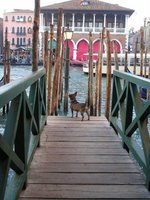
Photo by S. Webber: Dog at the S. Sofia traghehtto stop, Venice, Dec. 2005.

Saturday, January 07, 2006

HigherEd BlogCon 2006

There is an online conference: HigherEd BlogCon 2006: Transforming Academic Communities with New Tools of the Social Web taking place 3- 28 April 2006 at http://www.higheredblogcon.com There is a call for presentations which closes on 31 January. It is "Presented by Thomson Peterson's, PRNewswire, and The Council for Advancement and Support of Education ... All presentations will be made available on the event Web site at no charge to participants (with the exception of the live, Web/audio CASE Online Speaker Series events). Modeled after Global PR Blog Week 2.0 http://globalprblogweek.com/ *, Higher Ed BlogCon 2006 will focus on the use of blogs, wikis, RSS, podcasts, vblogs, and other digital tools in a range of areas in academe."
* There's some useful stuff on this if, like me, you're interested in marketing.

Photo by S. Webber: Bluebells, Hailsham, April 2005. It's a really grey day here, so I thought I remind myself spring is only a few months away...

Literacy and digital technologies: linkages

A recent Statistics Canada publication looks at ICT use and correlates it to educational and literacy levels. It is based on a survey (using the Adult Literacy and Life Skills Survey) of people in Italy, Canada, USA, Switzerland, Norway and Bermuda .
Veenhof, B., Clermont, Y. and Sciadas, G. (2005). Literacy and digital technologies: linkages and outcomes. Ottawa: Statistics Canada. http://www.statcan.ca/english/research/ 56F0004MIE/56F0004MIE2005012.pdf

Friday, January 06, 2006

Educational role of the university library

There is a new, interesting article by Thomas Hapke, Subject Librarian for Chemical Engineering, Hamburg University of Technology, which can be accessed on the web:

Hapke, T. (2005) "In-formation’ of Better Learning Environments - the Educational Role of the University Library." Liber, 15 (3/4). http://liber.library.uu.nl/cgi-bin/pw.cgi/articles/000145/index.html
(added on 10 Jan - Thomas has also put up a copy at
http://www.tu-harburg.de/b/hapke/liber-article-hapke.pdf)

Photo by S. Webber: Thomas Hapke in Frankfurt, at the DGI conference he mentions in the paper - May 2005 (I was giving a talk there on information literacy)

Thursday, January 05, 2006

Information literacy in the library & information curriculum

In 2005 I reported that I had been invited to be part of a group of European library and information school educators who were aiming to write a chapter about "Information literacy and learning" in the curriculum of library and information science (LIS) students. This was part of a European project looking at some core areas of the curriculum, especially in the light of the Bologna Process (harmonising certain aspects of higher education in the European Union). My Group was led by Sirje Virkus. There was a virtual discussion (involving a wider range of people) and then a 2-day conference in August.

The book has now been published virtually and can be downloaded in full as a pdf. The reference for our chapter is:
Virkus, S., Boekhorst, A. K., Gomez-Hernandez J.A., Skov, A. and Webber, S. (2005) “Information literacy and learning.” In: Kajberg, L. and Lørring, L. (Eds) European Curriculum: Reflections on Library and Information Science Education. pp65-83. Copenhagen: The Royal School of Library and Information Science.
http://biblis.db.dk/uhtbin/hyperion.exe/db.leikaj05

On the front cover is a photo of us all at the conference and I'm 3rd from the right in front, in brown, with Sirje just behind me and to the left.

ALA sessions

The American Library Association Midwinter conference is in San Antonio, USA and the ACRL Instruction Section’s Bright Ideas Roundtable Discussion will be held on 22 January at 4 - 5:30 p.m. It is entitled "Hello, anybody out there? How to improve outreach efforts and build positive relationships for your academic instruction program." More info at http://www.indiana.edu/~libinstr/ ACRL-MIS/brightIdeas2006.pdf There is also an Instruction Section Soiree on 20 January from 6 -7:30 pm at Durty Nelly's Irish Pub* "located on the Riverwalk adjacent to the Hilton Palacio del Rio." See also the ALA site at http://www.ala.org/
*Yes, that's right "Durty Nelly's Irish Pub".
Photo by S. Webber: Burano, Italy, Dec 2005.

Wednesday, January 04, 2006

Information literacy petition to Scottish Parliament: update

Previous blog entries urged readers to sign the Information Literacy petition being presented to the Scottish Parliament. John Crawford now writes
"The Petitions Committee of the Scottish Parliament met on Wednesday 21st December, and I attended with Christine Irving and Chris Milne. In the end the petition attracted 710 signatures in total; 415 were from Scotland, 186 from England, 31 from Wales and the rest from other parts of the world. I would like to take this opportunity to thank all those who signed. It strengthened our hand greatly.

I made a short opening presentation in which I drew attention to the worldwide interest in the petition. We then answered questions for about half an hour and it was clear that the committee members were genuinely interested in the issue and had given it some thought. These included:
* What research and development activity is taking place
* Should information literacy be implicit or explicit in the curriculum
* Do librarians feel undervalued and are they just trying the raise their image
* Who will take responsibility for information literacy within the curriculum

After the questions there was some discussion about how to progress the issue and it was decided to put it out for comment to relevant trade unions, Universities Scotland, and relevant specialist bodies such as Learning and Teaching Scotland (LTS) and The Scottish Qualifications
Agency (SQA). It has to be said that Christine and I are in contact with many of these bodies already but a letter under the banner of the Scottish Parliament will carry a lot more weight than we can. The collated responses will come back to the Petitions Committee for further consideration."

Photo by S. Webber: Sunset on the Grand Canal, Venice, Dec. 2005.

Friday, December 30, 2005

UNESCO sponsored IL projects


UNESCO has announced sponsorship of a number of information literacy projects. In one, involving 8 secondary schools and libraries in Tamale, in the northern region of Ghana, "10 students, 2 teachers and a librarian from each school will receive training in computer and Internet skills, in order to enhance the mastery of computer use in the study of subjects such as mathematics, English, science and social studies."

Another is aimed at higher education in Vietnam: " Within 12-month period, the project activities will include four phases:

1. Selection of appropriate key information professionals from about 10 major academic libraries in various Vietnamese regions;

2. Development of pre-course readings and exploration of information literacy practice in other academic environments;

3. Organization of a round table meeting at the Hanoi University of Foreign Studies;

4. Report by the participants on their individual and networking activities.

In addition to basic training, the project will produce a variety of Guidelines, in particular on the information literacy concept, competencies, framework and practical plan, applicable to academic library communities in Vietnam."

A further project is taking place in Nigeria.
There is news on the UNESCO IFAP page at: http://portal.unesco.org/ci/en/ ev.php-URL_ID=1627&URL_DO=DO_TOPIC&URL_SECTION=201.html

Photo by S. Webber: Blackheath pond, Dec. 2005.

Wednesday, December 28, 2005

LOEX


There are a few websites that we remind people about periodically. One of them is the LOEX website that has some material freely available (notably links to some material to do with training people in information literacy - tutorials etc.). There are further services for LOEX members and a long-running conference (usually held in the USA, where LOEX is based) http://www.emich.edu/public/loex/index.html

Photo by S. Webber. Venice, Dec 2005.

Monday, December 26, 2005

Happy festive season


A happy Christmas and holiday time to all our blog readers!

Photo: the Christmas wreath I made.

Thursday, December 22, 2005

Some recent Information Literacy articles

Catts, Ralph (2005). "Confirming the relational model of information literacy." International Information and Library Review, 37 (1), 19-24.

Fields, A.M. (2005) "Self-Efficacy and the first-year university student’s authority of knowledge: an exploratory study." Journal of Academic Librarianship, 31 (6), 539–545

Gratch-Lindauer, B. (2005) "Information Literacy behaviors: potential items for the National Survey of Student Engagement." College and research library news, 66 (10).
http://www.ala.org/ala/acrl/acrlpubs/ crlnews/backissues2005/november05/infolitbehavior.htm
Johnson, A. M. and Jent, S. (2005) "Library instruction and information literacy – 2004." Reference services review, 33 (4), 487-530. (This is the *big* annual annotated listing of information literacy articles, though it does miss quite a lot of things outside the USA)

McDermott, D (2005) "Library instruction for high-risk freshmen: Evaluating an enrichment program." Reference services review, 33 (4), 418-437.

Ondrusek, A. et al (2005) "A longitudinal study of the development and evaluation of an information literacy test." Reference services review, 33 (4), 388-417.

Snavely, L. (2005) "Visual Images and Information Literacy." Reference and user services quarterly, 45 (1), 27-32.

(Photo by S. Webber: Copper beech, Sheffield, Dec. 2005)

Learning about Learning course, London

There is a CILIP workshop on Learning about learning, being held on 7 February 2006 in London, UK ; and workshops on Teaching skills on 14 February and 16 March 2006. More details from: http://www.cilip.org.uk/training/training/2006/tl

Saturday, December 17, 2005

Presentations from day on elearning and IL in health libraries

There was a joint study day held by Information for the Management of Healthcare and Libraries for Nursing on 14 November 2005 in Leeds, UK: E-learning and information literacy: initiatives and challenges. You can find most of the PowerPoint presentations on the conference webpage, including:

Peter Godwin (Academic Services Manager, London South Bank University) Information literacy: present and future challenges.
Alison Lahlafi (Faculty Team Librarian, Leeds University Library) and David Clarke (School of Healthcare, Leeds University) Implementing an information literacy audit in the School of Healthcare, Leeds University

Webpage at: http://www.ifmh.org.uk/studydayprog1105.htm
(Photo by S. Webber: Copper beech leaves, Dec. 2005)

Thursday, December 15, 2005

Short IL articles

Some articles relevant to information literacy are in the latest issue of the SCONUL newsletter, SCONUL focus, no. 35, Summer/autumn 2005, namely:

Infoteach: developing an online community of practice of librarians who teach by Chris Powis

Learning and information services support for international students at the University of Hertfordshire by Helen Singer

E-learning at the University of Exeter Library by Jessica Gardner, Michelle Allen, Dominic Prosser, and Helen Hanson.

plus some relevant book reviews, and a number of other interesting articles (e.g. a survey of cafes in university libraries). The articles are all linked from the title page at http://www.sconul.ac.uk/pubs_stats/newsletter/35/
(Photo by S. Webber: autumn leaves on a sunny day in Sheffield, Dec. 2005)

2nd call for WILU

There is a Second Call for Proposals, deadline Monday January 9, 2006, for the 35th Annual Workshop on Instruction in Library Use (WILU) to be held at Acadia University in Wolfville, Nova Scotia May 10-12, 2006. This was an excellent conference in 2005, with interesting sessions and discussions. The theme of next year's conference is Charting a Course for Instruction. See http://library.acadiau.ca/wilu/proposal-e.html for more info. (Photo by S. Webber: Chipmunk spotted during the 2005 conference. Not actually in the conference room, obviously)

French information literacy articles

Thanks to Sylvie Chevillotte for alerting us to as special issue of Bulletin des Bibliotheques de France on Information Literacy ( or rather "Formation des usagers" - user training).

It can be accessed directly at http://bbf.enssib.fr/sdx/BBF/ frontoffice/2005/06/sommaire.xsp or choose http://bbf.enssib.fr/ Feuilletage and select n°6, 2005.

There are a number of articles, with a few giving perspectives from outside France, others addressing specific examples in France, an article on the TUNE project, and also an article from Sylvie herself in her tour of US libraries and conferences.

I will pick out one small part of the article by Claire Panijel-Bonvalot, which has a note on the concept itself, and what terms are used in France"On appelle « maîtrise de l’information » un ensemble de compétences intellectuelles et instrumentales permettant, dans un objectif de connaissance, de mettre en œuvre un processus de collecte, d’évaluation, de traitement, de production et de communication de l’information. Le terme anglais Information Literacy semble plus stable que sa traduction française « maîtrise de l’information », à laquelle on préfère parfois « culture de l’information » ou « éducation à l’information ».

(Photo by S. Webber: Window in Lyon, France, June 2005)

Wednesday, December 14, 2005

Plagiarism

A colleague here has recently reminded me about the The Plagiarism Advisory Service (PAS), run by Northumbria University and containing useful information on plagiarism:
http://www.jiscpas.ac.uk/

Monday, December 12, 2005

Last chance to sign e-petition on IL!

Th e-petition to the Scottish Parliament on Information Literacy closes on December 16th. Sign up now if you haven't already!
http://epetitions.scottish.parliament.uk/ view_petition.asp?PetitionID=76

Invisible Web Weblog

One of my PhD students had, like me, a blog that was victim of technical problems this summer. Yazdan Mansourian's blog on has now also been revived on Blogger at http://invisibleweblog.blogspot.com/ and is still called the Invisible Web Weblog. The invisible web was the starting point for his research, although the focus has subsequently moved to focus on perceptions of failure and success in web search. You can find out more about his research on his web page at http://dagda.shef.ac.uk/yazdan/
(Photo by S. Webber: Wedding at Sydney harbour, Australia, November 2005)

Sunday, December 11, 2005

Changing students' perceptions of research

There is a PowerPoint up from the ANZIIL Symposium Series Five Information Literacy: Getting Back to Basics, which was held on the 10-11 November 2005 at the University of Otago in Dunedin, New Zealand.
Lorette Rayner (Western Institute of Technology at Taranaki) Changing students' perceptions of research: A partnership to achieve information literacy
http://www.anziil.org/events_meetings/ 2005/events/symposiumseriesfive/overview.htm
From the slides it seemes that the librarian organised a series of exercises that encouraged the students and librarian to take a personal journey in reflecting on what, how and why to search ... interesting.

(Photo by S. Webber: Jacaranda, Oxford Street, Sydney, Australia, Nov. 2005)

Saturday, December 10, 2005

"Digital Divide" statistics

Thanks to Michel Menou for the following: "The Eurostat publication Statistics in focus, 38/2005 is devoted to recent data regarding the so-called "digital" divide (aka internet
penetration) in the countries of the European Union http://epp.eurostat.cec.eu.int/cache/ ITY_OFFPUB/KS-NP-05-038/EN/KS-NP-05-038-EN.PDF "
This highlights differences between countries and also common features e.g. there is more likely to be internet access in households with children.

(Photo by S. Webber: Kofukuji temple at night, Nara, July 2005)

Friday, December 09, 2005

Rencontre FORMIST: 12 Janvier, Lyon, France

Continuant son ouverture vers les pratiques d'autres pays, le service Formist, enssib (see photo on right), propose le jeudi 12 janvier 2006, à l’enssib, une rencontre avec Jocelyne Poirier, bibliothécaire spécialisée à l’Université de Technologie de Queensland, Australie.
http://www.library.qut.edu.au/contacts/ staff/j_poirier.jsp Journée d’étude gratuite sur inscription.

Matinée (10-12.30): Présentation générale des bibliothèques en Australie, puis des réalisations des bibliothèques australiennes en matière de formation. Cette conférence s’adresse aux élèves conservateurs de l’enssib et est ouverte aux professionnels intéressés. (dans la limite des places
disponibles)
Après-midi (14-16.00): (réservée aux professionnels). La formation documentaire dans les bibliothèques australiennes (Queensland) et plus spécifiquement la formation des ingénieurs. Exposé suivi de débat avec les professionnels présents et intéressés par la formation des usagers.

Lieu: enssib. 27 Boulevard du 11 novembre 1918. 69623 Villeurbanne Cedex

Inscription et renseignements auprès de Sylvie Chevillotte . 04 72 44 43 18 ou chevillotte@enssib.fr Informations sur le site de l’enssib http://www.enssib.fr
et sur le site FORMIST http://formist.enssib.fr

Thursday, December 08, 2005

Market research about libraries and internet use

The company OCLC (seller of library services) has published a full report on a survey they commissioned from Harris Poll Online (a market research company) about perceptions of libraries and competing products and services (in particular bookstores and search engines). The 290 page report is available in full or section by section from: http://www.oclc.org/reports/2005perceptions.htm

There were 3348 respondents, 450-500 each from Canada, UK and "Australia, India and Singapore" (latter treated as one region), and the rest (i.e. over half) from the USA. The researchers claim a hugh confidence level in terms of generalisability to the internet-using populations of the respective countries, though I would want to know more about how they selected the sample and how representative Harris' database of online users was to start with. They don't compare their findings with anything much else except some general stats of what % of the population uses the internet (i.e. they don't compare their findings with other surveys about people's use and perceptions of search engines, or stats on library use in the respective countries etc.), and knowing something about UK stats makes me think that you can't generalise these findings to the whole UK population.

However, having said all that, there's some interesting stuff in there. There are questions about perceived relative trustworthiness and use of search engines & libraries, extent to which people have used/heard of search engines, libraries and bookstores, positives and negatives about libraries, and so forth. A good sized sample of free-text responses to questions like "what's the first thing you think of about libraries" is given (by the way, the answer is that most people think - "books"). The conclusion (related to this "book" dominance in perception of the library brand) is that "It is time to rejuvinate the library brand" (section 6-8) Hmmm.

de Rosa, C. et al. (2005) Perceptions of libraries and information resources: a report to the OCLC membership. Dublin, Ohio: OCLC. http://www.oclc.org/reports/2005perceptions.htm

(Photo by S. Webber: Rose Apple tree (flower), Sydney Botanic Gardens, Australia, Nov. 2005.)

Monday, December 05, 2005

Creating Knowledge IV: Call for papers

There is a call for abstracts of papers and presentation for the Creating Knowledge conference IV: "Empowering the Student through cross-institutional support with focus on collaboration between library and academic support" which will be held in Copenhagen, Denmark, August 16-18, 2006. My colleague Bill Johnston is one of the keynote speakers - the others are Patricia Senn Breivik, Jude Carroll, Birgitta Hansson and Hans Siggaard Jensen.

It is organised on behalf of NORDINFOlit the Nordic Association on Information Literacy, by The Forum for Library User Education under the auspices of The Association of Danish Research Libraries. Co-organizers are Danish Network for University Pedagogy (www.dun-net.dk), a grassroot initiative of university teachers with intentions to develop the quality of
university education and teaching.

"The organizers of this conference would like to emphasize and support the idea of a learning conference. This indicates that participants will be engaged in networking and active participation during breaks, sessions and workshops. Traditional paper presentations are most welcome, and presentations of good practice will definitely also be valued."

Abstracts must be submitted by February 1, 2006. Chosen papers and presentations must be submitted by May 1st. Registration deadline is June 15th 2006. The conference website is at:
http://www.ck-iv.dk

Photo by S. Webber: White agapanthus and blue jacaranda petals, Sydney Australia, Nov. 2005

Friday, December 02, 2005

Alexandria meeting

A couple of weeks ago I posted the web address for the Alexandria Proclamation about information literacy and lifelong learning, produced on 9 November 2005. There are now translations into a number of languages, and a 2-page press release which includes the information that "Building upon the results and outcomes of the regional meetings, a series of thematic meetings will next be held, concentrating in depth on particular socioeconomic sectors such as Business and Economic Development, Education and Learning, Health and Human Services, and Governance and Citizenship. Finally, the results and outcomes of the various sector meetings will then be consolidated and analyzed for possible worldwide consensus and prioritizing. The regional and thematic/sector meetings will then be followed by the third stage - - a major World Congress on Information Literacy and Lifelong Learning, which will be held in 2008." http://www.infolit.org/International_Colloquium/index.htm

The original conference website, with information about who attended and the agenda for the day is at http://www.bibalex.org/infolit2005/Home.htm

(Photo by S. Webber: Circular Quay, Sydney, November 2005)

Online conference blog

The annual Online conference has been taking place in the UK. As I am in Australia I haven't got there, obviously, but I can glean some experiences of the conference from the "official" conference blog at:
http://vnuuk.typepad.com/online_information_2005/
and there's also a blog (and swiki) from the UK Electronic Information Group blogged by assorted information luminaries at:
http://www.ukeig.org.uk/blog/index.html
I learnt from this that one of my colleagues at Sheffield University, Mark Sanderson, was giving a talk (he's an Information retrieval expert)!

The actual conference website is at http://www.online-information.co.uk/
and has lots of info on exhibitors.