A summary report of research on the impact of Open Educational Resources (OER) has been published (on open access, naturally). It is produced by the OER Research Hub.
Full details of the methods aren't given, but surveys were undertaken by project partners, and, aggregated, there were (in terms of number of respondents) "By role: informal learners (50.3%, n= 3212); formal learners (24.7%, n= 1578); educators (21.6%, n=1382); and librarians (3.4%, n=218)". They were aiming to test 11 hypotheses, namely: Use of OER leads to improvement in student performance and satisfaction; The Open Aspect of OER creates different usage and adoption patterns than other online resources; Open Education models lead to more equitable access to education, serving a broader base of learners than traditional education; etention: Use of OER is an effective method for improving retention for at-risk students; Reflection: Use of OER leads to critical reflection by educators, with evidence of improvement in their practice; Finance: OER adoption at an institutional level leads to financial benefits for students and/or institutions; Informal learners use a variety of indicators when selecting OER; Informal learners adopt a variety of techniques to compensate for the lack of formal support, which can be supported in open courses; Open education acts as a bridge to formal education, and is complementary, not competitive, with it; Participation in OER pilots and programs leads to policy change at an institutional level; Informal means of assessment are motivators to learning with OER.
A short section is devoted to presenting evidence relevant to each hypothesis.
de los Arcos, B., Farrow, R., Perryman, L.-A., Pitt, R. & Weller, M. (2014). OER Evidence Report 2013-2014: building understanding in open education. http://oerresearchhub.org/2014/11/19/oer-evidence-report-2013-2014/
Photo by Sheila Webber: autumn leaves, November 2014
Curating information literacy stories from around the world since 2005 - - - Stories identified, chosen and written by humans!
Monday, November 24, 2014
Sunday, November 23, 2014
Great internet age divide is a myth
News article highlighting the fact that younger people aren't necessarily good at searching. This was following a talk by Google's Dan Rusell given at Glasgow University. I assume the content was similar to what he said at an earlier talk.
Denholm, A. (2014, 23 October) Great internet age divide is a myth. Herald. http://www.heraldscotland.com/news/education/great-internet-age-divide-is-a-myth.25672713
Photo by Sheila Webber: leaf on the step, November 2014
Denholm, A. (2014, 23 October) Great internet age divide is a myth. Herald. http://www.heraldscotland.com/news/education/great-internet-age-divide-is-a-myth.25672713
Photo by Sheila Webber: leaf on the step, November 2014
Saturday, November 22, 2014
Gaiman on libraries
Lots of people have been mentioning Toby Litt's interview with Neil Gaiman, The keys to the Kingdom, in the new (UK) Arts Council online magazine, Create. Gaiman has very positive things to say about the continuing role of libraries (despite I would say, Litt's appearing to want him to say that libraries are outdated, aren't they, really, but perhaps I am over-interpreting the questions). http://www.artscouncil.org.uk/what-we-do/value-arts-and-culture/state-arts/create/society/
Thursday, November 20, 2014
The Health Literacy Place
The Health Literacy Place is a Scottish site that includes the Health Literacy Action Plan for Scotland, other resources relating to health literacy in Scotland, and numerous links and embedded resources (e.g. videos). The site is produced by NHS Education for Scotland Knowledge Services Group. http://www.knowledge.scot.nhs.uk/healthliteracy.aspx
Photo by Sheila Webber: leaves, photoshopped, November 2014
Infodocket
When the internet was new, Gary Price was posting daily news about information and library things, and many years later he is still doing it - with multiple postings daily on Infodocket http://www.infodocket.com/. Not specifically about information literacy, but always useful snippets e.g. I just learnt that Twitter has made its archive searchable for everyone, and there's a link to information on "advanced" search features https://support.twitter.com/articles/71577-using-advanced-search#
Photo by Sheila Webber: autumn leaves, November 2014
Wednesday, November 19, 2014
Library Innovation: new articles
The latest issue of the open-access journal Library Innovation (volume 5 no. 2) includes the following:
- Learning Through Play, the Old School Way: Teaching Information Ethics to Millennials by Lucinda A Rush ("The author describes the process of creating an innovative game based on Candy Land to teach undergraduates about information ethics and makes recommendations for creating non-digital games for instructional purposes based on this experience."
- Using Blogs in the Library to Reach Diverse and Non-Traditional Student Groups by Amy Nelson Decker, Monya D. Tomlinson
- Channeling Passions: Developing a Successful Social Media Strategy by Elizabeth Ramsey, Amy Vecchione
Also one of the book reviews is of: Buchanan, H. and McDonough, B. (2014). The One-Shot Library Instruction Survival Guide. Chicago: ALA Editions. ISBN: 978-0-8389-1215-7.
http://www.libraryinnovation.org/issue/view/29
Photo by Sheila Webber: Gorgeous autumn beech leaves, November 2014
Tuesday, November 18, 2014
E-Learning and Digital Media: new articles
The new issue of E-Learning and Digital Media (subscription journal) (volume 11 no 6) includes articles:
- Owen Barden. Winking at Facebook: capturing digitally mediated classroom learning
- Catherine Beavis et al. Teachers’ Beliefs about the Possibilities and Limitations of Digital Games in Classrooms
- Anne Cloonan, Kirsten Hutchison & Louise Paatsch. Innovating from the Inside: teacher influence and the ‘promisingness’ of digital learning environments
- Ksenia A. Korobkova & Rebecca W. Black. Contrasting Visions: identity, literacy, and boundary work in a fan community
- Abel Usoro, Razep Echeng & Grzegorz Majewski. A Model of Acceptance of Web 2.0 in Learning in Higher Education: a case study of two cultures
- Steven J. Zuiker. Visual Communication in Transition: designing for new media literacies and visual culture art education
Abstracts at http://www.wwwords.co.uk/elea/content/pdfs/11/issue11_6.asp
Photo by Sheila Webber: Weston Park, early November 2014
cfp CAPAL Conference 2015: Academic Librarianship and Critical Practice
There is a call for papers for the annual conference of the the Canadian Association of Professional Academic Librarians (CAPAL), to be held May 31-June 2, 2015in Ottawa, Ontario, Canada. Deadline for proposals is December 8, 2014. Sub-themes are:
● Critical approaches to core practices: information literacy, collections, description, archives, scholarly communication, UX, copyright, metrics, technology, etc.
● Critical reflections on core values: intellectual freedom, (open) access, privacy, preservation, professionalism, etc.
● Critical reflections on professional issues: LIS education, deprofessionalization, governance, advocacy, etc.
● Intersections of librarianship with social and global justice, equity, decolonization
● Librarianship and higher education in relation to neoliberalism, austerity, and other socioeconomic phenomena
● Critical library research practice and/or methodologies
● Critical approaches to librarianship and culture
● Critical reflections on working in and across different disciplines in the humanities, social sciences, sciences, and beyond
● Critical theory and philosophy in librarianship
More info at http://capalibrarians.org/capal-conference-2015/
Photo by Sheila Webber: late autumn flower, 2014
Monday, November 17, 2014
Library A-Z launches #libraryatoz
Library A-Z launches today. The aim was " to produce a series of illustrations reflecting the wide range of positive services and experiences provided by libraries. These illustrations then formed the basis of advocacy and promotional materials including a book, greetings cards and posters." There is an illustration for each letter of the alphabet, with words and phrases starting with that letter, each relating to an aspect of library service. "Information Literacy" is included under "I". The illustrations and other materials are free to use under a Creative Commons licence. http://www.libraryatoz.org/index.php/list-z-words/
Illustrations on Flickr https://www.flickr.com/photos/21622267@N03/sets/72157647550942568/
"I" from https://flic.kr/p/pnbVgz An illustration created for the Library A to Z project by Josh Filhol. Images released under a CC by 4.0 licence.
Illustrations on Flickr https://www.flickr.com/photos/21622267@N03/sets/72157647550942568/
"I" from https://flic.kr/p/pnbVgz An illustration created for the Library A to Z project by Josh Filhol. Images released under a CC by 4.0 licence.
Saturday, November 15, 2014
International Games Day @ Your Library #igd14
Today is International Games Day @ Your Library There is information about it at http://igd.ala.org/
Thursday, November 13, 2014
Feedback on latest draft of ACRL Information Literacy framework wanted #acrlrevisions
ACRL is asking for feedback on the third draft of their proposed Framework for Information Literacy for Higher Education. The deadline for comments is December 12th, 5pm Central time (which is 11pm UK time). You are asked in particular to consider the questions:
- How satisfied are you with the new definition of information literacy?
- How satisfied are you with each of the six frames?
- How satisfied are you with the opportunities to provide feedback to the task force on drafts of the Framework?
- How satisfied are you that the task force has been responsive to feedback provided on previous drafts of the Framework?
- OVERALL, how satisfied are you with the third draft of the proposed Framework for Information Literacy for Higher Education?
- What one thing do you most want the Task Force members to know about the draft Framework?
You should comment via the online form at: http://www.acrl.ala.org/acrlinsider/archives/9460
Photo by Sheila Webber: brilliant autumn leaf, November 2014
Wednesday, November 12, 2014
cfp CILIP Conference 2015
There is a call for papers for the The CILIP Conference 2015 taking place 2-3 July 2015 in Liverpool, UK. The theme is Connect, debate, innovate. The four themes are: Information Management: building success; Information literacy and digital inclusion; Demonstrating value: what’s your impact?; Digital Futures and Technology.
Of the one most obviously relating to infolit it says "'People need the right skills, access, motivation and trust to get online and enjoy the benefits of digital inclusion. As more of our lives take place online those who are on the wrong side of the digital divide will be increasingly disadvantaged.’ (CILIP Statement on Digital Inclusion, September 2014). We are looking for papers that show how these challenges are bring overcome and innovative practice in all sectors that address the digital divide. Issues about learning and online learning (MOOCs and other matters) should be part of this strand."
Deadline for proposals is 5 January 2015. http://www.cilip.org.uk/cilip/events/cilip-conference-2015
Photo by Sheila Webber: giant remembrance poppy at Kings Cross Station on Sunday.
Journal Club in Second Life: Information-seeking behaviour of prospective geography teachers
Join us in the virtual world Second Life for a one-hour discussion of an open-access article. Marshall Dozier (Edinburgh University, Pancha Enzyme in Second Life) leads a discussion on:
Bitso, C. & Fourie, I. (2014). Information-seeking behaviour of prospective geography teachers at the National University of Lesotho. Information Research, 19(3), paper 637. Available from http://InformationR.net/ir/19-3/paper637.html
When: Today! 12 November 2014 at 12 noon SL time, that's 8pm UK time.
Where: Infolit iSchool, in the virtual world Second Life. You need a SL avatar and the Second Life browser installed on your computer. Go to http://maps.secondlife.com/secondlife/Infolit%20iSchool/134/47/22
Everyone is welcome to join the one-hour discussion.
A Sheffield iSchool Centre for Information Literacy Research event.
Seminar: critical literacy for school librarians
Sarah McNicol is running a free half day workshop in Manchester, UK, on 25 November 2014, on critical literacy for school librarians. "Critical literacy has been described as a 'new basic'. It is a set of skills, dispositions and strategies intended to enable students “to challenge text and life as we know it” (McLaughlin & DeVoogd). This half day session will outline the ideas underpinning critical literacy, focusing on what it means for school librarians and they ways in which they support students in the evaluation of texts. It will also give you an opportunity to try out different ways of teaching critical literacy through the analysis of a variety of texts."
Places are limited, and can be booked at https://www.eventbrite.co.uk/e/critical-literacy-for-school-librarians-tickets-13749393807
Photo by Sheila Webber: Poppy wreath, war memorial, Sheffield, November 2014
Places are limited, and can be booked at https://www.eventbrite.co.uk/e/critical-literacy-for-school-librarians-tickets-13749393807
Photo by Sheila Webber: Poppy wreath, war memorial, Sheffield, November 2014
Tuesday, November 11, 2014
Perspectives on Student Research Skills in K-12 and Academic Communities
Easybib have released further results from their questionnaire survey of 1,182 school and academic librarians: Perspectives on Student Research Skills in K-12 and Academic Communities. A copy of the questionnaire isn't given, but the main results reported relate to librarians perceptions of learners' skills in evaluating websites (they mostly rate them as rudimentary or average) and the type of IL education given (i.e. is it: Combination (in class, in library), One-shot Only, In Development or non-existent). There were more "one shot" answers from academic librarians and more "none" answers from school librarians (e.g. 26% of "high school" librarians gave the response "no instruction"). The page where you can download the report is at http://info.easybib.com/perspectives-on-student-research-skills-ink-12-and-academic-communities (you have to give them your name and email address before you can download). They quote statistics of a survey of students too, but I can't see any results from that in this report. However, there are some results in the report released earlier in the year here http://info.easybib.com/trends-in-information-literacy-comparative-view e.g. comparing students' perceptions of whether they are good at evaluating websites with librarians' perceptions (though obviously the students don't necessarily some from the same institutions as the librarians, so there have to be caveats about the comparison).
Photo by Sheila Webber: Today is Remembrance Day in the UK. New wreaths and crosses were placed on the Sheffield Weston Park war memorial in the ceremony on Sunday.
Sunday, November 09, 2014
New articles: Researchers, Assessment; LibGuides; Copyright
The latest issue of the The Journal of Academic Librarianship (priced publication) includes the following:
- Exner, N. (2014). Research Information Literacy: Addressing Original Researchers' Needs. The Journal of Academic Librarianship, 40 (5), 460-466.
- Turcios, M. et al (2014). How Much of Library and Information Science Literature Qualifies as Research? The Journal of Academic Librarianship, 40 (5), 473-479.
- Drabinski, E. (2014). Toward a Kairos of Library Instruction. The Journal of Academic Librarianship, 40 (5), 480-485.
- Rodriguez, J. et al (2014). Copyright and You: Copyright Instruction for College Students in the Digital Age. The Journal of Academic Librarianship, 40 (5), 486-491.
- Al-Shboul, M. and Abrizah, A. (2014). Information Needs: Developing Personas of Humanities Scholars. The Journal of Academic Librarianship, 40 (5), 500-509.
- Oakleaf, M. (2014) A Roadmap for Assessing Student Learning Using the New Framework for Information Literacy for Higher Education. The Journal of Academic Librarianship, 40 (5), 510-514.
- Dalton, M. and Pan, R. (2014). Snakes or Ladders? Evaluating a LibGuides Pilot at UCD Library. The Journal of Academic Librarianship, 40 (5), 515-520.
- Brown, R. (2014). A Literature Review of How Videogames Are Assessed in Library and Information Science and Beyond. The Journal of Academic Librarianship, 40 (5), 447-451.
The journal home page is here: http://www.sciencedirect.com/science/journal/00991333
Photo by Sheila Webber: beech leaves, November 2014
Friday, November 07, 2014
Science & Technology Section's Information Literacy chat, November 17th
The next Science & Technology Section's Information Literacy chat will be on November 17, 3pm-4pm US Eastern time, which is 8-9pm UK time. It will be held on Adobe Connect, and the chat room link is http://ala.adobeconnect.com/r3hvy6eliba/ Laksamee Putnam (Towson University) will be leading a chat on iPads: Enhancing library instruction or merely a computer substitute? "Interactive technology has found a place in the classroom. But is it making any difference in the way you teach? Come chat with STS, hear about a few ways other libraries are using iPads in information literacy instruction, and decide whether or not you view this technology as merely a computer substitute or an educational enhancement. Librarians with or without iPads are welcome to share their thoughts and ideas." The recommended reading is:
Cavanaugh, C., Hargis, J., Kamali, T., & Soto, M. (2013). Substitution to augmentation: faculty adoption of iPad mobile learning in higher education. Interactive Technology & Smart Education, 10(4), 270. http://www.emeraldinsight.com/doi/abs/10.1108/ITSE-01-2013-0001
The organisers gave some useful tips for using AdobeConnect:
"If you have never attended an Adobe Connect meeting before: Test your connection: http://ala.adobeconnect.com/common/help/en/support/meeting_test.htm and get a quick overview: http://www.adobe.com/products/adobeconnect.html
"Here are a few tips for using AdobeConnect:
- Adobe Connect has recently updated their software. When you log-in, you may notice a screen asking you to install the add-in. If you click “yes,” the update will install in about 20-30 seconds. You may need to complete the audio setup wizard after installing the add-in.
- Use Firefox, if possible -- Internet Explorer and Chrome seem to have some issues.
- Make certain you have an updated version of Flash.
- Only use PDF or PPT files.
- You will need a headset for VoIP. If you are using a machine with a built-in microphone, you will need to disable the built-in microphone and enable the microphone on your headset (a USB headset is best).
- Once you enter Adobe Connect (you will sign in as a guest -- so no log-in is needed), you will need to click on the speaker and microphone icons to activate -- both need to be GREEN.
- Please allow a few minutes to get in and test your audio, etc. before the start time.
- To test audio, click on ‘Meeting’ in upper left corner. Choose the audio set-up wizard. Click through every step, making sure the dropdown is set to your USB headset, and click through to the very last screen. IMPORTANT: You must click all the way through the audio wizard in order to save your selections."
Photo by Sheila Webber: last year's poppy wreaths on the Sheffield war memorial in Weston Park, November 2014.
Wednesday, November 05, 2014
Children and Parents: Media Use and Attitudes Report 2014
A new Ofcom (the UK communications watchdog organisation) report was published in October, with a much statistical data about children's use of devices, the internet etc. Children and Parents: Media Use and Attitudes Report 2014. As usual, they are drawing on a relatively robust data set, including 1,660 interviews carried out with parents in May/June 2014. Just snatching some headlines from the executive summary "There has been a significant increase in access to, ownership of and use of tablet computers by children of all ages. In contrast, the incidence of TVs and games consoles in the bedroom is declining, while smartphone ownership remains steady. ... 12-15s are twice as likely to say they would miss their mobile phone than the TV, say they spend more time going online than watching television in a typical week, and say they prefer to socialise online rather than watch TV. In contrast, younger children still prefer TV to any other device, and spend more time in a typical week watching TV than doing any other media activity. ... Gender differences are evident from an early age. Differences include a preference for gaming among boys and for communicating online among girls. Parents also treat boys and girls differently, monitoring some aspects of girls’ online activity more closely than boys’" and particularly interesting for this blog "Older children are making judgements about the truthfulness of online content, including search engine results and how accurately people present themselves online." Extracting a paragraph from the section that goes into this in more detail "The number of 12-15s who believe that all of the information they see on websites used for school work or homework is true almost halved between 2013 and 2014: from 30% to 16%. Similarly, there was a two-fold increase in the number of children aged 12-15 who say that only some of the information is true (29% in 2014 vs. 12% in 2013). These findings indicate an increase in critical awareness for this age group." (p90)
http://stakeholders.ofcom.org.uk/market-data-research/other/research-publications/childrens/children-parents-oct-14/
Photo by Sheila Webber: Autumn park, November 2014
http://stakeholders.ofcom.org.uk/market-data-research/other/research-publications/childrens/children-parents-oct-14/
Photo by Sheila Webber: Autumn park, November 2014
Tuesday, November 04, 2014
Google hangout on Second Life, today
Later today I will be doing a Google hangout connected with Sheffield University's MOOC on Play. The hangout is here https://plus.google.com/u/0/b/109086094055155842002/events/ca6obdmjm677dt68lv9rd8sfso0 I'm an educator in the MOOC (Massive Open Online Course) and this week it focuses on Play in virtual worlds, specifically Second Life. The hangout is about helping people find their feet in Second Life.The time is 7pm UK time (which is 11am Second Life time, same as Pacific time in the USA, see http://tinyurl.com/qbu8onx for times elsewhere).
Sunday, November 02, 2014
PRIMO site of the month: Research Tracker
The latest PRIMO (Peer-Reviewed Instructional Materials Online) Site of the Month is Research Tracker produced by Jacalyn Kremer and Wit Messangnil (Fairfield University, USA). This site "gives students a framework by which to navigate the complex stages of research and writing and avoid last-minute research panic. This flexible tool can be used in conjunction with face-to-face instruction, in the online learning environment, or independently. Key features include: the calculation of steps with assigned due dates that can be migrated to a student's calendar; the ability to store documents and research in one place; customized content suggestions based on assignments; Creative Commons Licensing." The research tracker is at http://librarybestbets.fairfield.edu/researchtracker and an interview with the producers at http://www.ala.org/acrl/aboutacrl/directoryofleadership/sections/is/iswebsite/projpubs/primo/site
Photo by Sheila Webber: autumn leaves against the sky (photoshop effect: paint daubs)
Saturday, November 01, 2014
IASL conference - CFP
There is a call for proposals for the 44th Annual International Conference and 17th International Forum on Research in School Librarianship (IASL conference), which will be held June 28- July 2, 2015, in Maastricht, The Netherlands. The title of the conference is: The school library rocks: living it, learning it, loving it. The main themes are:
- The school library as a space and place: meeting, sharing, discussing. Collaborative learning and growing.
- The school library as learning environment: 24/7 access to materials, resources, teachers, electronic learning environment and more.
- The school library as laboratory: experience and discovery in science, arts and media‐education.
- The school library as a window to the world: reading, writing and communication.
More info at http://iasl2015.org/call-for-papers/
Photo by Sheila Webber: remnants of Halloween at Sheffield University today (I hope....)
Thursday, October 30, 2014
California Conference on Library Instruction - Call for Proposals
The California Conference on Library Instruction will be held on April 17 2015 at Sonoma State University Library, California, USA. It's theme is: Teaching and Reaching Your Students in Environments of Rapid Change. There is a call for proposals, with a deadline of November 26 2014. The conference "will explore new and practical ways to craft innovative experiences for learners. Think about the buzz words of today: maker, hack, design, engage, community, framework, scalable, ethical, sustainable, etc. These are some of the ways librarians are working with library instruction." Proposal form at http://bit.ly/presentCCLI
Photo by Sheila Webber: Day of the Dead installation by Latin American Society in the Students' Union, University of Sheffield, October 2014
Wednesday, October 29, 2014
An #ecil2014 roundup
Almost done with posts from the European Conference on Information Literacy held last week, but here are some useful links, including a few presentations.
- The conference website is at http://www.ecil2014.org/
- The official Facebook page is at https://www.facebook.com/ECIL2014
- The Twitter stream is https://twitter.com/search?src=typd&q=%23ecil2014
- I liveblogged the conference. You can find my posts at http://information-literacy.blogspot.co.uk/search/label/ecil2014
- Jane Secker did a blog post http://janesecker.wordpress.com/2014/10/27/ecil-2014-dubrovnik-sunshine-and-information-literacy/
- A couple of posts in Dutch from Monique Schoutsen http://theeheeftzoveelcharme.blogspot.co.uk/2014/10/keynote-michael-eisenberg.html
Here are some links to presentations
- Kornelija Petr Balog and Ljiljana Siber University of Osijek, Croatia. Students of Law and E-Democracy: Are They Information Literate at All? http://www.slideshare.net/KornelijaPetr/ecil-14-petrsiber
- Marion Kelt, Senior Librarian, DDIL. SMIRK: the evolution of an IL training package http://www.slideshare.net/mke1/smirk-presentation-from-ecil2014 SMIRK itself is at http://www.gcu.ac.uk/library/SMIRK/Start.html
- Rebecca Kuglitsch, University of Colorado. More than a Citation Manager: Zotero for scalable embedded librarianship and instructional assessment http://www.slideshare.net/rkuglitsch/more-than-a-citation-manager-zotero-for-scalable-embedded-librarianship-and-instructional-assessment
- Lindsey McLean and Elisa Acosta, Loyola Marymount University, Los Angeles, U.S.A. Taking Active Learning to the Next Level: Increasing Student Engagement by Blending Face-to-Face Instruction and Digital Learning Objects http://t.co/M8anG82QlK and here is the Radar Game http://electra.lmu.edu/TheRadarGame/story_html5.html?lms=1
- Ewa Rozkosz , Documentation and Information Specialist at University of Lower Silesia. Information and Media Literacy of Polish Children According to the Results of “Children of the Net” and “Children of the Net 2.0” Studies http://www.slideshare.net/EwaRozkosz/rozkosz-presentation-2
- Drew Whitworth , Senior Lecturer at University of Manchester Toward Radical Information Literacy http://www.slideshare.net/DrewWhitworth/toward-radical-information-literacy-invited-talk-at-ecil-2014-dubrovnik
My own presentations are on Slideshare:
- Information Literacy as a discipline: a contemporary perspective Sheila Webber and Bill Johnston http://www.slideshare.net/sheilawebber/webber-johnston-ecil-2014-ss
- Digital Citizenship: Global Perspectives across age levels poster by Valerie Hill and Sheila Webber http://www.slideshare.net/sheilawebber/final-ecil2014-revisedoct6
- Relating Research and Practice in Information Literacy Panel by Sheila Webber (University of Sheffield), Ola Pilerot (University of Borås), Louise Limberg (University of Borås), Bill Johnston (Strathclyde University) http://www.slideshare.net/SheilaWebber1/ecil-compilation
Photos by Sheila Webber: 1. cats in Dubrovnik; 2. a map showing where ECIL delegates came from
Tuesday, October 28, 2014
One million page views
During the #ecil2014 conference this blog hit one million page views (since it started in 2005): perhaps no big deal if you are Lady Gaga or Stephen Fry, but I'm happy that so many people continue to find it worth visiting! (and here's another photo of Dubrovnik)
Monday, October 27, 2014
Presentation from #ecil2014 - Information Literacy as a discipline: a contemporary perspective
This is the invited talk I gave with Bill Johnston at the European Conference on Information Literacy on 22 October 2014, in Dubrovnik.
Poster at #ecil2014 Digital Citizenship: Global Perspectives Across Age Levels
This is the poster which I presented at the European Conference on Information Literacy , which was produced by me and Dr Valerie Hill. Val was describing her initiative using Minecraft with school children, to support their learning of digital citizenship.
Sunday, October 26, 2014
Post- #ecil2014 report - visual literacy in Puerto Rico; Serbian children's review website
I found some notes on a couple of presentations I attended at the European Conference on Information Literacy last week which I hadn’t blogged. One was on a book review website for Serbian primary school children, and the other on assessing photographic work.
Sharpening of Little Quill Pen: Research on MIL in primary schools by Slađana Galuška (Primary school „Milorad Mića Marković“, Mala Ivanča, Belgrade, Serbia, Anđelka Tančić-Radosavljević (Primary school „Ratko Mitrović“, Belgrade, Serbia) and Gordana Ljubanović (National Library of Montenegro). The authors described an initiative from the Association of School Librarians of Serbia which aimed to improve pupils Media and Information Literacy (MIL). The aim was to encourage the young children’s creativity and critical thinking by getting them to contribute reviews, posters, descriptive/promotional videos, author interviews, create plays etc. about books they had read, on a specially created website. The presenters showed some creative examples from the website. This initiative had been running for four years, with 500 students from 20 different primary schools involved in the 4th year. The presenters had carried out two evaluation surveys with mostly multiple choice questions, one for students (299 respondents) and one for teachers and school librarians (94 respondents). One finding was that the teachers were not using the web very creatively and had limited conceptions of MIL. The teachers underutilized librarians and librarians felt they did not have influence: the relationship between teachers and librarians was characterised as “co-operation, co-ordination, but not collaboration”.
Development of Visual Skills: Digital Photography as a Tool for Research and Teaching in Architectural Education by Mayra Jiménez-Montano and Laurie Ortiz-Rivera (University of Puerto Rico). This presentation described an initative where they had developed a rubric for assessing a photographic sequence. Architectural students had to take 5 photographs at a place of their choice in the city, that captured that place’s function as an architectural space. The four headings on the rubric used for marking were: General Image, Cinema Conventions in Photography, Visual Narratives, and Design Process.
Photo by Sheila Webber: blue and gold sea, looking out from Lokrum island, Croatia, October 2014
Thursday, October 23, 2014
Closing session of #ecil2014 and - #ecil2015
At the end of the European Conference on Information Literacy, held in Dubrovnik, Bill Johnston provided a reflection on the whole conference. He started by thanking the organisers for a successful conference. He also commended the speakers for keeping to the subjects forecast by their abstracts!
He noted that major issues had been raised by speakers, including societal issues such as inequality. He gave as an example a paper which talked about information literacy initiatives in South African townships. He felt that there was further scope for more focus on information as an economic resource and activity and as an element in political life. Bill identified information as a "natural human resource".
He noted that there were studies in the conference examining a variety of contexts, and in and out of formal education, and in many different countries. He felt it would also be useful to focus on "big units" such as political processes in action (an example recently was information activities to do with the Scottish Referendum), such as health (which is a big impact area) and such as the "green" agenda (sustainability, climate change).
Finally Bill felt there was a need to balance the power of big institutions to manage things (including information) and importance of human rights: this seemed very much an area that information literacy experts should have something to say about. In terms of the papers presented, Bill thought it would be valuable to triangulate some of the papers (best practice, theory etc.) as part of reflection on what had been revealed at the conference.
At a broader level, he felt it would be useful to have a time frame and target for greater awareness of information literacy, and also plan for the time when information literacy is better recognised.
Following Bill's summing-up there were various anouncements including the venue for next year's conference. ECIL 2015 will be held in Talinn, Estonia, 19-22 October 2015 http://ecil2015.ilconf.org/. The deadline for abstracts is next March so you can start planning now!
Report from #ecil2014 - digital literacy
Drawing to the close of the European Conference on Information Literacy, held in Dubrovnik. Radovan Vrana talked about Digital literacy as a prerequisite for achieving good academic performance. He did a survey of students at the University of Zagreb (apologies, I did not note the number, I think it was about 120 respondents). He asked what elements participants thought were included in digital literacy (see the slide for the responses): I thought it was interesting that a minority thought that writing text was part of digital literacy. When asked what they thought they needed in terms of additional learning, creating web pages, editing digital photographs, creating animating, and video editing came top; using email came last. Self-learning was the biggest means of learning. Participants thought the influence of ICT on their academic performance was strong. He asked about who was responsible for development of digital literacy, they thought that they themselves were most responsible, with formal education (school and university) after that. In the question session, an interesting question arose about application of digital literacy to their lives; that students are likely to have a narrower view of digital citizenship, as while they are students they haven't had to deal with things like buying houses, cars, children's education, and other interactions that come with later adult life.
Report from #ecil2014 - Use of Infographics in Education
Next at the European Conference on Information Literacy, held in Dubrovnik was Pınar Nuhoglu Kibar talking about A New Approach to Equip Students with Visual Literacy Skills: Use of Infographics in Education. She started by defining infographic ("visualization of data or ideas that tries to convey complex information to an audience in a manner that can be quickly consumed and easily understood") and visual literacy. The two questions addressed by the speaker in her PhD are (in abbreviated form) Could infographics be used in the learning process? and Could infographics be a way of ensuring qualified learning?
Participants were 64 students in the Computer Education and Instructional Design Department, taking an instructional design module. The tutors used an infographic to describe the instructional design process, as a roadmap for students. It presents the position of an instructional designer in the team, and presents at the kind of instructional design that should be recommended. The students then had each to create an infographic, which was subsequently assessed.
The educator developed a rubric to assess the infographic under the categories: visualisation, fonts, colours, layout, organisation, elements and title, though they want to work more on what to put in the rubric. She found that they needed to give the students more teaching about page design (the students were better at producing the text than they were at creating the visuals), that the students could have benefited by seeing the rubric, and to give more opportunities for peer feedback.
Infographic (nothing to do with the presentation!) by DimitraTzanos under Creative Commons license, https://www.flickr.com/photos/dimitratzanos/4604061808/
Report from #ecil2014 - Academics' Use of Scholarly E-Journals
I'm in one of the final sessions of the European Conference on Information Literacy, held in Dubrovnik. Alia Arshad presented on her doctoral work, on Academics' Use of Scholarly E-Journals: A Case of University of the Punjab. "Use" included scanning, downloading, accessing types of use. The speaker referred to the wider literature about use of e-resources (although few looked at reasons for non use); there were very few studies undertaken in Pakistan. Research questions included factors influencing use, and barriers to use. The population in this quantitative study includes full-time time staff in specific departments on two campuses of the University of the Punjab. A questionnaire has been used for data collection.
There was a pilot study. 86% used search engines more frequently to identify scholarly articles, 79% used discussion with peers more frequently and 50% used e-journal articles more frequently. The majority accessed e-journal articles through Google Scholar (86%). Respondents used title words (79%) most. Top barrier to using e-journals was having to pay (71%) with 50% identifying lack of training as a barrier. The fact that the subscribed journal databases could only be accessed on campus was also a barrier (as e.g. many did work at night, at home, and they could not access e-journals then.
Photo by Sheila Webber: cat, Dubrovnik
Report from #ecil2014 - Transitions from school to higher education: understanding the needs of undergraduates at London School of Economics
Next from ECIL in Dubrovnik, Maria Bell and Jane Secker talked about Transitions from school to higher education: understanding the needs of undergraduates at London School of Economics. The presentation is already on slideshare here: http://www.slideshare.net/seckerj/2014-bell-secker-final2 They started by giving some basic information about the LSE, noting that they have a relatively small undergraduate population. They had done an audit of undergraduate support using A New Curriculum for Information Literacy as an auditing tool in 2012, made recommendations, developed an LSE Digital and Information Literacy Framework and then created the Student Ambassadors for Digital Literacy project.
They recruited 20 undergraduates from the Statistics and the Social Policy departments: they were helped by both the departments and the student union. They tried to keep people engaged by offering Amazon vouchers, online badges and also giving the students credit to put on their HEAR (Higher Education Achievement Report). To start with they administered a questionnaire to find out where the students saw their information literacy skills. (Questions were: where do you start? How did you learn to use your favourite research tool? What do you think of the Library search tools? Assessing quality: library resources and internet resources? Identify strengths and weaknesses of your research practices).
There were workshops to develop the students' skills and encourage and enable them to share practice with other students. As an example, students were asked to share ways on which they worked on assignments, managed information, or kept up to date. One of the workshops focused on Managing your digital identity, including an exercise in which pairs of students googled each other (sometimes to their horror at what was doscovered aabout them). There are some resources here http://blogs.lse.ac.uk/lsesadl/resources/ including some worksheets and student videos.
LSE also developed 3 workshops for schools (and including access to the library) and this material is archived on JORUM: one of the things that was liked most were talks from the undergraduates on "what I wish I'd known when I was 16/17".
There is more (e.g. on "lessons learnt") on the powerpoint linked above. The website about the SADL project is here http://blogs.lse.ac.uk/lsesadl/
Photo by Sheila Webber: cat, Dubriovnik, October 2014
Report from #ecil2014 - Providing New Learning Strategies for Information Literacy Instruction
Next item I'll blog from the European Conference on Information Literacy, held in Dubrovnik is From Know That to How From Know That to How From Know That – Providing New Learning Strategies for Information Literacy Instruction, authored by Kathrin Knautz, Anja Wintermeyer, Lisa Orszullok and Simone Soubusta (Heinrich-Heine-University). They are using a computer role play game, Legend of Zyren, as part of a credit bearing course on knowledge representation. This approach is also carried outside the game. She said that the students reacted much more positively to group work when it became "forming a guild to compete against other guilds" - she gave an example of having to explain a technical term through drawing or mime. She also gave an example from the computer game - a murder mystery quest. In order to solve it you have to create a faceted classification (e.g. for the murder weapon). There was an evaluation, with a positive response. At the end of the course no one thought it uninteresting, no one thought it was useless and grades improved. A nice touch was that they had used students from another class who worked on developing the game, for credits!
Photo by Sheila Webber
Report from #ecil2014 - Developing a Strategy for Effective Health Information Literacy Instruction Using a Neurocognitive Model for Dual-Processing
Today is the final day of the European Conference on Information Literacy, held in Dubrovnik and I'll start by blogging a presentation from Ivonne Ramirez who talked on Developing a Strategy for Effective Health Information Literacy Instruction Using a Neurocognitive Model for Dual-Processing. The speaker definied health information literacy instruction as Access and retrieval of high quality health information for decision making. She identified the many groups who had a role in teaching health information literacy (see slide): an interesting list with for example parents having to help their children, and children (for example) helping relatives who had inadequate language skills. In the question sessionsomeone noted an increase in people coming along to doctors etc. with a supporting person.
The speaker proposed a neurocognitive strategy to meet the complexity of the situation. The dual processing systems are the declarative (conscious recall, facts and events) memeory system and the procedural (learning by doing, withoiut necessarily learning consciously) memory system. You can plan for (declarative) aural and visual input (which can be tested by asking for oral or text based recall) and (procedural) mimicing, following a process (which can be tested by problem solving tasks). Therefore the speaker was advocating planning for both kinds of input and output, including for information literacy assessment. She felt that using this terminology could also be useful when trying to persuade others to give time for both kinds of teaching. The speaker also felt that combining screenshare, powerpoint etc. was valuable. In terms of assessment, the speaker talked about authentic assessment (e.g. multimedia projects or research papers) or problem based learning.
Wednesday, October 22, 2014
Report from #ecil2014 - Ross Todd
Ross Todd, one of the invited speakers, is talking next at the European Conference on Information Literacy, held in Dubrovnik, on Collaborative Inquiry In Digital Information Environments: Expanding Perspectives on Information. He is Director of the Center for International Scholarship in School Libraries (CISSL) http://cissl.rutgers.edu/. He said he was troubled in "in-house territorial battleground for intellectual possession" and the multiplicity of models, which he felt was a "model media". Additionally he felt that information literacy needed better theoretical foundations and that there needed to be "deeper exploration of what constitutes meaningful pedagogy for information literacy intervention".
Todd referred to John Hattie's meta analysis of educational studies, and called for a similar meta analysis for the information literacy field, to identify a better theoretical base for information literacy. Todd put forward Carol Kuhlthau https://comminfo.rutgers.edu/~kuhlthau/ as a model of a researcher researching and working in the information literacy field (her work on the information search process and on guided inquiry will be familiar to many and there is a good deal of information about them on her website).
Todd made further points, based on his research with CISSL. This included moving from a "find" framework to "doing something with the found". Currently CISSL is looking at questions such as: team-based inquiry, collaborative learning, and (for example) investigating groups of school children engaged in tasks using a guided inquiry approach. Todd quickly presented some findings from the latter study to do with the dynamics of group works, one element of which was "social justice" (e.g. expecting equity of contribution), which "social justice" element was one he was particularly interested in pursuing ("information literacy through a social justice lens").
Photo by Sheila Webber: washing in the old town, Dubrovnik, October 2014
Report from #ecil2014 - The representation of information and media literacy in Icelandic educational legislation, policy documents and in the curricula of Icelandic upper secondary schools
Catching up on a talk just now in the European Conference on Information Literacy, held in Dubrovnik, Thordis T Thorarinsdottir and Augusta Palsdottir had authored Upstairs - Downstairs. The representation of information and media literacy in Icelandic educational legislation, policy documents and in the curricula of Icelandic upper secondary schools
The speaker started by outlining some information about Iceland and its educational systems, noting the impact of the economic crisis in the late 2000s. In terms of the aims of the talk, I will be lazy and copy from the programme "The main aim of this paper to study the representation of media and information literacy (MIL) in the legislation and education policy papers for upper secondary schools in Iceland, in the National Curriculum Guidelines, in the curriculum of the different secondary schools and further to consider whether MIL is included in the description of the learning outcomes in the various subject curricula. The main research question is whether there is a link between the presentation of MIL in the policy documents and in its manifestation in school curriculum."
They referred Klingenberg's IL framework which the speaker said had had an impact on teaching - search, evaluate, know, present are the main elements (I have copied the reference that they gave for this, below, I wasn't familiar with it)
The authors had undertaken a content and discourse analysis of key documents (legislation etc,) and an electronic survey was sent to intstitutions preparing students for university studies. Looking at legislation, searching and database use was mentioned (only). Examining the National Curriculum Guidelines, information literacy is mentioned twice, highlighting use of technology to work with information, and media literacy (so that students can analyse and evaluate media). By contrast, Information Technology is mentioned 3 times.
From the survey 82% of the schools surveyed have a library, and 85% of these are run by librarians. Looking at "who teaches", 41% respondents said that school librarians and teachers are responsible for IL teaching and 24% said there is no systematic IL teaching (I'm not reporting on all statistics, so these won't add up to 100%!). 74% said it is taught as part of a subject, for 17% information literacy is "stand alone". 50% follow National Curriculum Guidelines, most of the others use their school's curriculum. 39% said IL was sometimes included in learning outcomes, 50% said it seldom was, 4% said it was never included. When asked if their school put enough emphasis on IL, 48% said not at all, 33% said not quite.
The speaker identified that "MIL is not strongly represented in the legislation and Government policy documents for the secondary school". As noted above, coverage of IL was judged as inadequate by respondents to the survey. The National Curriculum Guidelines "does not seem a powerful tool for schools to set criteria for MIL". In concluding, the speaker noted that, considering the Icelandic population's high level of access to the internet, there was potential to develop MIL. They considered that developing a MIL framework (as suggested by Klingenberg) would be valuable.
Klingenberg, Andreas. (2012). Common Information Literacy Framework. A Model Draft. In C.R. Karisiddappa (Ed.), Information Control and Management in Digital Environment. A Festschrift in Honour of Prof. K.C. Panda, (pp. 447-454). New Delhi: Atlantic. This is his website (articles mainly in German) http://www.andreas-klingenberg.de/veroeffentlichungen.html
Photo by Sheila Webber: cat, harbour, Dubrovnik October 2014
Report from #ecil2014 - Social Networking Literacy
I'm still liveblogging from the European Conference on Information Literacy, held in Dubrovnik. Next for me was a paper by John Gathegi Social Networking Literacy: Re-balancing Sharing, Privacy, and Legal Observance. His focus was social media sharing amongst young people. He started by defining Social Media Networking. A distinguishing feature is the "public display of connections" which the speaker said is in a quest to build social capital. Motivations include entertainment, information sharing (including private information about themselves), showing off etc. and people are able to manage the profile or persona that they present to the world: this may include mis-reprentation. There are also the issues about oversharing of private information about themselves and others, and respect for others. This information may, and is, being used by empoyers to screen candidates for employment.
Gathegi presented a definition of social media literacy. He identified thaty is being dealt with inconsistently in court and the the question of what is a "reasonable expectation of privacy" (he gave the example of a nurse who posted criticisms of her work with limited access, but her supervisor persuaded one of the nurse's friends to show her the posting and teh nurse was fired: the court found in favour of the nurse and her reasonable expectation of privacy. However, this might not be the decision of all courts. Other legal and privacy issues were also raised. Thus as the end the speaker was advocating for social media/networking literacy as an essential area of learning for young people.
Report from #ecil2014 - Exploring Threshold Concepts in Scholarly Communications as Portals to Doctoral Student Success
Next from the European Conference on Information Literacy, held in Dubrovnik, Sharon Mader talked about Exploring Threshold Concepts in Scholarly Communications as Portals to Doctoral Student Success. Mader was presenting emerging findings from a pilot study at the University of New Orleans, which aims to identify difficulties doctoral students have in understanding scholarly communication concepts. She is using a a threshold concept approach.
Mader started by explaining threshold concepts and talked about research studies which identify threshold concepts in "doctorateness" (stumbling or "stuck" points for doctoral students) and the recent work on threshold concepts in information literacy. She is using semi-structured interviews with both academics and students. She is asking about stumbling blocks and challenges that graduate students experience, strategies that are used to address the challenges, and asking what fundamental and transformative concepts, behaviours and attitudes the doctoral students need to master.
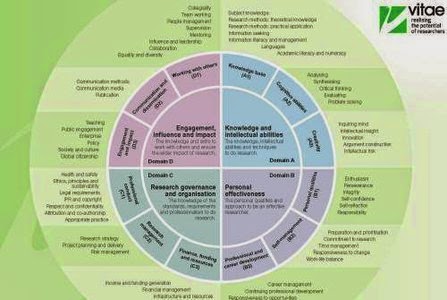
Mader is using the Vitae Researcher Development Framework (pictured) as a basis in the interviews, so that the academics can reflect on which of the elements in this researcher framework the students found most challenging and which the academics' thought was most important. From the initial part of the pilot study (interviews with an academic, so far), cogntive abilities and self-management emerged as the most important and the most challenging concepts for students.
Mader identified that conversations between faculty, librarians and students is crucial. From these conversations with students and faculty, the threshold concepts should emerge, and then the curriculum needs redesign (the future plan) to address the issues and improve the quality of student learning. She referred to Cousin's article on using threshold concepts (see below)
Cousin, G. (2006) An introduction to threshold concepts. Planet. (17), 4-5. http://journals.heacademy.ac.uk/doi/full/10.11120/plan.2006.00170004
Report from #ecil2014 - Transferability of information and data literacy beyond higher education
A shaky start to my liveblogging from the European Conference on Information Literacy, held in Dubrovnik this morning. I was delivering a talk (with Bill Johnston, I will post about that later) at 9am, and I'm afraid I took a little break after that to boost myself with coffee. Therefore I missed the first part of the panel from Stephane Goldstein, Ralph Catts, Jane Secker and Geoff Walton on Transferability of information and data literacy beyond higher education and can't do it justice.
However, to report on the part I attended: one thing was that a new membership organisation was being launched InformALL http://informall.org.uk, which has grown out of the Research Information and Digital Literacies Coalition.
Questions were flagged up for discussion. The first one was looking at the concept of Information and Data Literacy in the workplace, and how it might be explained to stakeholders. Responses included highlighting the value of case studies, creating evidence which show how IDL affected profits, adopting different strategies with Small and Medium Sized Enterprises and big businesses, talking to trade unions, skills agencies, and looking at existing portals (one in healthcare was mentioned).
In terms of looking specifically at "the juncture between higher education and employment", as well as the stakeholders mentioned above, careers services, course placements, placement agencies and associations that were concerned with professional development were mentioned. I also thought of parents (thinking about the successful programmes that I found out about last year, run by the Singapore National Library Board) who unfortunately nowadays may find their graduated students returning to them and might be motivated to helping their children to become employable.
They finished by asking whether initiatives such as the one they propose, InformALL, could be a vehicle for further action.
Doing a quick google, I found a poster here which is on the same topic by these authors http://www.slideshare.net/infolit_group/goldstein-walton-poster
Photo by Sheila Webber: restaurant street, Dubrovnik, October 2014
Tuesday, October 21, 2014
Report from #ecil2014 - Degree of School Librarians' Involvement in Providing Information Literacy skills
Today's final session (for me) at the European Conference on Information Literacy, held in Dubrovnik. Ruth Ash-Argyle (University of Haifa) and Snunith Shoham (Bar Ilan University) talked about Evaluating the Degree of School Librarians' Involvement in Providing Information Literacy skills to Students using The Big6 Model as an Assessment Tool. The purpose was to study how involved the school librarian was in teaching students information literacy and also to investigate the librarians' self-efficacy. They used the Big 6 model, because it takes account of stages in the information research process and it is a widely used model.
The researchers hypothesised that schools librarians would be more involved in the Big 6 stages associated with searching and sources, and that higher involvement would correlate with higher professional self-efficacy. They administered a questionnaire to school librarians. The participants were asked to rate their involvement in each of the Big 6 stages. The results were that stages 2 (Information Seeking Strategies) and 3 (Location and access) did have the highest involvement from librarians. Barriers to more involvement included lack of time, lack of cooperation from teachers etc.
The researchers identified (from previous research) four domains of professional self-efficacy: teaching, technical skills, interpersonal communication and self-teaching skills. The school librarian participants rated themselves as having high communication skills, with self-teaching as the lowest point. The domain that correlated significantly with high involvement in the curriculum was that of self-teaching and professional updating.
The participants were also asked to self-identify their role e.g. information expert, promoter of reading skills (there were 6 roles listed). The results were that "Promoter of reading skills" rated highest and "Educational consultant" lowest. Relating these results to the degree of involvement in the curriculum, the higher role of leader correlated with higher involvement in the curriculum.
Recommendations included developing school lbrarians to embrace the roles of leader, teacher etc. and encouraging continuing development and professional updating.
Photo by Sheila Webber: Flower pot, Dubrovnik old town, October 2014
Report from #ecil2014 - Towards adult information literacy assessment in Latvia
Next from a session on "assessment" at the European Conference on Information Literacy, held in Dubrovnik. Liga Krumina (University of Latvia) talked on Towards adult information literacy assessment in Latvia: UNESCO media and information literacy competency matrix in practice.
They had a product to develop diagnostic instruments for assessment of adults' (25-62 years) knowledge and skills. The participants were a purposive sample of the economically active population in a region of Latvia. The researchers were using the concept of "livelihood" involving resources such as knowledge, land, tools that can be shared. They were adopting a UNESCO definition of media and information literacy (MIL) as given in the UNESCO MIL assessment document. This document idetifies three levels of MIL, plus a "zero" level. Data was collected through focus groups, questionnaires and practical information tasks.
In the focus groups researchers asked about the importance of information in the participants everyday lives, problems encountered, and knowledge and skills with information. The knowledge questionnaire contained 23 questions based on everyday life situations (with questions concerning access, evaluation and creation). The practical tasks involved asking participants to undertake search tasks and using think-aloud protocolls to collect data.
In the focus group, a key problem that emerged was language skill (i.e. if there was no information in Latvian), and also skills in interacting with computers, software and search engines. In the questionnaire, the average level of respondents was level 2, in evaluation it was level 3, and in creation in was levels zero/one. The speaker noted that although participants self-rated their skills as good, "the results of practical tasks showed many shortcomings".
The speaker concluded that the four levels of competence were useful as they helped to identify where areas for improvement were. The think-aloud method was time-consuming but the results were "credible and accurate" and thus that aspect was valuable.
In the questions afterwards, the speaker said the biggest problem was with the questionnaire where there could be several valid answers to some practical questions (e.g. if you found a recipe for soup on the internet, how can you best save it while you make the soup). They are developing this further.
Photo by Sheila Webber: Dubrovnik city walls from the sea, October 2014
Report from #ecil2014 - Relating research and practice in Information Literacy
I just finished chairing a 90 minute panel on Relating research and practice in Information Literacy, which started with presentations by me, Bill Johnston, Louise Limberg, and Ola Pilerot and then had some time for discussion and questions. The presentations (in one document) are embedded below. Afterwards there were interesting points raised by the audience, mentioning barriers such as language (i.e. research being in different languages) and suggesting further studies such as investigating teh experience of people who were successfully conducting research in a practitioner context. There were also ideas about how the discussion could be continued at ECIL next year.
We don't say anything about ourselves in the slides, so it is worth saying that all four of us (Bill, Louise, Ola and me) started out as library practitioners and then made a move into academia (three of us into library and information science, Bill into educational development/research).
Report from #ecil2014 - the role of an information literacy model in transforming the curricula at the Durban University of Technology
Next from the European Conference on Information Literacy, held in Dubrovnik, Shirlene Neerputh talked on Graduate preparedness: the role of an information literacy model in transforming the curricula at the Durban University of Technology. She started by talking about the "new realities" in higher education e.g. changes in teaching approaches, the increased emphasis on lifelong learning and independent learning, and "the role of the library in enhancing teaching, learning and research in higher education in a knowledge society".
Looking at Durban University of Technology's vision and mission, it raised issues such as - how do educate for citizenship. The library's vision includes a focus on supporting independent student learners.
To promote lifelong learning the library aims to enrich the curriculum with information literacy learning and assessment. After working within other subjects, they are also now looking at a e-learning information literacy modules specifically taking a blended and independent learning approach. They have identified 6 themes to "cascade the entire undergraduate programme from first to final year". A student on a 3 year programme has to take 3 modules, and a student on a 4 year course, 4 modules. Modules have to be chosen from outside the home faculty, to help develop and stretch the students.
Firstly there is a General Education module, aiming to develop critical and humanistic skills and attitudes (e.g. to understand and appreciate diversity), and this is compulsory. The focus is very much on self-awareness and developing into a reflective student. Information Literacy is part of this module as a core competency. The concept of life journeys is a key way of developing student learning, and this theme is linked to physical journey in the landscape. The speaker talked about the problem of how you assess critical thinking. She identified questions that you would be asking e.g. is the student critical and self-aware when considering his/her life journey.
This sounds a very interesting programme and I hope to find out more about it.
Photo by Sheila Webber: sparkling sea with Lokrum island, October 2014
Report from #ecil2014 - An Information Literacy Course for Doctoral Students
Another liveblog from the European Conference on Information Literacy, held in Dubrovnik. Ann-Louise Paasio and Kristiina Hintikka (Turku University library) talked about An Information Literacy Course for Doctoral Students: Information Resources and Tools for Research. They were talking about a course they have run since 2012. It gives training to doctoral students in all faculties at Turku University (Finland). It is voluntary and run both in Finnish and in English.
It consists of 4 assignments, 15 hours of lectures and computer class sessions, and students get credit (1 ECTS). The basic course content is the same, but the students are grouped broadly by discipline, so they are working with students in their own fields - also it means subject specialists can be involved. The course includes searching, using bibliographic management and keeping up to date. Academics also are included as invited lecturers. The course web page (in English) is here
http://www.utu.fi/en/units/library/findasklearn/learn/utugs/Pages/home.aspx
The university's graduate school coordinator was an important collaborator in planning and publicising the course. The students' feedback has been mainly positive, with students finding the practical skill sessions useful, for example. They also liked sharing experience with other students and getting personal guidance from the lecturers. There is now an online version of the course being launched. The speakers noted the challenges of having groups with a mix of disciplines, and also the time taken for marking.
Photo by Sheila Webber: harbour cat, Dubrovnik, October 2014
Report fron #ecil2014 - Towards a radical information literacy
Talk three today, liveblogging from the European Conference on Information Literacy, held in Dubrovnik, was Andrew Whitworth on Towards a radical information literacy. He said that he wanted to close the "research practice" gap. He identified three approaches. He started by identifying phenomenography as a research methodology and also as a pedagogy (I think he was referring to variation theory here). The second approach was sociocultural practice, using Lloyd's work as an example, seeing information literacy as a source of practice, different contexts having different practices. Whitworth identified some elements of the context or landscape being "more open to transformation than others".
Whitworth went on to talk about mapping experience within a course, with use of different approiaches. Finally he talked about discourse analysis, which he felt should be included because "The reality of organisational life is not that all contexts are equal, not all experiences of variation can be expressed" because he felt that "practice architectures and the ways of thinking they represent, are pushed by dominant interests. He proposed that the work of Bakhtin on prosaic communication was valuable for understanding the discourses. Whitworth's idea of radical information literacy involved redistributing authority whilst including the concept of stewardship (a role for librarians) and he emphasised that it involved working with those in other fields and communities.
This is his book, that Whitworth was referring to in his talk: http://store.elsevier.com/Radical-Information-Literacy/Andrew-Whitworth/isbn-9781843347484/
Photo by Sheila Webber: view frommy window, Dubroknik, October 2014
Subscribe to:
Posts (Atom)


