Wednesday, April 19, 2023

#LILAC23 Social class equity and recruitment: content analysis of teaching librarian postings using critical social psychology

 Pam McKinney here live blogging the final session from day 1 of the #LILAC23 conference, this session wasled by Darren Flynn who is a PhD student at UCL, as well as working in a library context. Darren’s study is informed by the psychology of social class, which tries to understand how people socialise within a social class, and how this affects their behaviour, and differences in values, behaviours, predispositions and preferences.
Middle class norms negatively impact on working class people, for example in the UK school system the concept of school choice is exploited by middle class people but can negatively affect working class people who cannot exercise their choice in the same way. Darren spoke about the spectrum between interdependence and independence. People from working class backgrounds are more likely to rely on their communities and act in a more interdependent way. People from middle class backgrounds tend to focus on the development of personal preferences and choice, and independence. People from working class backgrounds tend to show more empathy, and recognise others’ emotional state. People from a middle class backgrounds tend to be more self-reflective and focus on the self in relation to events.
Generally people from working class backgrounds have less power, and are more constrained by rules and procedures, so learn to overcome and navigate systems and processes. This leads to a pessimistic outlook on life. People from middle or upper class backgrounds have a higher belief that  they can change their environment, and are more politically active, they are less likely to put up with situations they don’t like.
The distinction between pro-social and pro-self: people from working class backgrounds are more pro-social they give more money to charity and people from middle class backgrounds tend to be more driven by individual goal setting, and have a more transactional attitude to help giving. These dispositions are not mutually exclusive, but equity is related to the balance between them.  Darren looked at 197 job advertisements published between November 2021 and October 202, and all mentioned teaching or training related to information literacy. The research looked at 50 person specifications that were included in the job advertisement. All the data were anonymised and the institutions removed, then analysed each was scored against the criteri explained above.
For example working in a team and collaborative working was evidence of interdependence, and negotiation skills were evidence of an influential mindset..  Darren performed some quantifiable analysis on the data using SPSS, to analyse the individual pairs of dispositions and the correlation between pairs. The results showed that the job adverts and  job specs analysed skewed towards independence and reflective skills, which are more middle class dispositions. They were skewed towards pro-self and the more influential rather than adaptive, again the more middle class dispositions. Based on this data, there is evidence that person spec criteria are biased towards dispositions that are more middle class, which influences entry into the profession and career progression.
This affects sector diversity, but could be for a variety of reasons e.g. there is a lot of re-use of job specs without much critical analysis.  Cultural reproduction is the concept that the views and dispositions of a dominant group are reproduced, so if middle class people are writing job descriptions then they will enshrine middle class dispositions. So people from marginalised backgrounds experience jarring consequences of these dispositions and has consequences for the structures in libraries. If recruitment and promotion is biased towards middle class people, are the solutions we present to students also biased towards the middle class?
Photo of the conference venue by Pam McKinney

#LILAC23 How university students use TikTok to search for information

Student award winners

Pam McKinney here live blogging from the #LILAC23. This presentation was led by Elizabeth Brookbank from Western Oregon University, reporting initial results from a study to understand how TikTok might influence IL teaching.
Google are worried about the impact that TikTok could have on their business model, as GenZ are increasingly turning to these new social media for information discovery rather than search engines like Google. In response, Google are changing their algorithm to show more TikTok videos in their search results, and more videos overall. 

Initial conversations took place with students, who reported that it was a lot easier to see what content was paid for on TikTok than on Google. Some thought that using search was pointless on TikTok because of the way the algorithm works, in that it only shows you content in your filter bubble, that you’ve already shown an interest in. It doesn’t allow you to sort results by date, but is useful if you need practical advice on how to do things. There is little published research on how people search on TikTok but one study showed that relevant content is returned faster than on Google, and video content was thought to be easier to engage with than text. The participants didn’t care much about misinformation, and avoid material that is perceived to be risky e.g. health. 

Elizabeth conducted 3 focus groups with students, and these have not been analysed fully; she reported interim results only at the conference. Participants were concerned about spending too much time on the app, and have concerns about the amount of information it harvests. It was seen to be a good way to entertain oneself, and is relaxing. Some participants were TikTok  creators, and used this as a way to share their problems and self-care. Connecting with friends was seen to be a positive aspect of the app, and to find out about the news.
Students were asked if they used TikTok to search for information and half said yes they did, which seemed a little contradictory to Google’s panic about genZ all changing their search interface. TikTok is searched for “how to” videos e.g. for recipes, cleaning, or fixing things or crochet etc. one student used it in a class. Participants were asked about “searching” versus “scrolling”, and reported that TikTok would present them with relevant information if they had been searching for information on other platforms. Students would subscribe to certain hashtags if they had ongoing information needs. Some thought that searching didn’t really work on TikTok.
Comments on other peoples’ videos were useful for gaining a consensus on a topic, and TikTok was seen as a good place to start looking for information, that would be followed up on other platforms. There was a sense that participants were able to judge the authority of content creators, and were sensitive to the lived experiences of certain creators. Aspects such as camera quality, and the look of the video were important ways to judge the quality of the information presented. Political and health information was rarely trusted, generally the participants liked to search for low stakes information on TikTok.
Photo Pam McKinney

Student perceptions of librarian-teacher identity #LILAC23

Poster advertising LILAC

Pam McKinney live blogging from #LILAC23, this session is led by Heather Lincoln and Tiffany Chiu from Imperial College, reporting the results from a Masters in higher education dissertation research project. The study focused on business students’ perceptions of the role of the librarian and how they support learning. Much of the literature focuses on librarians’ perceptions of their role so this is a useful addition to the research base, and could lead to service development. Librarians can suffer from imposter syndrome in relation to their teaching identity. 

Heather conducted 6 focus groups with students studying a variety of programmes in the business school, and analysed the data thematically. Students thought that librarians were approachable, and helped them when they needed it. Students liked their IL teaching, and thought the librarian seemed ‘fun’ and enthusiastic, teaching sessions enabled students to ask questions, which was important to them. Students thought that librarians seemed knowledgeable, and saw their role linked to the library resources and providing access to them. Librarians have an enabling role linked to helping students achieve their learning outcomes. 

Heather framed her research using Lave & Wenger’s theory of communities of practice, saying that librarians were not perceived as part of the students’ academic community of practice. Librarians are seen as “experts” and not part of the community they are mastering. Students were conscious that they could make the librarian feel uncomfortable if they ask about something that the librarian isn’t an expert in. If we look at knowledge as co-constructed, it is useful to think of students as partners in learning, not passive apprentices. In conclusion librarians need to make their areas of expertise obvious to students, and use an approach the co-constructs knowledge with students.
Photo: Pam McKinney

First #LILAC23 Keynote: new professional panel

 Pam McKinney here live blogging from the #LILAC23 Conference. The first keynote is a panel session with new professionals Naomi Cassidy, Tom Peach, Naomi Smith and Kristabelle Williams, chaired by Katie Wise. The panel members work in a variety of sectors and roles, but all are recently qualified and were keen to share their views with the LILAC community.
The first question related to the lack of empathy that some academics have for the IL problems students face. Tom acknowledged that it is really tricky to challenge academics, but that it is useful to approach this problem from the position of seeking to understand. Sometimes institutional policy, departs mental culture and other aspects influence academic opinions, so trying to understand these is useful. Fostering empathy without alienating people is challenging, but is an aspect of successful liaison. It is important that librarians don’t try to adopt all the responsibility for others’ opinions, that is impossible. Tom said that working in an environment where challenge was supported was helpful, and good modelling from his colleagues really helped. 

The second question related to how colleagues respond to particular areas of interest from new professionals. Kristabelle said that her colleagues were really helpful, and that it helped to be opportunistic about promoting IL, for example the Extended Project Qualification taught in UK secondary schools is a good platform for engaging teachers. Kristabelle is a union lead for the National Education Union, and this has helped build relationships with teachers. Naomi Smith  is interested in anti racism and uses strategies such as creating inclusive reading lists and employs arguments such as “this is good for the university image” to encourage academics to engage with this practice.
Naomi Cassidy spoke about how it can be tricky to challenge if you are a member of a minorities group, and be thought of as unlikeable  even though you might just be trying to be assertive. Sometimes it doesn’t benefit senior management for there to be challenge, so that can be hard as a new professional. Any work touching on Equality and Diversity is important, and the role of librarians is to welcome students with protected characteristics into the library. 
Naomi Smith spoke about how important it is to speak openly about diversity, and this is part of institutional culture. Managers should support staff with protected characteristics, and enable discussions e.g. about how race might affect participation in the IL classroom. Naomi Cassidy spoke about how important it is to be bold, as lots of librarians are quite introverted, it sometimes takes one person to speak up to encourage others to say they have aligned values.  

There was a question about students’ use of non traditional academic sources, where the formal literature is seen to be the only valid source  that students could use. This is tricky when university structures do privilege this kind of resource. Naomi Smith spoke about decolonising the library, and including oral tradition as a valid resource is a radical change of direction for the university. Students want to use TikTok, and reference information they have found on that platform, but the librarian has to advise students to ask their lecturer if this is a valid source or not. Some things are beyond the power or role of librarians to control, but librarians can have influence. Naomi Cassidy spoke about the fetishising of peer reviewed research in the health sphere, but it has been proven that some of this literature is harmful for marginalised populations. It’s important to open up these conversations with academics.  

The panel were asked about the lack of diversity in pedagogical structures, Kristabelle spoke about the situation in schools, which have a recruitment and retention crisis. There are gaps and weaknesses in the school curriculum, where information literacy is not well covered. Schools could support transition to university much more comprehensively, if school librarians and university librarians could work more closely with each other.  It is important to involve the student voice in defining what information literacy teaching should look like in schools. In the UK there is a big discrepancy between the library provision in private schools and state schools, and a need for more development opportunities for school librarians. Naomi Smith spoke about how challenging it is to teach critical IL in a one hour class, when lecturers just want simple classes that cover the basics of engaging with the literature. It is hard to speak out from a marginalised position, so allies from more privileged backgrounds are really important. Naomi Cassidy spoke about the difficulties busy medical students face in engaging with information literacy when their courses are very full.
This was a really interesting panel!

Laura Woods: reading between the lines - information literacy in engineering education standards #LILAC23

Photo of Laura Woods

Pam McKinney at #LILAC23: this second session is led by a PhD student that Sheila and I supervise, Laura Woods, who is also a subject librarian at University of Huddersfield. Laura is presenting about how IL is represented in engineering education standards, and this is linked to Laura’s PhD topic of the information worlds of women engineering undergraduate students. 

In order to understand womens experiences in this area it’s useful to take a step back and look at the overall picture of students experiences in engineering with regards to information. The standards give us a sense of the expectations n this field and the outcomes students are expected to meet. The engineering council accredits engineering degree courses in the UK, and departments have to say how they meet these standards. Also we have standards for IL, the SCONUL 7 Pillars, and the ACRL framework for IL, both widely used in UK universities. The ACRL have a set of documents that are companions to the ACRL IL framework, for specific disciplines, and there is one recently published that is specific to STEM subjects. 

Laura has reviewed the literature on the intersection between IL standards and engineering standards, but only one study has previously been published from the context Bradley (2013), who compared accreditation standards from the UK, US, Canada and Australia for nursing, social work and engineering. Much of the language that Bradley found relating to IL in the engineering standards has now been removed, which has made the information skills required for engineers much more opaque. One statement explicitly identifies IL  needed “students should be able to select and evaluate technical literature “ but this ignores the activity needed to search for literature. Laura maps these competencies onto the SCONUL 7 pillars model and the ACRL framework. There are partial matches with the competencies in both IL frameworks, but also competencies that aren’t covered by the engineering standard. Slide from Laura Woods presentation

This was a useful exercise as it is good to understand the competencies that accrediting bodies require from their students and the courses they study. Information use is rarely mentioned, but is present as a hidden first step rather than a skill that students need to develop. There is a lack of recognition that IL needs to be taught and developed, it is seen as something that either they know already or can just “pick up” during their course. So what should librarians do to address this gap in conceptualisation of IL between librarians and academics? Laura’s PhD study should help answer this question! An association of engineering librarians in UK universities could also help.
Photos: Pam McKinney

Live blogging from Pam Mckinney at #LILAC23

 It’s Pam McKinney here live blogging from #LILAC23 at the university of Cambridge. The first session today is “why don’t they like me? The trials and tribulations of a newly qualified science librarian” by Eva Garcia Grau. Eva spoke about the challenges of starting her role during the covid pandemic, and the dissertation research she undertook while studying a masters at Aberystwyth university. She analysed over 200 published journal articles to understand the barriers to integration of IL teaching in the university curriculum. 

Central barriers were reluctance of academics to give time in their packed curriculum, a lack of institutional support, poor perceptions of librarians, librarian confidence in pedagogy.  There is a need to make IL teaching subject-specific, and teach within the disciplinary context. However close working with academics can facilitate this. Alternative strategies were for academics to do the IL teaching, which positions the librarian as “expert” consultant in IL. Stand-alone IL models are also used, as well as online IL courses. Recommendations coming from the review are to speak the language of academics, and link IL to to the capabilities that students need. Librarians need to be brave, and engage with the acadmicsin the disciplines you support. 

Be confident in librarian teaching identity is also important. Eva’s strategies. Were to adopt  a ‘drip-drip’ approach, and be visible. She made sure she was invited to committees in the academic departments, attending social events and really getting to know the academics socially. She developed good relationships with the professional services colleagues in departments. She found that Demonstrating her knowledge of research helped, and how she could save academic staff time. Word of mouth is helpful for marketing services. 

Barriers were when colleagues left the institution which meant that there was a decrease in engagement, and it is hard to devise IL teaching that is appropriate for Maths. Evidence of success can be seen in an increase in teaching, increase in student appointments, academics seeking her out for support, being invited to events, teaching being booked well in advance, and feeling more confident in her abilities.

It's #LILAC23 !

 Look out for posts from my colleague Dr Pam McKinney who will be liveblogging here through the LILAC conference, and I will be joining her tomorrow!

Tuesday, April 18, 2023

Supporting Library Instruction with Learning Tools Interoperability

The latest Tips and Trends article from the ACRL Instruction Section, Instructional Technologies Committee is Supporting Library Instruction with Learning Tools Interoperability (LTI) by Kelly Safin. "The issue reviews the benefits of utilizing LTI to connect already developed library resources (i.e. LibGuides) within learning management systems such as Canvas." You can find it in pdf https://acrl.ala.org/IS/wp-content/uploads/Spring-23-Tips-and-Trends.pdf and linked from the Tips and Trends home page https://acrl.ala.org/IS/instruction-tools-resources-2/technology/tips-and-trends/
Photo by Sheila Webber: cherry blossom, April 2023

Monday, April 17, 2023

ACRL Science Technology Section's virtual idea exchange

The ACRL Science Technology Section's Information Literacy Committee has organised a free virtual idea exchange. It is on 24 April 2023 at 15.00 US Central Time (which is, e.g., 21.00 UK time). "This session will focus on how to use the ACRL Framework Companion Document for STEM https://www.ala.org/acrl/sites/ala.org.acrl/files/content/standards/Framework_Companion_STEM.pdf and will provide opportunities for participants to drop into different break out rooms based on each Frame to exchange ideas. No need to have attended previous sessions in order to participate." You must register at https://uncw.zoom.us/meeting/register/tZMuf--przstGdOC31GKzUoEM9hEfAgHBYO5#/registration
Photo by Sheila Webber: sunbeam and cherry blossom, April 2023

Saturday, April 15, 2023

Alternative search engines

A short article highlights"new search engines like Brave Search, Neeva and You.com" and how they differ from Google et. al.
Lewandowski, D. (2023, 7 March). Search engines that give users control over their results. https://www.infotoday.eu/Articles/Editorial/Featured-Articles/Search-engines-that-give-users-control-over-their-results-157358.aspx
Photo by Sheila Webber: Greenwich Park, April 2023

Thursday, April 13, 2023

New articles about health literacy

The priced journal Health Information and Libraries Journal (vol. 40 issue 1, 2023) has a special issue on health literacy:
- Health literacy and consumer health information by Maria J. Grant PhD (Editorial; Open access)
- Patient education information material assessment criteria: A scoping review by Khadijeh Ahmadzadeh MSc, Masoud Bahrami PhD, Firoozeh Zare-Farashbandi PhD, Payman Adibi Md-PhD, Mohammad Ali Boroumand MSc, Alireza Rahimi PhD
- A survey of health information seeking by cancer patients indicates some problems over medical explanations and terminology by Mahmut Akbolat PhD, Mustafa Amarat PhD, Özgün Ünal PhD, Gülcan Şantaş PhD - Information seeking behaviour differences indicate which US population groups lack information about human papilloma virus and associated cancer risks by Bahareh Ansari MBA
- Caregivers of children feel confident about using the Internet for health information by Emma Delemere M.sc, Rebecca Maguire PhD CPsychol
- Study of health information needs among adolescents in Croatia shows distinct gender differences in information seeking behaviour by Ivana Martinović PhD, Sung Un Kim PhD, Snježana Stanarević Katavić PhD
- Few changes shown in cancer information-seeking behaviour among young adults in China between 2012 and 2017 by Shaohai Jiang PhD, Piper Liping Liu PhD
- The prevalence of low health literacy in undergraduate students in Pakistan by Aziz-ur Rehman PhD, Salman Bin Naeem PhD, Anthony Faiola PhD
Go to https://onlinelibrary.wiley.com/toc/14711842/2023/40/1
Photo by Sheila Webber: Cherry blossom, April 2023

Wednesday, April 12, 2023

Library Instruction Together @LibInstruct

The conference Library Instruction Together (LIT) 2023 is being held in two parts. There is a virtual conference on 24 May 2023 and an in-person conference on 19 May 2023 in Nashville (Tn.), USA. Both parts are free but registration is required for each.
"The sessions reflect this year's theme, Better Together. This theme reflects the restructuring of LIT to reflect its growth from a small, regional conference named Library Instruction Tennessee to one that was renamed Library Instruction Together this year in recognition of its expanded reach to librarians from all over."
- Registration form for the virtual event, May 24, 2023 https://www.tnla.org/events/register.aspx?id=1738917&itemid=31ca0bd3-5876-40e2-b954-5851e12522d4 and this is the programme https://libraryinstructiontn.files.wordpress.com/2023/04/lit-virtual-conference-program-2023-1.pdf
- Registration form for the in-person event, May 19, 2023 is here and the programme is here ·

Tuesday, April 11, 2023

Call for proposals: Let’s Work Together to Develop Critical Thinkers in the ChatGPT Era

There is a cfp from the IFLA Information Literacy Section (ILS): this is for a session at the IFLA World Library and Information Congress (WLIC) in Rotterdam, Netherlands, August 21-25, 2023 (so you have to be a delegate at the conference to present). The theme is Let’s Work Together to Develop Critical Thinkers in the ChatGPT Era. The deadline for proposals is 1 May 2023. Presentations will be 10 minutes, with a 10-minute Q&A.
"As we continue to move into a more digital age, it is becoming increasingly important to develop critical thinking skills to navigate the vast amount of information available. Libraries should be working together to 1) develop policies, lesson plans and strategies while embracing ChatGPT and related AI technologies; 2) address issues and concerns about the use of AI in libraries through critical lenses; 3) prepare learners for a sustainable future.
"ChatGPT can be a powerful tool for teaching and developing information literacy skills, but it can also be a source of misinformation. It is important for users of ChatGPT to be aware of its limitations and to critically evaluate the information it provides. We are looking for innovative and practical solutions that can equip individuals with the necessary skills to navigate and evaluate information in an era where machine-generated content is ubiquitous.
"Possible sub-themes may include, but are not limited to:
- policies, best practices, and issues with including AI in academia and library information literacy instruction
- strategies to develop critical thinkers collectively in the ChatGPT era
- research on combatting misinformation and disinformation in media, including machine-generated content
- best practice in using ChatGPT and other AI technologies and the ethical implications of using them.
There is full information about how to submit a 500 wotrd abstract at https://www.ifla.org/news/information-literacy-section-call-for-papers-lets-work-together-to-develop-critical-thinkers-in-the-chatgpt-era/
Photo by Sheila Webber: flowerbed, Greenwich Park, April 2023

Monday, April 10, 2023

Generative #AI and search: two articles

Firstly, an article by Phil Bradley on AI and search engines, with some tips on how you can use one on the other, and how AI will be a "Google evolver":
Bradley, P. (2023) The Future of Search Is Intelligent. Computers in Libraries, 43(3). https://www.infotoday.com/cilmag/apr23/Bradley--The-Future-of-Search-Is-Intelligent.shtml

Secondly, some interesting insights from:
Chiang, T. (2023, 9 February). ChatGPT is a blurry jpeg of the web. The New Yorker, https://www.newyorker.com/tech/annals-of-technology/chatgpt-is-a-blurry-jpeg-of-the-web. (n.b. you only get a limited number of stories free, so whether you can access all of this will depend on how many New Yorker articles you accessed previously)
Some quotes (in which I take the Google rather than the ChatGPT approach - you have to guess whether I understood the quotes or not!) "The fact that ChatGPT rephrases material from the Web instead of quoting it word for word makes it seem like a student expressing ideas in her own words, rather than simply regurgitating what she’s read; it creates the illusion that ChatGPT understands the material. In human students, rote memorization isn’t an indicator of genuine learning, so ChatGPT’s inability to produce exact quotes from Web pages is precisely what makes us think that it has learned something."
[having identified that ChatGPT is good at generating filler "content"] "I’d say that anything that’s good for content mills is not good for people searching for information. The rise of this type of repackaging is what makes it harder for us to find what we’re looking for online right now; the more that text generated by large language models gets published on the Web, the more the Web becomes a blurrier version of itself."
Photo by Sheila Webber: fallen cherry blossom, April 2023

Sunday, April 09, 2023

Chatting Info Lit podcast @infolitgroup

The Information Literacy Group New Professionals Sub-Committee has launched a Chatting Info Lit  podcast series. "We will be inviting both new and experienced professionals across multiple LIS sectors to hear about their exciting information literacy projects and to find out what information literacy means to them. We will also be exploring the experience of being a new professional and all the challenges that come with it." There are 2 episodes so far:
(1) Ella Wharton (University of Nottingham, UK) chats to Katie Wise (Berkshire Healthcare NHS Foundation Trust, UK), about the importance of health literacy and about Conversations of Care, a communication training project developed at Royal Berkshire Hospital.
(2) Bethan Morgan (Manchester University NHS Foundation Trust, UK) chats to Frankie Marsh (University of Cambridge, UK) about the link between information literacy and decolonisation in academic libraries.
Apple: https://podcasts.apple.com/gb/podcast/chatting-info-lit/id1673423506
Soundcloud: https://soundcloud.com/chatting-info-lit-podcast
Spotify: https://open.spotify.com/show/18iLL0XJhLMg9YW8IXcPSi
If you want to propose a podcast episode fill in this form https://docs.google.com/forms/d/e/1FAIpQLSebmI12uRP3hstq04_MEhor0xpTw8hNBPVBoU7zDVUwC2wjqw/viewform

Photo by Sheila Webber: Greenwich Park, April 2023

Friday, April 07, 2023

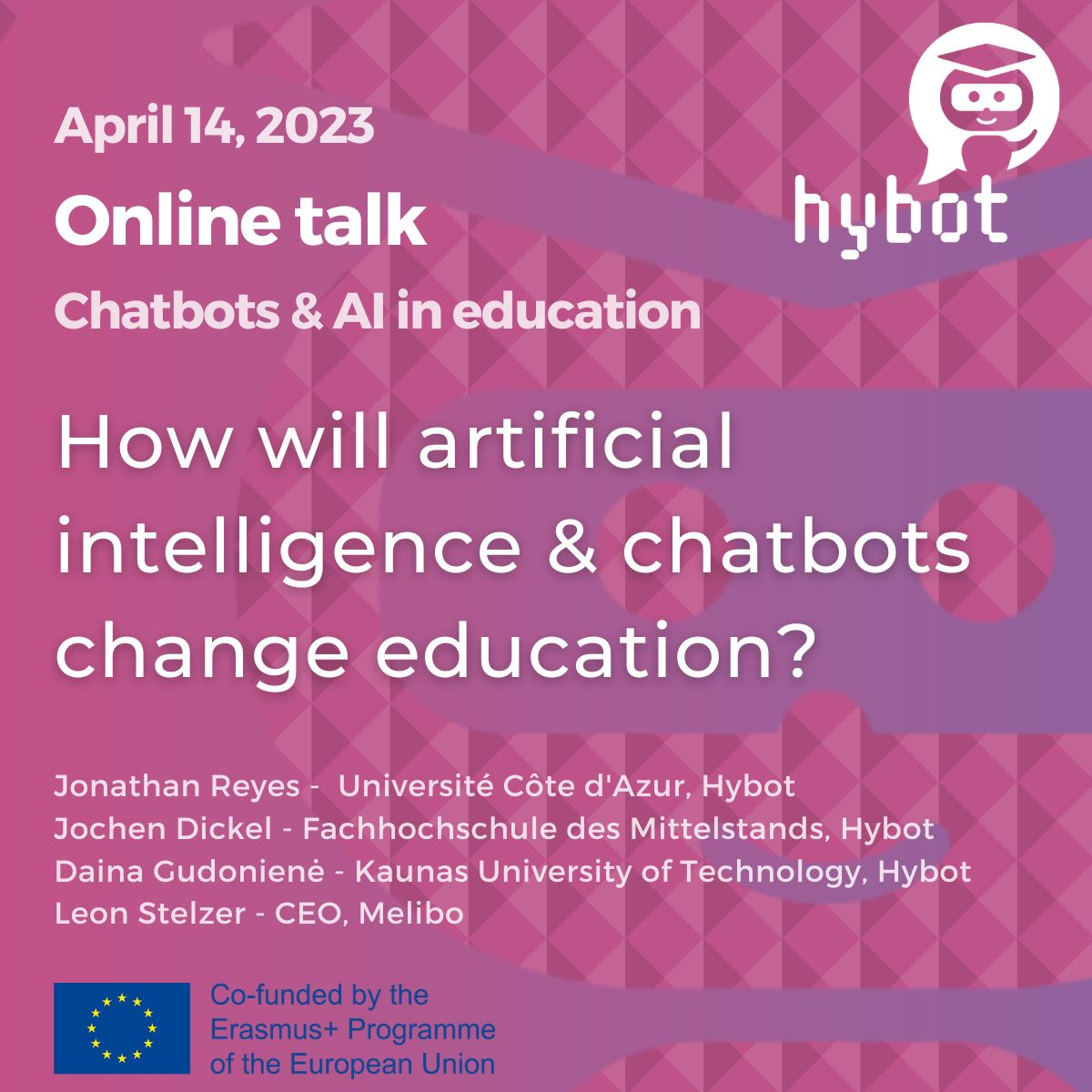
Webinar: How will artificial intelligence and chatbots change education?

Free webinar on 14 April 2023 at 11.00 CET (10.00 UK time) How will artificial intelligence and chatbots change education? This "will discuss technological, pedagogical, and ethical implications of using AI & chatbots in education." The Hybot project (Enhancing hybrid teaching in higher education through chatbots) "aims at creating specific learning spaces through interlinking physical and digital learning environments. In these spaces, various teaching and learning scenarios can be implemented, with variety of time, place, number of students, collaborative and individual tasks." Melibo also creates custom chatbots to answer customer queries etc. Join zoom at https://lnkd.in/e_xjrN9K

Thursday, April 06, 2023

Poscast: Why is Spectrum not a Learning Organistion? @pedagodzilla

My 2nd contribution to the podcast that combines pedagogy and pop culture, Pedagodzilla, is Why is Spectrum not a Learning Organistion? (Ft. Captain Scarlet) Pedagodzilla (Pedagogy = Godzilla!) is run by Mike Collins (The Open University) and Mark Childs (Durham University). In this case I was drawing on my understanding of the learning organisation and applying it to the problematic working culture that pervades the series Captain Scarlet and the Mysterons (spoiler alert, due to the complete inability of Scarlet's employer organisation, Spectrum, to learn anything ever, the result of most episodes is Spectrum nil, The Mysterons 10). To listen to the podcast go to https://www.pedagodzilla.com/why-is-spectrum-not-a-learning-organistion-ft-captain-scarlet/
Photo taken by Sheila Webber in the 3D virtual world Second Life, at the Second Life Sci-Fi Convention, April 2023

Wednesday, April 05, 2023

Webinar: Using Kahoot! to Transform Library Instruction

Another useful free webinar from LiLi (Lifelong InformationLiteracy) is Using Kahoot! to Transform Library Instruction on 19 April 2023 at 10.00-11.00 US Pacific time (which is, e.g. 18.00-19.00 UK time)
"Turn passive library instruction into active learning opportunities by gamifying them, using Kahoot! Build in excitement, engage students, and increase retention by employing low-stakes competition, putting participants in the driver’s seat and bringing high energy to synchronous sessions." Led by Melissa Johnson (Instructional Design Librarian at Southern Methodist University, USA) and Tracey Rinehart (Instruction Coordinator and Business Graduate Programs Librarian at Southern Methodist University, USA). If you are attending, register here. If you just want the recording, register here
Photo by Sheila Webber: another spring/winter tree, March 2023 

Tuesday, April 04, 2023

New articles: Groupwork; information avoidance; use of streaming video

The latest complete issue of the Journal of Academic Librarianship (a priced publication), Volume 49 issue 2 (2023), includes the following: 
- Information literacy problems in groupwork: Interpretations of the ACRL Framework by G. Arave, Ilana Stonebraker ("What problems does groupwork pose for information literacy, and how can the ACRL Framework help us to address them? This paper addresses gaps in the scholarly literature to examine how groupwork problematizes our understanding of information literacy. We explore ramifications of what it means to be information literate as a group versus as an individual. The ACRL Framework is explored for areas of potential opportunity.")
- Exploring the Influence Mechanism of Chinese Young Researchers' Academic Information Avoidance Behavior by Jianing Zhang, Xiaofei Hu, Dawei Wu, Haijuan Yan
- How ethnic studies faculty use streaming video: Instructional needs, applications, and challenges by Keri Prelitz et al. (this article is open access)
Go to https://www.sciencedirect.com/journal/the-journal-of-academic-librarianship/vol/49/issue/2
Photo by Sheila Webber: cherry blossom nranches, March 2023

Monday, April 03, 2023

Podcast: Could phenomenography increase the happiness quotient in Say Yes To The Dress? @pedagodzilla

I was excited to contrubute to two episodes of the podcast that combines pedagogy and pop culture, Pedagodzilla, run by Mike Collins (The Open University) and Mark Childs (Durham University). My first episode is Could phenomenography increase the happiness quotient in Say Yes To The Dress? which combines two areas of my expertise i.e. the research approach phenomenography and the series of many episodes and spinoffs, Say Yes To The Dress (in which brides and their entourages do or do not buy a very expensive wedding dress). The podcast includes explanations about SYTTD and phenomenography, how you can apply the latter to the former, and also how phenomenography can be useful in your educational practice. To listen to the podcast go to https://www.pedagodzilla.com/could-phenomenography-increase-the-happiness-quotient-in-say-yes-to-the-dress/
Photo taken by Sheila Webber in the 3D virtual world Second Life in 2021

Saturday, April 01, 2023

Recent articles: Misinformation; Privacy literacy; Credibility

The latest issue of open access IFLA Journal (Volume 49, No. 1, March 2023) includes
- Strategies for checking misinformation: An approach from the Global South by Anup Kumar Das and Manorama Tripathi
- Croatian adolescents’ credibility judgments in making everyday life decisions by Alica Kolarić
- A review of international education literature: Interdisciplinary and discovery challenges by Shanna Saubert and Liz Cooper
Full issue available at: https://repository.ifla.org/handle/123456789/2540

Hartman-Caverly, S., Chisholm, A., & Glenn, A. (2023). Digital Shred: Case Study of a Remote Privacy Literacy Collaboration. College & Research Libraries, 84(2), 238. https://doi.org/10.5860/crl.84.2.238 "This qualitative, evaluative case study details the conceptual framing, development, delivery, and assessment of a privacy literacy workshop called Digital Shred. The workshop is a multi-institutional effort offered initially in-person in fall 2019 and adapted to virtual delivery in fall 2020. The conceptual framework underlying the workshop includes reputation management, behavioral surplus, data doubles, data governance, and information security damage assessments. " 
Photo by Sheila Webber: winter spring sky, March 2023

Friday, March 31, 2023

#ACRLFramework sandbox

There is an ACRL Information Literacy Framework Sandbox Upload-a-thon on19 April 2023, at 13.00-14.00 US Central time (which is, e.g. 19.00-20.00 UK time). "If you created info lit teaching materials that you would like to share, join the event" Speakers are Renee Kiner (Public Services Librarian University of Pittsburgh at Greensburg, USA);  Rosalinda Linares-Gray (Collections & Research Services Librarian Fort Lewis College, USA); Lauren Wallis (First Year Experience and Student Success Librarian University of Delaware, USA)/ Registration at https://ala-events.zoom.us/meeting/register/tJ0vcuuvqzwtHdEIVgOsKHerkFyL9E2cw2bZ
As background, this webinar explains the sandbox https://youtu.be/tM9OfxicIj8 and there are instructions about organising an upload a thon (which will give you more of an idea of what to expect than does the above link) arre here https://sandbox.acrl.org/how-can-i-host-framework-information-literacy-sandbox-upload-thon-my-institution
Photo by Sheila Webber: daisies, March 2023

Thursday, March 30, 2023

Webinar: Teaching Material, Visual, and Political Literacy: Primary Sources in Library Instruction

The ACRL Instruction Section Teaching Methods Committee has organised Teaching Material, Visual, and Political Literacy: Primary Sources in Library Instruction on 3 April 2023 at 13.00 US Central time (which is, e.g. 19.00 UK time). It is free. "In this session attendees will be able to describe how to use primary sources to teach a variety of information literacies" The speakers are all at the University of Kentucky in the USA: Colleen Barrett (Rare Books Librarian, Special Collections Research Center); Jay-Marie Bravent (Graduate Outreach & Teaching Archivist, Special Collections Research Center); Anu Kasarabada (John G. Heyburn Archivist, Special Collections Research Center): Taylor Leigh (Hispanic Studies & Political Science Librarian, William T. Young Library). Register at https://ala-events.zoom.us/meeting/register/tJIufu-uqjIsH9XJzApQwzM1VNsbozhrknJH
Photo by Sheila Webber: more signs of spring, March 2023

Tuesday, March 28, 2023

Call for proposals extended: #CALC23

The 2nd call for papers for CALC (Critical Approaches to Libraries Conference) 2023 has been extended to 9 April 2023. The conference takes place online, 24-25 May 2023. You can propose any topic related to critical librarianship you can use this page as a prompt - https://sites.google.com/view/calcconference/about/what-is-critical-library-practice and if in doubt email the conference organisers calcconference@gmail.com who will give you some helpful feedback about whether your proposal fits the theme. The call for papers page is here: https://sites.google.com/view/calcconference/call-for-papers
Photo by Sheila Webber: heather outside the Sheffield UCU office - it is in UCU colours! March 2023

Sunday, March 26, 2023

Maddie is Online showcase

There is an online showcase event on 27 March 2023 at 6pm (UK time): Maddie is Online': Ethics of Online Safety and Security Final Showcase. You will see the 5 short-listed video cartoon stories created by young people as part of the Maddie is Online projecton, on the ethics of online safety and security. The winner of this schools competition will be announced during the session. The project is funded by the Scottish Government, supported by Digital Xtra Fund.
"During the session we will play all the video stories, followed by the final announcement of the winning team that will be selected by an external panel. Our five stories are: 'Friend Finder', 'Lucy the Influencer', 'Violet', 'Yphone Scam' and 'Yolo Classroom'. They all have some important lessons for online safety by young people and their own scripts, characters and voice-overs. Several teachers/librarians also took part in the stories."
Register at https://www.eventbrite.co.uk/e/maddie-is-online-ethics-of-online-safety-and-security-final-showcase-tickets-580172289937

Saturday, March 25, 2023

Bradley's take on AI chat

Online expert Phil Bradley had stepped back profesionally, but happily he has now re-engaged, in particular in examining Chat AI tools. You can find some short videos on his Youtube channel - the latest is a short test of Bard
Image created by Sheila Webber with Midjourney: evidently it doesn't know what "Bard" is yet; prompt was Bard, Google’s alternative to ChatGPT, anime style, judgement, Phil Bradley  BTW I don't try and tweak the prompts much, I'm interested in what it comes up with when I feed in key words from my posts

Thursday, March 23, 2023

Webinar: KeyWordPlay: #Playfulness in Information Literacy

LiLi logo

LiLi (Lifelong Information Literacy) has organised a webinar KeyWordPlay: Playfulness in Information Literacy on 5 April 2023 at 10.00-11.00 US Pacific time (which is e.g. 18.00-19.00 UK time). It is led by Jay Edwards. "A library user takes an active role in searching. Their success not only depends on their knowledge of search strategies, but their tendency to persist and change their strategies on the fly. Successful searchers are those who experiment, explore, and even play. But how do we teach flexibility and creativity in a time-limited classroom setting? How do we teach someone to persist when they're on their own, or to navigate new information environments in the future? ... Learn how the language of play can reframe the vocabulary of the ACRL Framework. See how various librarians have integrated games into library instruction to teach a balance of strategy and flexibility in time-limited classroom settings."
Register here https://www.eventbrite.com/e/keywordplay-playfulness-in-information-literacy-tickets-596912490327
Fill in this form if you can't attend but would like the recording https://docs.google.com/forms/d/e/1FAIpQLSeLcOpXa_sqg2M0GicDcz3kh-623aLw921m1Q2714SF22mhVw/viewform

Wednesday, March 22, 2023

AI Tools to Create and Curate Content in Higher Education

A useful set of annotated links A Snapshot of AI Tools to Create and Curate Content in Higher Education has been assembed by Contact North | Contact Nord (a Canadian education site): it covers Text mining tools, Automated grammar and punctuation checkers, Sentiment analysis tools, Content curation tools, Plagiarism and originality checkers, Speech-to-text and Text-to-speech. Go to https://teachonline.ca/tools-trends/snapshot-ai-tools-create-and-curate-content-higher-education
Photo by Sheila Webber: daisies, March 20
23

Tuesday, March 21, 2023

ASIS&T 2023 Mid-Year Conference

The Association for Information Science and Technology (ASIS&T) 2023 Mid-Year Conference takes place online 11-13 April 2023, with the three days timed to take place in 3 different time zones so there is something for everyone (though unless you like attending conferences in the middle of the night it is unlikely you will participate in all 3 days). The programme is here (scroll to the bottom to click to days 2 and 3). The theme is: Expanding Horizons of Information Science and Technology and Beyond. This is a priced conference, and the early bird raes end on 31 March - they are listed here
Full details at  https://www.asist.org/my23/

Monday, March 20, 2023

UX in Libraries: Connections and Collaborations

The in-person user experience conference UX in Libraries: Connections and Collaborations takes place 6-8 June 2023 in Brighton, UK. The keynote speakers are Marie Østergård (Library Director of Aarhus Public Libraries) and Dr Arun Verma ,there is a pre-conference workshop with Andy Priestner . More information at https://uxlib.org/uxlibs2023/ They offer sponsored places: 2 to staff from public libraries (or further education) and 1 to a BME (Black and Minority Ethnic) delegate, application deadline 31 March 2023

Call for proposals: WLIC poster session

There is a call for posters for the World Library and Information Congress, being held in Rotterdam, Netherlands, 21-25 August 2023. The application deadline is 1 April 2023. The conference theme is Let’s work together, Let’s Library with the sub-theme of Building a sustainable future through the Sustainable Development Goals (although I think these themes can be interpreted broadly) More information at https://2023.ifla.org/call-for-posters/ You have to attend the conference in person to present the poster. There are normally a great many posters at a WLIC poster session (well over 100) and also you get lots of visitors.
Photo by Sheila Webber: the poster area at the 2022 WLIC

Friday, March 17, 2023

Webinar: AI-Driven Search Engines: A Comparative Study

There is a free webinar organised by the SLA on 5 April 2023, at 6pm BST (UK time): AI-Driven Search Engines: A Comparative Study, given by longtime search expert Marydee Ojala. She will "share a preview of her talk on AI search capabilities and results, which she'll also be giving at this year's MLA | SLA 2023 Conference in Detroit [USA]. ... Advances in Artificial Intelligence and Machine Learning have affected the search technologies that power search engines used for general as well as scholarly research. Google and Google Scholar remain a staple for free web searching, But newer entrants, such as Neeva and Consensus, change search behaviour and influence results. This study compares the search capabilities and results among several search engines used across multiple disciplines and considers the impact of the content base used by each."
Register at https://zoom.us/meeting/register/tJwucu-rrTwvG9FqQeyyVAapXIDkW7fdRblw
Image by Sheila Webber and Midjourney with prompt marydee ojala, information today, head & shulders, anime style

Thursday, March 16, 2023

New articles: Data cultures; Older adults' proxies; e-health literacy

There is is a new issue (volume 28 issue 1, 2023) of the open access journal Information Research. It includes:
- Data Cultures: a scoping literature review by Gillian Oliver, Jocelyn Cranefield, Spencer Lilley, Matthew Lewellen ("This paper reports the outcomes from a literature review of the concept of data cultures as the first step in extending the body of knowledge relating to information culture in the information science domain and raising awareness of the need for further research.")
- Internet use and e-health literacy among tuberculosis patients in the Directly Observed Therapy Centre, Lagos State, Nigeria by Olalekan Moses Olayemi, Timothy Shola Abolarinwa
- Social Media by Proxy: how older adults work within their ‘social networks’ to engage with social media by Gemma Webster, Frances VC Ryan
Go to https://informationr.net/infres/issue/view/28-1

Tuesday, March 14, 2023

New articles: SoTL; Communication skills; Learning outcome engagement; Reading; Health equity

The latest issue of Reference Services Review (priced journal) vol. 51 issue 1, 2023, includes
- “We turn the lens … on ourselves:” assessing digital primary source library instruction through the lens of scholarship of teaching and learning by Peggy Keeran
- Teaching undergraduates to develop concise and compelling scholarly communication through storytelling by Tiffanie Ford–Baxter, Kendall Faulkner - Tracking student learning outcome engagement at the reference desk to facilitate assessment by Michael D. Current
- The reader's way: student process guiding library practice by Annie R. Armstrong, Glenda M. Insua, Catherine Lantz
- Libraries advancing health equity:a literature review by Amanda J. Wilson, Catherine Staley, Brittney Davis, Blair Anton (this article is open access)
Go to: https://www.emerald.com/insight/publication/issn/0090-7324/vol/51/iss/1Photo by Sheila Webber: dusk, February 2023

Monday, March 13, 2023

Center for Countering Digital Hate

The Center for Countering Digital Hate (CCDH), which produces material and runs campaigns to highlight misinformation and hate speech in social media, has recently produced a TikTok parents guide. After looking at their material and doing a little googling it seemed to me that their material was worth considering if you are putting together guides and teaching material, but they do seem to have an agenda (though a left rather than right wing one - and they certainly don't like TikTok!) that might influence some of their material.

Image by Sheila Webber and Midjourney, created with prompt tiktok, monster, hate, fantasy style, pastels (as you may gather I have run out of new pictures of flowers, vegetables and trees: as spring is coming I should have more nature photos soon, though)

Sunday, March 12, 2023

#HILJclub discusses "Google is goodish"

HILJClub aims to encouraging engagement with articles published in HILJ (Health Information & Libraries Journal). Someone writes an introduction to their chosen article and sets articles for discussion in the comments. The latest contribution is by Rachel Holmes (Clinical Librarian, Royal Surrey NHS Foundation Trust, UK) who introduces:
Lacey, P. (2021) Google is goodish: An information literacy course designed to teach users why Google may not be the best place to search for evidence Health Information and Libraries Journal, 39 (1), 91-95. https://doi.org/10.1111/hir.12401
Holmes set the questions:
- Should health librarians accept that Google searching is here to stay and start to teach such sessions as these or should we still be trying to promote the more traditional use of the medical and nursing literature databases?
- What else can usefully be included in information literacy sessions taught by health librarians?
- Will you change your practice as a result of reading this article? If so, tell us how!
You will see some interesting responses in the comments, and you are free to add your own thoughts. https://hilj.club/2023/02/02/hilj-article-google-is-goodish-an-information-literacy-course-designed-to-teach-users-why-google-may-not-be-the-best-place-to-search-for-evidence/

Image by Sheila Webber & Midjourney: this rather odd image (perhaps in a doctor's waiting room in an outpost of some unknown country) was created with the prompt: google searching goodish clinical poster

Saturday, March 11, 2023

Libraries and Sustainable Development

Decorative image alluding to SDGs
The Libraries for Sustainable Development (LSD) website "was created to feature and bring together information to act on the United Nations Sustainable Development Goals (SDGs), and sustainable development, in general". Created by the Mortenson Center, University of Illinois, USA, there are "Information Action Briefs" for libraries for each UN SDG. Go to https://sdglibact.web.illinois.edu/ or https://www.library.illinois.edu/mortenson/
I would also remind people about IFLA's extensive and sustained work around the SDGs and libraries: https://www.ifla.org/units/sustainable-development/

Thursday, March 09, 2023

Information and Democracy: Education, Access, Libraries, and Society (ID:EALS) Symposium

The Purdue University Institute for Information Literacy has organised the Information and Democracy: Education, Access, Libraries, and Society (ID:EALS) Symposium on 12 April 2023 (online only, 10.00-16.30 US Eastern time, which is e.g. 15.00-21.30 UK time) and 13 April 2023 (online and in person, 13.00-18.00 US Eastern time e.g. 18.00-23.00 UK time). There is a very interesting lineup including:
- Mike Caulfield (University of Washington) Interpretation and Context in “Stream-Based” Information Literacy
- Nicole Cooke (University of South Carolina) Disinformation and the Literacy Landscape
- Anish Vanaik (Purdue University), Dwaine Jengelley (Purdue University) and Rolfe Peterson (Susquehanna University) Seeing and Unseeing Racism: Explorations of salience and the Black Lives Matter Movement
- Bethany McGowan (Purdue University) Service-Learning Projects Can Improve Societal Resilience to Misinformation
plus contributions from students and award winners.
Go to: https://www.lib.purdue.edu/ideals
Photo by Sheila Webber: daffodils early spring, March 2023

Wednesday, March 08, 2023

International Women's Day - #DigitALL #IWD2023

The United Nation's theme for International Women's Day is DigitALL: Innovation and technology for gender equality. This "celebrates the women and girls who are championing the advancement of transformative technology and digital education. IWD 2023 will explore the impact of the digital gender gap on widening economic and social inequalities. The event will also spotlight the importance of protecting the rights of women and girls in digital spaces and addressing online and ICT-facilitated gender-based violence." See this UN news story. There is an event livestreaming today 8 March 2023, at 10.00–11.30 USA EST (which is, e.g., 15.00-16.30 UK time) - go to https://media.un.org/en/webtv/schedule/2023-03-08 and you should see the schedule in your time zone. 

I'm celebrating friends' and colleagues' digital expertise and also their research into digital practice and exclusion e.g. Dr Sharon Wagg.
Below is the UN's short video explaining its theme and goals.

Tuesday, March 07, 2023

Webinar: Beyond Universal Design for Learning

A free online presentation: Beyond Universal Design for Learning presented by Amanda Roth and Dominique Turnbow has been rescheduled to 10 March 2023 at 13.00 USA Central Time (which is, e.g. 19.00 UK time). It is sponsored by the ACRL ULS Professional Development Committee
"While helpful, UDL is just a starting point for inclusive learning. As a profession, we need to move beyond UDL because it falls short of inclusive design practices. Inclusive design, defined by the Inclusive Design Research Center, considers the full range of human diversity with respect to ability, language, culture, gender, age, and other forms of human difference. In this webinar, we'll explore the question of how to support all aspects of equity, diversity, and inclusion within learning object design and development. You'll discuss Universal Design for Learning benefits and shortcoming for designing inclusive learning objects and explore inclusive design practices.
Register at https://ala-events.zoom.us/webinar/register/WN_TTiAZ1wRTb--CqGMWXgrCg Photo by Sheila Webber: Crocus, March 2023

Monday, March 06, 2023

Maintaining a Safer Online World for Children and Young Adults in Libraries

screenshot of report cover

A new report from IFLA was just published: Creating and Maintaining a Safer Online World for Children and Young Adults in Libraries: A Report on the 2021 Safer Internet Day Baseline Survey for the International Federation of Library Associations and Institutions (IFLA)
"This report provides the results of a baseline survey of safe internet practices in libraries for children and young adults around the world. This survey was created by members of IFLA’s Libraries for Children and Young Adults (C&YA) Section, with the goal of finding out: What would help librarians create and maintain a safer online world for children and young people?" The carried out a survey of librarians, with 482 responses. Most respondents were putting " significant effort into educating children and young adults on how to use the internet safely" and examples of how they are doing that are given, as well as the issues that librarians face.
"A key message for decision makers, resource allocators and policy makers is that as librarians provide a point of intervention with children and young adults there is a need for continuing professional development and training opportunities, some of which could be sourced via IFLA and the wider library community, perhaps in partnership with the SID [Safer Internet Day] organisation. Another theme was about resources, which also extended to organisational issues in the work environment including calls for better software and good network connections. There was a perceived need for international guidelines and policy support from national library associations" Go to https://repository.ifla.org/bitstream/123456789/2537/1/ifla-professional-report-138-en.pdf

Friday, March 03, 2023

Approaches to curriculum and learning design across UK higher education @sheilmcn

At the end of last year a report for JISC by Helen Beetham and Sheila MacNeill was published: Approaches to curriculum and learning design across UK higher education which reports on a questionnaire and interview study. At the end is a useful list (with links) of learning design models and frameworks (soooo many acronyms!) that is useful to anyone designing learning. https://beta.jisc.ac.uk/reports/approaches-to-curriculum-and-learning-design-across-uk-higher-education
Sheila MacNeill has an interesting blog, and she blogged yesterday reflecting on this theme https://howsheilaseesit.net/curriculum-design/everything-everywhere-all-the-time-some-thoughts-on-time-space-and-learning-design/
Photo by Sheila Webber: tulips at the market, February 2023

Thursday, March 02, 2023

#WorldBookDay

In the UK and Ireland today is World Book Day (the rest of the world celebrates it on 23 April!) The home page is here https://www.worldbookday.com/celebrate-world-book-day/ and if you are involved in reading development you may find some of the downloadable resources useful. I'll also highlight the post on my department's blog, contributed by some of my colleagues, in which they identify favourite books https://information-studies.blogspot.com/2023/03/world-book-day-2023.html

Wednesday, March 01, 2023

Intercultural perspectives on Information Literacy

There are recordings from the Intercultural perspectives on Information Literacy project's Intercultural Perspectives on Information Literacy and Metaliteracy conference, that took place on 25 February 2023. This project involves experts and students from different countries working together, and then the students making presentations on their projects. In 2022/3 it was Intercultural Perspectives on Information Literacy and Metaliteracy: A transnational online course with partners from Germany, Bosnia-Herzegovina, India and the USA (see here). The student presentation videos are
- Researching and comparing national initiatives to foster information literacy
- Impact of algorithms on information consumption - Gamification of information literacy learning scenarios
- Corporate misinformation and financial scandals
- Digital rights for a digitally literate citizen
- Building Research Capacity through Information Literacy
- Surveillance and data protection on the Internet
- Google as an information gatekeeper

The recordings are at https://www.youtube.com/@interculturalperspectiveso2656/videos

Image created by Sheila Webber and Midjourney AI, using prompt Intercultural, transnational, Information Literacy, Metaliteracy, online, learning, paul klee