Sunday, June 17, 2007

IL marketing/education for law: BIALL conference

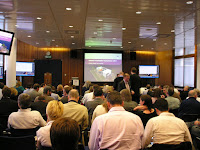
Yesterday I gave a talk, Information literacy: marketing and educational views … and some research, at the British & Irish Association of Law Librarians (BIALL) conference, held here in Sheffield. Sheffield celebrated by tipping down with rain (so I paddled to the conference dinner!) and although it had cleared up by yesterday, there were still problems with the trains (flooding) so the audience for my almost-last-in-the-conference talk was reduced. It wasn't actually as bad, though, it looks in the photo below (of previous speaker David Connolly): the plenary sessions were in Sheffield City Halls (capacity 2000, see entrance in first photo) so the 200+ delegates were inevitably somewhat spread out.

I have uploaded my presentation to Slideshare, and you can get it here. The abstract I put on Slideshare is as follows: "Sheila identifies a tension between the librarian's role as marketer and educator, and proposes relationship marketing as a context for lessening this tension. Research into chemistry and marketing academics' conceptions of information literacy is described. Sheila proposes how this might be applied to a legal environment, and says that understanding your clients’ approaches to information literacy could be fruitful for training and marketing. The presentation finishes by giving highlights into recent research by O'Brien and Rhodes into legal information professionals’ priorities for information literacy research." Slideshare provides some code to embed the presentation in your blog, but when I tried it just now it crashed the browser and lost the post, so I'm not trying that again today!

There was a question afterwards about the research technique that James O'Brien and Chistopher Rhodes used in their study (which was done as the main coursework for the IL Research module). This was the Delphi technique, and there is some more info about it on (where else) Wikipedia: http://en.wikipedia.org/wiki/Delphi_method

Friday, June 15, 2007

Transliteracies

Alerted by a post to the lis-infoliteracy discussion lits about a talk How Can We Improve Online Reading? by Professor Alan Liu, Dept of English, University of California (working with the Transliteracies Project) at 2pm 4 July 2007, De Montfort University, Leicester (free, email Sue Thomas sue.thomas@dmu.ac.uk) , I was led to the DMU Transliteracy blog "Transliteracy is the ability to read, write and interact across a range of platforms, tools and media from signing and orality through handwriting, print, TV, radio and film, to digital social networks." http://www.hum.dmu.ac.uk/blogs/part/

Whilst on the subject of literacies, Dr Joolz has moved her Digital Literacies blog back to blogger: http://digital-literacies.blogspot.com/
Photo by Sheila Webber: Pink rose posed (but it did come off a climber just behind, almost in my garden), June 2007.

Wednesday, June 13, 2007

ICS projects

There are a couple of projects sponsored by the HEA Information and Computer Science subject centre

Enhancing librarians teaching skills: the key aim is to "re-purpose existing teaching material created by the EduLib project to make it interactive and reflective, so that it will help librarians / information workers to enhance their teaching skills and therefore enhance the student learning experience." It is led by Ruth Stubbings http://www.ics.heacademy.ac.uk/projects/
development-fund/fund_details.php?id=99

Beyond Google: developing training skills for LIS students: "This project aims to provide practical advice and guidance on how library and information professionals can demonstrate to end users the value of information resources beyond the public Internet. ... The aim will be achieved through the production of a video which can be shown to library students in a variety of formats. " Leader: Martin de Saulles
Photo by Sheila Webber: Black cat on next door's wall, June 2007.

Evaluation article

I encountered an article that describes an initiative in a more refreshingly honest way than some I've read. A teacher and librarian at McMaster University together identified evaluation frameworks for different types of information on the "Credibility" "Content" "Currency" model. They got the students on their undergraduate health course to take tests of their ability to apply the evaluative frameworks. The authors observe "We can only infer that this test, like many others, did not generate great enthusiasm. In retrospect, it was perhaps not a good idea to have imposed the artificiality of an assessment on this exercise. We should have stressed the significance of obtaining this skill and left it up to the students to practice it on their own and take it seriously or lightly as they chose to."
Later on they admit that they intended to follow up the cohort, but here a note of sadness enters since "midway through the term, the position of the education resources specialist was made redundant, so we could not follow through in upper-level courses" They also thank the "delightful and enthusiastic students at the University of Calgary who took MDSC 203", a nice touch which you don't often see.
Rangachari, P. and Rangachari, U (2007) "Information literacy in an inquiry course for first-year science undergraduates: a simplified 3C approach."Advances in Physiology Education, 31, 176-179. http://advan.physiology.org/cgi/content/abstract/31/2/176
Photo by Sheila Webber: First strawberry, just before plucking, June 2007 (here it was as a flower(I think).

Monday, June 11, 2007

Media Literacy

The 10th Media Literacy newsletter was published in May on the Ofcom website (UK watchdog for media and communications industries). The newsletter page is here. Amongst some of the organisations it mentions in the newsletter is the Associate Parliamentary Media Literacy Group (APMLG) "set up to promote a greater understanding of the importance of media literacy within [UK] Parliament and more widely" with a minimalist website at http://www.apmlg.org.uk/index.htm The Ofcom Media Literacy group published a good deal of research last year, but things have gone a bit quiet, although Media Literacy does still appear to be on the UK political agenda (mostly in terms of protecting children and empowering disadvantaged groups)
Photo by Sheila Webber: Strawberry flower (and beetle), May 2007.

Saturday, June 09, 2007

Paraphrasing

The Gypsy Librarian provides reading notes on a number of articles. The most recent article he writes about is:
Bronshteyn, K. and Baladad, B. (2006) "Librarians as Writing Instructors: Using Paraphrasing Exercises to Teach Beginning Information Literacy Students." Journal of Academic Librarianship, 32 (5), 533-536.
As I think I have said elsewhere, I do some work with students in a couple of modules on synthesis and abstracting, both of which are genuinely difficult to do well. Paraphrasing is also a challenging area and one where I want to do more with students.
See Gypsy Librarian's blog entry here

Photo by Sheila Webber, Wild rose, Sheffield, June 2007.

Friday, June 08, 2007

Canadian IL

The Canadian Information Literacy Interest Group has a group of that name on Facebook (you will only get to this address if you are a member of Facebook): http://www.facebook.com/
group.php?gid=2338221377


While I'm mentioning Canada and Information Literacy, I notice from the above that the 7th Annual Augustana Information Literacy in A cademic Libraries Workshop has been announced for December 10, 2007: Presenter is Lisa Hinchliffe, University of Illinois at Urbana-Champaign: see http://www.augustana.ca/facilities/
library/infolit/workshop/
Photo by Sheila Webber: Bee on icelandic poppy, my garden, June 2007.

Visual Literacy

At http://eye2i.wordpress.com/ you can view "posters" under the theme Eye to I: Visual Literacy Meets Information Literacy which are part of the 2007 American Library Association conference. Titles include "Analyzing the Dynamics of Race with Information & Visual Literacy", "Is Seeing Believing? Visual Literacy and Web Evaluation" and "Embedding Information Literacy into a Visual Literacy Course". Some posters are ppts in pdf, some are Camtasia presentations etc.
Photo by Sheila Webber: Rose in my garden, June 2007.

Questionnaire

There is a questionnaire on the Netskills site which "aims to gather: opinions of library staff about the essential teaching skills they feel are required by librarians; experiences of different methods of skills development; examples of good teaching practice".The results will be presented at the UK Umbrella conference in July. http://www.netskills.ac.uk/
content/surveys/survey/7/index.html

Wednesday, June 06, 2007

Copyright, e-Resources & i-Skills Conference

Copyright, e-Resources & i-Skills is a one-day conference on 27 June at City of Sunderland College: Usworth Sixth Form College, Washington, UK. Delegates will receive a free CD containing i-skills tutorials to take away, including a How To Copy Right! tutorial. More information at http://www2.citysun.ac.uk/CopyrightInviteBrochure.pdf

Photo by Sheila Webber: Lily of the valley bed, May 2007.

Tuesday, June 05, 2007

UWE seminar (3)

This is the 3rd and final post on the seminar at the University of the West of England (UWE) in Bristol. In the afternoon, Marcus Lynch, from the Faculty of Environment and Technology, talked about his Creativity and design module. A lot of interesting ideas emerged, for example:
- the idea of researching the nature of a diary, log or journal as part of creating it, with students having to justify the final format of the journal
- a “Desert Island disks” activity, use as a way of surfacing the notion of “criteria”
- bringing in magazines and articles for students to scan through, cite and tag.
He has a blog at http://marcuslynchatuwe.blogspot.com in which he blogged regularly about the class.

Marcus (and Praminda Coleb-Solly who taught the class with him) also brought in their learning diaries - physical diaries which they used (I think Marcus’ was red), and reviewed periodically. Ursula Lucas also talked about how she kept a log to parallel the learning diary that the students were required to keep. She mentioned that she used time in which the students were working on tasks in class.

This reminded me of the blog that colleagues in English (at Sheffield) kept in WebCT whilst they were collaboratively teaching a class, and obviously of the blog that my colleagues and I used (and still do, a bit) whilst teaching “Inquiry in Information Management”. One idea is reflect on your own experience, just like you are asking the students to do. It brings home how difficult the activity is!

I want to give students more guidance on reflective writing next year and both Ursula and Marcus mentioned books by Jennifer Moon*, which I’ll have to get hold of. Ursula also made a telling comment about how students can be “good at picking up a surface approach to reflection” i.e. learning the sorts of things that lecturers want to read in reflective work! She described an exercise in which students had to turn descriptive statements (e.g. “The workshop was fun and quite interesting”) into reflective ones. Another exercise which I’d like to incorporate in teaching next year is one on “How am I doing” in relation to the module learning outcomes. There is always the danger of learning outcomes being ritual statements paraded at certain points in the class.
* Learning Journals: A Handbook for Academics, Students and Professional Development &
A Handbook of Reflective and Experiential Learning: Theory and Practice
Photo by Sheila Webber: Victoria Square, Clifton, Bristol, June 2007.

UWE seminar (2)

Here is the PowerPoint that I used at UWE yesterday http://dis.shef.ac.uk/sheila/
webber-uwe2007-3.pdf
. In it I identify the categories for IL and pedagogy for IL that we identified in academics in Marketing, Civil Engineering, Chemistry and English. I also talked a bit about the ways that I had used the research: with my students, with colleagues in my Departments, and with academic staff elsewhere in Sheffield Uni. In the breakout session, the delegates at the UWE seminar briefly considered their own approach to IL and that of colleagues. We discussed this in small groups and then fed back on three points: an issue that was contentious or problematic, an area on which there was agreement and an unanswered question.

In my breakout group for the first we had both “time” (constraints) for staff and students and the linked issue of getting people engaged with IL in the midst of their busy lives. Of course there is also the issue of getting some students engaged in learning generally, but it can be even more difficult to get them to take IL seriously. The thing we agreed on was the importance of IL ;-)) and the unanswered question was “how?” I don’t think we identified a neat answer - well, I don’t think there IS a neat answer. Some of the academics at the event were interested in exploring further what IL meant in their subject/Department, which obviously I think is a productive route. There was good support for seeing librarians as partners in learning, but as ever there aren’t enough librarians to go round...
Photo by Sheila Webber: Beech tree, Victoria Square, Clifton, Bristol.

Monday, June 04, 2007

UWE seminar

Today I was contributing to seminar at the University of the West of England (Bristol, UK) Information Literacy, reflective practice and critical thinking: how do they inter-relate? There were about 28 participants; academic staff from various Departments plus librarians. I will post my presentation (which focused on the conceptions of information literacy research) tomorrow, when I'm back in Sheffield.

It was a very interesting day, and also included a session from Ursula Lucas (a Professor in the Business School) "Case study: developing students as critical consumers of business information: a reflective practice framework." This provided the theoretical background for, and a practical description of, a module called "Accounting in context." There is some information about this at http://www.uwe.ac.uk/bbs/research/drc/index.shtml.

Photo: Malcolm McEachran and Jackie Chelin, two of the organisers.

Sunday, June 03, 2007

Global Information Society Watch

This project (a joint initiative of the Association for Progressive Communications and the Third World Institute) has published The Global Information Society Watch 2007 report "the first in a series of annual reports" which "looks at state of the field of information and communication technology (ICT) policy at local and global levels and particularly how policy impacts on the lives of people living in developing countries." It includes "Studies of the ICT policy situation in twenty-two countries from four regions are featured" and the focus is around the World Summit on the Information Society, with a critique of what happened at/between the WSIS meetings and what is happening (or not happening) subsequently. http://www.globaliswatch.org/

Photo by Sheila Webber: Cat on the heath, Blackheath, April 2007.

Thursday, May 31, 2007

Library Philosophy and Practice

Articles added to Library Philosophy and Practice (a peer-reviewed electronic journal) in March and April include Games for Teaching Information Literacy Skills (games element in teaching chemistry sources) and The Role of Nigerian Primary School Libraries in Literacy and Lifelong Learning. The contents page (linked to full text) for 2007 is at http://www.webpages.uidaho.edu/~mbolin/lpp2007.htm

UNESCO initiative

"The Society for the Advancement of Library and Information Science (SALIS), India, in collaboration with UNESCO, has just launched a six-month project entitled Interactive E-Learning Portal on Information Literacy Competency Development Skills for South Asia. The project aims to raise awareness and enhance information literacy competency skills of laymen as well as information professionals and educators." An e-learning portal is being developed using the Moodle Virtual Learning Environment. A little more information is here. SALIS has a website at http://autolib-india.net/salis/ but there wasn't any information on the initiative when I just looked.
Photo by Sheila Webber: Fern in my garden, May 2007.

Wednesday, May 30, 2007

Another IL blog

Came across another nice blog, the Alkek Library Information Literacy blog at http://txstateinfolit.blogspot.com/. It had a posting about the Second Life best practices conference, and also news on what they are doing e.g. creating wikis for faculty.
Photo by Sheila Webber: Rose in Radford vase, May 2007.

Tuesday, May 29, 2007

Blogging in LIS teaching and learning

Today I tried to give a distance talk to a conference in Portugal called Web 2.0 na Ciência da Informação. My talk was on Blogging in LIS teaching and learning. I was using a service called WebEx which allows a host to switch control to a participant's desktop. Thus Julio Anjos in Portugal could, after he had invited me into the "meeting", switch control to my desktop (so he saw it on a screen that could be projected for the delegates). This meant I could show the PowerPoint on my machine and the delegates could see it. The delegates were in a real conference hall in Portugal (most talks were live).
That worked fine, but I was TALKING over the telephone, and that did not work well: they couldn't really hear what I was saying when my time came at 12.00 noon. Thus we had to abandon the attempt after 5 minutes or so. Fortunately I didn't have any more appointments today, so I was able to hang round my computer and I added extra text to my ppt. In the end I gave my first SILENT presentation at 17.00, highlighting important bits on the ppt using a drawing facility and managing the whole thing in 3 or 4 minutes. Perhaps all my presentations should be that short. I believe I got applause ;-))
So, here is the ppt, in pdf format at http://dis.shef.ac.uk/sheila/blogging2007.pdf . With the extra notes I hope it should be even easier than normal PowerPoints for you to follow what I meant!

Photo by Peter Stordy: Me, today, in my office.

Critical perspectives

Hazel Edmunds emailed me recently about an article which she says is based on the book Teaching Defiance: Stories and strategies for activist educators.
Newman, M. (2007) "Adult education and the home front."Adults Learning, 18 (7), (probably pages 8-11, I found this info on another site; the publisher - see URL below - doesn't give page numbers!).
Hazel continued "one part of Newman's article struck me as very apt for the information literacy scene. I quote: 'The skills I suggest we examine and practise are:
- 'how to critically appraise the statements of others;
- 'how to think clearly for ourselves;
- 'how to think inventively;
- 'how to participate actively in the affairs of our state; and
- 'how to participate wisely.
'Whenever we come across an apparently authoritative statement we can encourage people to tease out 'truth' from 'ideology'. I realise that both these concepts are contested but we can ask such questions as:
- 'Has the speaker (or writer) included all relevant information?
- 'Has the speaker included inconvenient ads well as convenient arguments? Or
- 'Is the speaker pushing a party line?'
"Newman then goes on to talk about legitimacy, authority, sincerity and openness."
Thanks to Hazel for this. The contents page for that issue of Adult learning is at http://www.niace.org.uk/Publications/
Periodicals/AdultsLearning/BackIss/Mar07Cont.htm

There is a review of Newman's book in College and research libraries, here

Photo by Sheila Webber: There are memorial trees for students on the Sheffield Campus. This is a young memorial tree for Louise Andrews, a student of French and German, which has a foxglove growing beside the little tree.

Monday, May 28, 2007

Research review - searching

For those of you interested in searching behaviour, two reviews in the latest edition of JASIST:

Markey, K. (2007) "Twenty-five years of end-user searching, Part 1: Research findings." Journal of the American Society for Information Science and Technology, 58 (8), 1071 - 1081. "This is the first part of a two-part article that reviews 25 years of published research findings on end-user searching in online information retrieval (IR) systems."

Markey, K. (2007) "Twenty-five years of end-user searching, Part 2: Future research directions." Journal of the American Society for Information Science and Technology, 58 (8), 1123-1130.
Photo by Sheila Webber: Garden rose, May 2007.

Thursday, May 24, 2007

Second Life again

Eduserv have now put up stuff from their Virtual Worlds symposium the other week. It is available in Second Life and also at http://www.eduserv.org.uk/foundation/
symposium/2007/presentations
On the same themes, there is a Second Life International Best Practices in Education Conference tomorrow, which unfortunately I'll miss because of Real Life commitments, though I think it's a bit sad that we're already talking about "best practices" when surely it should stil be a case of creating and experimenting: see http://slbestpractices2007.wikispaces.com/
Finally I have a diary about my SL, http://adventuresofyoshikawa.blogspot.com/: that's me in the photo.

Wednesday, May 23, 2007

Talk on IBL & learning space

This is a week of "sharing practice" in learning and teaching at Sheffield Uni and I was giving a talk in an internal seminar called Advocating Inquiry Based Learning, specifically focusing on the use of the learning space refurbished using CILASS money.
My talk was called Collaboratory in practice: Department of Information Studies: a case study and I was talking about what we had used this space for, which modules, plus some detailed examples of activities. A couple of the activities were in a Human Resources Management module, some others in a Business Information module and a new module called Inquiry in Information Management. Here is the presentation in a pdf format: http://dis.shef.ac.uk/sheila/webber-barthouse2007.pdf
If you want to see what the room we were discussing lookes like, there is a video A technology-rich space for inquiry-based learning: CILASS – University of Sheffield on the JISC website (scroll down the page to find the link). Also the photo above was taken in the room at the poster presentation which was the culmination of the Inquiry in Information Management class. I avoid putting photos of students on my blog because it doesn't seem fair to them, but this seemed OK as it is mostly backs, and mostly my colleagues' backs, at that (they were helping to assess the posters).
Other presentations today were from Bill Hutchings of the Centre for Excellence in Enquiry Based Learning at Manchester Uni (see http://www.campus.manchester.ac.uk/ceebl/resources/ where there are a number of papers by him) and two colleagues in English, Duco van Ostrum and Richard Steadman Jones: here is a posting on the CILASS blog about their class. You can also see them in the above JISC video.

Updated State-of-the-Art report & Directory

The IFLA/UNESCO Information Literacy Resources Directory has been redesigned and includes the just-published latest version of the State-of-the-Art report on Information Literacy in different countries. This includes the report on the UK and Ireland authored by me and Claire McGuinness (written in June last year). The site also has a new, more memorable, web address http://www.infolitglobal.info/
Photo by Sheila Webber: Foxglove, Sheffield, May 2007.

Rencontres FORMIST

The 7th Rencontres FORMIST (French annual information literay conference) Entrer dans le flux ? Le défi du « web 2.0 » pour le bibliothécaire-formateur takes place at Enssib, Villeurbanne, 14 juin 2007. more information here

Tuesday, May 22, 2007

Informs survey

There is a survey to find out what people think the priorities should be for developing the tutorial system Informs: http://www.survey.bris.ac.uk/intute/informs

Monday, May 21, 2007

Use of e-books by people at UCL

CIBER, University College London, have published a study of UCL faculty and students: What do faculty and students really think about e-books? (authors: Ian Rowlands, David Nicholas, Hamid R. Jamali and Paul Huntington) "This article reports on a large-scale survey of nearly two thousand faculty and students at one institution, University College London, and profiles their use and perceptions of ebooks." http://www.homepages.ucl.ac.uk/~uczciro/findings.pdf
Photo by Sheila Webber: Copper beech leaves, Weston Park, Sheffield, May 2007.

Friday, May 18, 2007

WILU blog

There are a few postings on the WILU (Canadian Information Literacy conference) blog. WILU took place just over these past few days (16-18 May). Apart from a complaint about accommodation there are pretty full write-ups of two sessions - I imagine there might be more after the event. http://wilu.wordpress.com/

Photo by Sheila Webber: taken whilst at the 2005 WILU conference in Guelph.

Thursday, May 17, 2007

Engaging learners: new opportunities for learning support and development in libraries

Engaging learners: new opportunities for learning support and development in libraries is a one-day conference for library and information professionals, organised by National Teaching Fellows from the University of Northampton and De Montfort University. It takes place at De Montfort University, Leicester 12th June 2007. Speakers and workshop leaders include: Professor Sally Brown, Pro Vice-Chancellor (Assessment, Learning and Teaching) at Leeds Metropolitan University; Sandy Gilkes (Head of the Centre for Academic Practice at the University of Northampton); Sally Patalong (Library Teaching Fellow at Coventry University); Mary Pillai (Teacher Fellow and Academic Team Manager of the Centre for Learning and Study Support at De Montfort University); Chris Powis, Deputy Director (Academic Services); Jo Webb (Academic Services Manager). Contact Chris Powis: chris.powis@northampton.ac.uk
Photo by Sheila Webber: It was nice weather for ducks today.

Learning about learning

Learning about learning is a one day event on 17 July 2007, held in London, UK. It is led by Sharon Markless and "explores how people learn, and is designed to give library and information staff knowledge about learning theory that should underpin their work." For more information go to http://www.cilip.org.uk/training/

Wednesday, May 16, 2007

Introducing Pedagogic Research Methods

Bill Johnston, Stuart Boon and I are doing a workshop session on "The phenomenographic approach" at a free Higher Education Academy event, Introducing Pedagogic Research Methods, on 20th June in Glasgow. The day is aimed at people who are more beginners in educational research or want to learn about a new area: lecturers, educational developers, and librarians too - although I see the latter are not mentioned as a target audience!http://www.heacademy.ac.uk/events/List_5532.htm
Photo by Sheila Webber: roses, Sheffield, May 2007.

Monica Vezzosi

I was recently in touch with Monica Vezzosi and she reminded me about her articles:
Vezzosi, M. (2005) "Information Literacy and Reflective Learning. An action-research experience at the University of Parma."(Dissertation) MSc University of Northumbria. http://dspace-unipr.cilea.it/handle/1889/476
Vezzosi, M. (2006) "Information literacy and action research: an overview and some reflections." New Library World, 107 (1226/1227), 286-301.
Photo by Sheila Webber: Cow Parsley, Hellingly, May 2007.

Tuesday, May 15, 2007

Communications in Information Literacy

The first issue of Communications in Information Literacy (CIL) has been published at http://www.comminfolit.org/ There is an interview with Patricia Senn Breivik plus articles:
Nancy E. Goebel, Paul J. Neff : Information Literacy at Augustana: A Programmatic Approach.
Jacqui Weetman DaCosta and Becky Jones: Developing students' information and research skills via Blackboard
Claire McGuinness: Targeting Academic Champions: A Short-Term Solution for Integrated Information Literacy?
Photo by Sheila Webber: Weigelia in my mother's garden, May 2007.

Monday, May 14, 2007

COLRIC Conference 2007

Council for Learning Resources in Colleges (COLRIC) Conference 2007: Impact Birmingham University, Edgbaston Campus Arts Building one day conference and AGM will be held in Birmingham on Friday 15th June 2007. The themes are "How do you ensure that service impact is recognised by senior managers and inspectors? How do you prove the value of teaching information literacy skills and improving status in your organisation? How do you make the most of the new inspection process? How can you use the CoLRiC self-assessment tool effectively?" http://www.colric.org.uk/

Also a few useful resources on the site e.g.:
Achen-Owor, F (2006) " 'Researching for your studies' project: Developing an online Information Literacy course to support Access to Nursing learners at Lewisham and Greenwich Community Colleges." COLRIC Newsletter, (40). http://www.colric.org.uk/
news06.htm#Researching_for_your_studies_project
Photo by Sheila Webber: Elderflower (I think), Hailsham, May 2007.

JISC web 2.0 seminar

A posting on lis-link from Ruth Keane about the JISC Web 2.0 seminar took me to this site which has content from the seminar (podcasts, ppt and the like) and also discussion fora: http://moodle.cs.man.ac.uk/
web2/course/view.php?id=3
When I arrived there I thought it looked vaguely familiar, and then realised I'd looked at it before, as Brian Kelly was presenting at it remotely and I'd thought of contributing to the discussion (but didn't). Ruth in her post lists the draft actions which JISC considering - they don't seem to me to cover all the aspects that emerged in the seminar.
Photo by Sheila Webber: Rhododendron, Hailsham, May 2007.

Sunday, May 13, 2007

Second Life symposium

Last Thursday I attended the Eduserv Symposium Virtual Worlds, real learning. The main event took place in London, but it was also streamed to 3 venues in Second Life (SL) and people in SL could join an Instant Messaging board where they could comment and post questions. There were screens round the lecture room which showed one of the SL venues (mostly the venue on Eduserv Island). In the photo you can see 2 of these screens; when I took the photo, the Eduserv person who was leading events in SL was using his text editor.
I try not to make the postings on this blog too long, and not everyone interested in IL will be interested in Virtual Worlds, so I will blog a bit here and later will do some additional stuff on the Livejournal blog I set up a few years ago for our Educational Informatics module. From Eduserv, there are bookmarks on del.icio.us and other blog entries will be using the tag efsym2007 at Technorati. Also the whole thing is hopefully being put online in due course.
The delegates included another information lecturer, Mark Hepworth from Loughborough Uni, and some librarians, including Lyn Parker from here at Sheffield. There were also academics from other disciplines, people involved in/in charge of educational development or technical services, people researching in the area... job titles weren’t given on the delegate list, so I’m not sure of the exact composition. The food was nice, BTW, although it was the kind where waiters circulate with trays of stuff and greedy folk like me have to be on the alert to grab.
Although the day wasn't supposed to just be about SL, in fact a lot of talk focused on it. Presenters were Jim Purbrick (of Linden Labs, the developers of SL), Roo Reynolds (Metaverse Evangelist at IBM: yes, that really is his job title), Hamish Macleod, talking about the University of Edinburgh’s involvement, Jenny Scott from the journal Nature, talking about their experiments in SL including their “Second Nature” island, Gilly Salmon on her research, and finally Stephen Downes from Canada (all the other speakers were Brits) who had been asked to provide a critical perspective and Stephen duly obliged. Here are some themes and issues:
- What it offers in educational & information terms: the advantage of SL in particular seems to be that it has more parallels with Real Life (RL) than some virtual worlds and so is a more gentle introduction for non-techies. The fact that there is a real economy in SL (see below) also means that people can practice marketing, production etc. Of course there are librarians in SL, and libraries and library suppliers (see http://www.infoisland.org/). It still seems an issue, though, as to what form libraries should take. Librarians have (to me) more of a function than libraries in SL. On the other hand, the "gathering space" role of a library seems to have a place in SL as in RL, whether for educational or community activities. There seem to me LOTS of questions to do with IL and SL (e.g. what IS information literacy in SL?) which has the researcher in me gleeful ;-)
- There are already examples of people in Higher/Further education taking their students into SL, an example is a chemistry lecturer (multiple choice quiz dressed up with obelisks). Most popular are subjects where being able to construct and manipulate things (sciences, engineering etc.), do stuff with artificial life, & explore social issues like identity.
- The business/economy aspect of SL seems to be a controversial, but possibly success-defining, aspect of SL. The Linden speaker gave the stats: that 41% of the 6 million people registered on SL are female (presume that means: claim to be female), the average age is 33 (except on the teen version of SL, of course) and US$6 million a month are changed into Linden dollars. There are two sides to it: the fact that the Linden/US dollar exchange means that the Real Life (RL) and SL economy are linked, and not just for the developers. You can become an entrepreneur in SL: also you can spend lots of money on casinos and "adult" activities. Stephen was arguing that this meant it was too comfortable and like RL, and also that the strongly commercial element meant conflicted with public service and educational aims. On the other hand, these RL monetary links encourage a diversity of people into SL and encourage more diverse activities (even leaving aside the sex and gambling). The second side is to what extent Linden are going to make everything Open Source.
- There were debates about whether SL was a game, and whether it was Web 2.0. I have my views on this, but am not clear why it matters so much to make a decision on these points. I suppose it might if you were facing misguided colleagues who thought All Games Were Evil.
- Privacy and confidentiality. There is commercial confidentiality (e.g. at IBM they have created a behind-the-firewall private metaverse, so they can have confidential virtual meetings) and also the privacy of individuals, including students. One question from the "backchannel" (participants in SL) was about whether students would want 2 avatars, one for class, one for themselves. Seems very likely to me, and my perception is that students may wish to keep private & academic separate, under their control (which is their right).
- Practical issues. There certainly are some e.g. apparently at the moment they are constantly updating the software you need to download to use SL; getting central computing to install software and then upgrade it once a year is hard enough. Diana Laurillard (who chaired the panel session at the end) seemed determined to accentuate the positive. Indeed, she appeared to be berating us for asking about “technical issues” and barriers rather than burbling with excitement about the new opportunities. However it seemed to me that this discussion of practical issues was a sign that people were contemplating using it with diverse cohorts of students (i.e. not just geeky/edtech students who are going to think it is interesting even if they are having to cope with stuff that doesn’t work). That there were practical issues in access was emphasised by some of the chat going on in 2nd Life about reception of all aspects of the seminar e.g. “I have nothing” “audio and video (but video is inverted)” “now white screen”.
This has now been an excessively long post. Perhaps I am burbling after all. At any rate I'm starting to get some SL/IL ideas.

New frontiers in user education

CILIP's UC&R Group (South West) has organised Go West! New frontiers in user education, a one day event on 21st June 2007 taking place at Exeter University, Exeter, UK. Topics to include: information skills for international students, working with postgraduates and academics, and the value of teacher training in delivering user education. Cost: £45 + VAT (CILIP members); £55 + VAT (Non-CILIP members). Contact Alastair Sleat, alastair.Sleat@UWE.AC.UK
Photo by Sheila Webber, near Hellingly, May 2007.

Latest new/updated tutorials

The latest batch of new of updated internet tutorials at Intute are: Internet Physicist, Internet Civil Engineer and Internet for Petroleum and Offshore engineering. Go to http://www.vts.intute.ac.uk/

Wednesday, May 09, 2007

Google things

Here is an article which does some quick evaluations and provides some thoughtful discussion, plus a couple of events.
White, B. (2006) "Examining the Claims of Google Scholar as a Serious Information Source." New Zealand library and information management journal, 50 (1) 11-24 http://www.lianza.org.nz/publications/journal/
files/TNZLIMJOctober2006v50i01.pdf
(this is the web address for the whole issue)
Event on 6 June Beyond Google: Strategies for Finding Images Online in Bristol, UK, organised by TASI (Technical Advisory Service for Images). http://www.tasi.ac.uk/training/training.html
Three day events in June, Summer Institute June 2007 - Google IT, led by Google Certified Teachers, organsied by the California Technology Assistance Project (CTAP), USA, (see http://www.ctap4.org/infolit/ -they also have some resources including IL leaflets to download, aimed at children).
I hadn't come across the concept of a Google certified teacher before, so I did some googling. Here is the webpage of the Google Teacher Academy. This initiative is aimed at schoolteachers, and "only K-12 educators within a 90-minute local commute of an Academy event may apply" (so that cuts out anyone from, say, Peckham, participating in the Californian one). http://www.google.com/educators/gta.html
Phot0 by Sheila webber: wild rose, Sheffield, May 2007.

Tuesday, May 08, 2007

A couple of recent articles

Johnson, A-M. and Jent, S. (2007) "Library instruction and information literacy: 2005." Reference Services Review, 35 (1), 137-186. This is their annual annotated bibliography - 288 items this time, divided into broad categories (Academic/Public/School/Special/All types). As usual there are loads more academic-sector articles than public library ones (131 vs 2!), and bias towards US material. Still very useful though, obviously.

Gómez-Hernández, J.A. and Pasadas-Ureña, C., (2007). “La alfabetización informacional en bibliotecas públicas. Situación actual y propuestas para una agenda de desarrollo”. ("Information Literacy in public libraries: current situation and proposals for a development agenda")Information Research, 12 (3). http://InformationR.net/ir/12-3/paper316.html In Spanish.
Photo by Sheila Webber: Strawberry flowers, May 2007.

Monday, May 07, 2007

Informs

Informs is "a flexible adaptive tool for the creation of interactive online tutorials. It consists of easy to use software and a database of tutorials. These tutorials have been created by users as a shared community resource, which can be re-used by other registered users". Its typical layout has an instruction frame on the left, with a second frame on the right that might e.g. be occupied by the source you are learning to search.
Informs started off as a JISC project some time ago, and almost disappeared because it wasn't clear who was going to continue to maintain it. However, a good number of people had found it useful and created tutorials using it, so fortunately now Intute have taken on its support. There is a new logon site and a little documentation. It is free to use for UK higher and further education. The Informs website is at http://www.informs.intute.ac.uk/ One article that mentions using Informs is: Fiander, W., Peters, L. and Sinclair, C. (2003) "Taking the pain out of network induction: using INFORMS to induct new first year students." SCONUL focus, (30), 17-19 . http://www.sconul.ac.uk/publications/newsletter/30/8.PDF
Examples of tutorials are e.g. at http://www.informs.intute.ac.uk/
informs_perl/portfolio.pl?folio=58

Photo by Sheila Webber: Pink hawthorn, April 2007.

Friday, May 04, 2007

Practical research for education

For people working in schools who are interested in doing more educational research, the following conference may be interesting: Practical research for education 2007 conference: Research is important because…. It is held on 11 July 2007 in London, UK. It is aimed at teachers etc.: librarians aren't mentioned but I am sure that is merely an oversight ;-) One of the workshops reports on a study of The impact of the play agenda and toy libraries in Wales, in fact (though the research doesn't seem to have involved librarians). http://www.pre-online.co.uk/pre_events07.asp There are the presentations from last year's conference at http://www.pre-online.co.uk/conferenceprogramme.asp
Another photo of Euuphorbia and garlic mustard by Sheila Webber, May 2007.

Eduserv/ 2nd life

Next Thursday I'm off to the Eduserv Foundation Symposium 2007 Virtual worlds, real learning? "This year's symposium will attempt to look past the hype surrounding virtual worlds such as Second Life and evaluate whether they offer real opportunities for learners at UK educational institutions." It is full with a waiting list, and is also being streamed into 3 venues in 2nd life (though with only 40 avatars allowed in each venue: shouldn't virtual lecture theatres be expandable things?) Evidently we are expected to be blogging, flickring and twittering away, using the tag efsym2007 and they've already tagged some relevant items on del.icio.us Website is at http://www.eduserv.org.uk/foundation/symposium/2007/
Since I was attending this, I thought I ought to join 2nd life. Above is the obligatory photo of my avatar in 2nd life. She is still dressed as a standard Harajuku Female, since every time I tried to edit my appearance (4 times), the computer crashed into the blue screen of death. Be interesting to see what they say about the nitty-gritty technical issues on Thursday. When technologies start being just part of your pedagogy (rather than some whacky cool experimental thing) students (and I) expect the technology stuff just to WORK. This was a problem with LAMS last year - it just wasn't reliable enough, and I didn't feel why the students should feel experimented upon. Obviously I won't condemn 2nd life on one try though and I was happy enough bumbling around on Info Island, though I didn't pluck up courage to enter into conversation with the fellow-info-library-folk.

Thursday, May 03, 2007

Web 2.0 meets information fluency

The Web 2.0 meets information fluency wiki (just one page at the moment) has a large number of links to: background resources relevant to information literacy/fluency and/or Web 2.0; material by Joyce Valenza; and resources relevant to teaching some aspect of information literacy (e.g. communicating with powerpoint, copyright, synthesis). In her article Information Fluency Meets Web 2.0 (on the wiki), Valenza says "Through my librarian visioning glasses, I see two threads—information fluency and Web 2.0-- beautifully woven into rich 21st century cloth as teachers and librarians who value inquiry, thinking skills, ethical behavior, and innovative student work hone their craft on a funky and vibrant 21st century loom, with learners as collaborators."
http://informationfluency.wikispaces.com/
Photo by Sheila Webber: Euphorbia and garlic mustard, Sheffield, May 2007.

ACRL online course

The US Association of College and Research Libraries (ACRL) are running an online seminar, Creating a Comprehensive Plan for Information Literacy, May 29-June 16, 2007. "This course will provide you with the information you need to create a comprehensive plan for information literacy for your institution. The course will cover: planning; setting goals and objectives; how to organize and prioritize ideas; the writing process; and the creation of a draft plan." Go to: http://www.ala.org/ala/acrl/acrlproftools/comprehensiveplan.htm

Libraries without walls conference

Photo by Sheila Webber: Laburnum outside polling station, May 2007
Interesting presentations at the 7th Libraries Without Walls conference, being held 14 - 18 September 2007 on the Aegean Island of Lesvos, Greece. Talks include: Libraries as a social space: enhancing the experience of distance learners using social networking tools (Gwyneth Price and Jane Secker); Developing re-usable learning objects to deliver information skills training: are they practical? (Nancy Graham); The LearnHigher CETL and Information Literacy Assessments (Bob Glass) ; Information skills through electronic environments: considerations, pitfalls and benefits (Cath Hunt); Development of information-related competencies in European ODL institutions (Sirje Virkus). Go to http://www.cerlim.ac.uk/conf/lww7/
Photo by Sheila Webber: Laburnum outside polling station, May 2007.

Wednesday, May 02, 2007

Representing learning designs

The Mod4L project final report (of about 100 pages) was published last month. "This final report refines the discussion of issues of representing learning designs for sharing and reuse evidenced in the interim report and highlights problems with the concept of practice models (section 2), characterises the requirements teachers have of effective representations (section 3), evaluates a number of types of representation against these requirements (section 4), explores the more technically focused role of sequencing representations and controlled vocabularies (sections 5 & 6), documents some generic learning designs (section 8.2) and suggests ways forward for bridging the gap between teachers and developers (section 2.6). "

An underlying message seems to be a) it would be useful to have a clear way of representing an intervention, or session plan, or learning sequence (or whatever) so that people could judge more quickly whether it had anything they could re-use or learn from, but it is time-consuming to do this effectively, and no one way can capture all the aspects.

I must say I have always been a bit sceptical of the pursuit of generic learning designs, because of the need to tailor learning to the learning & teaching context, but certainly I do learn things from other people's teaching (even if I don't want to copy it exactly). If there were clearer ways of presenting case studies about teaching information literacy that would be a help too.
Falconer, I. et al. (2007) Mod4L Final Report: Representing Learning Designs. Glasgow: Glasgow Caledonian University. http://mod4l.com/tiki-list_file_gallery.php?galleryId=2
Photo by Sheila Webber: Beech tree with new leaves, Sheffield, April 2007.

Tuesday, May 01, 2007

Webbed or WebSceptic: I guest on Brian Kelly's blog

Brian Kelly just posted a guest post from me on his UK web focus blog. I wrote a post called "Webbed or WebSceptic? You decide!", it's sort of about the information profession, and their media habits. One thing I found was that, in the end, I found I needed to draft it in blogger (i.e. here) and then copy it back into Word to send Brian to try and get that "blogly" feel. Anyway, please go along & add a comment to Brian's blog if you feel so inclined, as the previous guest blogger got quite a few comments added and I will feel mortified if I don't get any ;-) The post is at http://ukwebfocus.wordpress.com/2007/05/01/
guest-post-webbed-or-web-sceptic-you-decide/

Photo by Sheila Webber: Apple blossom in my garden, April 2007.

Online teaching and learning Initiatives

There is a half day event, Online teaching and learning Initiatives, organised by ALISS (Association of Librarians and Information Professionals in the Social Sciences) on 4th June 2007 in London, UK. Speakers include: Angela Joyce on Intute and Web 2.0 Developments; Sally Patalong and Olivia Llewellyn on the development and promotion of an online tutorial using macromedia at Coventry University. Free to all ALISS members Non-members may attend at a fee of £25.00. Contact Heather Dawson, h.dawson@lse.ac.uk, LSE Library 10 Portugal Street, London WC2A 2HD.

LAMS

LAMS (Learning Activity Management System) is software that enables people to design learning sequences; you may remember I mentioned trying it out last semester. Online proceedings of the LAMS conference held in December 2006 have been published. Information Literacy isn't mentioned specifically, but there a couple of papers dealing with student skills.

Philip, R., Voerma, A. and Dalziel, J (Eds) (2007) Proceedings of the First International LAMS Conference 2006: Designing the Future of Learning. LAMS Foundation
http://lamsfoundation.org/lams2006/papers.htm

I was using LAMS as part of the JISC funded DESILA project. I notice that the similarly-JISC-funded ALED project (http://aled.swancoll.ac.uk/mediawiki/index.php?title=Welcome_Introduction) was going to create some library-related LAMS sequences (using the catalogue etc.)
Photo by Sheila Webber: Violets, drybrush effect, April 2007.

Monday, April 30, 2007

Free stuff on Online site

Just got an email from Online Information about new content (mostly podcasts, some free, some priced, and the odd white paper) being available each month. This month the theme is social media. There are free podcasts as follows: Wikis and the lightweight software revolution (presentation by someone who sells wikis): The value of social media in 21st century organisations (round table discussion chaired by Euan Semple) : Enterprise wikis and employee collaboration (talk by JP Rangaswami, formerly Head of Alternative Market Models at DrKW and now CIO at BT Global Services, he has a blog at http://confusedofcalcutta.com/)
I listened to some of the latter (part of the problem of podcasts is they are difficult to skim!) and he does give some examples of why wikis are used in business (e.g. for deciding meeting agendas, as well as building up opinions or perspectives on a business problem, and capturing the context of contributions).
I'll also mention that there is a call for papers for the 2007 Online conference in London 4-6 December (http://www.online-information.co.uk/), ending 9 May. There is a minor theme "Information literacy as a core competency", but Web 2.0 and information discovery are more central themes.
NB There is a link to the podcasts on the above online-information webpage.
Photo by Sheila Webber: White and pink blossom on grass, Sheffield, 2007

IL Research module

Two students from my Information Literacy Research module (James O'Brien and Christopher Rhodes) talked about the module as Inquiry-Based learning & about their project, at last Tuesday's IBL cafe (a regular CILASS event). Here is the post from CILASS' Sabine Little on the event: http://cilass.group.shef.ac.uk/?p=165 (James and Chris are at the far end of the table)
Photo by Sheila Webber: Rhododendron, Weston park, Sheffield, April 2007.

Friday, April 27, 2007

Horizon Report 2007

Each year Educause (in the USA) bring out a new Horizon Report which "seeks to identify and describe emerging technologies likely to have a large impact on teaching, learning, or creative expression within higher education." I linked to the 2006 one a few months ago, and now the 2007 edition has been published. One of the good things about the report is that it isn't very long (32 pages). The report identifies:
- trends in Higher Education generally (these may cause no shocks, including things like "The environment of higher education is changing rapidly", but the arguments are stated nice and concisely and they include "Information literacy increasingly should not be considered a given");
- critical challenges (e.g. "The renewed emphasis on collaborative learning is pushing the educational community to develop new forms of interaction and assessment");
- technologies to watch (mobile, virtual worlds, social software, user-created content, "The New Scholarship and Emerging Forms of Publication" and multiplayer games). It then goes into the technologies in a little more detail, including a list of some relevant links.
I'm going to an Eduserv event about virtual worlds etc. the week after next, so this looks like a good thing to print out and read on the train.

New Media Consortium and Educause Learning Initiative (2007) Horizon Report: 2007 edition. New Media Consortium. http://www.educause.edu/LibraryDetailPage/666?ID=CSD4781

Photo by Sheila Webber: If only people like me wouldn't insist on printing things out to read, perhaps fewer trees would end up like this ;-)) (Sheffield, March 2007)

Riding the online knowledge wave

Following the theme of free online samples, a "book in progress" SurfingThroughNoise: Riding the Online Knowledge Wave by George Lorenzo has chapter one up online, "What is this World Wide Web". It is a sort of spinoff from work he was involved in for Educause (see next post!), and it draws quite heavily on interviews with US academics and commentators. It's under a creative commons licence, and touches on a number of familiar themes: insofar as it draws some of these together and has some nice quotes it could form the basis of a class discussion. However I must warn you that the chapter finishes "At the risk of sounding corny –“Surf’s Up, Dude,” – let’s ride the online knowledge wave, stay balanced, learn how to avoid nasty undertows, know where we are at all times and reach the shoreline safely so we can hop on the next wave." The chapter is at http://www.edpath.com/stn.htm
Photo by Sheila Webber: Wild roses, Sheffield, April 2007.

Thursday, April 26, 2007

Bother, missed marking the 23rd...

23rd April is the day Shakespeare and Cervantes died, and in most parts of the world it is also World Book Day. (For reasons known only to the UK book trade, World Book Day in the UK and Ireland is held on 1st March) This year 23rd April also was International Pixel-Stained Technopeasant Day, on which science fiction and fantasy writers were encouraged to post free stuff on the web. This was in response to a shirty article in which a Vice-President of Science Fiction and Fantasy Writers of America complained that authors who posted free stuff online were devaluing the work of those who still asked for payment from publishers. A lively debate ensued, in which numerous authors explained how putting free stuff on the web had emerged as a sensible marketing enterprise, helping to demonstrate interest in their work etc. so they could then get money from publishers and readers that they wouldn't otherwise have earned. There are links to lots of free works celebrating this day linked at http://papersky.livejournal.com/320114.html
Photo by Sheila Webber: a prospectus-type view of Sheffield Uni, April 2007

Wednesday, April 25, 2007

Information use in NHS24

Today Ruben Toledano O'Farrill visited to lead this week's Information Literacy Research module session. Ruben is a research student and Ad-Hoc Lecturer in the department of Information Management, Robert Gordon University (RGU), Aberdeen. His supervisor is Professor Dorothy Williams and I am external supervisor. Ruben aims to "research conceptions of effective information use in NHS24, exploring the relationships between information literacy and knowledge management in the context of a knowledge-managed organisation". NHS24 is operated by the National Health Service (NHS) in Scotland, and through it trained nursing staff provide advice and information over the phone.
Obviously this is interesting because of the workplace context (where there is little research when compared to research in educational contexts), and also because of the linkage with knowledge management. Ruben is in the data collection phase at the moment.

Photo by Sheila Webber: I forgot to take a photo of Ruben & can't find my photos of RGU, but at least this is in Scotland (like Aberdeen): Glasgow University viewed over the Kelvin river, April 2007.

Monday, April 23, 2007

Management Development Programme

Today I'm in Glasow, as External Examiner on the Management Development Programme of the University of Strathclyde's Business School. This is an interesting programme with modules in the first 3 years for all undergraduate students in the business school. It covers key areas such as teamworking, problem solving, information handling, business ethics, leadership, and it is delivered in a problem solving approach. Students work in teams, there are few large plenary sessions and there is a variety of coursework: learning diaries, presentations, online statistics tests etc. There are over 500 students taking it in each year. The site for the programme is here. An article about it is:
Johnston, B. and Watson, A. (2004) "Participation, reflection and integration for business and lifelong learning: Pedagogical challenges of the integrative studies programme at the University of Strathclyde Business School." Journal of Workplace Learning, 16 (1/2), 53-62.
Photo by Sheila Webber: the grand former Post Office on George Square, Glasgow, has been empty for years. They have now gutted it entirely inside (I think it will be "lifestyle apartments")