Wednesday, March 29, 2017

Reecent papers: training in teaching; IL concepts; kindergarten children

Gammons, R., Inge, L. & Carroll, A. (2017). Sharing Our Success: Using a Teacher Training Program to Improve Information Literacy Instruction and Support MLIS Students. (full text paper, presented at the 2017 ACRL conference). http://hdl.handle.net/1903/19171 "A research library and an MLIS program have created a fellowship to develop future leaders in information literacy instruction. This conference paper presented at the Association of College and Research Librarians 2017 conference provides an overview of the fellowship’s curriculum and a discussion of the challenges and opportunities of working with an MLIS program. The paper concludes with results from the program’s first cohorts, including job placement rates for alumni, reflections from student participants, feedback from participating librarians, and lessons learned from fellowship directors."

Murphy, D. (2016) Dream of a common language: Developing a shared understanding of Information Literacy concepts. (full text of the paper presented at the ARL Assessment Conference). http://escholarship.org/uc/item/8fd4662m#page-1 "Librarians are an essential part of the diverse community of campus stakeholders focused on student success. Establishing a mutually understood and shared foundation of concepts is critical if we wish to collaborate successfully with these stakeholders on assessment projects and ultimately integrating information Literacy into campus learning outcomes and student success goals. The process of developing and normalizing a collectively accepted understanding of Information Literacy between librarians, faculty and institutional research partners was more of a challenge than anticipated and required research, discussion, documentation, and patience to achieve."


Chlapana, E. (2016). An intervention programme for enhancing kindergarteners' cognitive engagement and comprehension skills through reading informational texts. Literacy, 50, 125–132. doi: 10.1111/lit.12085. http://onlinelibrary.wiley.com/doi/10.1111/lit.12085/full (Priced)
"The purpose of the present study was to investigate whether systematic instruction of informational texts can enhance kindergarteners' cognitive involvement in text discussion and comprehension skills. The sample consisted of 15 children aged 5–6 years old in a kindergarten classroom located in a rural area in Rethymno, Crete. A four-phase intervention programme was implemented within a 2-month period. During the first phase, activities were carried out in order to familiarise children with the features of informational texts. During the subsequent phases, reciprocal teaching, What I know - What I want to learn - What I learned (KWL) practice and dialogic reading were used to help children comprehend text information, enhance their cognitive involvement in text discussion and train them in asking literal and inferential questions. The teacher's reading-aloud sessions were recorded and transcribed. Data showed that the intervention programme helped children recognise the features of informational texts, enhanced their cognitive involvement in text discussion and motivated them to demonstrate comprehension skills that are related to information processing."
Photo by Sheila Webber: spring, March 2017

Tuesday, March 28, 2017

Journal of Critical Library and Information Studies #critlib

Apologies for not blogging the very first issue of the  open access Journal of Critical Library and Information Studies more promptly! It came out last month, and this issue includes articles of particular relevance to information literacy:
- Contextualizing Information Behavior: A Methodological Approach by Nicole Marie Gaston
- Critical Pedagogy In Libraries: A Unified Approach by Melissa M. Gustafson
along with other articles such as:
- On “Diversity” as Anti-Racism in Library and Information Studies: A Critique by David James Hudson
- Mind the Gap: Towards the Integration of Critical Gerontology in Public Library Praxis by Nicole K. Dalmer
- Classification Along the Color Line: Excavating Racism in the Stacks by Melissa Adler
This first issue is at http://libraryjuicepress.com/journals/index.php/jclis/issue/view/1
Photo by Sheila Webber: magnolia stellata, Sheffield Botanic Gardens, March 2017

Monday, March 27, 2017

Global perspectives on Information Literacy

ACRL (Association of College and Research Libraries) Student Learning and Information Literacy Committee commissioned a report with perspectives from some non-USA countries on information literacy in those countries/regions: "We asked fifteen authors to reflect on research trends, models of information literacy,
theory and practice, the role of librarians, and envisioning the future of information literacy" (p. 145). There are contributions from authors based in Canada, Israel, New Zealand, México, the UK, Uganda, South Africa, United Arab Emirates, Croatia and Norway; and also a summary, foreward and reflection. Some of the authors also presented at the ACRL conference last week.
ACRL Student Learning and Information Literacy Committee. (2017). Global perspectives on Information Literacy: Fostering a dialogue for international understanding. Retrieved from http://www.ala.org/acrl/files/publications/whitepapers/GlobalPerspectives_InfoLit.pdf
Photo by Sheila Webber: Camellia, March 2017

Sunday, March 26, 2017

Access and inclusion: Outcomes for consumers in vulnerable circumstances

There is a research report from Ofcom on issues for vulnerable people in the UK (for example those with learning difficulties abd those with other disabilities) in terms of access to communication technologies (the internet, mobile phones and tablet computers etc.)
https://www.ofcom.org.uk/research-and-data/multi-sector-research/access-and-inclusion
"In this report, we present a range of data on the availability, take-up, use and affordability of communications services. This helps us understand how well the communications sector is meeting the needs of consumers whose circumstances make them vulnerable"

Thursday, March 23, 2017

Blog-post journal club: Flipping the classroom in business and education one-shot sessions #ILread

The next blog-post journal club takes place on 30 March 2017 at 8pm UK time (3pm US Eastern time, 12 noon Pacific time). The article is:
Cohen, M.E., Poggiali, J., Lehner-Quam, A., Wright, R. & West, R. (2016). Flipping the classroom in business and education one-shot sessions: a research study. Journal of Information Literacy, 10(2), 40-63. http://dx.doi.org/10.11645/10.2.2127
The authors have written an introduction and posed some questions for the blog-post discussion.
Anyone can join this discussion. Participants aim to read at least some of the article in advance, then come along at 8pm BST and join in the discussion by adding comments to the lead blog post (which has the authors' introduction), which is here: http://infolitjournalclub.blogspot.co.uk/2017/03/flipping-classroom-in-business-and.html
You can see how this works by looking at previous discussions on the blog at http://infolitjournalclub.blogspot.co.uk/

Wednesday, March 22, 2017

Webinar: Framework for Information Literacy: A Community College Showcase

The ACRL Student Learning & Information Literacy Committee is offering two free webinars

Framework for Information Literacy: A Community College Showcase. April 12 2017 12:00-1:00 pm US Central time, which is 6pm-7pm UK time. "This session will showcase the work of three community college librarians who have found recent success in using the Framework for Information Literacy in their practice." Speakers: Ellen Carey, Librarian & Assistant Professor, Santa Barbara City College; Carleen Huxley, Coordinator of Library Instruction, SUNY Jefferson Community College; Ann Roselle, Faculty Librarian at Phoenix College. Registration https://acrl.webex.com/acrl/onstage/g.php?MTID=ef836c92d1cd351f8e43679b6ce670cd0

Framework Freak-out: How to Stop Worrying and Learn to Live With the Framework. June 1 2017 12:00-1:00 pm US Central time, which is 6pm-7pm UK time.Speaker: Meredith Farkas, Faculty Librarian, Portland Community College (Sylvania Campus) "Librarians greeted the adoption of the Framework for Information Literacy with mixed emotions. Some discussions around the Framework make it seem like it has either doomed us all, requires a total reboot of our instruction programs, or that we need additional degrees in philosophy and instructional design to even understand it. The reality is not nearly so dire. In this presentation, Farkas, a pragmatist and long time instruction coordinator, will talk about how the Framework has enriched her work as one of many tools she relies on to inform her teaching, outreach, and assessment. She will also discuss approaches she and colleagues at Portland Community College have taken to embrace aspects of the Framework, particularly around outreach to disciplinary faculty." Registration https://acrl.webex.com/acrl/onstage/g.php?MTID=e642329730720e0ab7e7c13a00ae1d3dc
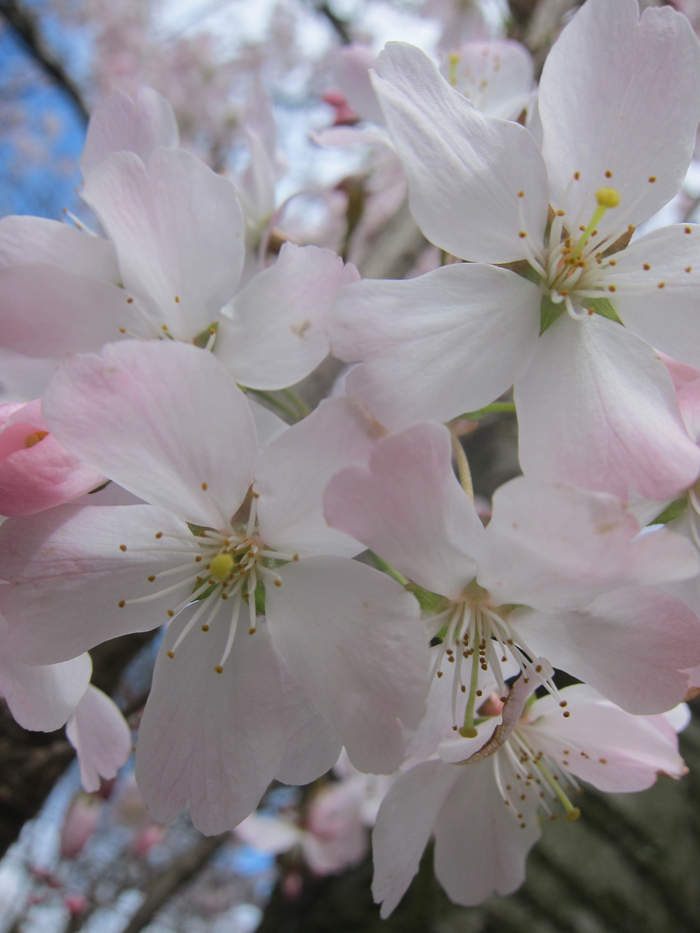
Photo by Sheila Webber: cherry blossom, March 2017

Teachmeet: Information Literacy and Making Judgements: from Brexit to The White House

There is a free Teachmeet at Staffordshire University, Stoke-on-Trent, UK, on 4 May 2017: Information Literacy and Making Judgements: from Brexit to The White House. It is sponsored by the CILIP Information Literacy Group. They are "looking for presenters and enthusiastic audience members": "We believe library and information professionals should make a significant contribution to addressing concerns about fake news, 'alternative facts' and echo chambers. We invite attendees to share their experiences of teaching, promoting and practicing Information Literacy at a challenging time for traditional media, reporting and information sharing." Register at http://bit.ly/2nivX9W
Photo by Sheila Webber: cherry blossom after rain (not fake, but photoshopped), March 2017

Tuesday, March 21, 2017

Information Literacy at #BOBCATSSS2017

BOBCATSSS is an annual library and information science conference, with particular involvement from LIS students. This year's BOBCATSSS took place in Tampere, Finland, 25-27 January, and the slides from conference presentations have been put online. It is an interesting collection, and includes some which are related to information literacy, including the one I've embedded below.


Monday, March 20, 2017

Webinar: Role of Information Scholars and Professionals in Responding to Fake News, Misinformation, and Propaganda

Heidi Julien (Professor and Chair of the Department of Library & Information Studies at the University at Buffalo) is presenting a webinar on 31 March 2017, at 1pm US Eastern time (which is 6pm UK time): The Role of Information Scholars and Professionals in Responding to Fake News, Misinformation, and Propaganda. It is free to members of the Association for Information Science and Technology (ASIS&T) and US $15 to others. It is sponsored by the ASIS&T Special Interest Group - Education. "In an era where fake news, misinformation, and propaganda are circulated rapidly via social media and destabilize traditional expertise and authority, information scholars and professionals are called upon to respond. We must engage in the public conversation about misinformation and its effects, and support those working to counteract it. Moreover, we need to educate future information professionals who can engage in these conversations and who can help others develop digital literacy skills. Perhaps now more than ever, digital literacy matters, not just as a skill set to enable citizens to analyze and evaluate the information they encounter; it is critical to many important social phenomena, including positive health outcomes (of particular importance when so much health information is now obtained online), workforce development, and participative governance. Increasingly, governments are delivering information and services only online, which requires citizens to be digitally literate in order to access that information. Digital literacy is also recognized as an essential competency for job performance, since information gathering, manipulation, and application are key work tasks. In light of the relevance and urgency of digital literacy, this webinar will explore ways we can educate information professionals to empower citizens to become discerning information consumers, and will explore the many challenges to the digital literacy agenda." Information is here and to register go to https://www.asist.org/product/webinar-the-role-of-information-scholars-and-professionals-in-responding-to-fake-news-information-and-propaganda/
Photo by sheila webber: cherry blossom, March 2017

Saturday, March 18, 2017

Scamspotting: choose online safety

A new video from my University (Student Communications, University of Sheffield) to alert people to online scams (to clear out people's bank accounts etc.) - in the style of the original Trainspotting trailer. 


Scamspotting from Student Comms - Uni of Sheffield on Vimeo.

Friday, March 17, 2017

Health Literacy Place #healthlitevent

Today there is a health literacy event in Glasgow (follow at https://twitter.com/hashtag/healthlitevent?src=hash) and one site that was tweeted was the National Health Service (Scotland)'s Health Literacy Place. One thing I'll highlight on the site is the 2 page flyer on Health Literacy and finding information that was produced in December 2016 - I have copied the 2nd page here (it's a 2 page pdf). Although it is customised to Scotland, I imagine they would be happy to let other people use its ideas/design, if you contacted them for permission. It's at http://www.healthliteracyplace.org.uk/resource-library/article/h/health-care-support-worker-resource-health-literacy-and-finding-information/

Thursday, March 16, 2017

#Citation Compass

A rather nice citation tool that was mentioned today in the blog post journal club conversation with Torunn Skofsrud Boger and Hanne Dybvik just now: the Citation Compass. I like the fact that it is all in one page: when you click on type of material (e.g. online thesis, book with one author) it pops up with the format for in text citation, reference citation and also how you would add it in EndNote. It was created by Norwegan librarians, but is in English. http://kildekompasset.no/references/apa-6th.aspx
Photo by Sheila Webber: more posters from the student Union elections

Wednesday, March 15, 2017

Defining and supporting the Scholarship of Teaching and Learning #SoTL #librarianSOTL

Following on from yesterday's post, there are publications on the Higher Education Academy's website on the Scholarship of Teaching and Learning: Defining and supporting the Scholarship of Teaching and Learning (SoTL): A sector wide study. The (2016) pack includes an "audit tool", a literature review, examples from different disciplines, examples of student engagement in SoTL etc. https://www.heacademy.ac.uk/resource/defining-and-supporting-scholarship-teaching-and-learning-sotl-sector-wide-study
Photo by Sheila Webber: banner for the Sheffield University SU elections March 2017, banner for Mayeda Tayyab

Tuesday, March 14, 2017

Online discussion of the scholarship of teaching and learning (SoTL), April 6 and May 31 2017 #librarianSOTL #SOTL

The ACRL Student Learning & Information Literacy Committee and the ACRL Instruction Section have organised a two-part discussion on the scholarship of teaching and learning (SoTL). "This free series will provide the opportunity to engage with leading SoTL scholars to learn more about this exciting area of scholarly inquiry." More information at http://acrl.libguides.com/slilc/sotl
Part 1: Introduction to SoTL: April 6, 2017 1pm US Central Time, which is 7pm UK time. https://acrl.webex.com/acrl/onstage/g.php?MTID=ecc72615ecc5f67923e1c9654c9a2dad2 "Three SoTL practitioners will discuss what this movement is and how it ties into educational theories, practices, and instructional design. Discussion leaders: Nancy Chick (University of Calgary), Margy MacMillan (Mount Royal University), and Cara Bradley (University of Regina)."
Part 2: Applying SoTL in Your Work. May 31, 2017 1pm US Central time, which is 7pm UK time. https://acrl.webex.com/acrl/onstage/g.php?MTID=ed285e8903f56eb78e19f545386cc942e "This discussion builds on the information shared in the first session. The presenters will share practical strategies and examples of SoTL work in academic libraries, including how librarians can integrate it into their own practice. Discussion leaders: Nancy Chick (University of Calgary), Margy MacMillan (Mount Royal University), and Cara Bradley (University of Regina)."
Photo by Sheila Webber: spring, the Royal Standard, March 2017

Monday, March 13, 2017

Information Literacy Journal Club: 16 March: An assessment of library instruction: #ILRead

The next blog-post information literacy journal club discussion will be on 16 March at 8pm UK time (4pm US EST, 9pm Norwegian time). The article to be discussed is:
Torunn Skofsrud Boger, Hanne Dybvik, Anne-Lise Eng, Else Helene Norheim. (2016) An assessment of library instruction: its influence on search behaviour of first- and third-year students. Journal of Information Literacy, 10(2), 64-77. http://dx.doi.org/10.11645/10.2.2135
How does this discussion work?
Anyone can join this discussion! Participants aim to read at least some of the article in advance, then come along at 8pm BST and join in the discussion by adding comments to the starter blog post, where Torunn Skofsrud Boger has provide an introduction, at http://infolitjournalclub.blogspot.co.uk/2017/03/an-assessment-of-library-instruction.html. You can see how this works by looking at previous discussions on the journal club blog
Photo by Sheila Webber: Birch leaves, Oslo, Norway, 2005

Online Roundtable Discussion: Outreach to International Students

The March 2017 Online Roundtable Discussions on Academic Outreach topics (organised by ULS Academic Outreach Committee) is on: Outreach to International Students and will take place on March 14, 15 and 16. "This month’s discussion will focus on how libraries approach outreach to international students. We will talk about reaching international students, customizing outreach based on the unique cultural and educational backgrounds of students, and how the library can help international students overcome challenges they face on campus. Come prepared to talk about what you’re doing, share ideas, successes, and lessons learned. Join us for a lively discussion and leave with great ideas to bring back to your library!"
Each discussion lasts 1 hour and be limited to 9 participants and 1 facilitator, hosted on Google Hangouts on Air/YouTube Live. The sessions will be recorded and posted to the ACRL ULS Academic Outreach Committee YouTube Channel.
You can sign up via ALA Connect http://connect.ala.org/node/264523
March 14 5pm UK time/ 10am US PST /12pm CST / 1pm EST
March 15 6pm/11am US PST /1pm CST / 2pm EST
March 16 7pm/ 12 noon US PST /2pm CST / 3pm EST
Note that the USA set clocks forward at the weekend, but many other countries did not, so the time difference is different from normal this week.
You need a gmail account to participate. Confirmation details and instructions for accessing the discussion will be sent to participants by email. Questions to ULS.AOC@gmail.com

Thursday, March 09, 2017

#MILID yearbook: Opportunities for Media and Information Literacy in the Middle East and North Africa

The open access book has been published:
Abu-fadil, M., Torrent, J. and Grizzle, A. (Eds) (2016). Opportunities for Media and Information Literacy in the Middle East and North Africa. Gothenburg, Sweden: The International Clearinghouse on Children, Youth and Media. ISBN 978-91-87957-33-8
This is the latest MILID Yearbook (Media and Information Literacy and Intercultural Dialogue). The chapters are:
- Magda Abu-Fadil: Introduction:
- Alton Grizzle: Preliminary Comparative Analysis of Media and Information Literacy in the MENA Region
- Jad Melki & Lubna Maaliki: Helping Arab Digital and Media Literacy Blossom. Three years of the Media and Digital Literacy Academy of Beirut (MDLAB)
- Jordi Torrent: Youth and Digital Media. Drafting a Landscape from Fez and Cairo
- Lucy Nuseibeh & Mohammed Abu Arqoub: An Overview from the Occupied Palestinian Territories
- Abdul Ameer Al-Faisal: An Iraqi Perspective
- Redouane Boujemaa: An Algerian Perspective
- Abdelhamid Nfissi & Drissia Chouit: A Moroccan Perspective
- Samy Tayie: An Egyptian Perspective
- Yasar Durra: A Jordanian Perspective
- Naifa Eid Saleem: An Omani Perspective
- Magda Abu-Fadil: A Lebanese Perspective
- Carmilla Floyd & Gabriella Thinz: Empowering Children and Youth in Tunisia
The page with links to all the MILID yearbooks is http://www.unesco.org/new/en/communication-and-information/media-development/media-literacy/global-alliance-for-partnerships-on-media-and-information-literacy/milid-network/
Photo by Sheila Webber: Seagulls over the Thames, December 2017

Wednesday, March 08, 2017

#iwd2017 #MIL for gender equality

UNESCO have a Women make the News initiative starting today (International Women's day). It includes emphasising that "Empowering citizens through media and information literacy (MIL), to advocate for gender equality is more important than ever" http://en.unesco.org/women-make-the-news-2017/get-involved They also promote the MIL CLICKS initiative at https://en.unesco.org/MILCLICKS
There's a live tour of the Open University Archives and Library at 12 noon UK time (which is 7am US Eastern time) for International Women's Day at http://minerva.open.ac.uk/georama/?video_play_id=Mzc0OA==&single_video=1

Tuesday, March 07, 2017

Webinar 14 March: Views on Information Literacy in Librarianship

This is a one hour webinar in which there are 3 presentations, which I think are all drawing on books published by the Chandos imprint of Elsevier (who are running the seminar). It is on March 14, 2017, at 3pm UK time, which is 7 am US Pacific time and 10am US Eastern time (not the usual time differences as it's the week when the US clocks have changed by other countries' haven't). The titles and speakers are as follows
Critical Thinking and Information Literacy
- Bill Johnston is an Honorary Research Fellow in the School of Psychological Sciences and Health at the University of Strathclyde. Before retiring in 2010 he was Senior Lecturer and Assistant Director at Strathclyde’s Centre for Academic Practice and Learning Enhancement.
- Anthony Anderson is a Senior Teaching Fellow in Psychology at the University Strathclyde, where he is also Vice-Dean (Academic) of the Faculty of Humanities and Social Sciences. He lectures on selected topics in the Psychology of Thinking and in Artificial Intelligence.
This will be drawing on material from their book: Anderson, A. and Johnston, B. (2016). From Information Literacy to Social Epistemology: Insights from Psychology. Chandos.


Science Information Literacy and the Role of the Academic Librarian
- Svetla Baykoucheva is Chemistry and Life Sciences Librarian at the University of Maryland College Park. She holds a MS in Chemistry, a PhD in Microbiology, and a library degree. Her current research interests focus on information literacy, management of scientific information, and scientific communication. This may be drawing on this book


Information Literacy Skills in the Research Process
- Kari-Mette Walmann Hidle is associate professor at Faculty of Social Science at Agder University. She researches questions of plurality and unity and their ethical consequences in legislative processes and professional practices, and lectures in the vocational studies.
- Hilde Johannessen is the head of section for Teaching and Research services at Agder University Library. Her work is concentrated on library instruction, research support and knowledge management. I think that draws on this book
To register go here: https://elsevier.webex.com/elsevier/onstage/g.php?MTID=e89e4518dab995f6101162813c55bb3eb
Photo by Sheila Webber: Bill Johnston


Monday, March 06, 2017

New articles: ECIL; Scholarship as conversation; Proficiences for evaluation/ assessment; Digital scholarship

The latest issue of open-access journal College and Research Libraries News (volume 78 (3) March 2017) includes:
- Loriene Roy, Serap KurbanoÄŸlu, Diane Mizrachi, and Sonja Å piranec: The European Conference on Information Literacy: An international research-practice nexus
- Kathy Shields and Christine Cugliari: “Scholarship as Conversation”: Introducing students to research in nonprofit studies
- Merinda Kaye Hensley and Steven J. Bell: Digital scholarship as a learning center in the library: Building relationships and educational initiatives
- ACRL Proficiencies for Assessment Librarians and Coordinators: Approved by the ACRL Board of Directors at ALA Midwinter Meeting, January 2017 [assessment means "evaluation, not assessment of student learning, here]
Go to http://crln.acrl.org/content/78/3.toc

#WILU2017 registration open

Registration has just opened for the WILU 2017 conference Engage | Expand | Explore. WILU is the annual Canadian conference "related to information literacy and teaching and learning in library settings." It will take place May 23-May 25 2017, at the University of Alberta in Edmonton, Canada. Keynote speakers are Niigaanwewidam James Sinclair, Associate Professor at the University of Manitoba and Jessie Loyer, Librarian at Mount Royal University in Calgary. There are lots of very interesting-looking sessions on the programme! Go to https://wilu2017.library.ualberta.ca/registration/ to register. Go to https://wilu2017.library.ualberta.ca/program/ for the conference programme and the main website is at https://wilu2017.library.ualberta.ca/
Illustration - photo of a poster created by Nancy Goebel (University of Alberta, Augustana Library) - a little more info here

Saturday, March 04, 2017

Researching learners' experiences and uses of technology using action research #LERMOOC

This MOOC, which is about using action research to improve learning and teaching, has an excellent series of teams of educational developers and researchers facilitating it. It is a free MOOC. "We have chosen to focus on one research approach – action research – as a way of conducting research into learners' experiences of technologies. In this course, you will work on a plan for a small-scale action research project in preparation to write and publish about student learner experience. You will consider why we need learner experience research and follow a series of activities to guide you through the process." https://platform.europeanmoocs.eu/course_researching_learners_experienc
Photo by Sheila Webber: moon and tree, January 2017

Thursday, March 02, 2017

cfp Learning Social Justice through Critical Information Literacy

There is a call for papers for the one-day conference (July 31 2017) Learning Social Justice through Critical Information Literacy which will take place at Glendale Community College, Glendale, CA, USA, as the 4th Annual Lifelong Information Literacy (LILi) conference. Proposals for either 20-minute presentations or 10-minute lightning talks are wanted. The deadline for abstracts is April 30 2017. "We are living in a time of alternative facts, fake news, and information poverty. The will address practical teaching strategies and tools for you. You will feel more confident about including social justice through the lens of critical information literacy in your teaching. "Critical information literacy differs from standard definitions of information literacy (ex: the ability to find, use, and analyze information) in that it takes into consideration the social, political, economic, and corporate systems that have power and influence over information production, dissemination, access, and consumption” (Gregory & Higgins, 2013). While the new ACRL Framework for academic libraries does not have a social justice frame, it provides structure to address many issues including authority, power structures, voices represented in scholarly conversation, as well as those that are not included. How can we create safe spaces for students and community members in all types of libraries, in order to learn about power structures influencing information, critically evaluating it, and advocating for information equality and fairness for all?" There is further information here http://campusguides.glendale.edu/lili and the proposal form is here: https://goo.gl/forms/l0r2WzBXqkFzMtRL2
Photo by Sheila Webber: small boats on the Thames, December 2016, I'm assuming that California in July will be blue and sunny

Wednesday, March 01, 2017

IFLA's How to Spot Fake news poster, in many languages

The poster that the International Federation Of Library Associations and Institutions (IFLA) produced on, How to spot fake news (shown here) is available in many languages, including Japanese, Latvian, Portuguese, Romanian, Swedish, Turkish and Ukrainian. In each case there is a jpg and a pdf, and IFLA are happy for people to use and share them. Go to http://www.ifla.org/publications/node/11174

This graphic is listed on the Ukrainian anti-fake-news website StopFake and was shown (yesterday) in a CNN feature on the Ukrainian site (though they didn't mention IFLA).

#ACRL Intersections of Scholarly Communication and Information Literacy Webinars

The UK's CILIP Information Literacy Group (ILG) has scheduled the ACRL Intersections of Scholarly Communication and Information Literacy Webcast Series. Each is one hour and includes time for questions and discussion. They are on: March 3 2017 (Crossing Paths: An Introduction to the Intersections); April 4 2017 (Creating Learning Experiences at the Intersections of Scholarly Communication and Information Literacy) and May 5 2017 (Talking Points: Strategies for Building Collaborative Partnerships at the Intersections). They are all at 3pm UK time, 10am US Eastern time. They are free to ILG members, and to others cost £25 per webcast or £50 the 3. The speakers are Emma Molls, Publishing Services Librarian at University of Minnesota and Michelle Reed, Open Education Librarian at the University of Texas at Arlington. This is part of an ongoing initiative, for which the website is here: http://acrl.ala.org/intersections/
"In recent years the Information Literacy Group (ILG) has seen a rise in dedicated library support for researchers, as well as increasing support from other areas of universites, to support publication and Scholarly Communication. This overlap between general research support, library specific research support, and general academic liaison work has resulted in some interesting opportunities and duplications in work. The ILG sees Scholarly Communication as a key part of Information Literacy, so is pleased to explore these overlaps in these series of webinars, with the help of our presenters from the ACRL. This series of webinars will suit any higher education librarians particular those involved in teaching and learning, academic liaison, or research support."
Register at https://www.eventbrite.co.uk/e/intersections-of-scholarly-communication-and-information-literacy-tickets-31316034101?aff=eac2
The blurb for the first one (March 3) says "Following the 2013 publication of ACRL’s white paper on the intersections of scholarly communication and information literacy, interest in the connection between these two critical areas of librarianship has grown tremendously. The first webcast in this three-part series explores common definitions of the two topics; analyzes the intersections and objectives presented in the white paper and in subsequent publications; offers practical examples of librarianship at the intersections; and discusses partnerships that advance outreach and education initiatives. This webcast provides participants with a shared theoretical foundation on which the rest of the series is built."
Photo by Sheila webber: Intersecting branches, January 2017

Tuesday, February 28, 2017

Librarians’ Role in Encouraging Exploration

Interesting article about helping students to select meaningful topics for their essays:
Deitering, A-M. and Rempel, H. (2017, 22 February). Sparking Curiosity – Librarians’ Role in Encouraging Exploration. In the Library with the Lead Pipe. http://www.inthelibrarywiththeleadpipe.org/2017/sparking-curiosity/
"Students often struggle to approach research in an open-minded, exploratory way and instead rely on safe topics and strategies. Traditional research assignments often emphasize and reward information-seeking behaviors that are highly prescribed and grounded in disciplinary practices new college students don’t yet have the skills to navigate. Librarians understand that the barriers to research are multidimensional and usually involve affective, cognitive, and technical concerns. In this article we discuss how a deeper understanding of curiosity can inspire instructional strategies and classroom-based activities that provide learners with a new view of the research process. We share strategies we have implemented at Oregon State University, and we propose that working with teaching faculty and instructors to advocate for different approaches to helping students solve information problems is a crucial role for librarians to embrace."
Photo by Sheila Webber: Trees in Greenwich park, December 2016

Saturday, February 25, 2017

Online chat #critlib in business, professional, medical, health, & STEM programs

On February 27 2017 from 7pm UK time, 11am US pacific time, 2pm US Eastern time, there will be a Twitter chat as part of the regular #critlib series. The topic is critlib in business, professional, medical, health, and STEM programs, moderated by @librarianilana @kennygarciamlis @CaitlanMaxwell and @JessicaJerrit The discussion questions are: Q1. What program or discipline do you work with? What unique challenges do you see in your discipline? Q2. How are you using critical pedagogy or critical information literacy in your instruction? Q3. Why have you adopted #critlib? How has using or reflection on #critlib affected your work?
"Participating in #critlib chats requires a free Twitter account. Follow #critlib on Twitter during the time of the chat by searching for “#critlib” in the search field, then clicking on the “live” tab to see the most recent tweets. You’ll need to refresh your search periodically to see the most recent tweets pop up. ... When the chat is over, all tweets with the #critlib hashtag will be gathered together in a Storify, which provides a digital archive of the conversation." More info at http://critlib.org/twitter-chats/
Photo by Sheila Webber: boats on the Thames, December 2017

Friday, February 24, 2017

Awards for Pagowsky, McElroy, Archambault and McClean

Congratulations to Nicole Pagowsky, Associate Librarian and Instruction Coordinator, Research and Learning Department, University of Arizona, USA, and Kelly McElroy, Student Engagement and Community Outreach Librarian, Oregon State University who have been awarded the Ilene F. Rockman Publication of the Year Award for the Critical Library Pedagogy Handbook. (which they edited). See http://www.ala.org/news/member-news/2017/02/mcelroy-and-pagowsky-receive-2017-acrl-instruction-section-ilene-f-rockman

Congratulations also to Susan Gardner Archambault, Head of Reference & Instruction, Loyola Marymount University, and Lindsey McClean, Clinical Training Associate III – Instructional Designer, AbbVie, Inc. who have been awarded the ACRL Instruction Section Innovation Award for Project CORA: Community of Online Research Assignments. See http://www.ala.org/news/member-news/2017/02/archambault-and-mclean-win-2017-acrl-innovation-award

New articles: Pedagogical practice; Coordination; Curriculum support; Student learning

SCONUL Focus issue 68 (2017) has been published. This is an open access journal with short practice-based articles. This issue includes:
- Editorial: Playing a positive role in enhancing teaching and learning: How do libraries demonstrate their own excellence? Steve Rose, Birmingham City University
- Library as third place: A strategic framework. Diane Bruxvoort, University of Aberdeen
- Developing a teaching and learning programme for librarians at UAL Library Services. Elizabeth Staddon and Leo Appleton, University of the Arts, London
- Personal learning networks: Collective intelligence and knowledge communities in the digital age. Donald Maclean, University of the Highlands and Islands
- Embedding information literacy through critical skills, collaboration and a new curriculum. Lorna Dodd, Maynooth University
- Developing a new co-ordinated approach to information literacy at the University of Chester. Jon Hardisty, Charlotte Gleeson, Paul Verlander, University of Chester
- Evolving pedagogical practice at Middlesex University: The state of our art. J. Adam Edwards, Middlesex University
- Is it possible to teach and learn collaborative skills while still having fun? Using an on-campus scavenger hunt to answer the question. Jane Burns, Royal College of Surgeons in Ireland & University College Dublin
- Transforming student learning through ResourceLists@Bham. Ann-Marie James, Polly Harper, University of Birmingham
- Development of an Academic Integrity LibGuide: Experiences at University College Dublin. Maolsheachlann O’Ceallaigh, Jenny Collery,
Nessa Collinge, University College Dublin Library
- The university archive as teaching resource: From Corporate Service to Curriculum Support. Anna McNally, University of Westminster
- Embedding unique and distinctive collections into the curriculum: Experiences at Maynooth University Library. Barbara McCormack, Maynooth University Library
- Supporting teaching in the Henry Grunfeld Library. Gerry Power, The London Institute of Banking & Finance
https://www.sconul.ac.uk/page/focus-68
Photoby Sheila Webber: cable car, Greenwich, December 2016

Thursday, February 23, 2017

Webinar: Global Perspectives on Information Literacy

On 28 February at 11am US Eastern time (which is 4pm UK time) there will be an online forum with Merinda Kaye Hensley and Dr. Emma Coonan, which is the first in a series of events related to a forthcoming report, Global Perspectives on Information Literacy: Fostering a dialogue for international understanding. Edited by the ACRL Student Learning and Information Literacy Committee, the report has thirteen chapters written by authors from Africa, Canada, Europe, Oceania, Asia, Latin America, and the Middle East. It will be published in March 2017. The foreword to the report is already available here: https://drive.google.com/file/d/0BzT2sL8tu8HDNFRpbzZJNWNGUGc/view "Hensley and Coonan will outline the genesis of the white paper, as well as introduce the themes and highlights emerging from the work. Future programming and opportunities to engage with the authors, including a ACRL 2017 Conference panel and discussion, will be outlined." Register at https://goo.gl/forms/u1HG6JENgqoKc8Oa2

#DayofFacts

Friday 17 February was designated #dayofFacts, with library and museum staff tweeting facts, as a resistance to "alternative facts". The website is here https://dayoffacts.wordpress.com/, the twitterstream is at https://twitter.com/hashtag/DayofFacts?src=hash , here's an example of a Storify https://storify.com/NatureMuseum/day-of-facts and some thoughtful commentary from Barbara Fister at https://www.insidehighered.com/blogs/library-babel-fish/matter-facts
It was also picked up e.g. by the Washington Post
Kaplan, S. (2017, February 17). Museums and libraries fight ‘alternative facts’ with a #DayofFacts. Washington Post. https://www.washingtonpost.com/news/speaking-of-science/wp/2017/02/17/museums-and-libraries-fight-alternative-facts-with-a-dayoffacts/?utm_term=.da4809bcb033
Logo from #dayoffacts website

Wednesday, February 22, 2017

Science Literacy in Developing Countries: new report

Just published is: Davies, R. and Priestley, C. (2017). Science Literacy in Developing Countries: Landscape Survey. Hardie Wren Development Initiatives and Network for Information and Digital Access (NIDA).
The main sections are: What Is Science Literacy? (Terms applied to public science activity in the developed world; Science and the public; Public Appreciation of Science; Science Literacy; Health Literacy; Citizen Science). Science Literacy In Developing Countries (Formal education; Basic literacy; Access; Gender; International policies; The link to innovation; National policies; Science in developing countries). Science Literacy: Major Areas Of Impact Opportunity (Climate change; Biodiversity, environmental degradation and conservation; Maternal health, reproduction and birth practices).
Some key information literacy organisations are mentioned (though unfortunately with slight garbling of the names!) and there is a passing reference to information literacy when discussing literacies.
The website is at http://www.nida-net.org/en-gb/activites/information-literacy/science-literacy/landscape-study-science-literacy/ and also has links to examples of initiatives. The report is published with a Creative Commons licence

Call for items for the ACRL Instruction Section newsletter

The editors of the ACRL Instruction Section newsletter seek items for the newsletter. Submissions can be "Short articles of 250-500 words on any aspect of instruction or information literacy; Annotated bibliography or recommended reading list of 250-500 words on any instruction or info lit issue; 140 character length (tweet length) reflections, suggestions, best practices, worst practices on all things instruction or info lit". Contact the co-editors: Angelica Delgado, Head of Public Services, Concordia University Texas Library, angelica.delgado@concordia.edu and Kelly LeMeur, Librarian, Community College of Rhode Island & Roger Williams University, kellylemeur@gmail.com​
Copies of the newsletter from 2010 are at http://acrl.ala.org/IS/about-is-2/who-we-are/instruction-section-newsletters/, earlier copies are here http://www.ala.org/acrl/aboutacrl/directoryofleadership/sections/is/iswebsite/projpubs/newsletter (the links could be a bit easierto find on their blog IMHO ;-)
Photo by Sheila Webber: Russell Square, London, February 2017

Tuesday, February 21, 2017

Digital Labs

There is a new Tips and Trends article from the ACRL Instruction Section, Instructional Technologies Committee. Digital Labs is a 5 page article including readings, links and examples of "digital labs" (which are spaces with tech tools of various kinds, to support teaching, learning, collaboration etc.)
Julian, S. and McPherson, P. (2017). Digital Labs. http://bit.ly/tipsandtrendsfa16
They also encourage people to contribute digital labs photos to the album at https://goo.gl/photos/gPcFYCCJhP4N6u5CA
Photo by Sheila webber: city of London, February 2017

cfp #ECIL2017 conference extended to March 1st

The call for proposals for the 2017 European Conference on Information Literacy (to be held in St Malo, France, 18-21 September) has been extended to March 1st 2017 (n.b. it still says 15 February on the "submissions" page but it definitely has been extended) http://ecil2017.ilconf.org/abstract-submission/

Sunday, February 19, 2017

Free chapter of: Practical Tips for Facilitating Research

A substantial chapter can be downloaded from the publisher's website:
Bent, M. (2016). Practical Tips for Facilitating Research. London, England: Facet. ISBN 9781783300174
The chapter is "Chapter 8: Specific interventions in the research process or lifecycle" including: Identifying opportunities in research workflows; Make early contact with the research community;  Attend research group meetings; Communicate your message effectively; Contribute to research proposals; Charge for literature searches; Systematic reviews – get involved in the planning process; (and lots more)
http://www.facetpublishing.co.uk/title.php?id=300174
Photo by Sheila Webber: remembering past spring, taken a few years ago

Saturday, February 18, 2017

Media and Information Literacy Education Intern

For anyone looking for an intern position in New York, USA, ... Media and Information Literacy Education Intern, for the United Nations (UN) Alliance of Civilizations, working to the UNAOC Media and Information Literacy Project Manager
Closing date is 22 February 2017. http://www.unaoc.org/2017/01/vacancy-announcement-media-and-information-literacy-education-intern/

Thursday, February 16, 2017

Free books on social media research (in England; China; Internationally) @UCL

University College London has a book series, with books available as free pdfs as well as proced publications. The series (which is ongoing) focuses on research into use of social media in different parts of the world. They have published one book which has an overview looking worldwide, one book on England and two on China. Others are scheduled to follow.
- Miller, D. et al. (2016). How The World Changed Social Media. London, England: University College London. (Published February 2016 ISBN: 978-1-910634-49-3) "How the World Changed Social Media is the first book in Why We Post, a book series that investigates the findings of anthropologists who each spent 15 months living in communities across the world. This book offers a comparative analysis summarising the results of the research and explores the impact of social media on politics and gender, education and commerce." https://www.ucl.ac.uk/ucl-press/browse-books/how-world-changed-social-media
- Miller, D. (2016). Social Media in an English Village. London, England: University College London. (February 2016, ISBN: 978-1-910634-44-8) "Daniel Miller spent 18 months undertaking an ethnographic study with the residents of an English village, tracking their use of the different social media platforms. Following his study, he argues that a focus on platforms such as Facebook, Twitter and Instagram does little to explain what we post on social media. Instead, the key to understanding how people in an English village use social media is to appreciate just how ‘English’ their usage has become. He introduces the ‘Goldilocks Strategy’: how villagers use social media to calibrate precise levels of interaction ensuring that each relationship is neither too cold nor too hot, but ‘just right’. He explores the consequences of social media for groups ranging from schoolchildren through to the patients of a hospice, and he compares these connections to more traditional forms of association such as the church and the neighbourhood. Above all, Miller finds an extraordinary clash between new social media that bridges the private and the public domains, and an English sensibility that is all about keeping these two domains separate." https://www.ucl.ac.uk/ucl-press/browse-books/social-media-in-an-english-village
- Wang, X. (2016). Social Media in Industrial China. London, England: University College London. (September 2016, ISBN: 978-1-910634-64-6) "Described as the biggest migration in human history, an estimated 250 million Chinese people have left their villages in recent decades to live and work in urban areas. Xinyuan Wang spent 15 months living among a community of these migrants in a small factory town in southeast China to track their use of social media. It was here she witnessed a second migration taking place: a movement from offline to online" https://www.ucl.ac.uk/ucl-press/browse-books/social-media-in-industrial-china
- McDonald, T. (2016). Social Media in Rural China. London, England: University College London.  (September 2016, ISBN: 978-1-910634-69-1) "Tom McDonald spent 15 months living in a small rural Chinese community researching how the residents use social media in their daily lives. His ethnographic findings suggest that, far from being left behind, social media is already deeply integrated into the everyday experience of many rural Chinese people." http://www.ucl.ac.uk/ucl-press/browse-books/social-media-in-rural-china
Photo taken by Sheila Webber in the 3D VW Second Life in China Town

Wednesday, February 15, 2017

Conversations With Blended Librarians

On March 2nd at 3pm US Eastern time (8pm UK time) there is a free webinar Conversations With Blended Librarians. All four of the blended ones are involved in information literacy and learning (see below). "This session explores the role of Blended Librarians by discussing with our panel how they developed their skills, how they obtained their positions, what their work is like, what their challenges are and what they enjoy about being a Blended Librarian." The panellists are
"Francesca Marineo, instructional design librarian at Nevada State College. She received her MLIS from the University of California, Los Angeles, where she discovered her profound passion for information literacy instruction. Currently pursuing a Master in Educational Psychology, she focuses on improving teaching and learning in higher education through innovative pedagogy and data-driven design.
"Kristin Woodward, Online Programs and Instructional Design Coordinator at UWM Libraries. In this role Kristin consults with faculty and teaching staff to build information competencies and library resources into the framework of online, hybrid and competency based courses. Kristin also serves as the campus lead for the student-funded Open Textbook and OER Project as well as the library team lead for Scholarly Communication.
"Julie Hartwell is an Instructional Design Librarian at the University of Missouri-Kansas City’s Miller Nichols Library. She serves as liaison to the Sociology, Criminal Justice, and Instructional Design departments. She contributes to the creation of library learning objects and instruction for the library’s Research Essentials program. She is a content creator and instructional designer for the New Literacies Alliance, an inter-institutional information literacy consortium.
"Amanda Clossen has been working as the Learning Design Librarian at Penn State University Libraries for the past five years. In this position, she has worked on projects spanning the micro to macro aspects of learning design. She has created award-winning videos, overseen Penn State’s transition from an in-house guide product to LibGuides, and was deeply involved in integrating the Libraries in the new LMS, Canvas. Her research interests include accessibility, video usability, and concept based teaching"
Register at http://blendedlibrarian.learningtimes.net/conversations-with-bl-feb2017/#.WKOI86Jlx6C


Tuesday, February 14, 2017

Webinar: Thinking Critically About Badges

On February 16, 2017 at 12 noon US Central time (which is 6pm UK time) there is a free webinar organised by the ACRL Digital Badges Interest Group, Thinking Critically About Badges. This will be "a lively discussion on the topic of using digital badges for learning in libraries. Our two featured speakers are Emily Ford, Urban & Public Affairs Librarian and Scholarly Communication Coordinator at Portland State University Library and recent author of the College and Research Library News article, “To Badge or Not to Badge: From Yes To Never Again” http://crln.acrl.org/content/78/1/20.full , and Victoria Raish Ph.D., Online Learning Librarian at the Penn State University Libraries." Go to https://acrl.webex.com/acrl/onstage/g.php?MTID=e2f12336abffc754db601c99ae955b596
Badge created hastily with https://www.openbadges.me/

Monday, February 13, 2017

Code-Dependent: Pros and Cons of the Algorithm Age

Seven major themes about the algorithm eraAnother interesting report from Pew. "Pew Research Center and Elon University’s Imagining the Internet Center conducted a large-scale canvassing of technology experts, scholars, corporate practitioners and government leaders. Some 1,302 responded to this question about what will happen in the next decade: Will the net overall effect of algorithms be positive for individuals and society or negative for individuals and society?
The non-scientific canvassing found that 38% of these particular respondents predicted that the positive impacts of algorithms will outweigh negatives for individuals and society in general, while 37% said negatives will outweigh positives; 25% said the overall impact of algorithms will be about 50-50, positive-negative." As they stress in the quote, this isn't a robust piece of research, but nevertheless it uncovers an interesting range of views. In amongst them is a call for "Algorithmic literacy"


Rainie, L. and Anderson, J. (2017, February 8). Code-Dependent: Pros and Cons of the Algorithm Age. Pew Research Center. http://www.pewinternet.org/2017/02/08/code-dependent-pros-and-cons-of-the-algorithm-age/
The list of themes is embedded from http://www.pewinternet.org/2017/02/08/code-dependent-pros-and-cons-of-the-algorithm-age/pi_2017-02-08_algorithms_0-01/

Sunday, February 12, 2017

Webiner: Research Methods in Library and Information Science

On February 16, 2017, 11am US Eastern time (which is 4pm UK time) there is a webinar in which Lynn Silipigni Connaway and Marie L. Radford, authors of the new (6th) edition of Research Methods in Library and Information Science "review top trends and tips for LIS research, to highlight some of the book’s comprehensive coverage of what is new and exciting for beginning scholars as well as those wishing to learn about current trends." The webinar is free to members of the association of Information Science and Technology (ASIS&T) and costs US $15 to non-Members. More information at https://www.asist.org/events/meet-the-author-series/meet-the-authors-top-trends-and-tips-in-lis-research/
Photo by Sheila Webber: Turnips, February 2017

Saturday, February 11, 2017

Handbook for information literacy teaching

A recent discussion post reminded people that Cardiff University's Handbook for information literacy teaching was revised towards the end of last year (its 4th edition). It includes "new introductory chapters, on the strategic context of information literacy and advocating IL, to equip our librarians to open discussions with their academic colleagues on integrating information literacy into the taught curriculum. This new 2016 edition of HILT also brings a whole new chapter covering the understanding of approaches to learning, to help librarians to design effective learning activities which appeal to students who may prefer to learn in a variety of different ways.We also address emerging issues around the sustainability of IL teaching, such as achieving economies of scale through means such as collaborative teaching and moving some of our provision, such as library induction, into online formats. New technologies for creating online materials are introduced, along with case studies and examples reflecting some of the good practice which is happening at Cardiff in the creation of open and shareable resources." A few aspects are tailored to the context of Cardiff University (Wales), but mostly it is relevant to any academic library context.
http://sites.cardiff.ac.uk/ilrb/handbook/
Photo by Sheila Webber: frosted, Sheffield, February 2017

Thursday, February 09, 2017

cfp Models for #Copyright Education in Information Literacy Programs #WLIC2017

There is a call for presentations for the one-day event Models for Copyright Education in Information Literacy Programs. This will be held 23 August 2017 at the University of Lower Silesia, Wrocław,Poland, as part of the World Library and Information Congress which is the annual conference of the International Federation of Library Associations and Institutions (IFLA). It is organised by the IFLA Copyright and other Legal Matters Advisory Committee and the IFLA Information Literacy Section. The deadline for proposals is 15 March 2017.
"The purpose of this day-long event is to discuss models for education on copyright, licensing, and other legal matters within the scope of information literacy programs. We encourage proposals to share views and implementations on copyright education in libraries and in universities aimed at introducing instructors, students, and librarians to the history, current laws, and application of copyright law. The session will focus on effective teaching methods of the full range of copyright and licensing issues for libraries, research and publication, and education: exclusive rights, copyright duration, limitations and exceptions, digital copyright, licensing in the digital environment, applications of the law nationally, the international copyright system, and the legal framework for open access licensing.
"The offsite session will be devoted to methodologies for providing a comprehensive knowledge of the legal landscape for copyright, licensing, and related legal and policy matters in libraries and universities. Due to time constraints, presentations focused on advocacy or to promotion of particular views on copyright reform are beyond the scope of the session."
More details at http://2017.ifla.org/cfp-calls/copyright-and-other-legal-matters-advisory-committee-joint-with-information-literacy-section and the online proposal form is at https://illinois.edu/fb/sec/8200675

Information Literacy #uklibchat storified

There's a storify of the #uklibchat twitter discussion of Information Literacy at https://storify.com/uklibchat/uklibchat-7th-february-2017? - some interesting points and links! This Google Doc gives the questions that were used to prompt discussion

Wednesday, February 08, 2017

cfp Valuing the Visual in Literacy Research

There is a call for papers for a conference to be held in Sheffield, UK, 4-5 July 2017, Valuing the Visual in Literacy Research, organised by the University of Sheffield's Centre for the Study of Literacies. "How do we understand the relationship between literacy and the visual? This conference seeks to explore the many intersections between written and spoken language and the visual. Making sense of the visual in relation to literacy important in an age of social media and rapid change in representational practices. This has key implications for literacy education. By valuing the visual we are acknowledging the lived experience of children young people and adults in homes, communities and schools. This conference will explore the intersections between the visual, everyday life, representational practices and literacy. We welcome research that looks at graphic novels; film; images; maker spaces; multimodality; virtual spaces; social network sites; animation; gamers; Art; design (im)materiality, mulitilingualism and the post human." Deadline for proposals is 17 April 2017. More information at https://shef.ac.uk/education/research/csnl/conf
Photo by Sheila Webber, taken at the Penumbra installation in the 3D world Second Life, January 2017

Tuesday, February 07, 2017

Safer Internet Day 2017 #saferinternetday #SID2017

Today is Safer Internet Day. The main site is at https://www.saferinternetday.org/ (with a link to national sites, links to resources in different languages, a map of activities etc.) , the UK website is at https://www.saferinternet.org.uk/safer-internet-day/2017 and the International Federation of Library Associations and Institutions (IFLA) has produced a page at http://www.ifla.org/node/11197 with "examples of what libraries are doing"

Monday, February 06, 2017

cfp Western Balkan Information Literacy Conference

There is a call for papers for the Western Balkan Information Literacy Conference, which will take place June 6-9 2017 in Bihać, Bosnia and Herzegovina. The theme is Generation Z: Fake News and Information Literacy, the New Horizon. Proposals are welcomed in many different aspects of information literacy - se the conference website for more details http://www.wbilc2017.com/en/ Deadline for proposals is April 24 2017
Photo by Sheila Webber: London Plane in Russell Square, London (where I am today for a phenomenography seminar)

Friday, February 03, 2017

Researching digital literacy

A useful presentation from Rhona Sharpe (Head of the Oxford Centre for Staff and Learning Development at Oxford Brookes University), whose research and reviews I find useful in my teaching. This one is on Researching digital literacy within an institutional context and was presented today at the Enhancing Higher Education Through Research conference. She identifies key findings and models from previous studies and goes into detail about the research they are doing at Oxford Brookes University. These are just teh slides, but there is a good deal of information in them.


Thursday, February 02, 2017

The Innovative Library Classroom - presentations

Following up from my last post, there are presentations from previous (2014, 2015, 2016) Innovative Library Classroom conferences ("a day-long event dedicated to the exploration of innovative practices related to teaching and learning in libraries") on their website. Just as a taster, the first half of the presentations are the following (there are also posters and the ketnote presentations)
Balance Through Mindfulness: The Art of Now in the Library Classroom Maryke Barber | Hollins University
Scale-up Strategies for Selfie Scavengering Katelyn Tucker Burton & Alyssa Archer | Radford University
Reframing a General Education Course: A Case Study of the ACRL Framework in Action Jenny Dale & Lynda Kellam | University of North Carolina – Greensboro
​Building a Balanced Portfolio: Investing in TAs and Other Contingent Faculty Julia Feerrar & Rebecca K. Miller | Virginia Tech & Penn State University
Chasing the White WHALE: iPad-Based Library Instruction Alex Harrington & Garrison Libby | Tidewater Community College
Finding a Balance: Using Qualitative Data to Identify Student Learning Barriers and Alleviate Instructor Burnout in an Online Information Literacy Course Holly Mabry & Natalie Bishop | Gardner-Webb University
Flipped and Floundering? Strategies for Facilitating Authentic Learner-Centered Inquiry in the Active Library Classroom Jill Markgraf | University of Wisconsin – Eau Claire
at http://theinnovativelibraryclassroom.weebly.com/presentations-and-handouts.html
Photo by Sheila Webber: innovative teacher, created by me out of lego during our departmental awayday in January (she is flexible, can move in all directions, scaffolds learning (with the stairs) and encourages creativity to bloom ;-)

Innovative Library Classroom conference grant

The Innovative Library Classroom (TILC) has announced a conference grant to attend the 2017 conference (in Radford, USA, May 10-11 2017). "The grant will help someone from an underrepresented and/or marginalized group attend the conference by providing funding for registration or accommodations at a nearby hotel. Multiple applicants may be awarded the grant. To be eligible to apply for the travel grant you must: (1) ​Be working in librarianship (professional or paraprofessional), pursing a job in librarianship, or enrolled in an ALA accredited post-graduate program, and (2) ​Identify as a member of a racial or ethnic minority in the United States, the LGBTQ+ community, or as a person with a disability. Underrepresented and/or marginalized groups are identified in accordance with the ALA’s Office of Diversity recruitment resources."
Deadline for applications is February 27, 2017. For more details and to apply, visit: https://goo.gl/forms/GX5Iep8S7N2IVPOm2
The deadline for registrations for the conference, generally, is March 13 2017​
Photo by Sheila Webber: my room, January 2017