Wednesday, December 02, 2020

Business Reference in Academic Libraries webinar

On December 9th and 16th there is a series of sessions comprising The Brass (Business Reference and Services Section) Symposium. Several sessions are relevant to this blog. The timetable is as follows - all times are US Eastern time (which is, e.g., 5 hours behind time in the UK)

- December 9th 12:00 - 12:45 p.m. US EST. Make a Case: Strategies for writing effective business information literacy case studies during COVID-19 and beyond. Presenters: Zoeanna Mayhook and Dr. Annette Bochenek 

- December 9th from 1:00 - 1:45 p.m. US EST. Classroom Assessment in the Virtual Classroom. Presenter: Chloe Dufour 

- December 9th from 4:00 - 4:45 p.m. EST. The Ladder of Inference and 4-Step Source Assessment Model: Making Connection between Business and Information Literacy. Presenter: Grace Liu 

- December 16th from 12:00 - 12:45 p.m. EST. You, me, and data literacy: A professional community exploration through the emerging themes from the research on business and economics librarians' data literacy instruction practices. Presenter: Charissa Jefferson 

- December 16th from 1:00 - 1:45 p.m. EST. Rework the Network: Virtual Outreach Methods in the Covid Era. Presenters: Alexandra Howard and Amber Willenborg 

- December 16th from 3:00 - 3:45 p.m. EST. Light, camera, action: attracting business students to library resources. Presenter: Doris Jui 

- December 16th from 4:00 - 4:45 p.m. EST. Outreach, Collections and Open Educational Resources: Unique partners with ideas for saving cost during a pandemic. Presenters: Janet Reid and Patricia Sobczak

To register go to https://forms.gle/BU2KoNzPZ99jjk7s6 Photo by Sheila Webber: imprint of a leaf on teh pavement, November 2020

Tuesday, December 01, 2020

New articles: researching conflicts; digital reading; IL in public libraries; university-school outreach; nursing students

The latest issue (Volume 14 No 2) of open access Journal of Information Literacy has been published. The articles are: 

- Be kind: Teaching for information literacy in a pandemic era by Alison Hicks (Editorial)

- Students’ approaches when researching complex geographical conflicts using the internet by Eva Engelen, Alexandra Budke  (the participants were secondary school students in Germany)

- How to teach digital reading? by Fei Victor Lim, Weimin Toh 

- Information literacy outreach between universities and schools by Sharon Wagg, Pam McKinney (a case study using situational analysis of a programme)

- Information literacy instruction in public libraries by Miriam Louise Matteson, Beate Gersch  ("Key findings were that public librarians incorporate a range of IL concepts in their interactions with patrons, across a wide variety of expressed information needs, with most of the instruction directed toward helping patrons plan their information tasks, access information, and judge information. Secondary themes showed that although librarians believed strongly in the value and importance of providing instruction, individual and situational factors presented barriers to effective instruction.")

- Developing information literacy skills in elementary students [10-12 years] using the web-based Inquiry Strategies for the Information Society of the Twenty-First (ISIS-21) Century by Anne C. Wade, Larysa Lysenko,Philip C. Abrami 

- Innovative digital tools in EBP [evidence based practice] and information literacy education for undergraduate nursing students by Bryan Chan, Ruth Wei 

Go to https://ojs.lboro.ac.uk/JIL/issue/view/221  

Photo by Sheila Webber: autumn anemone, November 2020

Monday, November 30, 2020

Webinar: Moodle for Education and Training

A webinar organised on 10 December 2020 at 5pm CET (which is, e.g., 4pm Uk time, 11am US Eastern time) by the IFLA SET (International Federation of Library and Information Associations: Education & Training Section)- Moodle for Education and Training. "Are you thinking about using or currently using Moodle for Education and Training? Join us as four speakers share their experiences about Moodle. Joanne Rodger will talk about using Moodle in public libraries and non profit sector. Dave Laurie will talk about supports for users (instructors and students/learners) to be successful in the Moodle environment. Kais Abid will talk about making Moodle work for you including sharing plug-ins that help specific organizations make the best use of Moodle. Jerine Pegg will talk about research with online instructors who use Moodle and share implications to support instructors as they teach and learn online." In English, with text translation into other IFLA Languages. Registration at https://zoom.us/webinar/register/WN_I47xEHslQ6-2zJrhiQC86Q

Photo by Sheila Webber: autumn tree, November 2020

Saturday, November 28, 2020

Manifesto per l’Information Literacy

Published a few years ago, but I had only just come across it: the Italian Library Association's working group on information literacy (Associazione Italiana Biblioteche, Gruppo di studio nazionale AIB sulla Information Literacy (GLIT) produced a Manifesto per l’Information Literacy https://www.aib.it/struttura/commissioni-e-gruppi/gruppo-literacy/ilmanifesto/ (in Italian, obviously)

Friday, November 27, 2020

Survey: please complete and retweet TODAY! #MILCLICKS

Today (27th November) is the final day for the UNESCO Global Survey on Media and Information Literacy Developments. The more responses the better, so please take the time to fill this in and tell others! In particular it is important if you are connected to any kind of institution or association, and they need to collect information from as many countries as possible. Go to https://en.unesco.org/news/take-our-global-survey-media-and-information-literacy-developments (the link is halfway down the page)

Wednesday, November 25, 2020

New articles: historical perspecive on fact checking; transcendental information

The latest issue of open access journal Libres (volume 30, Issue 1) features: 

- Gaining Historical Perspective on Political Fact-Checking: The Experience of the United States by James W. Cortada and William Aspray 

- What is Transcendental Information? A Conceptual Paper by Yazdan Mansourian "The paper introduces transcendental information as a subjective and contextual concept to provide insights on lesser explored corners of the information behaviour scholarship. This concept is compared with existing theories and concepts in the information behaviour area. ... This conceptual paper is based on a critical literature review of human information behaviour, and reflects on some key concepts in the field, including the nature of information, information needs, information seeking and sharing. The paper also provides a selective literature review of the serious leisure perspective to contextualise the analysis. ... It is found that transcendental information usually has an aesthetic and intellectual essence. It may be expressed in various imaginative forms and can appear in different non-textual and embedded formats. Moreover, it can generate joyful and inspiring impacts. The paper refers to serious leisure as an exemplary setting to contextualise transcendental information within a relevant and well-established theoretical framework." 

 Go to https://www.libres-ejournal.info/all-issues/volume-30-issue-1/

Photo by Sheila Webber: apples and pears, October 2020

Tuesday, November 24, 2020

UNESCO Media and Information Literacy Alliance Awards 2020

Last week, the UNESCO Media and Information Literacy Alliance Awards 2020 were announced. First place went jointly to Michelle Ciulla-Lipkin, representing the USA's National Association for Media Literacy Education (NAMLE) and Willice Onyango representing the Youth Cafe Limited in Kenya. Joint second place went to Silvia Bacher representing the Las Otras Voces, Comunicacion para la Democracia (LOV) in Argentina and USA's Sam Wineburg, working with who supports media literacy "lateral reading" skills and tools to schools. Joint third place went to Carlos Lima, who created an educational programme within the Imprensa Jovem (Youth Press) organisation and Syed Ommer Amer, who founded the Daastan institution in Pakistan. More information at https://en.unesco.org/news/all-candidates-are-winners-unesco-media-and-information-literacy-alliance-awards-2020

Monday, November 23, 2020

Lake-Sumter State College Information Literacy Conference

At 8.15-4.30 US Eastern time (so e.g. 1.15pm-9.30pm UK time) on January 6th 2021, Lake-Sumter State College (USA) is holding a online free Information Literacy Conference. The conference includes sessions about the IL programme at Lake-Sumter (which can be interesting as an example of how one institution intergrates IL) and also sessions which look more broadly useful e.g. "Setting Students Up for Success: Incorporating Information Literacy Through Collaboration", "Crafting a Research Assignment: The Good, the Bad, and the Confusing". Presenters include librarians and faculty. Further information on the conference programme and registration (there is a link to each on this page): https://lssc.libwizard.com/f/IL_Conference and more information about the Quality Enhancement Programme that IL seems to be a core lement of at the college at http://www.lssc.edu/qep

Photo by Sheila Webber: white lily, October 2020

Sunday, November 22, 2020

Cfp: Critical Approaches to Libraries Conference 2021 #CALC2021

The Critical Approaches to Libraries Conference 2021 takes place provisionally on 5-6th May 2021, and is likely to be online. The Call for Papers Stage 1 has been announced. "This stage is reserved for presenters from marginalised and/or underrepresented groups (a complete list of eligible groups can be found on the CfP page http://calc.coventry.domains/participate/call-for-papers/). The closing date for Stage 1 is Sunday 10th January 2020 23.59 UK time. The second stage CfP will be open to all and will start in January 2021."

Friday, November 20, 2020

Webinar - Being open: taking your Library teaching online

A CILIP London event is a webinar on 25th November 2020, 5pm-6pm UK time, Being open: taking your Library teaching online (a Zoom link will be provided). Presenters are Amanda Closier and Fiona Durham. It is "an event looking at the way Open University Librarians deliver online teaching, both in live tutorials and authored activities, and how you might adapt our experiences for your own institution. We will be sharing examples from both our live teaching and authored activities. This session is aimed specifically (but certainly not exclusively) at librarians outside an HE context. Aims of this session: Give examples of how to make live online teaching more engaging; Think about the benefits of synchronous vs asynchronous teaching; Be introduced to examples of asynchronous activities and how we integrate them." The cost is £5, or £3 to CILIP members (remember to sign in before starting the billing process!) To register go here https://www.cilip.org.uk/events/EventDetails.aspx?id=1447669&group=201291

Photo by Sheila Webber: a London park, November 2020

Thursday, November 19, 2020

Webinar: Privacy Literacy Reboot: Grounding Practice in Theory

On December 4 2020, at 2pm US Eastern time, which is 7pm UK time, there is a virtual panel discussion: Privacy Literacy Reboot: Grounding Practice in Theory. It is moderated by Alexandria Chisholm and Sarah Hartman-Caverly (Pennsylvania State University) with panelists Symphony Bruce (American University), Claire Lobdell (Greenfield Community College), and Andrew Wesolek (Vanderbilt University). 

"With growing social justice issues related to algorithmic bias and the disparate impact of surveillance, it is more important than ever for librarians to assume leadership in advocating for and educating about privacy literacy (PL). Participants will gain working knowledge of contemporary privacy challenges and solutions to build professional self-efficacy, access the moderators’ PL toolkit featuring resources to develop future PL programming, and leave inspired to lead PL education and advocacy initiatives." 

Register at https://ala-events.zoom.us/webinar/register/WN_ro8T86USTjuHxHLZ8bEHTQ Discussion questions and background reading at https://drive.google.com/file/d/1hFn7bP_oi_qjSQG4FRHEIUkYIsYr82LS/view?usp=sharin: one of the readings is - Hartman-Caverly, S., & Chisholm, A. (2020). Privacy literacy instruction practices in academic libraries: Past, present, and possibilities. IFLA Journal. open access https://scholarsphere.psu.edu/resources/6e465f98-fc36-478e-bba5-3f29c52a7632

Photo by Sheila Webber: winter branches, with birds, November 2020

Wednesday, November 18, 2020

Library Instruction Round Table (LIRT) awards

Nominations are sought for the LIRT Librarian Recognition Award (for librarians) and the LIRT Innovation in Instruction Award (for libraries). Deadline is 15 January 2021 for both awards. These are presented by the American Library Association Library Instruction Round Table (LIRT), but none of the criteria mention restriction to North America, so I think librarians from any country can apply, and the awards are also open to any type of library. 

The LIRT Librarian Recognition Award "is given to acknowledge a librarian's contribution to the development, advancement, and support of information literacy and instruction. The award is open to any librarian who participates in instruction/information literacy activities in any type of library. Instruction need not be the main focus of their position." Elements wich are considered are: Contributions to library literature; Key role in the creation of an instruction/information literacy program or project; Impactful participation within professional organizations at local, regional, national, and/or international levels. You get a $1,000 cash award, a plaque, and a $500 travel stipend to be used to attend the ALA Conference. 

The LIRT Innovation in Instruction Award "is given to acknowledge a Library's contributions to the development, advancement, and support of information literacy instruction.... Practice(s) will be prioritized over scholarship with preference for innovative practices that are low-cost and can be easily reproduced elsewhere." It will have done something like: "Revamped its public instruction program in response to a new technology, an assessment report, etc.; Initiated a public program that utilizes best practices of instruction in combination with new methods of delivery; Created an original type of instruction." The prizes are the same as for the other award. 

For full information go to http://www.ala.org/rt/lirt/awards

Photo by Sheila Webber: autumn roses, October 2020.

Tuesday, November 17, 2020

Featured Teaching Librarian: Yvonne Mery

The ACRL (Association of College and Research Libraries) Instruction Section Teaching Methods Committee periodically interviews a librarian involved in teaching. You can find the latest interview, with Yvonne Mery (University of Arizona) here, and there are links to the previous interviews here: https://acrl.ala.org/IS/category/istm/featured-teaching-librarian/

Monday, November 16, 2020

#lisrival presentations on Syrian Information Literacy; public libraries & citizenship; e-legal deposit; school library provision

RIVAL is a collaborative network of Scotland-based Library and Information Science (LIS) researchers and practising library and information professionals interested in maximising the impact and value of library and information science research. They are having a closed meeting on 19 November, but video presentations and some other resources are already available to all. These include 

- A keynote from my colleague in the Information School, University of Sheffield, Dr Leo Appleton: Public library services and citizenship: a longitudinal analysis of roles, impact, and value 

- Syrian new Scots’ information literacy way-finding practices: Dr Konstantina Martzoukou and Professor Simon Burnett (Robert Gordon University) 

- Digital library futures: the impact of e-legal deposit in the academic sector: Dr Paul Gooding (University of Glasgow) with Dr Frankie Wilson (Bodleian Libraries) 

- Turning school library provision digital and return to school in times of COVID19: Hayley Lockerbie 

Go to https://lisrival.com/rival-events/event-3/

Sunday, November 15, 2020

Project Information Literacy seeking a part-time Fellow

Project Information Literacy is seeking a PIL Fellow, who must be based in the USA. You are expected to work 6-8 hours (remotely) a week between January and June 2021, and the payment is a US $500 honorarium to be paid at the end of the Fellowship in June 2021. The deadline for applications is 10 December 2020. "The PIL 2021 Fellow will work virtually on a brand new initiative, the “PIL Provocation Series.” The purpose of this occasional series is to provide the library and higher education fields with an OA forum for formalizing and voicing pressing information literacy-related issues, ideas, and concerns while raising solutions or new ways of thinking for plotting a way forward. The goal of the web-based publications is to create better teaching and learning opportunities for students, librarians, and educators, while identifying new directions that inform future research." For more details about the Provocation Series go to https://docs.google.com/document/d/1CmAfjXSaOWd5dEI3xZ-2bSBIWmTbQ9mtNCtBHlXahV8/view More detils of the Fellowship and an application form go to https://docs.google.com/forms/d/e/1FAIpQLSf20zSuhg9YQvk9_265cR7PZA-NbIrJr4YjrcCYt0wX-FyfZA/viewform

Saturday, November 14, 2020

The FOSIL Group

An interesting group that I haven't blogged about directly is the FOSIL group, which developed the FOSIL model "a model of the inquiry process, an evolving continuum of specific and measurable skills that enable each of the stages in the inquiry process" and which has a website which hosts thoughtful discussion and "a growing collection of freely available resources that develop these skills within the inquiry process." Based on Barbara Stripling's model, the FOSIL (Framework Of Skills for Inquiry Learning) model has the stages: Connect; Wonder; Investigate; Construct; Express; Reflect. Pam McKinney previously blogged a conference session that talked about its use. Their website is at https://fosil.org.uk

Thursday, November 12, 2020

#PIDLit

I'm not too sure about the acronym (perhaps it doesn't call up the same word for Americans?), but the concept of PIDLit is interesting "Public Interest Data Literacy (PIDLit) weds Public Interest Technology and Data Literacy. Students who are skilled in finding, evaluating, analyzing, and using data are better equipped to serve the public good. Communities need thoughtful and well-prepared data experts who can evaluate and use data for informed decision making for the public good, while being ever mindful of the ethical implications that go along with big data collection and increased surveillance." 

Georgia State University is recruiting a PIDLit Fellow who "will take the lead on developing a curriculum for first-year students at Georgia State’s main campus and two-year Perimeter College around data literacy and promoting data careers for the public good. GRAs and undergraduate Peer Leaders will assist with program development, outreach, and instruction. The Fellow will coordinate outreach and marketing efforts, including the hosting of webinars with other universities in order to gain insights and share experiences in reaching undergraduates". (dealine for applications is 10 December) They are also recruiting a graduate research assistant. More information at https://research.library.gsu.edu/PIDLit  

Photo by Sheila Webber: autumn berries, Sheffield Botanics, October 2020

Wednesday, November 11, 2020

New articles: underserved students; comparing student competencies; collaboration

Foskey, A., & Roper, A. (2020). Constructing authority: Using the ACRL Framework to connect with underserved students. College & Research Libraries News, 81(10), 508. https://doi.org/10.5860/crln.81.10.508 "At the community college level, rethinking library instruction in light of the ACRL Framework for Information Literacy for Higher Education often feels like a puzzle. ... In this column, we outline our library’s outreach efforts to engage with two intersecting and underserved groups: returning adult students and students in the LGBTQ+ community.  ... At our library, engaging with the Framework provided an opportunity to design innovative instruction and programming."

Głowacka, E., Kisilowska, M., & Paul, M. (2020). Patterns of Differentiation of Students’ Competencies: A Comparative Study. College & Research Libraries, 81(7), 1061. https://doi.org/10.5860/crl.81.7.1061 "The aim of the project is threefold. First, it offers a comparative analysis of the information literacy skills of Polish and Spanish students, regarding both their self-assessment and belief in the importance of information literacy. Second, it focuses on differences and unique IL needs of students of courses rooted in social sciences and/or humanities. And third, due to these differences, it discusses the role of academic librarians in profiled IL training, integrated with the specific courses. Quantitative methodology was applied. The comparative study covered subgroups of humanities and social science students from Poland and Spain. Competencies in information searching, processing, evaluation, and communication/dissemination were taken into account. The results indicate some common ways of perception of valuing information competencies and major differences in assessment of IL self-efficacy. Students’ reluctance to visit libraries is another argument to enhance profiled IL training being realized in close cooperation of academic librarians and the faculty."

Tran, N., & Chan, E. (2020). Seeking and Finding Research Collaborators: An Exploratory Study of Librarian Motivations, Strategies, and Success Rates. College & Research Libraries, 81(7), 1095. https://doi.org/10.5860/crl.81.7.1095 "This exploratory study explores librarians’ motivations, strategies, and their perceived or relative success rates for finding collaborations on research projects or library initiatives. Survey results indicate that the most prevalent motivators for seeking a collaborator were to acquire expertise that one lacked, sustain research interest, and obtain a sounding board. Workplace culture, being open to collaborations, and attending conferences and meetings were the top selected strategies for finding research collaborators with the highest relative success rates."

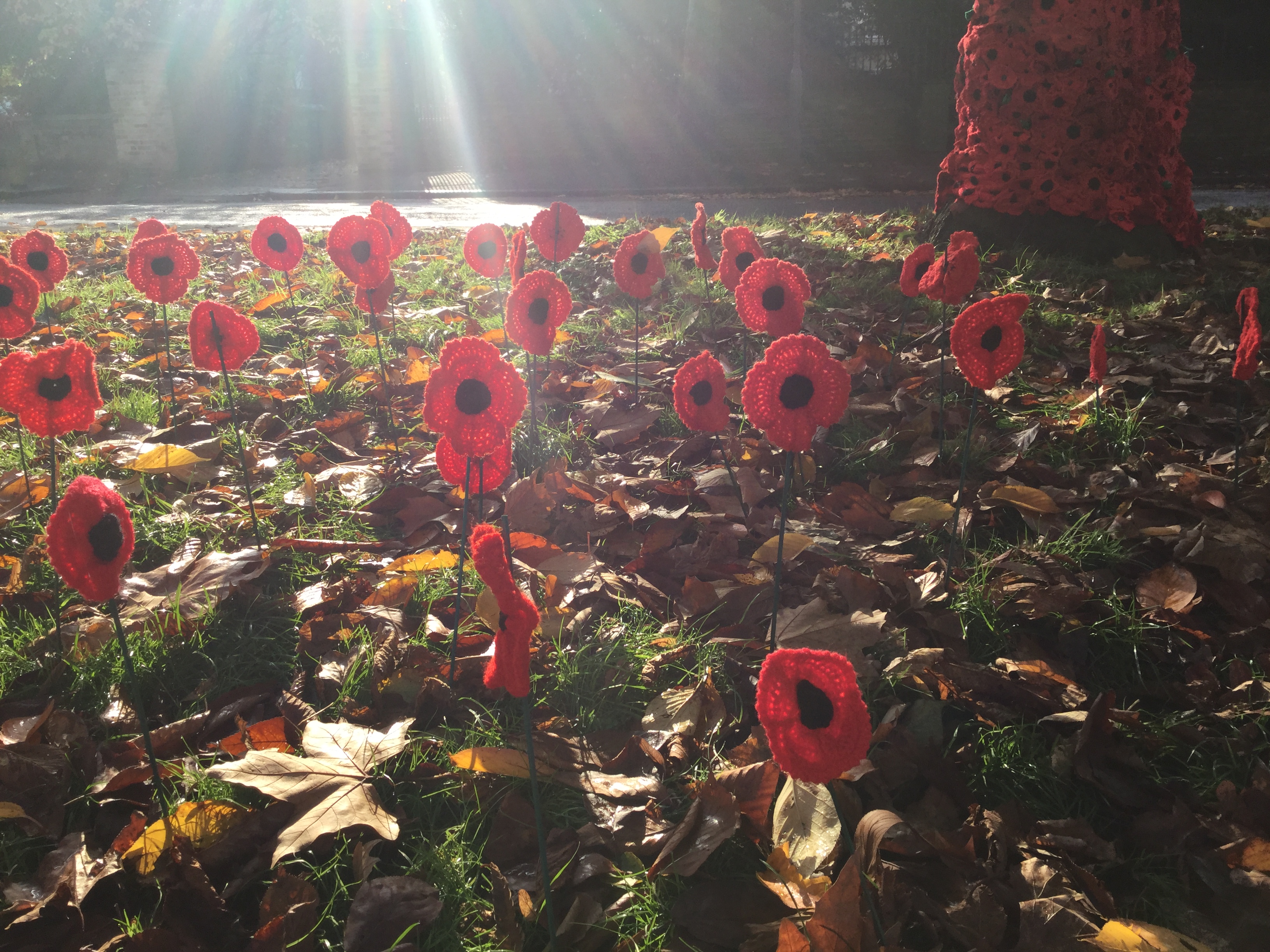
There is also a book review of Julien, H., Gross, M. & Latham, D. (2020). The Information Literacy Framework: Case Studies of Successful Implementation. Lanham, MD: Rowman & Littlefield (ISBN 978-1-5381-2144-3) Photo by Sheila Webber: remembrance poppies and sunlight, November 2020

Tuesday, November 10, 2020

Tips and trends: Zoom for Library Instruction: Benefits and Considerations

The latest in the short Tips & Trends guides series (each a few pages with links) is Zoom for Library Instruction: Benefits and Considerations by Meg Grotti and Jamie Johnson, which "explores how the Covid-19 pandemic has altered library instruction and how Zoom can be used as to build classroom community and deliver synchronous instruction. The series is published by the Instructional Technologies Committee of the ACRL Instruction Section. Download the guide at https://bit.ly/tirpsandtrendsf20

Photo by Sheila Webber: knitted remembrance day poppies, November 2020

Monday, November 09, 2020

Updated call: WILU 2021:  Visions of the  Possible

The 2021 WILU (Canadian information literacy) conference will take place online, June 17-25 2021. There is an updated call for presentations from Black, Indigenous, and People of Colour (BIPOC) colleagues with review beginning on 18 December 2020. They say "Academic institutions, including libraries, continue to fall short with representing our diverse communities. The academic environment continues to favour white people, as they hold the majority of academic roles, positions of power, and decision-making capabilities. The WILU 2021 Steering Committee has reflected on and discussed the outcomes of these imbalances. One change going forward is a new call for presentations from our BIPOC colleagues. The WILU Steering Committee believes that it is crucial to augment, amplify, and honour these voices. 

Therefore, we are adding space to our program, to ensure that our conference is more inclusive. The WILU 2021 Programming Committee is now inviting proposal submissions from BIPOC library professionals. Speakers may report on original research, completed projects, instructional programs, innovative projects, or other information literacy initiatives. Discussions of pedagogy, learning theory, and educational philosophy are also acceptable. Participants may represent diverse experiences or points of view." 

Presentations and panels are sought. Submit using this online form.

Saturday, November 07, 2020

Final cfp #LILAC21

The call for papers for LILAC (the UK information literacy conference, taking place 7-9 April 2021) closes on 12 November 2020 5pm UK time. The current plans are for it to take place at Manchester Metropolitan University, but, they say "are closely monitoring the current COVID situation. We are exploring an online option should things change". "LILAC welcomes proposals which address information literacy from all sectors and contexts. For LILAC 2021 we invite you to present on any aspect of information literacy, there are no specific themes. We ask that your presentation makes explicit reference to your innovative practice or research in information literacy. All submissions to the conference are peer reviewed before acceptance." 

The options are: Micro-teach (15 minutes long); Masterclass (30 or 60 minutes); Workshops (60 minutes); Short presentation (30 mins inc questions); Long presentation (60 mins inc questions); Panel Discussion (60 mins). Go to

https://www.lilacconference.com/lilac-2021/call-for-presentations

Thursday, November 05, 2020

The role of public pedagogy, open education and information literacy in a rapidly changing world

Sheila MacNeill presented an interesting keynote at the CILIP Scotland conference, on The role of public pedagogy, open education and information literacy in a rapidly changing world. The slides are embedded below and she blogs about it here: https://howsheilaseesit.net/digitalcapability/the-role-of-public-pedagogy-open-education-and-information-literacy-in-a-rapidly-changing-world-cilips-2020-keynote/ noting that "In my keynote I wanted to focus on the role of information and public pedagogy and the direct relationship they have on each other. In our increasingly confused world ensuring that everyone has the capacity and opportunities (both in digital and physical spaces) to find, share and critique information is increasingly important, if not urgent"

She also refers to a recent article: MacNeill, S., Johnston, B. and Smyth, K. (2020). Critical Engagement for Active Participation: The Digital University in an Age of PopulismNew Directions for Adult and Continuing Education, 115-127. https://doi.org/10.1002/ace.20372
(there is also an open access version here). "In this article, the authors describe a new vision of open education, a “public pedagogy,” that can respond to both the neoliberal university and contemporary rightwing media."


Wednesday, November 04, 2020

Online course: Introduction to Universal Design for Learning

Starting next month is a Library Juice Academy online course: Introduction to Universal Design for Learning, running from 7 December 2020 to 3 January 2021 (so, something for those of you unsure of how to occupy yourselves during a lockdown Christmas). The cost is US $175.00. "This four-week course will introduce participants to the principles and practices of Universal Design for Learning (UDL). The UDL framework provides an approach to designing meaningful learning environments that support learning variability in instructional settings, and creates a learning environment that supports all learners by removing barriers to learning before the learner encounters the barrier." It is taught by Liz Johns, the Teaching and Learning Librarian at Goucher College in Baltimore, USA.

Photo by Sheila Webber: autumn leaves, October 2020

Tuesday, November 03, 2020

ACRL Instruction Section newsletter

The Association of College & Research Libraries Instruction Section newsletter (vol 37 no 2) has been published. It has short articles on Using Canvas Commons; Adding Learning Units to Canvas Commons; & Teaching Online with Active Learning Tools, and also includes information on the ACRL Framework Sandbox (https://sandbox.acrl.org/) Go to http://www.ala.org/acrl/sites/ala.org.acrl/files/content/aboutacrl/directoryofleadership/sections/is/iswebsite/projpubs/newsletter/is_fall2020.pdf - the newsletter home page is at https://acrl.ala.org/IS/about-is-2/instruction-section-newsletters/

Photo by Sheila Webber: Sheffield Botanics, October 2020

Saturday, October 31, 2020

A #GlobalMILweek collection of #disinformation and #infodemic links #MILCLICKS

Enjoy the selection of articles, games, news stories, videos and websites about disinformation and infodemics, curated by students in my Information Literacy class in the Information School, University of Sheffield, UK. They created this padlet, which is a treasure trove of advice and information, as their contribution to Global Media and Information Literacy week. Go to https://padlet.com/s_webber/globalmilweek

Thursday, October 29, 2020

The use of Web 2.0 tools to teach information literacy in the UK university library context #FOILresearch #GlobalMILweek


This is my final blog post from the second FOIL webinar , entitled Masters’ Class: Emerging Voices in Media & Information Literacy Research. The final presentation was: William Shire (working at Magdalene College, Oxford and dissertation submitted to University of Sheffield): The use of Web 2.0 tools to teach information literacy in the UK university library context 

Shire's research questions included finding out what Web 2.0 tools were being used, why people were using them, whether they were connected with pedagogy and how they perceived the tools.  He gathered 110 questionnaires from academic librarians and did three follow up interviews. Librarians were using a wide variety of tools, with Virtual Learning Environments, Libguides and quizes coming up most frequently. In terms of the intended use, improving student engagement was more frequently mentioned, closely followed by course delivery. When examining the link with pedagogy, the research revealed that some tools were used more intrumentally (e.g. for advertising) but many were using them in a more complex way: "79% use tools for student engagement, 48% to enable students to share information with the teacher" and the qualitative research revealed constructivist approaches.

A small minority of the respondents did not find Web 2.0 tools useful and did not use them, but the majority found them "useful" or "very useful" (and responding in this way correlated with reporting use of more Web 2.0 tools, in the earlier question). Some respondents said they would like to explore more use of Web 2.0 tools, but did not have time/ management support for this exploration. Shire finished by talking about the ways that his own library had used many more of these tools for the online delivery of services, induction etc. in the current pandemic.


The place and role of workplace information literacy in a corporate environment #FOILresearch #GlobalMILweek

 More blogging on the second FOIL webinar , entitled Masters’ Class: Emerging Voices in Media & Information Literacy Research, hosted by Dr Drew Whitworth. The second presentation was:

 - Tsveta Rafaylova (working at RSM UK, dissertation submitted to University College London): The place and role of workplace information literacy in a corporate environment: exploring the information literacy capabilities of knowledge workers in a professional services firm  

She started by explaining her motivation for the research, wanting to focus on the less-studied workplace context and being encouraged to focus on her own workplace. Her research question was: what does Information Literacy look like for knowledge workers in a tax and accounting firm? She focused on workers in the tax faculty, and used Lloyd's 2017 IL model. She got 149 questionnaires returned (20% of those workers) and did four interviews. Useful in recruiting responses was the presentation of the research as a collaboration between the Information Department and the tax Knowledge Manager. The findings were shared with the tax faculty afterwards. Rafaylova identified some limitations of the research (e.g. that is was mainly descriptive) but interesting findings emegred. The first finding was the social processing of information, with junior colleagues reaching out to colleagues more than senior colleagues did. Information processing emerged as a shared team activity. The second set of finding related to challenges and barriers. These did not seem attached to particular to job roles, but were specific to the tax work context. Challenges included assessing internal information and finding andd applying external information. Because tax work involves interpretation and judgement, just finding the information is not the end of the story, it has to be combined with the worker's knowledge and applied to the specific problem. The process of acquiring knowhow and sharing and guiding colleagues has become more difficult in a working-from-home situation. One of the recommendations was to focus more on the IL of junior tax employees.

Approaches to Integrating Media Literacy in the K-12 Curriculum: The Case of Qatar #FOILresearch #GlobalMILweek

The second free webinar that the University of Sheffield Information School (my department) was involved with for Global Media and Information Literacy was today, entitled Masters’ Class: Emerging Voices in Media & Information Literacy Research. This was hosted by Dr Drew Whitworth (University of Manchester). This session was another event organised by the Forum on Information Literacy (FOIL), which is committed to sharing Information Literacy research and providing opportunities for new researchers to participate. I'll blog a little bit about each of the presentations. The first was:

 - Dona Fernandes (working at Hamid Bin Khalifa University, dissertation submitted to University of Manchester): Approaches to Integrating Media Literacy in the K-12 Curriculum: The Case of Qatar  

She started with an introduction to Qatar and the schools (K12) sector. There are a range of curricula in independent and private schools, catering to the different nationalities in the student body. Fernandes presented a timeline of Media Literacy in Qatar, relating it to other developments in education, politics (e.g. the opening and closure of the Doha Centre for Media Freedom & Doha News, issues to do with fake news) and outlined her conceptual frameworks e.g. aligning with local interests. Fernandes' research questions focused on the challenges to developing media literacy in the school curriculum and she explored them by analysing the literature. She identified the overarching challenges as. The first was lack of media freedom (although by itself it does not enable media literacy (ML) education) - from that point of view it is important, therefore not to import unrealistic Western models of ML curricula. The second challenge was an absence of national policy for ML, linked to the third challenge, a lack of multilateral colaboration in the region. The fourth challenge was a lack of technical training opportunities, including the contextual ML skills of being able to navigate the media landscape of Qatar without breaking the laws. In her final slide, Fernandes presented a diagram linking the conceptual framework and these challenges.

Wednesday, October 28, 2020

Exploring metaliteracy with symbolic modelling @valibrarian #GlobalMILweek #SecondLife

Another event to celebrate Global Media and Information Literacy week, which I organised in the 3D virtual world, Second Life, on Thursday 29th October 2020 for the Virtual Worlds Education Round Table (VWER): Exploring metaliteracy with symbolic modelling. This is at 12 noon Second Life Time (the same as US Pacific time): Note that this week the clocks have changed in many countries, but have not in the USA, this may be an hour earlier than usual for you e.g. in the UK it is at 7pm

Dr Valerie Hill will be facilitating a symbolic modelling session, with vounteers exploring what metaliteracy means to them. Symbolic modelling is an approach developed by Niela Miller and this snippet shows a participant from a previous session talking (Dr. Cynthia Calongne, Lyr Lobo in Second Life) to their model. You need a Second Life avatar (free) and the Second Life browser installed (an ordinary web browser doesn't work). The location for the event is https://maps.secondlife.com/secondlife/Infolit iSchool/45/202/23

Tuesday, October 27, 2020

Webinar: Las redes sociales y los jóvenes. Manejo y prevención de peligros y delitos digitales #GlobalMILweek #MILCLICKS

A Spanish-language webinar on defending young people from the dangers of social media on 31 October at 10am Mexico time (which is e.g. 5pm in Spain) Las redes sociales y los jóvenes. Manejo y prevención de peligros y delitos digitales is part of the celebration for Global Media and Information Literacy week. The speakers are: Estrella Luna Munoz, Miriam Pacheco Garduno, Máximo Román Domínguez López, and Liliana Domingues. More information (in Spanish) and registration at https://www.runtheworld.today/app/invitation/10631

Monday, October 26, 2020

#GlobalMILweek virtual conference

It's not too late to sign up for sessions at the online feature Global Media and Information Literacy Week conference http://www.gmil2020.com/ Sessions on 27th October are: 
MIL for equality: Women, refugees, persons with disabilities, and indigenous peoples
;
Implementation and evaluation of MIL policies and curricula: long-term defenses against disinformation
and
Press Conference - 'Youth Tackling the Disinfodemic: Outcome of the Global MIL Youth Hackathon'

Sunday, October 25, 2020

#Metaliteracy exhibit in Second Life #GlobalMILweek

At 7pm UK time, 12 noon US Pacific time today (25th October 2020) there is the first virtual event supported by the University of Sheffield Information School for Global Media and Information Literacy week, when an exhibit of symbolic models of "Metaliteracy" will be opened on the iSchool's island in the 3D world, Second Life. Infolit iSchool is a place which is dedicated to information literacy and learning and has been hosting events, exhibits and learning since 2007, and I am its chief curator. 

This event is held under the aegis of the Association of College and Research Libraries Virtual Worlds Interest Group, and takes place at http://maps.secondlife.com/secondlife/Infolit%20iSchool/149/226/3479. You need a Second Life avatar (free) and the Second Life browser installed (an ordinary browser doesn't work). Contact me if you would like more information, as there are more events over the next week (see here). 

The event will start by my own introduction to Global MIL week, and then I will hand over to Dr Valerie Hill. Dr Hill has recently published a book on Metaliteracy and she uses the Symbolic Modelling approach pioneered in Second Life by Niela Miller, to get people to reflect on how they think and feel about metaliteracy, information and literacy. 

The new exhibition at contains some of the models created so far. As an example, the embedded video below shows Greg Perrier (Emeritus Professor, Biology at Northern Virginia Community College, USA) who is Dodge Threebeards in Second Life, talking about the model he created in ten minutes, as his response to the idea of metaliteracy. This is one quotation from the video where he's talking about his relationship with information "I'm surrounded by this stuff, constantly rotating and popping in, my phone's dinging away, and so it's, there'd be almost connections, like spiderwebs between that green [representing him], with panels rotating around it, as things are flying in to me, basically [me] dealing with it, sorting and making some sense out of it all" 

Saturday, October 24, 2020

What is Media and Information Literacy #GlobalMILweek #MILClicks

Today is the start of Global MIL week and they got Eric Nam to explain what MIL was, on Twitter

Teaching the Teachers: the Information Literacy Framework Teacher Education Students

The USA's ACRL EBSS (Education and Behavioral Sciences Section) Instruction for Educators Committee has, on 13 November at 11.00-12.30 US Pacific tme (which is, e.g., 7pm-8.30pm UK time) organised an online discussion Teaching the Teachers: A Collaborative Discussion on the [ACRL] Framework and Standards for Teacher Education Students. This is a "session to share ideas, tools, techniques, and good luck charms for teaching information literacy skills to teacher education students." (the good luck charms are connected to the "Friday 13th" date). Registration deadline is 11 November, and there are limits on the number. Register at https://ewu.zoom.us/meeting/register/tJAqf-mspzIoHdClo8HmMNrHgDgIyAZLbLzh
Photo by Sheila Webber: old yew, Sheffield Botanics, October 2020

Thursday, October 22, 2020

#lispedagogy chats - schedule; and Post-Election Pedagogy

There is a schedule for the regular online discussions about teaching library and information subjects, lispedagogy, organised by Laura Saunders & Melissa Wong. The next is today (23 October) at 2pm US Eastern time (which is, e.g., 7pm UK time) on Post-Election Pedagogy: Preparing for Wednesday, November 4 (that's the presidential election in the USA) "A discussion about teaching in the days immediately following a contentious election." Register here.

Then (always at 2pm US Eastern time (which is, e.g., 7pm UK time): 

November 6: Grading (or "marking" as we call it in the UK) Moderator: Africa Hands (SJSU) 

November 20: What’s Going Well? "It’s been a crazy fall (autumn)! Let’s take a moment to be thankful for what has gone well in our classrooms and discuss how to replicate those successes in spring. Moderators: Laura Saunders & Melissa Wong 

December 4: Supporting First-Year Students. Moderator: Jennifer Joe (University of Toledo) 

Go to https://www.lispedagogychat.org/schedule-registration

Photo by Sheila Webber: Sheffield Botanics, October 2020

Wednesday, October 21, 2020

Maximising Access Now: A Library Pledge to promote digital inclusion and access to information

IFLA (International Federation of Library Associations and Institutions) has launched a pledge (which they urge people to sign up to): Maximising Access Now: A Library Pledge to promote digital inclusion and access to information during COVID-19 and Beyond. It reads 

"To the best of our abilities, and with full respect for the law and public health: 
"We pledge to promote the best possible internet access for communities, reliably and at no or low cost, so that no-one should lack connectivity for financial reasons 
"We pledge to promote the widest possible access to relevant digital content and services, supporting education, research, and economic, social and cultural participation 
"We pledge to promote the strongest possible support for the development of digital skills, giving users the ability to be successful and confident internet users 
"We pledge to promote equitable broadband policies at all levels"

More information at https://www.ifla.org/node/93389 and the sign-up is here http://survey.alchemer.com/s3/5964536/Sign-up-to-the-Library-Pledge-to-Promote-Digital-Inclusion 

IFLA also announced that they had signed up to the Libraries in Response: Every Community Connected declaration. Currently the other signatores are: Alliance for Affordable Internet (A4AI)/ Web Foundation; Internet Society; People Centered Internet; Bibliothéques Sans Frontières; EIFL (Electronic Information for Libraries); Gigabit Libraries Network (GLN).

Tuesday, October 20, 2020

Webinar 29th October: Masters - Emerging Voices in Media & Information Literacy Research #globalMILweek #MILCLICKS

The second free webinar that the University of Sheffield Information School (my department) is involved with for Global Media and Information Literacy week is on 29th October 11am-12 noon GMT, entitled Masters’ Class: Emerging Voices in Media & Information Literacy Research. This gives an opportunity for recently graduated masters students to share their dissertation research and it is hosted by Dr Drew Whitworth (University of Manchester). 

This session is another event organised by the Forum on Information Literacy (FOIL), which is committed to sharing Information Literacy research and providing opportunities for new researchers to participate. 

Each presenter is a practising information Literacy educator, and represent emerging voices in research and practice of Information Literacy. The presenters are: 

- Tsveta Rafaylova (RSM UK, dissertation submitted to University College London): The place and role of workplace information literacy in a corporate environment: exploring the information literacy capabilities of knowledge workers in a professional services firm 

- William Shire (Magdalene College, Oxford and the University of Sheffield): The use of Web 2.0 tools to teach information literacy in the UK university library context 

- Dona Fernandes (Hamid Bin Khalifa University, and the University of Manchester): Approaches to Integrating Media Literacy in the K-12 Curriculum: The Case of Qatar 

William Shire is a graduate from the MA Library Services and Information Management programme and was awarded the Henry Heaney Memorial Prize for the best dissertation in the field of academic librarianship. William, with the support of supervisor Pam McKinney, has had a journal paper based on his dissertation accepted for publication in the Journal of Information Literacy, expected publication in early 2021. 

All are welcome to come along, please register your interest here: https://www.eventbrite.com/e/foil-masters-emerging-voices-in-media-information-literacy-research-tickets-124536394709

Monday, October 19, 2020

Webinar 28 October: Information Literacy in the United Kingdom: past and future #globalMILweek #MILCLICKS

My iSchool colleague Pam McKinney and I are partcipating in two free webinars which we have helped to organise, as part of our celebration of Unesco’s Global Media and Information Literacy (MIL) Week. Global MIL Week is an annual event to celebrate and promote MIL worldwide, and this year it is (unsurprisinglyly) virtual. The first webinar is an expert panel on Wednesday 28 October at 11am UK time (which is, e.g., 7am US Eastern time - sorry!), entitled Information Literacy in the United Kingdom: past and future and chaired by me. 

The other panellists are: Annemaree Lloyd, Alison Hicks and Charlie Inskip from University College London, Bill Johnston from University of Strathclyde, Drew Whitworth from Manchester Institute of Education and Geoff Walton from Manchester Metropolitan University. I will be posing the questions: (1) What has been the UK narrative about Information Literacy? and (2) What will be the UK narrative about Information Literacy? We will draw on our varied experiences, inside and outside the UK, to reflect on how Information Literacy has (and hasn't) developed, and where it should go in the future. 

The one-hour event is on Zoom. To register, go to https://www.eventbrite.com/e/124218423649/ The event is a collaboration as members of FOIL: the Forum on Information Literacy. This is a new national network of information literacy researchers in the UK. We aim to discuss and challenge ideas, and engage in critical reflection and enquiry about the practices of information literacy. 

I will draw attention to a 2017 issue of the Journal of Information Literacy where some of the panel (me, Bill, Annemaree, Geoff) discussed issues to do with information literacy. I will blog about the 2nd webinar tomorrow!

Saturday, October 17, 2020

New articles: infolit & #DEI ;beyond one-shot; global perspectives on knowledge; eye-tracking

The latest issues of open access journal College & Research Libraries News (C&RL News) include: 

- Heffernan, K. (2020). Loaded questions: The Framework for Information Literacy through a DEI lens. College & Research Libraries News, 81(8), 382-386.[DEI = Diversity, Equity & Inclusion]. https://crln.acrl.org/index.php/crlnews/article/view/24597 

and in Vol 81, No 9, go to https://crln.acrl.org/index.php/crlnews/issue/view/1586/showToc

- Educational development partnerships and practices: Helping librarians move beyond the one-shot by Sara Sharun, Erika E. Smith 

- Multiple ways of knowing: Global perspectives on academic libraries re-imagining systems of knowledge by Kanwal Ameen, Clara M. Chu, Spencer Lilley, Ana Ndumu, Jaya Raju 

- The eyes have it: Using eye-tracking to evaluate a library website by Lindsay Guarnieri, Tracey Kry, Emily Porter-Fyke

Photo by Sheila Webber: Sheffield Botanics, rudbeckias, October 2020

Thursday, October 15, 2020

Libraries Today: Services, Safety and Novelty

A free online event from the online Frankfurt Book Fair (one of the major book fairs of the world) on 16th October at 1.30-2.30pm CEST (which is, e.g., 12.30-1.30 UK time): Libraries Today: Services, Safety and Novelty. Its argument (libraries providde great online services too!) is not exactly novel, but it could be worth librarians participating to reinforce the point. "The reality of the worldwide virus threat has challenged academic libraries to respond with service delivery that encompasses attention to safety protocols and novel delivery methods. This session represents a view of academic libraries worldwide and the services they are rendering to faculty and students under a variety of conditions, including in person, remote, and hybrid learning environments. While the pandemic situation is temporary, the lessons learned from it and skills attained because of it, will likely have a lasting legacy for academic librarians. Two of our experienced members of the scholarly community will review what has happened to academic libraries and how they have acted to stay relevant and central to their academic missions." It is run by two people from Springer. To register go to https://group.springernature.com/gp/group/landing/frankfurt-book-fair-2020/live-events#c18336774

Wednesday, October 14, 2020

LOEX 2021: Call for Breakout Session Proposals @loex_library

There is a call for proposals for the LOEX 2021 conference (LOEX is the major informaton literacy conference in the USA), which will be held virtually May 11-14 20121. The theme is Information Literacy in a Time of Transformation. The deadline for submissions is 4 December 2020. "Facing the unique social and technological challenges of the present time, we’re approaching our instruction, our libraries, and our world differently. And that asks for an approach to LOEX 2021 that encompasses this transformation" 

"This year’s LOEX tracks are: * Pedagogy: Transforming the Classroom * Leadership: Elevating the Field * The Anti-Racist Instructor: Cultivating Inclusion and Belonging * The Value in Failure: From Missteps to Forward Movement * Theory in Practice: Reversing the Paradigm (How have you used educational and critical theory to form the backbone of your instructional design?)* Collaboration: Building Unity in Diversity" 

Proposals for 60-minute sessions have to be submitted through an online form. "Successful proposals will showcase effective and innovative library instruction & information literacy practices, provide valuable information that participants can utilize at their libraries, support collaboration, and be applicable to the broad variety of academic institutions." More details at http://www.loexconference.org/breakout-proposals

Photo by Sheila Webber: Sheffield Botanics, October 2020

Tuesday, October 13, 2020

Call for nominations: Ilene F. Rockman Publication of the Year Award

The Ilene F. Rockman Publication of the Year Award is given to someone who has written an outstanding publication related to teaching in a library environment, which has been published in the last two years (2019 or 2020). Eligible publications include journal articles, books, book chapters, and published proceedings, and may have been authored by any number of people, or an organisation or committee. The deadline is December 4 2020. The full criteria and more information are at http://www.ala.org/acrl/awards/publicationawards/publicationyear The winner(s) receive US $1,000 and a plaque sponsored by Carrick Enterprises.   

Photo by Sheila Webber: Sheffield Botanics, October 2020

Friday, October 09, 2020

Strengths-Based Librarianship for Instruction and Research Services

A priced online course organised by the US Reference and User Services Association between 9 November 2020 and 12 December 2020 is Strengths-Based Librarianship for Instruction and Research Services. "Are you curious how your students' authentic, real life research skills can impact your teaching? Please join us for a 5-week online course to discover and discuss strengths-based pedagogy. You will transform your teaching and individual consultation by valuing the uniqueness of learners' perspectives and building on their prior knowledge and experiences. Together, we will have the opportunity to identify, examine, and create strengths-based activities that improve the learner experience in your institutional settings."

The course is facilitated by: Emily Cox (Collections and Research Librarian for Humanities, Social Sciences, and Digital Media at NC State University); Liz Kocevar-Weidinger (Head of Research & Instruction Services at Virginia Military Institute); Mark Lenker (Teaching and Learning Librarian at the University of Nevada, Las Vegas); Tatiana Pashkova-Balkenhol (Undergraduate Research and Instruction Librarian at Millersville University, PA.) (All in the USA) 

Cost is US $130 for RUSA members; $175 for ALA members; $210 for non-ALA members; $100 for student members and retired members 

More info at http://www.ala.org/rusa/flip-deficit-script-and-be-strengths-based-librarian

Thursday, October 08, 2020

#HackingDisinfodemic - hackathon for young adults #MILClicks

As part of the Global Media and Information Literacy week celebrations, UNESCO with various partners (see below) has organised a hackathon around disinformation #HackingDisinfodemic. Those eligible (you can apply individually or as part of a team) are "Any person or group of persons who are of ages between 18 and 35 years and adheres to the values of UNESCO. No previous coding background is required. Experience and expertise in game, mobile application, website and radio development would be an asset." 

Deadline for applications is 12 October 2020 at midnight Paris time (you have to describe your proposed solution concisely, but don't have to have created it). 

The task and challenges are to: "Design innovative and creative solutions to one of the three challenges: Media and information literacy to counter the COVID-19 disinfodemic; Media and information literacy to fight discrimination; Media and information literacy to combat online privacy and data protection infringements" 

The Solution categories are (1) Game (2) Application/Website (3) Radio programme/Podcast (4) Creative community-based intervention (non-technology focused) The partners are: UNESCO, the Republic of Korea, the World Health Organization, the United Nations Population Fund, the UNESCO Mahatma Gandhi Institute of Education for Peace and Sustainable Development (MGIEP), and IBM. 

See more details: https://en.unesco.org/news/call-applications-hackingdisinfodemic

Wednesday, October 07, 2020

Alert to information consultants/experts - World Health Organization training in infodemic management

There is a call for applicants for World Health Organization training in infodemic management. The deadline for submissions is 18 October 2020 and the training takes place during 3-27 November 2020. They say they "invite applications from experienced professionals from the fields of epidemiology, risk communication, health service delivery/health care workers, digital health, policy making (in health and intersectoral), who are responding to the current COVID-19 and overlapping infodemics at country level." 

In other words - they don't mention any information professionals, however, looking at the scenarios you have you to address to apply for the training, certainly there would be people with an information background who ought to qualify. The other statement about suitability says "Applications are open to freelance consultants, national health authority staff and United Nations staff who meet the selection criteria to constitute the cohort of trained infodemic managers that support response in countries." (see aso the video below)

The aims of the training are "Build a curriculum and apply it in delivering a training of the 1st cohort of cross-disciplinary infodemic managers that can be deployed to the field for infodemic response; Build up the skills of health authority staff in infodemic management; Offer opportunity for UN staff to learn about infodemic management; Become the basis for creating future infodemic training facility training modules." 

More information at https://www.who.int/news-room/articles-detail/call-for-applicants-for-1st-who-training-in-infodemic-management

Librarians as Koru Mindfulness Teachers

The ACRL Contemplative Pedagogy Interest Group runs free online discussions on topics related to contemplative pedagogy in the college or university setting.The next one is on 20 October 2020 at 2pm US Eastern time (so, e.g. 7pm UK time) on Zoom. The topic is Librarians as Koru Mindfulness Teachers. "Learn about Koru Mindfulness, an evidence-based, four-week curriculum designed for college students. Madeleine Charney will share about her experience training, teaching, and getting buy-in for this part of her job as a Research Services librarian at UMass Amherst Libraries. There will be time for questions, discussion, and brainstorming ideas for those of us interested in teaching mindfulness." Register at https://apsu.zoom.us/meeting/register/tZYrcOqhqT4pH9BoOcnAl4gNXDx7xidmqemv  

Photo by Sheila Webber: contemplating the palm tree, taken in Second Life, September 2020

Tuesday, October 06, 2020

Flexible Online Instruction Using Modular Learning Design Workshop

A priced (US $65) online 90 minute workshop from the American Library Association, on 21 October 2020 2.30-4pm US Eastern time (which is e.g. 7.30-9pm UK time) is Flexible Online Instruction Using Modular Learning Design Workshop. It is run by Amanda Nichols Hess. "With our myriad responsibilities and busy schedules, librarians frequently produce online learning materials ad hoc or in a race against time, missing valuable opportunities for synergy and consistency. In this workshop, library instruction expert Amanda Nichols Hess introduces the concept of modular learning, an approach to developing intentional, strategic online learning objects. A modular learning approach is one where we intentionally build documentation and structure into our work so that content is ready to be updated or remixed to meet different learning needs in the near, mid-, or long-term. Nichols Hess discusses topics that participants can immediately apply, such as learning design, evaluation and assessment, accessibility, and usability. She will also cover how you can use existing content to create flexible online learning resources." 

More info and registration at https://www.alastore.ala.org/content/flexible-online-instruction-using-modular-learning-design-workshop

Photo by Sheila Webber: cat on my walk, September 2020

Monday, October 05, 2020

Who Is Susceptible to Online Health Misinformation?

This short article is interesting (and, I think, open access), and could be used to stimulate discussion about misinformation and how to combat it. For example, you could get different groups of learners to propose ways of diagnosing and tackling each of the 3 types of cause, you could critique the categorisations (e.g., perhaps understandably for a health publication, it assumes there always IS a way to tell true from false, and doesn't address circumstances where talking about true and false is problematic). You could ask students to follow up and find more research about the argument that most interested them. If you have a good relationship with them, learners might be willing to reflect om whether they felt any of these 3 applied to them. Also the article suggests lines of future research (e.g. do people who believe misinformation about X also believe it about Y). 

Scherer, L. and Pennycook, G. (2020). Who Is Susceptible to Online Health Misinformation? American Journal of Public Health, 110, S276_S277. https://doi.org/10.2105/AJPH.2020.305908

"Although everyone has the potential to be misled by false information, online misinformation is not an equal opportunity aggressor. Some of us are more likely to believe misinformation than are others and serve as vectors by sharing it on social media. To effectively combat misinformation on social media, it is crucial to understand the underlying factors that lead certain people to believe and share false and misleading content online. A growing body of research has tackled this issue by investigating who is susceptible to online misinformation and under what circumstances." 

They indentify three main arguments (1) "the deficit hypothesis" "people who believe misinformation do not have sufficient knowledge or literacy to discriminate between true and false information." (the literacies they focus on are primarily health and digital literacy - information literacy isn't mentioned) (2) "people tend to be susceptible to misinformation that is consistent with their preexisting beliefs or worldview." and (3) "those who are worse at discerning between true and false information tend to overclaim their own knowledge and to be receptive to “pseudoprofound” statements”

Photo by Sheila Webber, apples and pears, farmers' market, late September 2020

Saturday, October 03, 2020

Nominations invited for ACRL Instruction Section Innovation Award

The ACRL Instruction Section Innovation Award is open for nominations, deadline December 4, 2020. There is a US $3,000 prize sponsored by EBSCO Information Services. "The Innovation Award recognizes a project from the past two years that demonstrates creative, innovative, or unique approaches to information literacy instruction or programming. ... Nominations must describe how the project meets the award criteria and should include a letter of support and documentation presenting the project’s purpose, content, impact, and innovative aspects." 

"Academic librarians or academic project teams that include an academic librarian are eligible to receive the award. Recipients must have implemented their project in an academic or research library or through the aegis of a professional library organization ..." More information at http://www.ala.org/acrl/awards/achievementawards/innovationaward 

It doesn't say that the award is restricted to North America, and it isn't part of the criteria, but I can't see any previous winners based outside USA and Canada.

Photo by Sheila Webber: September roses, 2020

Thursday, October 01, 2020

Understanding and Improving Information Search: A Cognitive Approach

A book recommended by enterprise search expert Martin White is: 

Fu, W.T. and van Oostendorp, H. (eds). (2020). Understanding and Improving Information Search: A Cognitive Approach. Springer. https://doi.org/10.1007/978-3-030-38825-6. It "adopts a cognitive perspective to provide breadth and depth to state-of-the-art research related to understanding, analyzing, predicting and improving one of the most prominent and important classes of behavior of modern humans, information search"

Here is Martin's review of the book on his blog: http://intranetfocus.com/understanding-and-improving-information-search-a-cognitive-approach/

Photo by Sheila Webber: rudbeckias, September 2020