Tuesday, July 26, 2022

Part 2 of - News literacy session #WLIC2022

This is part 2 of my notes from the WLIC session on News Literacy: Fighting Mis/Disinformation at Your Library this morning (part 1 is here).
The next speaker was Ebele Nkiru Anyaoku, University of Abuja, Nigeria and the paper was coauthored by Ngozi P. Osuchukwu, Nnamdi Azikiwe University, Nigeria. The paper was Librarians use of information literacy strategic tools for teaching students in Nigerian universities to combat fake news and information. The speaker outlined the problem of information disorders and its impact on wellbeing: fake news spreads fear and panic and can be literally fatal if people believe health myths and false health information. Young people are certainly at risk since they access online information through social media through the day, and may not be able to identify fake news. People need a critical mindset, search skills and knowledge about quality information sources and finally the ability to evaluate information. There is an officially approved information literacy course which is used by people in Nigerian universities called GST 121 Use of Library and Study Skills. Therefore they carried out a research study to investigate whether the material being used to teach it were meeting the course's aims. They carried out document analysis and analysed websites. The review showed there was no module on fake news. They did discover media and informatiteracy modules and analysed the content. The percentage (about 11%) of material on evaluation was not sufficient, with more material on search etc. Also the library websites more broadly did not have material countering, and warning against, fake news. They recommend that e.g. fact checking, evaluating, spotting fake news should be included in modules, with revision of the GST121 course, and also the library websites should be upgraded. The paper for this talk is at https://repository.ifla.org/handle/123456789/1961 

The next talk was Fighting Against Fake News: a Study of Central University Libraries in India presented by Mahender Pratap Singh, Babasaheb Bhimrao Ambedkar University, India. As with other speakers, he emphasised the role of librarians in combatting misinformation. The speaker presented research (a questionnaire survey carried out during the pandemic) into the role of librarians and their strategies in combatting fake news. The participants were from Central Universitiy libraries, and more than half the libraries responded. The respondents identified fake news as harmful. They did identify roles for librarians in identifying fake news and fact checking, and said there were offering information literacy training. A major problem was lack of support from their institution. Suggestions made by the presenter ranged from those aimed at librarians up to those aimed at government. They included institutions taking disciplinary action against those spreading fake news, and also government policies to raise awareness and control fake news. The paper is here https://repository.ifla.org/handle/123456789/1965 

Finally we had a presentation on Vietnam academic libraries and fake news on social networks: revealing the truth and solving the problem by Lan Nguyen Thi Kim, University of Social Sciences and Humanities, Vietnam National University Hanoi, Vietnam. She presented some general statistics about the population and their use of internet and socal media. They had carried out a survey about how university librarians were dealing with fake news. There were 505 valid responses to the survey that they conducted. They found that those with former training and better education were better at discerning the truth and more careful when shring information. The paper is here https://repository.ifla.org/handle/123456789/1963

News Literacy: Fighting Mis/Disinformation at Your Library #WLIC2022

I'm at the World Library and Information Conference in Dublin and will be blogging some of the sessions. The first is: News Literacy: Fighting Mis/Disinformation at Your Library. This was a session organised by Social Science Libraries Section and News Media Section, of the International Federation of Library and Information Associations (IFLA). The moderators were Abby More, University of North Carolina at Charlotte, United States and Ann Okerson, Center for Research Libraries, United States. The session was attended by over 200 people, and when asked whether fake news was a serious issue in our country, I think everyone put up their hand. I'll blog the session in two parts. The following a just notes, and I have linked to the full text papers that give more information.

The first talk was on Training the trainers: A public library - higher education collaboration for Media Literacy education in Ireland, presented by Crystal Fulton, University College Dublin, Ireland and Claire McGuinness, University College Dublin, Ireland. They described a collaboration between academics at the School of Information and Communication Studies (ICS) at University College Dublin (UCD), and Meath County Council Libraries in Ireland, providing media literacy training for public librarians. They managed to get funding from Meta, in the form of a donation, so they could avoid pressures on what they produced. The researchers examined existing initiatives and also surveyed library staff about their needs and preferences for media literacy training, using a participatory action research approach. They then created online training focusing on the topics: Identifying and sharing good media literacy information; our data footprints; Google is not the internet; cyberbullying / hate speech; conspiracy theories. There were recommendations including having training about how to train library users. Their paper is here https://repository.ifla.org/handle/123456789/1952 

The second talk was Fighting Fake News and Disinformation: a scholar experience in Latin America presented by Jonathan Hernández Pérez, Library and Information Research Institute, UNAM, Mexico. He explained that there is an initiative called  Seminar in information & society, started in 2002, which from 2016 worked on the issue of disinformation. In 2017 they launched ethical use of information week, then in 2018 they organised workshops for librarians, and webinars about information on COVID19 in 2020. They have published open access books addressing the same issues e.g. Repositorio IIBI UNAM: La posverdad y las noticias falsas : el uso ético de la información. From these Mexican initiatives they have extended to other South American countries. They noted that there seems to be a disconnect between scholarly work and people’s ideas and experience, which librarians need to address. They in particular called for research into internet sub cultures. The paper is here https://repository.ifla.org/handle/123456789/1969 

The next speaker, Jelena Rajić, Public Library "Radislav Nikčević", Serbia, had been delayed because her flight was cancelled, but had made a virtual presentation on the spot (I think at the airport?) which she had emailed in (since librarians are so resourceful!). Her talk was Genuine librarians as a shield between fake information and library patrons. She started by identifying the role and capabilities of public librarians. To the existing role of providing support to people using the internet, the librarians realised that they needed to help people be aware of what information was fake. They carried out a survey of users and as a result of that decided they needed to organise critical information literacy training. Librarians used exercise, quizzes and so forth, but then the pandemic occurred and this led to new needs. The librarians helped by identifying sites providing false information about COVID19, and other guidance towards reliable COVID19 information. Her paper is here https://repository.ifla.org/handle/123456789/1960

Photo by Sheila Webber

Sunday, July 24, 2022

Webinar: Infodemic Management community event: The science of storytelling

There is a free webinar on 26 July 2022 at 10am USA Eastern time (which is, e.g., 3pm UK time): The science of storytelling . It is organised by the World Health Organisation in collaboration with The Story Collider. The focus is "Effective storytelling to communicate about infodemics, their impact and how to contribute to infodemic management practice  ...  By understanding how emotive storytelling is successful in reaching audiences and causing narratives to go viral, infodemic managers can reverse engineer the same approach to tell their own stories about working in the trenches, managing the infodemic in the time of COVID-19 and being more effective in their jobs. Infodemics consist of narratives that shape and shift over time. Understanding how stories are constructed and what emotional and cognitive shortcuts they rely on to spread quickly are skills every storyteller knows."
Speakers are: Tina Purnatt, WHO;  Maryam Zaringhalam, The Story Collider; Claire Wardle, Brown University School of Public Health. Register at https://us02web.zoom.us/webinar/register/WN_N7lON7UpRCK6A5Bcp7T4WQ The webinar will take place in English, French and Spanish. For more information, go to https://www.who.int/news-room/events/detail/2022/07/26/default-calendar/infodemic-management-community-event-the-science-of-science-storytelling

Photo by Sheila Webber, Taken in Second Life June 2022.

Saturday, July 23, 2022

Information Futures Fellowship

This sounds an interesting opportunity - and libraries are specifically included!
"The Information Futures Fellowship is a novel opportunity for practitioners in public health, healthcare, community organizations, media, policy, design and other fields who are actively working on responses to the ongoing information crisis. The six-month fellowship provides these practitioners with the resources, time, research partners, training and peer network to develop new ideas, evaluate existing programs or design and test novel interventions." Th eFellowship is offered by Brown University in the USA, but you don't have to live in the States for the whole 6 months.
"The Information Futures fellowship is designed for practitioners with at least 5-10 years of experience and a proven track record in areas including, but not limited to: policy making, public health, libraries, education, communications, design, fact checking, journalism, healthcare, community leadership, research or government." 

There is a salary (though only if your employer does not pay your wages while you are on the Fellowship) and $5000 expenses for those outside the USA (less for those within the USA). Deadline for applications is August 15 2022. Go to https://sites.brown.edu/informationfutures/fellows-program/?
Photo by Sheila Webber: cherries, July 2022

Friday, July 22, 2022

Africa Infodemic Response Alliance (AIRA)

The Africa Infodemic Response Alliance (AIRA) is "Africa’s network to share safe, proven facts on health and to counter dangerous health misinformation". Alliance members are World Health Organization AFRO; UNICEF; Africa CDC; International Federation of Red Cross and Red Crescent Societies (IFRC); UNESCO; Verified; and UN Global Pulse. They issue an Infodemic Trends Report (the links to download the most recent ones didn't work when I looked - there is definitely a link for the June 6th one). The newsletters counter misinformation and identify campaigns against misinformation (e.g. this) There are also other news and resources 

Wednesday, July 20, 2022

cfp #LIDA2023

There is a call for papers for the LIDA (Libraries & Information Institutions in the Digital Age) biennial international conference to be held in Osijek, Croatia, May 24-27, 2023. The theme of the conference is Information Everywhere. Deadline for proposals is 1 October 2022. There will also be a celebration of the life of Professor Ross Todd, formerly LIDA co-director. You can propose papers, panels, workshops and posters "that address critical and theoretical examinations of the theme; report current research and evidence-based approaches as well as present innovative approaches from the field, and practitioner applications and perspectives." This is currently planned as an in-person event. For more information visit http://lida.ffos.hr
The organisers also note that earlier the same week (May 22-23, 2023) the conference Digital Transformation and Inclusiveness of the Higher Education Institutions in the Time of Crisis Situations, organized by Erasmus+ project DECriS, takes place in the same city Osijek. The call for paper for this conference ends 1 December 2022. There is a discounted registration rate for attendance at both conferences.
Photo by Sheila Webber: hydrangea, July 2022

Tuesday, July 19, 2022

Information Literacy and #climatechange

It is extraordinarily hot in England and Wales today, so climate change seems an obvious topic. This article from UNESCO talks about climate change literacy as part of Media and Information Literacy (MIL) and this page https://en.unesco.org/covid19/communicationinformationresponse/visualresources includes some posters that are about MIL and climate change (scroll down the page to find them: one example is used here)

As some more examples:
- Hauke, P. (2018). From Information Literacy to Green Literacy: Training Librarians as Trainers for Sustainability Literacy. Paper presented at: IFLA WLIC 2018 – Kuala Lumpur, Malaysia – Transform Libraries, Transform Societies in Session 116 - Library Theory and Research with Information Literacy. http://library.ifla.org/id/eprint/2147 This talks about development of green literacy or sustainability literacy as one of the goals for a sustainable library (practicing, and educating for, sustainability). 

- Dailey, A. & Smith, M. (2017). From Climate Change to Vaccination Safety: Teaching Information Literacy in an Undergraduate Epidemiology Course. All Musselman Library Staff Works. 76. https://cupola.gettysburg.edu/librarypubs/76 This leads to an abstract and a powerpoint you can download. It describes a collaboration between a faculty member and a librarian on an assessment targetting information literacy, with a scenario on climate change being one topic the students had to investigate. In fact the climate change subject isn't described in detail, but the powerpoint has a good amount of detail about the intervention and the results, so I thought it was still worth mentioning from a "teaching information literacy" point of view. 

- Lovitt, C. & Shuyler, K. (2016). Teaching Climate Change Concepts and the Nature of Science: A Library Activity To Identify Sources of Climate Change Misconceptions. In: Integrating Information Literacy into the Chemistry Curriculum. (pp. 221-246). ACS Symposium Series. https://pubs.acs.org/doi/abs/10.1021/bk-2016-1232.ch012 A priced publication, but it looks an interesting example "A library activity was developed in which students found information about climate science misconceptions from popular and scientific literatures. As part of the activity, students developed a rubric to evaluate the credibility and type of literature sources they found. The activity prepared students to produce an annotated bibliography of articles, which they then used to create a training document about a climate science misconception for staff at a local science center." 

- Duru, P. & Emetumah, C.F. (2016). Evaluating the Effects of Information Literacy on Climate Change Awareness among Students in Imo State University. Archives of Current Research International, 4(3), 1-10. https://doi.org/10.9734/ACRI/2016/27186 A questionnaire was administered at a Nigerian university: the questions were mostly to do with knowledge about the impact of climate change, but there were also questions about how the students got information about this topic and whether they felt it was sufficient.

Monday, July 18, 2022

New articles: Countering misinformation

- Veletsianos, G., Houlden, S., Hodson, J. et al. (2022). An Evaluation of a Microlearning Intervention to Limit COVID-19 Online Misinformation. Journal of Formative Design in Learning. https://doi.org/10.1007/s41686-022-00067-z "As part of a design-based research project, we designed, developed, and evaluated a web-based microlearning intervention in the form of a comic into the problem of COVID-19 online misinformation. In this paper, we report on our formative evaluation efforts. Specifically, we assessed the degree to which the comic was effective and engaging via responses to a questionnaire (n = 295) in a posttest-only non-experimental design. The intervention focused on two learning objectives, aiming to enable users to recognize (a) that online misinformation is often driven by strong emotions like fear and anger, and (b) that one strategy for disrupting the spread of misinformation can be the act of stopping before reacting to misinformation. Results indicate that the comic was both effective and engaging in achieving these learning objectives."
The comic is more like a poster, i.e. fairly short, and it is reproduced well in the article - worth taking a look at. 

 - Germani, F. & Biller-Andorno, N. (2022). How to counter the anti-vaccine rhetoric: Filling information voids and building resilience. Human Vaccines & Immunotherapeutics https://doi.org/10.1080/21645515.2022.2095825
An interesting article in its discussion of how you should aim to get to know what the concerns of the vaccine-hesitant are, so that you can persuade them more effectively (and not just use rational argument, but also use emotional images etc.) However the authors really needed to do some further reading before writing the sentence "The role of education in building information literacy has been widely discussed, but so far, it can be considered marginal" (in fact they then don't actually discuss information literacy, so I'm not sure they are fully up to speed with its meaning).

Photo by Sheila Webber: summaer berries, farmers market, May 2022

Sunday, July 17, 2022

Is Youtube not a reliable health information source?

Spoiler alert - the answer seems to be "no". This is a review of existing research into Youtube's reliability.
Osman, W., Mohamed, F., Elhassan, M. et al. (2022). Is YouTube a reliable source of health-related information? A systematic review. BMC Medical  Education, 22 (382). https://doi.org/10.1186/s12909-022-03446-z
Abstract: "YouTube is a valuable source of health-related educational material which can have a profound impact on people’s behaviors and decisions. However, YouTube contains a wide variety of unverified content that may promote unhealthy behaviors and activities. We aim in this systematic review to provide insight into the published literature concerning the quality of health information and educational videos found on YouTube. ...
"Based on eligibility criteria, 202 papers were included in our study. We reviewed every article and extracted relevant data such as the number of videos and assessors, the number and type of quality categories, and the recommendations made by the authors. ... The total number of videos assessed in the selected articles is 22,300 ... The video quality was assessed by scoring, categorization, or based on creators’ bias. Researchers commonly employed scoring systems that are either standardized (e.g., GQS, DISCERN, and JAMA) or based upon the guidelines and recommendations of professional associations.
"Results from the aggregation of scoring or categorization data indicate that health-related content on YouTube is of average to below-average quality. The compiled results from bias-based classification show that only 32% of the videos appear neutral toward the health content. Furthermore, the majority of the studies confirmed either negative or no correlation between the quality and popularity of the assessed videos. ...
"YouTube is not a reliable source of medical and health-related information. YouTube’s popularity-driven metrics such as the number of views and likes should not be considered quality indicators. YouTube should improve its ranking and recommender system to promote higher-quality content. One way is to consider expert reviews of medical and health-related videos and to include their assessment data in the ranking algorithm."Photo by Sheila Webber: farmers market May 2022 - those were early raspberries and it was still asparagus season.

Friday, July 15, 2022

New articles: #COVID19 ; epistemology; health librarian research; virtual refernce; universal design; neoliberalism

The latest complete issue of the Journal of Academic Librarianship (a priced publication), Volume 48 issue 4 (July 2022) has a COVID-19 focus and includes, amongst other articles, the following:
- Automated Epistemology: Bots, Computational Propaganda & Information Literacy Instruction by Ian O'Hara
- “First years' information literacy backpacks: What's already packed or not packed?” by Joyce Kasman Valenza et al.
- Health sciences librarian research and instruction services in pandemic information environments by Deborah H. Charbonneau, Emily Vardell
- Reading Format Attitudes in the Time of COVID by Diane Mizrachi, Alicia M. Salaz
- Effectiveness of Virtual Reference Services in Academic Libraries: A Qualitative Study Based on the 5E Learning Model by Angel Lok Yi Tsang, Dickson K.W. Chiu
- Transformation of libraries during Covid-19 pandemic: A systematic review by Murtaza Ashiq, Farhat Jabeen, Khalid Mahmood
- Students with disabilities and library services: Blending accommodation and universal design by Casey Alexander Roberson, Trisha Barefield, Eric Griffith 

Also a refreshing read is COVID-19 doesn't change anything: Neoliberalism, generation-ism, academic library buildings, and lazy rivers by John Buschman
Go to https://www.sciencedirect.com/journal/the-journal-of-academic-librarianship/vol/48/issue/4
Photo by Sheila Webber: cherries on my tree July 2022

Scholarly Communication Libguide

The University of Witwatersrand, Johannesburg, South Africa has a number of interesting Libguides, including this one on scholarly communication which has section on open publishing, trends, data management etc. https://libguides.wits.ac.za/ScholarlyCommunication/Publication/Intro

Thursday, July 14, 2022

Good Things Foundation: Digital Inclusion

I'll highlight two recent things from the UK's Good Things Foundation (which has a mission concerning digital inclusion). The first is that yesterday (13th July 2022) they published a report on The economic impact of digital inclusion in the UK "The report finds that investment of £1.4 billion could reap economic benefits of £13.7 billion for UK plc. This is £9.48 return for every £1 invested.". One thing that they highlight is that "Lockdowns, social isolation, experiences of poor physical and mental health, care and support needs, disruptions in service provision, and also in training for adult learners, and low income - will have variously contributed to loss of digital skills for some who were previously online, and disengagement from opportunities for others" 

The 2nd item is a blog post from 11th July 2022 in which they list some "holiday reading" around the topic Growing the evidence base for digital inclusion (e.g. Me and My Big Data: Understanding citizens’ data literacies). That is here https://www.goodthingsfoundation.org/what-we-do/news/growing-the-evidence-base-for-digital-inclusion/

Photo by Sheila Webber: Hydrangea, June 2022

Wednesday, July 13, 2022

Health and medical articles alert

Thomas Krichel maintains curated updates including one on Biomedical librarianship at http://biomed.news/bims-librar. This weekly list of references+abstracts focuses on the information/search aspect and thus always includes some papers relevant to information literacy, and it is valuable in NOT just covering library and information sources. Evaluations of the quality of health information on websites and Youtube occur regularly. The latest one as of writing (10 July) includes, for example, an article written by HCI (Human-Computer Interaction) researchers, reporting on their qualitative investigation into the barriers in using information experienced by their sample of people with mild to moderate dementia (and how the participants mitigated this) [you can see avideo abstract free - I recommend it]; a number of studies of the quality of websites or websites relating to various conditions; a report about the NHS initiative to share search strategies related to COVID-19
Photo by Sheila Webber: Hydrangea, July 2022

Tuesday, July 12, 2022

Closing call for papers: International Conference on Information Literacy (ICIL) 2022

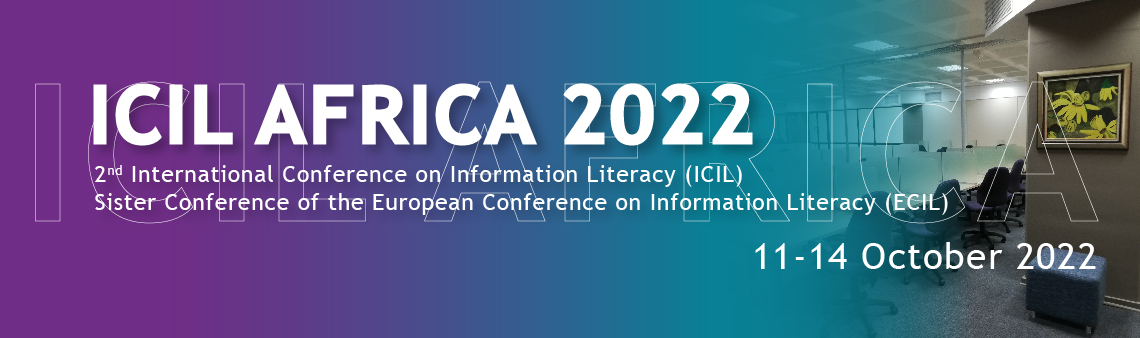
The deadline for proposals for the International Conference on Information Literacy (ICIL) 2022 (the Africa-based sister conference to ECIL) is 15 July. The conference will take place in Potchefstroom (South Africa) and online, 11-14 October 2022. The theme is Information Literacy in the Fourth Industrial Revolution and submissions are welcomed on a wide range of themes.
"The ICIL-SA 2022 conference aims to bring together researchers, library and information services professionals, employers, media specialists, educators, policymakers and all other related parties from around the world to exchange knowledge and experience and to discuss recent developments and current challenges in both theory and practice." Submissions can be: Individual papers orposters; PechaKucha; Doctoral forum; Panel discussions.
Go to https://library.nwu.ac.za/international-conference-information-literacy-icil-2022 for more information

Monday, July 11, 2022

South Carolina Conference on Information Literacy #SCCIL

Registration is open for the free online 2022 South Carolina Conference on Information Literacy (SCCIL), taking place on 5 August 2022, 9:00-16:30 US EST (which is, e.g., 14.00-21.30 UK time), with the theme Communities of Practice "The SCCIL Conference seeks to bring together a group of librarians, educators and practitioners for presentations, discussions, and networking. We encourage participation from all types of libraries such as academic, community, museums, libraries (K-12, higher education, public, special), institutions, and organizations." Featured speakers are Nicole Cooke, Lisa Janicke Hinchliffe, Lorin Jackson and Amy Blevins. Register at https://www.eventbrite.com/e/2022-south-carolina-conference-on-information-literacy-tickets-368388940237

Thursday, July 07, 2022

New articles: Learning outcomes; Orientation;

The latest issue of the open access College & Research Libraries News (vol 83 issue 7) has been published. It includes:
- Jennifer M. Brady and Susan Kromrie. Creating a self-paced library orientation and information literacy module: Providing access to library resources at the point of need.
- Debbie Sharp, Beth Fuchs, Peter Hesseldenz, and Karyn Hinkle. Merged learning outcomes for information literacy: A David Letterman-style Top Ten List.
Go to https://crln.acrl.org/index.php/crlnews/issue/view/1622/showToc
Photo by Sheila Webber: narcissi, April 2022

Wednesday, July 06, 2022

Online courses: Scaffolding Information Literacy; Politically Polarized Times

Two online courses offered by Inquiring Teachers (led by Andrea Baer) are:
- Information Literacy in Politically Polarized Times (September 5 - October 4 2022) Cost US$200 https://inquiringteachers.com/courses/il-polarized-times/
- Scaffolding Information Literacy (October 17 - November 15 2022) Cost US$200 https://inquiringteachers.com/courses/scaffolding
Photo by Sheila Webber: Cosmos, June 2022

Monday, July 04, 2022

Reports on international Media and Information Literacy events

Firstly, there was a webinar held a few days ago by UNESCO, at the Transforming Education pre-Summit 2022. There were speakers from different parts of the world, talking about the importance of Media and Information Literacy, Online/Open Educational Resources and the ICT Competency Framework for Teachers. They refer to the UNESCO hub collecting open educational resources for teachers. The report on the event is here: https://www.unesco.org/en/articles/transforming-education-pre-summit-media-and-information-literacy-and-oer-key-addressing-todays 

Secondly, there was an event in March 2022 in Dubai (rather confusingly called Dubai Expo 2020 - perhaps it was supposed originally to take place in 2020)  which promoted the vale of Media and Information Literacy, and the report on that is here https://www.unesco.org/en/articles/media-and-information-literacy-highlighted-during-expo-2020-dubai

Sunday, July 03, 2022

Recent articles: ACRL Framework; Nursing students; doctoral journeys

The latest issue of Reference Services Review (priced journal) vol. 50 issue 2 includes
- Is the ACRL Framework a teaching tool? Undergraduates’ interpretations of its language and concepts by Jennifer Jarson, Rachel Hamelers. "In this case study, the authors analyzed 25 undergraduates’ reflections on their information literacy learning guided by recommendations for thematic analysis of qualitative data from Braun and Clarke (2006) and Castleberry and Nolen (2018). ... The authors’ analysis of students’ reflections offers insight into how these students interpreted the Framework’s language and related it to their own experience. By noting language that seemed to resonate in this instance, the authors suggest ways in which educators could effectively use the Framework’s language with undergraduates."
- Information literacy: assessment of undergraduate and graduate nursing students by Rabia S. Allari, Khaldoun Hamdan, Maha Alkaid Albqoor, Abeer Shaheen. "Cross sectional-correlational design was utilized. Data were collected using an electronic self-administered questionnaire from graduate and undergraduate nursing students in Jordan. ... Information competency of nursing students was positively correlated with students' age. Significant differences were found in information competency according to the academic level, addressing scientific research and research in databases in the course of the study, frequency of meeting the supervisor to discuss the research and university sector."
- Graduate student intellectual journeys: a functional method to identify library service gaps by Elizabeth Kline
Go to https://www.emerald.com/insight/publication/issn/0090-7324/vol/50/iss/2

Photo by Sheila Webber: Red berries at Farmers Market, June 2022

Friday, July 01, 2022

Online courses: Zines; Digital Learning Objects; Informal Learning.

Some forthcoming courses from Library Juice Academy
- Zines for Critical Reflection and Pedagogy
- July 4 - August 14 2022. Cost US $300.00. Tutors: : Dawn Stahura and Des Alaniz. "During the six-weeks we will learn what zines through the lenses of critical pedagogy and social justice. Students will not only read zines each week but make a finished zine for their final project. We will delve into case studies, ethics and considerations, how to start a zine collection at your institution, and how to incorporate zines into your teaching, whether it is an entire course or a one-shot." More info at https://libraryjuiceacademy.com/shop/course/285-zines-for-critical-reflection-and-pedagogy/
- Creating Digital Learning Objects for Libraries
- August 1 - August 28 2022. Cost US $200.00. Tutor: John Stawarz. "Interactive tutorials helping students locate peer-reviewed journal articles, a short video introducing patrons to interlibrary loan services, podcasts covering copyright basics for faculty—these are all examples of digital learning objects (DLOs) that libraries have created to support members of their communities. Developing asynchronous online resources such as these has become increasingly essential as library services, resources, and patrons shift online. In this four-week course, students will examine DLOs, apply instructional design basics to propose and design a DLO that could be deployed at their library, investigate technologies used to create DLOs, and explore assessment, marketing, and accessibility as related to DLOs." More info at https://libraryjuiceacademy.com/shop/course/277-creating-digital-learning-objects-for-libraries/
- Informal Learning in the Academic Library - August 1 - August 28 2022. Cost US $200.00. Tutors: Lauren Hays and Teresa Slobuski. "Attendees of this course will be introduced to the concept of informal learning in the academic library. The instructors will discuss specific examples of how informal learning can be supported including through gameplay, makerspaces, space design, furniture selection, and technology." More info at https://libraryjuiceacademy.com/shop/course/127-informal-learning-academic-library/
Photo by Sheila Webber: lettuces, Farmers Market, June 2022